Improved Volterra Kernel Methods with Applications to the Visual System
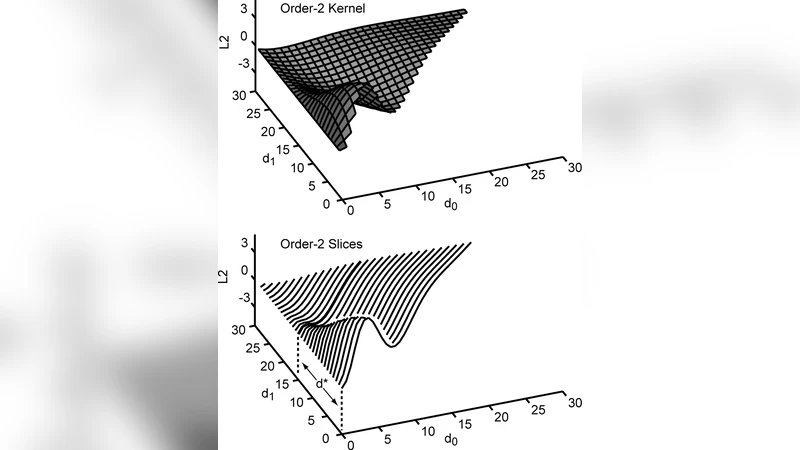
Volterra analysis and its variants have long been prominent among methods for modeling multi-input non-linear systems. The product of Volterra analysis, the Volterra kernels, are particularly suited to quantifying intra- and inter-input interactions. They are also readily interpretable, which means that they can be related directly to physical behaviors, and more distantly, to the underlying processing mechanisms of the system being tested. However, accurate estimation of a sufficient set of classical kernels is often not possible for complex systems because the number of kernels that need to be determined, and hence experiment time, increases radically with system memory, response frequency bandwidth, and non-linear interaction order. Practical approaches to kernel estimation often involve forced reductions of the generality of the analysis that in turn compromise interpretability. Here we illustrate the effects on kernel interpretability of two common reductions, slow-stimulation and the use of binary inputs, using both numerical simulations and data from a Visual Evoked Potential experiment. We show how a non-standard version of binary analysis, involving a different coding of the inputs and the use of particular groupings of kernel slices, improves kernel interpretability. We bring together, in a comprehensive fashion, all of the mathematical considerations needed to apply and interpret the results of Volterra kernel analyses. The input-coding method we describe allows one to correctly quantify multi-input interactive effects that occur both within the separate input channels and across them.
💡 Research Summary
Volterra series provide a mathematically rigorous framework for describing multi‑input nonlinear systems by expanding the input‑output relationship into a hierarchy of kernels. The first‑order kernels capture linear dynamics, while second‑ and higher‑order kernels encode intra‑ and inter‑input interactions. In principle, a complete set of kernels (all orders, all memory lags) fully characterises the system, but in practice the number of kernels grows explosively with memory length, bandwidth, and interaction order, making exhaustive estimation infeasible.
Researchers therefore resort to two common simplifications. The first, “slow‑stimulation,” reduces the stimulus bandwidth and lengthens inter‑stimulus intervals so that only short‑memory kernels are needed. This approach discards high‑frequency nonlinear effects that can be crucial in fast sensory pathways. The second, “binary inputs,” forces each stimulus channel to take only two values (typically 0/1). Binary coding dramatically cuts the number of experimental conditions, but it also removes information about graded stimulus strength and can severely distort cross‑terms that represent simultaneous interactions between channels.
The present paper systematically evaluates how these simplifications affect kernel interpretability. Using a synthetic nonlinear model with a known full Volterra expansion, the authors first estimate the complete kernel set as a ground truth. They then repeat the estimation under slow‑stimulation and under conventional binary coding. The comparison reveals that slow‑stimulation eliminates most high‑frequency second‑ and third‑order kernels and reduces cross‑channel kernels to near‑zero, while binary coding introduces a bias in the first‑order kernels and flips the sign or magnitude of many second‑order cross‑terms. Consequently, important physiological mechanisms—especially those that rely on rapid, simultaneous inputs—are either missed or misrepresented.
To overcome these limitations, the authors propose a “non‑standard binary analysis.” Instead of the usual 0/1 coding, inputs are recoded to symmetric values such as +1/‑1 or multi‑level symbols that centre the mean at zero. This recoding removes the mean‑offset bias from first‑order kernels and makes higher‑order kernels more sensitive to genuine interactions. In addition, the authors introduce a systematic grouping of kernel slices: time‑symmetry groups (slices sharing the same lag) and channel‑symmetry groups (slices that involve the same pair of input channels). By aggregating slices that correspond to the same underlying physical process, the resulting grouped kernels are easier to interpret and retain quantitative fidelity.
The methodological advances are validated with a visual evoked potential (VEP) experiment. Two independent visual channels (left and right eye) were stimulated with random flash sequences while EEG recorded cortical responses. Conventional binary analysis failed to reveal any significant cross‑channel kernels, and the estimated second‑order kernels were weak and noisy. In contrast, the non‑standard coding combined with slice grouping uncovered a robust positive cross‑kernel in the 20–40 ms latency window, precisely the period when bilateral visual cortices are known to co‑activate. Moreover, the higher‑order kernels quantified nonlinear saturation effects of stimulus intensity that were invisible under the traditional approach.
The paper concludes that careful stimulus coding and principled kernel aggregation can preserve the interpretability of Volterra analyses without prohibitive experimental overhead. The proposed framework is not limited to the visual system; it can be applied to auditory, somatosensory, and motor control studies where multiple input streams interact nonlinearly. Future work outlined by the authors includes extending the method to incorporate longer memory kernels, developing real‑time kernel estimation algorithms, and integrating the approach with modern machine‑learning pipelines to enhance model‑based neuroscience and engineering applications.
Comments & Academic Discussion
Loading comments...
Leave a Comment