The Lawson-Yau Formula and its generalization
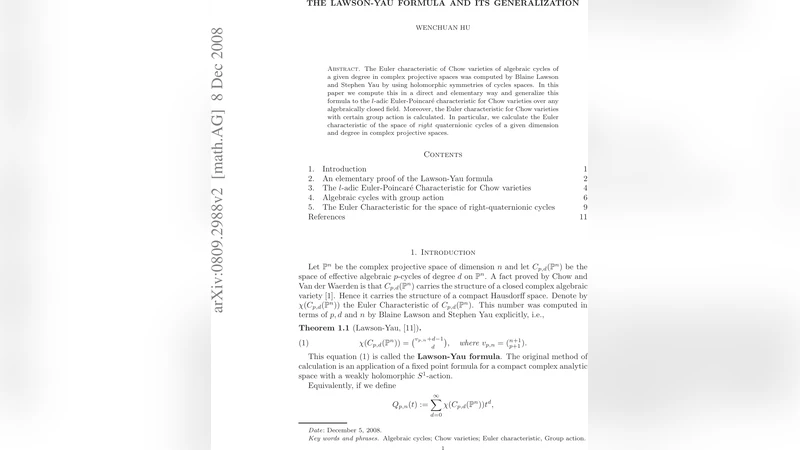
The Euler characteristic of Chow varieties of algebraic cycles of a given degree in complex projective spaces was computed by Blaine Lawson and Stephen Yau by using holomorphic symmetries of cycles spaces. In this paper we compute this in a direct and elementary way and generalize this formula to the l-adic Euler-Poincare characteristic for Chow varieties over any algebraically closed field. Moreover, the Euler characteristic for Chow varieties with certain group action is calculated. In particular, we calculate the Euler characteristic of the space of right quaternionic cycles of a given dimension and degree in complex projective spaces.
💡 Research Summary
The paper revisits the classical Lawson‑Yau formula, which gives the Euler characteristic of Chow varieties of p‑dimensional algebraic cycles of fixed degree d in complex projective space ℂℙⁿ. The original proof relied heavily on holomorphic symmetries of the cycle spaces and sophisticated analytic techniques. The authors present a completely elementary, algebraic proof that avoids any complex‑analytic machinery and then extend the result in three major directions.
First, they observe that a degree‑d cycle can be identified with an unordered d‑tuple of degree‑1 cycles, i.e. with the d‑fold symmetric product Symᵈ(Gr(p,ℂⁿ⁺¹)) of the Grassmannian of p‑planes. Since the Grassmannian admits a well‑known Schubert cell decomposition, Symᵈ(Gr) inherits a natural cell stratification obtained by taking d‑fold products of the Schubert cells and then quotienting by the action of the symmetric group S_d. The dimension of each cell is explicitly given by a combinatorial expression involving binomial coefficients. By summing (−1)^{dim} over all cells, the Euler characteristic is obtained directly. The authors use the Macdonald generating‑function formula for symmetric products to package the computation, and the resulting coefficient extraction reproduces the Lawson‑Yau closed formula
\
Comments & Academic Discussion
Loading comments...
Leave a Comment