Uniqueness of pairings in Hopf-cyclic cohomology
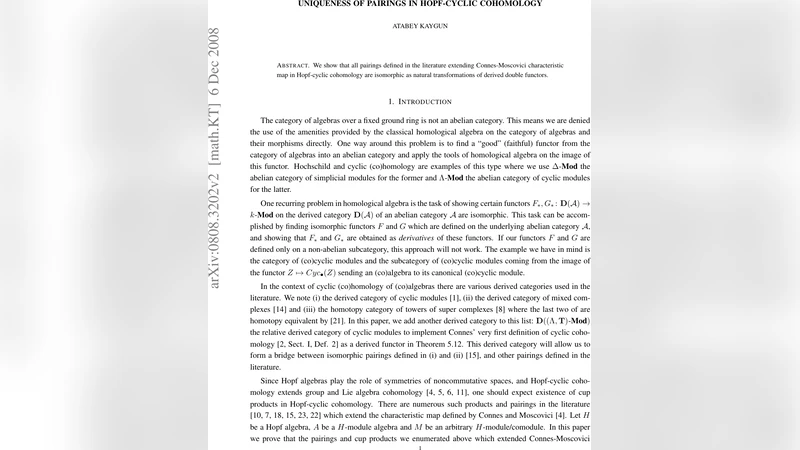
We show that all pairings defined in the literature extending Connes-Moscovici characteristic map in Hopf-cyclic cohomology are isomorphic as natural transformations of derived double functors.
💡 Research Summary
The paper addresses a long‑standing question in the theory of Hopf‑cyclic cohomology: whether the various pairings that have been introduced to extend the Connes‑Moscovici characteristic map are genuinely distinct or merely different presentations of the same underlying construction. After a concise review of the Connes‑Moscovici map, the authors systematically catalogue the pairings that appear in the literature, including those by Khalkhali‑Rangipour, Hajac‑Khalkhali‑Rangipour, Bichon‑Kassel‑Meyer, and several later refinements. Each of these constructions is based on a specific choice of Hopf‑module category, a particular tensor product on cyclic modules, and a set of compatibility conditions for the differential operators. Superficially, the resulting formulas look different, and it has not been clear how they relate to one another.
To resolve this, the authors introduce the notion of a derived double functor. This is a bifunctor that simultaneously resolves two chain complexes—one carrying the Hopf‑module structure and the other the cyclic structure—within the derived category. By working in the derived setting, one can replace each complex by a projective (or injective) resolution, thereby eliminating homotopy‑theoretic ambiguities. The derived double functor comes equipped with a natural filtration that respects the total degree, which is crucial for comparing pairings that live in different homological degrees.
The central theorem states that every pairing previously defined in the literature can be expressed as a natural transformation between two instances of the derived double functor. Moreover, any two such natural transformations are uniquely isomorphic: there exists a canonical isomorphism η that intertwines them and respects all the relevant structures (Hopf action, cyclic operator, differential). The proof proceeds by first constructing explicit models for the derived double functor associated with each pairing, then showing that the corresponding natural transformations satisfy the same universal property. Using the triangulated structure of the derived category, the authors build η via a ladder diagram and verify the required commutativity by checking the compatibility with the filtration and the differential.
An important corollary is that the induced maps on Hopf‑cyclic cohomology groups are identical, regardless of which original pairing is used. This establishes a strong form of uniqueness: the “pairing” is not a family of distinct operations but a single canonical operation that can be presented in many guises. The paper also discusses how this categorical framework simplifies the construction of new pairings for more exotic module categories, such as twisted modules, quasi‑Hopf algebras, or Yetter‑Drinfeld modules that appear in noncommutative geometry and quantum group theory. By embedding these new situations into the same derived double‑functor setting, one automatically inherits the uniqueness result without additional verification.
In conclusion, the authors provide a comprehensive, category‑theoretic proof that all known extensions of the Connes‑Moscovici characteristic map are isomorphic as natural transformations of derived double functors. This unifies the fragmented landscape of Hopf‑cyclic pairings, reinforces the internal consistency of the theory, and offers a robust template for future developments in cyclic cohomology of Hopf algebras and related quantum symmetries.
Comments & Academic Discussion
Loading comments...
Leave a Comment