Information transmission in oscillatory neural activity
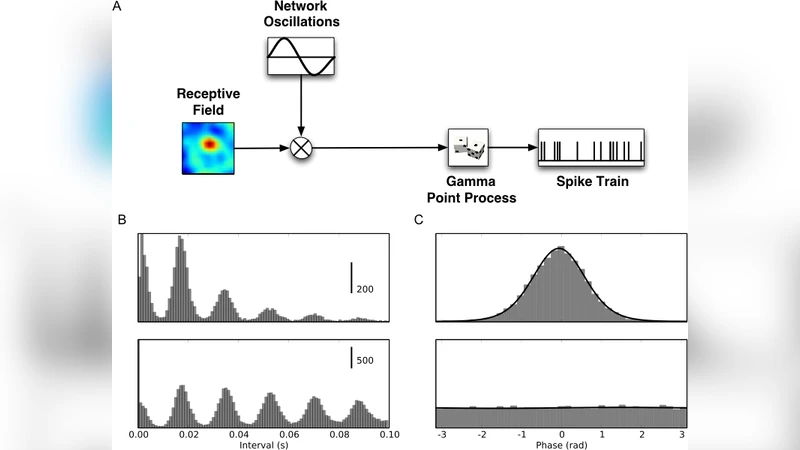
Periodic neural activity not locked to the stimulus or to motor responses is usually ignored. Here, we present new tools for modeling and quantifying the information transmission based on periodic neural activity that occurs with quasi-random phase relative to the stimulus. We propose a model to reproduce characteristic features of oscillatory spike trains, such as histograms of inter-spike intervals and phase locking of spikes to an oscillatory influence. The proposed model is based on an inhomogeneous Gamma process governed by a density function that is a product of the usual stimulus-dependent rate and a quasi-periodic function. Further, we present an analysis method generalizing the direct method (Rieke et al, 1999; Brenner et al, 2000) to assess the information content in such data. We demonstrate these tools on recordings from relay cells in the lateral geniculate nucleus of the cat.
💡 Research Summary
The paper tackles a long‑standing blind spot in neural coding research: the treatment of periodic neural activity that is not phase‑locked to external stimuli or motor responses. Traditional analyses discard such “background” oscillations, assuming they carry no useful information. The authors argue that this assumption is unwarranted and develop both a generative model and an information‑theoretic analysis method that explicitly incorporate quasi‑random phase relationships between spikes and an internal oscillatory drive.
Modeling framework
The core of the modeling effort is an inhomogeneous Gamma process. The instantaneous firing intensity λ(t) is expressed as the product of two factors: (i) a stimulus‑dependent rate λ_s(t), which captures the conventional stimulus‑driven modulation of firing, and (ii) a quasi‑periodic modulation g(t)=1+α·cos(2πft+φ), which represents an internal oscillatory influence with amplitude α, frequency f, and phase φ. By using a Gamma process rather than a Poisson process, the model introduces a shape parameter k that controls the variability of inter‑spike intervals (ISIs). When k>1 the process generates more regular spiking, while k<1 yields burstier, more irregular patterns. This flexibility allows the model to reproduce the characteristic ISI histograms observed in real data, which often display heavy tails that a simple Poisson model cannot capture.
Parameter estimation proceeds via maximum‑likelihood optimization. The oscillatory component’s frequency and phase are initially identified with a Fourier transform of the spike train, then refined together with k, α, and the stimulus‑driven rate profile λ_s(t) by maximizing the full log‑likelihood of the Gamma process. Simulations using the fitted parameters generate synthetic spike trains that match the empirical data in three key respects: (1) the ISI distribution, (2) the power spectrum (showing a clear peak at the imposed oscillation frequency), and (3) phase‑locking metrics such as the mean vector length and the pairwise phase consistency (PPC).
Information‑theoretic analysis
The second major contribution is a generalization of the “direct method” for mutual information estimation (Rieke et al., 1999; Brenner et al., 2000). The classic direct method computes I(S;R)=⟨log
Comments & Academic Discussion
Loading comments...
Leave a Comment