Fully distributed and fault tolerant task management based on diffusions
The task management is a critical component for the computational grids. The aim is to assign tasks on nodes according to a global scheduling policy and a view of local resources of nodes. A peer-to-peer approach for the task management involves a be…
Authors: Alain Bui, Olivier Flauzac, Cyril Rabat
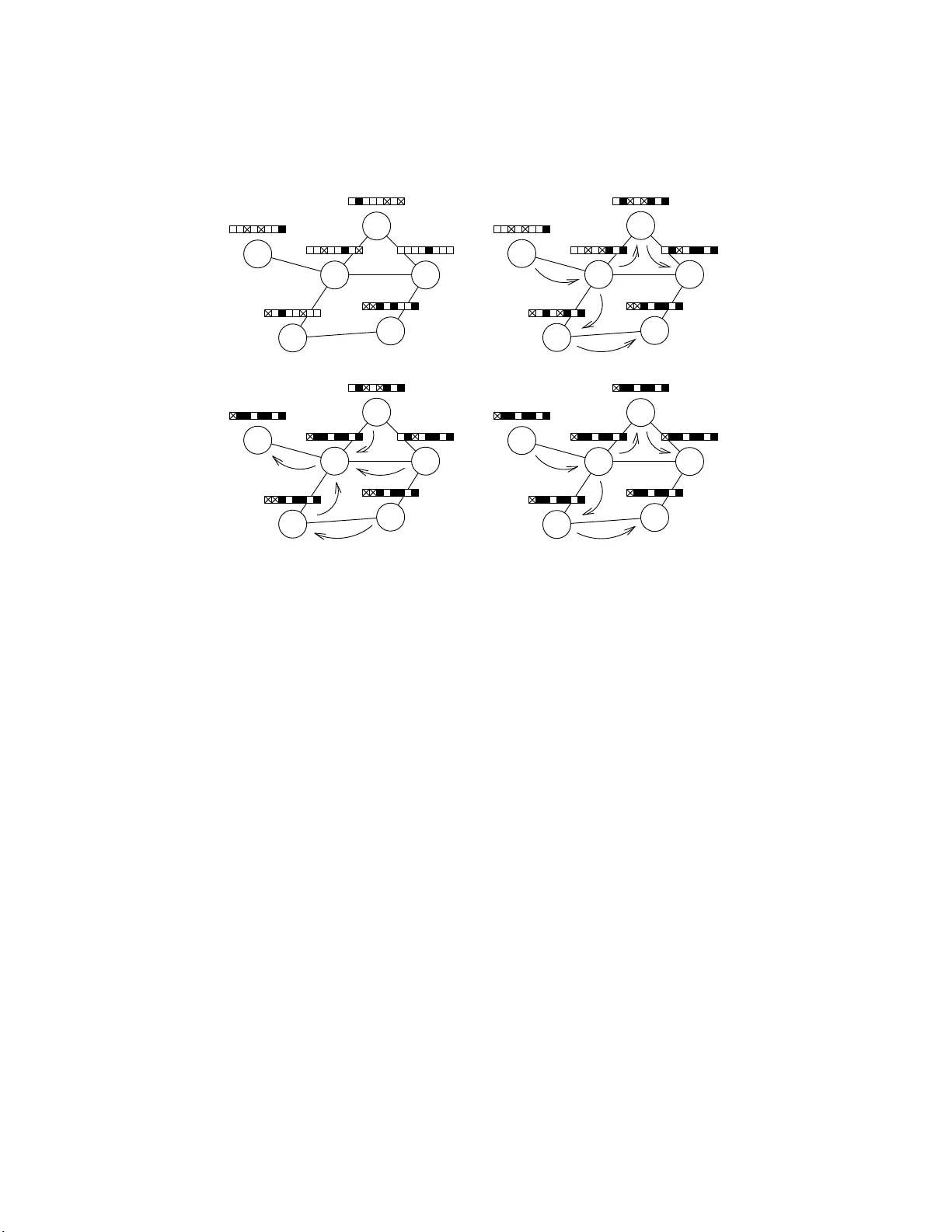
F ully distributed and fault toleran t task managemen t based on diffusions Alain Bui × Olivi er Flauzac + Cyril Rabat + × Lab oratoire PRiSM (UMR CNRS 8144) Univ ersit ´ e d e V ersailles-St-Quen tin-en-Yv elines 45, a v en ue des Etats-Unis – F-7803 5 V ersailles Cedex – F rance alain.bu i@prism.uvsq .fr + Lab oratoire CReSTI C Univ ersit ´ e d e Reims Champagne-Ardenn e, BP 1039, F-51687 Reims Cedex 2 – F rance { olivier.fl auzac,cyril. rabat } @univ-reims.fr Abstract The task managemen t is a critical comp onen t f or the co mpu ta- tional grids. Th e aim is to assign tasks on nodes according to a global sc heduling p olicy and a view of lo cal resources of nod es. A p eer-to- p eer approac h for the task manage ment in v olv es a b etter scalabilit y for the grid and a higher fault tolerance. But some mec hanisms h a v e to b e prop osed to a v oid th e computation of replicated tasks that can reduce the efficiency and in crease the load of no des. In the same w a y , these mechanisms ha v e to limit the num b er of exc hanged messages to a v oid th e o v erloa d of the netw ork. In [4], we h a v e prop osed t w o metho ds f or th e task managemen t called activ e and p assive. These method s are based on a random w alk: they are fully distribu ted and fault toleran t. Eac h no de o wns a lo cal tasks states set up dated thanks to a random w alk and eac h no de is in c harge of the lo cal assignment. Here, we prop ose three metho ds to improv e the efficie ncy of the activ e metho d. These new metho ds 1 are b ased on a circulating w ord. The nod es local tasks states sets are up dated thanks to p erio dical diffusions alo ng trees built from the circulating w ord. P articularly , we sho w that these m ethods increase the efficie ncy of the activ e metho d: they pro duce l ess replicated tasks. These three metho ds a re also fu lly d istributed and fault to lerant . On the other w a y , the circulating w ord can b e exploited f or other appli- cations lik e th e resources managemen t or the no des synchronizat ion. 1 In tro duct ion When a problem is submitted in a grid, it can b e divided in a set of tasks . These tasks ha v e t o b e assigned to no des of the grid according to the re- sources needed fo r their computation and the r esources o wned and a v ailable on nodes. A grid has to manage a lot of resources as the storag e space and the computational p o w er, sp ecific data, shared applications or to ols. Eac h resource has to b e ide n tified for the global sc heduling of t asks . In Nimr o d [6], the resources are ga thered on an agen t. So, the sche duling can b e ac hiev ed with the agen t know ledge and tasks are assigned b y the agen t. In Middlew are NetSolve [3], the computational res ources giv e an estimation of the task computation length in function of the task parameters. It lets the agen t sc hedules the tasks according to the serv ers load. In su c h applications, the cen tral agen t is a critical p oin t in the grid. An ov erload or a failure of this no de can in volv e a grid failure or a lo w global efficiency . T o impro v e the scalabilit y , the global kn ow ledge can b e divide d or shared in sev eral serv ers or in a hierarch y of serv ers as in Globus [11] or in DI ET [1]. Since sev eral y ears, the p eer-to-p eer approac h has b een prop osed for in- creasing the scalabilit y and the f ault tolera nce of the applications. The cen- tralization is a v oided and the top ology of the application is flexible: the deplo ymen t is also simplified. The authors of CONFII T [9] choose to let the nodes in c harg e of the tasks selection. The tasks parameters are sen t to all no des so they can choose to compute a task according to their lo cal resources. But the nodes of CONFI IT are setup in a virtual ring that has to b e main tained. It in v olv es a lot of con trol messages esp ecially if the net w ork is highly v olatile and, in the worst case, the ring cannot be maintained. T o a v oid the main tenance of a virtual structure, we pro po sed fully dis- tributed metho ds based on a random walk. In [4] w e propo se a task ma n- 2 agemen t: the tasks para meters are sen t to nodes and the ta sks states are up dated thanks to the circulation of a tok en. W e prop osed t w o tasks assign- men t metho ds called p assive and active . F or the passiv e metho d, the no des w ait for the toke n b efore selecting a task. The num b er of replicated ta sks is lo w but some computational resources is un used. F or the activ e metho d, the no des select a task b efore receiving the tok en. It induces replicated tasks but it increases the global efficiency . In the follo wing, w e fo cus on the impro ve- men t of the activ e metho d. Indeed, w e sho w in [4], t ha t t his metho d has a b etter efficiency than the pa ssiv e metho d. In this article, w e pr o po se to use another too l called the circulating w ord. Its aim is to collect no de iden tities and to build and main tain spanning trees of the ne tw ork. W e prop ose to diffuse perio dically the tasks states along these spanning trees in order to speed up the up date o f the no des local kno wledge. In next section, w e presen t the to o ls w e used in our algorithm: t he gr id mo del, the random w alks and the circulating word. In section 3, w e presen t the task managemen t (task definition, efficiency). Then, we presen t our solutions a nd we describ e the algorit hms. W e sho w in section 5 some exp er- imen tal results. Fina lly , we conclude and w e pres en t our future w orks. 2 Preliminaries A mo del for grid In [14], w e pro po se a mo del comp osed of 5 lay ers to analyze grid applicatio ns. The three lo w er la y ers concern the net work, the routing and the messages exc hange proto cols. La y er 4 represen ts the re- sources managemen t for the grid and the last one the other grid compo nen ts (sc heduling, monito ring, . . . ). T he task managemen t w e expose here is for La y er 5. But a grid is built o v er four other lay ers a nd w e ha v e to tak e care of their impacts . W e sho w that w e can model a grid b y a dir e cte d g r a ph G = ( V , E ), where V is a set of activ e no des of the grid with | V | = n and E is the set of directed commun ication links. An activ e no de is a r esource or a no de t ha t uses resources (to compute task). In the follow ing, w e use the terms ”resource”, ”no de” and ”activ e node” in terchangeably . A comm unication link ( i, j ) exists if and only if j is a neigh b or of i in the grid, i.e. i can directly send a message to j . Ev ery no de i can distinguish all its links of comm unication and maintains a set o f neigh b ors denoted N i . W e consider that all resources of the grid hav e a dis tinct iden tity (IP address, 3 for example or a complete description with a specific language like RSL [7], in that case an index ation is needed to hav e better p erformances). As G is a comm unication graph, w e assume it is strongly connected. In- deed, if the graph is not strongly connected at a time, t here exists a sink subgraph E ( G ): resources of G \ E ( G ) cannot b e reac hed from any no de of E ( G ). F or a tok en circulation, it means that t he tok en will stay in E ( G ) and cannot reac h no des of G \ E ( G ). With our metho d, w e accept that the graph sta ys not strongly connected during a short time. If this transien t state is to o long , unreac hable resources will b e considered as disconnected. Random w alk A random w a lk is a sequence of no des vis ited b y a toke n that starts at i and visits other resources according to the following transi- tion rule: if the tok en is at i at time t then at time t + 1 , it will b e at one of the neigh b ors of i , c ho sen uniformly at random among N i ([13]). Similarly to deterministic distributed algorit hms, the time complexit y of random w alk based tok en circulation algorithms can b e view ed as the n umber of ”steps” it tak es for the algorithm to ac hiev e the net work tra v ersal. With only one w alk at a time (whic h is the case w e deal), it is also equal to the message complexit y . The cov er time C — the a v erage time to visit all no des in the system — and the hitting time denoted by h ij — the a v erage time to reac h a no de j for the first time starting fro m a g iv en no de i — a re tw o impor- tan t v alues that a ppear in the analysis of random w a lk-based distributed algorithms. Both of them are on av erage b ounded by n 3 . There are three prop erties ab out random w alks: p er cussion – an arbitrary no de is visited in a finite time, c over age – all no des are vis ited in a finite time and me eting – sev eral random w alks w ill meet eac h other in a finite time. Circulating word A circulating w or d is a to o l used to collect data on a net w ork. It has been in tro duced in [12] for the detection of the exe cution termination of distributed alg orithms. P articularly , it can be used to colle ct iden tities of visited no des b y a random w alk. With a sp ecific managemen t, as prop o sed in [8 ], w e are able to build a spanning tree root ed on the no de that o wns the token. This tree is p erp etually up dated and adapted to the top ology when no de failures o ccur. W e can send data through the net work along this tree. This application is used in our task manag ement metho ds. 4 3 T ask managemen t W e define a task by the tuple { id T , id E , p, s , r } where id T is the task iden tity , id E the iden tit y of the task emitter, p the parameters of the task, s the state of the task and r the results of the task (if it has b een computed). A task can be in three states: unc ompute d , in pr o gr e s s (lo cally or in a distan t no de) and c ompute d . With a cen tralized metho d, the tasks are gathered on a serv er as w e presen t on Figure 1 ( a ). When a task is assigned to a no de, its state is mo dified and the task cannot b e assigned to another no de (excepted if a v olun tary replication is ac hiev ed as in BOI NC [2]). With o ur metho d, the parameters and resu lts of the task s are diffused to all no des. On eac h no de, a lo cal set noted E contains a lo cal view of the tasks states. When a no de w an ts to compute a task, it selects an uncompute d ta sk a t random in its lo cal set and tags it as in pr o gr ess . This new state will be up dated on other no des step b y step by the to k en (Figure 1 ( b )). In the same w a y , when a no de has to submit new tasks, it a dd them only to its lo cal set. The tasks will b e kno wn b y other no des whe n the token will vis it the no de and will diffuse their par a meters to other nodes. When a task is selected, its state is unc ompute d but another no de can select sim ulta neously the same task. So, w e obtain a r eplic ate d task . This in v olv es a w aste of computational p o w er and decreases the efficiency of the task management. T o compute the efficiency of the t a sk managemen t, w e compare the sequen tial execution time t e – that is the time fo r one no de to compute all the tasks – a nd the distributed execution time t d – that is the time for a ll no des to compute all the tasks . Efficiency of the metho d, noted e , is obtained by the for m ula: e = t s t e × n × 100, where n is the n um b er of no des. W e also compare the task manag emen t s olutions on the n um b er of exc hang ed messages. 4 Diffusion based task managemen t W e prop ose three solutions based on the activ e metho d describ ed in [4]. A tok en circulates at random in the net w o rk and up da tes the local tasks states sets of nodes. W e add a circulating w ord in the tok en that is use d to build spanning trees. W e desc rib e three solutions to increase the active metho d efficiency: metho d D s is based on p erio dical diffusions, method D f is based 5 ( a ) ( b ) In progress Uncomputed Computed Task state: Figure 1: Cen tralized task manag emen t ( a ) and tok en based task manage- men t ( b ). on diffusions with feedbac ks and metho d D m is based on diffusions with feedbac ks follow ed b y another diffusions. 4.1 D s metho d W e define a to ken b y a tuple T = { id T , E T , W , C T } where id T is the tok en iden tit y , E T is the tasks states set, W is a circulating w o rd and C T is a hop coun ter. When a no de receiv es a tok en, it incremen ts C T and up dates W (b y adding its iden tity). If C T is upp er than a b ound, noted b , the no de builds from the circulating w ord a diffus ion tr ee T D ro oted on it. Then, a diffusion of E T (up dated b y the no de set) is launc hed through T D . W e define eac h message of the diffusion b y the t uple M D = { id T , E M , T D } where id T is the to ken iden tity (used to con tro l the mess age v a lidit y), E M is a tasks states set up dated according to visited no des and T D the diffusion tree. When a message is receiv ed, the no de up dates its lo cal tasks states s et and fo rw ards the message to all of its neigh b ors in T D . T o reduce the messages size, T D can b e reduced to t he subtree ro oted on neighbors. The frequency of diffusion launc hes depends on b ound b . T o reduce use - less diffusions, w e compute b according to the curren t state of the g lobal computation. Indeed, when the n um b er of ta sks to compute decreases, the lo cal task selection metho d in v olv es replicated tasks. So, we compute b ac- 6 W = <0, 3, 5, 4, 1, 4, 3, 2, 0> 0 2 3 4 1 5 ε 0 ε 0 ε 2 ε 0 ε 2 ε 3 ε 0 ε 2 ε 3 ε 4 ε 0 ε 2 ε 3 ε 4 0 1 2 3 4 5 Figure 2: Example of a tasks states diffusion from a circulating w ord cording to the f ollo wing form ula: b = min ( nbT n ∗ c r , m r ) nbT is the num b er of tasks to compute, n is t he num b er of no des, c r is the refresh co efficien t and m r is the minim um refresh v alue. When t he ratio b et w een the num b er o f tasks and the n um b er of no des b ecomes to o small, the f reque ncy of diffusions inc reases: more diffusions are launc hed to reduce replicated tasks. T o prev en t the ov erload of the net w ork, w e sp ecify a mini- m um threshold no t ed m r . c r in teracts on the diffusions fr eque ncy . Example 1 Fi g ur e 2 shows an example of a single diffusion. No de 0 r e c eives the token and her e , we supp ose C T b e c omes upp er than b . No de 0 builds a diffusion tr e e fr om the cir c ulating wor d and launches a diffusion. We show that lo c al tasks states sets E ar e up da te d d uring the diffusion. 4.2 D f metho d On the previous example , w e observ e that the no des on lea ve s of the diffusion tree are updated with sev eral tasks states sets but the set of the diffusion tree ro ot ( i.e. the initia tor no de) is not up dated. In the same w a y , if a no de is deep er in the tree, it is upda t ed with sev eral no des sets but its lo cal set is not diffused to other no des. In Figure 2, No de 5 is up dated with sets of No des 0, 2, 3 and 4 but its tasks states set is not sen t to other no des. 7 T o improv e the up date of lo cal sets, w e prop ose to add a feedbac k after the diffusion. Eac h no de sends its lo cal set to its father. At the end of the diffusion and the feedbac k, the initiator no de receiv es a global view of the tasks states. T o limit the n um b er of exc ha ng ed messages, w e exploit the al- gorithm of the distributed recursiv e w av es describ ed in [10]. Before sendin g its set to it s father, each no de w aits for the response of eac h son. T o supp ort no de or link failur es, w e add a timeout on eac h no de reseted at eac h diffusion: if a no de do es no t receiv e the responses of its sons before the timeout ends, it sends its set to its father. If sons resp onses are receiv ed later, they will b e ignored (or only us ed to up date the node). In the worst case, the diffusion and the feedbac k tak e 2 × ( n − 1) steps. If b is low er than this v alue, sev eral diffusions can b e launc hed at the same time but on differen t diffusion trees. W e need to iden tif y each diffusion and no des ha v e to keep in memory their f a ther in the diffusion and its sons. W e add a diffus ion coun ter in the tok en that is incremen ted at eac h diffusion. Eac h message o f a diffusion is tagged b y the coun ter v alue. On the no des, w e add t w o sets to k eep in memory the no de f a ther and its sons corresp onding t o a diffusion. When a no de has receiv ed a response of eac h son o f a diffusion, it can send its own resp onse to its father. 4.3 D m metho d After a diffusion with a feedbac k, the tasks states set of the initiator is up dated. Th e no des on the leav es of the tree ar e only updat ed b y few no des, esp ecially if the diffusion tree has a small depth. So, after a diffusion with a fee dbac k, w e can initiat e a new diffusion with the initiator set. After this diffusion, all the no des will ha v e the same view of the tasks states. The same diffusion tree can b e used that do es not cost an y extra computational p o w er for the initiator. 4.4 Example Figure 3 sho ws an example of an up date diffusion. Figure ( a ) presen ts the tasks stat es set of eac h no de. Some tasks are considered as uncomputed on some nodes and are in progress on others no des. A node receiv es the tok en and initiates a diffusion ( F igure ( b )). The tasks states sets are up dated along the diffusion tree and the no des on leav es of the tree obtain the best view. 8 ( a ) ( b ) ( a ) ( b ) Figure 3: D iffusion based task managemen t: task states are up dated t hanks to a diffusion through a tree built from a circulating w o rd. After the feedbac k (Figure ( c )), the initiator receiv es the mor e recen t view of all ta sks . The last diffusion (Figure ( d )) in volv es that all the no des ha ve the same view. 5 Exp erimental result s W e sim ulate our methods with Dasor librar y [5]. W e generate a set of ra n- dom task lengths t hanks to the log-normal law . W e obtain a set of irregular task lengths. The se t is sen t to eac h no de and we compute the time for the no des to compute the tasks: here y ou suppo se that all nodes ha v e the same computational p ow er. F or the diffusion metho ds, w e fix arbitrarily c r = 1000 and m r = 1500 (these v alues giv e a go o d compromise b etw een the effic iency and the n um b er of exc hanged mess ages). The first series o f sim ulations presen ted on Fig ur e 4 ( a ) sho ws the evolu- tion of the efficienc y in function of the grid no des n um b er. It presen ts the 9 executions results w ith 1000 no des and a n umber of tasks that ev olv es from 1000 to 20000. W e remark that the diffusion metho ds hav e a better efficiency than the activ e metho d esp ecially when the ta sks n um b er increases (ab out 5% for D m in a v erage). F or a small n umber of ta sks , the efficiencies are al- most identical. Indeed, at t he b eginning of the ex ecution, eac h no de selects at random a task in its lo cal set and sev eral no des selec t the same tasks (the ratio is 1 task p er node). Figure 4 ( b ) presen ts executions results with a set of 20000 ta sks and a n um b er of no des that ev olv es from 1000 to 500 0 . When the n um b er of nodes increases, the diffusions metho ds ha v e a b etter efficiency (more than 15% for D m ). W e observ e that the efficiency decreases faster with the activ e metho d. The co v er t ime of the tok en is higher and in v olv es more replicated tasks: t he latency b et wee n up dates is higher. The diffusion methods seem to b e more scalable. On Figure 5 ( a ), w e presen t the n um b er of pro duced messages during the computat io n and on Figure 5 ( b ) the n um b er of replicated tasks. W e fix the n um b er of no des at 1000 and w e increase the num b er of tasks from 10 00 to 20000. W e can observ e that the num b er of mess ages for Metho d D m is ab out t wice more than the activ e metho d (with c r = 1000 and m r = 150 0). Ab out the n um b er of r eplicated tasks, w e hav e abo ut t wice less replicated tasks than the activ e metho d. The diffusion metho ds reduce the global lo a d of the grid by r educing the useless computations. T o impro ve the efficiency , c r and m r can b e reduc ed to increase the fre- quency of the diffusions but it induces more messages. With these exp eri- men tal results, w e observ e that w e ha v e already a b etter efficiency and less replicated tasks than for the activ e metho d. W e also realize others sim ula - tions series with c r = 100 and m r = 100. F or 1000 no des and 2 0000 tasks, it increases the efficienc y by 5 % and r educe the n um b er of replicated tasks. But it pro duces 4 times more messages than with the prev ious coefficien ts. 6 Conclus ion W e prop ose in this art icle three solutions for the task managemen t based on a random w alk and a circulating w ord. The no des are in c harge of the lo cal assignmen t of tasks according to their resources and the tasks states are up dated thanks to the token . These solutions are fully distributed and 10 Dm method 20 40 60 80 100 2000 4000 6000 8000 10000 12000 14000 16000 18000 20000 Efficiency Tasks number Active method Ds method Df method 0 ( a ) Dm method 10 20 30 40 50 60 70 80 90 1000 1500 2000 2500 3000 3500 4000 4500 5000 Efficiency Nodes number Active method Ds method Df method 0 ( b ) Figure 4: Ev o lution of the efficiency in function of the t a sks n umber ( a ) and in function of the no des num b er ( b ) . 11 Dm method 20000 40000 60000 80000 100000 120000 140000 2000 4000 6000 8000 10000 12000 14000 16000 18000 20000 Messages Tasks number Active method Ds method Df method 0 ( a ) Dm method 500 1000 1500 2000 2500 3000 3500 4000 2000 4000 6000 8000 10000 12000 14000 16000 18000 20000 Replicated tasks Tasks number Active method Ds method Df method 0 ( b ) Figure 5: Ev olution of the mes sages exc hanges ( a ) and of the replic ated ta sks ( b ) in function of the t asks num b er. 12 are resilien t to no de failures. W e presen t some ex p erimen tal results and w e observ e a b etter effic iency than the a ctive metho d presen ted in [4]. The se new metho ds pro duce more messages but they reduce significan tly the n um b er of replicated tasks: it reduc es t he useless load of grid no des. These metho ds are ba sed on tw o co efficien ts c r and m r that allo w to mo d- ify the frequency of diffusions according to the curren t state of the system (n um b er of t a sks and nu m b er of no des). W e plain to automatize these pa- rameters to tak e in to accoun t others grid parameters a s the bandwidth of the net w ork or the actual load of the system. Another solution is to exploit the h ybrid metho d pro p osed in [4] coupled with the diffusion methods. When the ra tio b et wee n the n um b er of no des and the n um b er of ta sks is low, w e ma y reduce the replic ated tasks. Ac kno wledgmen ts This w ork w as partly supp orted b y ”Ro meo” 1 , the high p erformance com- puting cen ter of the Unive rsit y of Reims Champagne-Ardenne. References [1] A. Amar, R. Bolze, A. Bouteiller, P . K . Chou h an, A. Chis, Y. C aniou, E. Caron, H. Dail, B. Depardon, F. Desprez, J.-S. Gay , G. Le Mahec, and A. S u. DIET : New Deve lopment s and Recen t Results. In L. et al. (Eds.), editor, Cor eGRID Worksho p on Grid Midd lewa r e (in c onjunction with Eu- r oPar2006) , num b er 4375 in Lecture Notes in Computer Science, pages 150– 170, Dresden, German y , Aug. 2006. Spr in ger V erlag. [2] D. P . Anderson. BOINC: A System for Public-Resource Computin g and Stor- age. In GRID ’04: Pr o c e e dings of the Fifth IEEE /A CM International Work- shop on Grid Com puting (GRID’04) , page s 4–10, W ashington, DC, USA, 2004. IEEE Compu ter So ciet y . [3] D. Arnold, S. Agra w al, S . Blac kford, J. Dongarra, M. Miller, K. Seymour, K. Sagi, Z. Shi, and S. V adhiya r. Users’ Guide to NetSolv e V1.4.1 . In no v ativ e Computing Dept. Tec hnical Rep ort IC L-UT-02 -05, Univ ers it y of T ennessee, Kno xville, T N, June 2002. [4] A. Bui, O. Fla uzac, and C. Rabat . F ully Distributed Activ e and P assiv e T ask Manage ment for Grid Compu ting. In ISPDC ’07: Pr o c e e dings of the 1 http:/ /www.ro meo2.fr/ 13 Sixth Interna tional Symp osium on Par al lel and Distribute d Comp uting . IEEE Computer So ciet y , July 2007. [5] A. Bui, O . Flauzac, and C . Rabat. Dasor, a grid mod el based sim u latio n library. In I2CS’08, 8th Interna tional Confer enc e on Innovative Internet Community Systems . IEEE Computer So ciet y , 2008. T o app ear. [6] R. Buyy a, D. Ab r amson, an d J. Giddy . Nimro d/G: An Arc hitecture o f a Resource Manag emen t and Sc heduling System in a Global Computational Grid. Co RR , cs.DC/0009021 , 2000 . [7] K. Cza j k o ws ki, I. F oster, N. Karonis, C. Kesselman, S . Martin, W. Smith, and S . T uec k e. A Resource Managemen t Arc h itecture for Me tacomputing Systems. In The 4th Workshop on Job Sche duling Str ate gies for Par al lel Pr o c essing , v olume 1459 of LNCS , pages 62–82. Springer-V erlag, 1998. [8] O. Flauzac. Random circulating w ord information m an agement for tree con- struction and s hortest path routing tables computation. I n On Principle Of DIstribute d Systems , pages 17–32. Stud ia Informatica Univ ersalis, 2001. [9] O. Flauzac, M. Kra jec ki, and J. F ugere. CONFI IT : a middlew are for p eer to peer computing. In ICCSA 2003 , v olume 26 69 of LNCS , pages 69– 78. Springer-V erlag, 2003. [10] G. Florin, R. G´ omez, and I. La v all ´ ee. Recur siv e distributed programming sc hemes. In International Symp osium on Autonom ous De c entr alize d Systems (ISADS) , p ages 122–1 28, 1993. [11] I. F oster. Globus T o olkit V ersion 4: S oft ware for S ervice-Orien ted Systems. J. Comput. Sci. T e chnol. , 21(4):51 3–520, 20 06. [12] I. Lav all ´ ee. Algorith mique d istribu´ ee et p ar al l ` ele . Hermes, 1990. [13] L. Lo v asz. Rand om w alks on g raphs : A survey . In Combinatorics: Paul Er dos is Eighty (vol. 2) , pages 353–3 98. Janos Bolya i Mathematical So ciet y , 1993. [14] C. Rabat, A. Bu i, and O. Flauzac. A random walk top ology managemen t solution for grid. In II2CS , v olume 3908 of LNCS , pages 9 1–104. S p ringer- V er lag, 2006. 14
Original Paper
Loading high-quality paper...
Comments & Academic Discussion
Loading comments...
Leave a Comment