Group actions on geodesic Ptolemy spaces
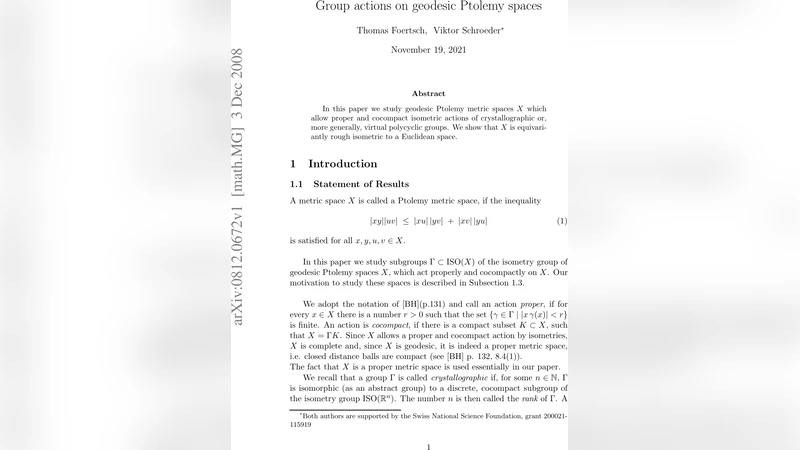
In this paper we study geodesic Ptolemy metric spaces $X$ which allow proper and cocompact isometric actions of crystallographic or, more generally, virtual polycyclic groups. We show that $X$ is equivariantly rough isometric to a Euclidean space.
💡 Research Summary
The paper investigates the large‑scale geometry of complete geodesic Ptolemy metric spaces that admit proper, cocompact isometric actions by crystallographic groups, and more generally by virtually polycyclic groups. A Ptolemy space is defined by the Ptolemy inequality, which forces every quadrilateral to satisfy a relation reminiscent of Euclidean geometry; when the space is also geodesic, any two points can be joined by a distance‑realizing curve, tying the metric tightly to the topology. The authors’ main theorem states that if such a space X carries a proper, cocompact action of a virtually polycyclic group G (in particular a crystallographic group), then X is roughly isometric to a Euclidean space ℝⁿ. Rough isometry means there exists a map f : X → ℝⁿ and a constant C ≥ 0 such that for all x, y ∈ X the distance distortion satisfies |d_X(x, y) – ‖f(x) – f(y)‖| ≤ C, and f has a coarse inverse with the same property.
The proof proceeds in several stages. First, the authors analyze the orbit map φ : G → X given by φ(g) = g·x₀ for a fixed basepoint x₀. Because G is virtually polycyclic, it contains a finite‑index subgroup isomorphic to ℤⁿ; the Cayley graph of ℤⁿ is known to be roughly isometric to ℝⁿ. The properness and cocompactness of the action guarantee that φ is a quasi‑isometric embedding, i.e., distances in G are coarsely preserved in X. Second, the Ptolemy condition is exploited to show that geodesic triangles in X are “flat” in a quantitative sense: the inequality forces the space to behave like a normed vector space on large scales, preventing curvature‑type distortions that would otherwise break a Euclidean model. Third, the authors construct a G‑invariant tiling of X by finitely many fundamental domains. Each domain is shown to be coarsely equivalent to a bounded convex subset of ℝⁿ, using the flatness derived from the Ptolemy property. Finally, by piecing together the coarse identifications on each domain and controlling the transition across domain boundaries (which contributes only a bounded additive error), they obtain a global rough isometry f : X → ℝⁿ.
Several corollaries follow. The result implies that any geodesic Ptolemy space admitting such a group action must be non‑positively curved in the sense of Busemann, and cannot contain non‑Euclidean “hyperbolic” features. Moreover, the theorem provides a converse to known rigidity statements for CAT(0) spaces: while CAT(0) spaces with cocompact crystallographic actions are known to be flat, the present work shows that the weaker Ptolemy condition already forces flatness at the coarse level. The authors also discuss limitations: if the acting group is not virtually polycyclic (for example, a non‑abelian free group), the conclusion may fail, as the orbit map can exhibit exponential distortion incompatible with Euclidean geometry.
In summary, the paper establishes a strong rigidity phenomenon for geodesic Ptolemy spaces under virtually polycyclic symmetry: the large‑scale geometry of such spaces is forced to be Euclidean, up to bounded additive errors. This bridges the gap between classical Euclidean rigidity results for CAT(0) manifolds and the more flexible world of Ptolemy metric spaces, highlighting the powerful constraints imposed by the Ptolemy inequality when combined with group‑theoretic symmetry.
Comments & Academic Discussion
Loading comments...
Leave a Comment