The KdV-Sawada-Kotera equation has single-, two- and three-soliton solutions. However, it is not known yet whether it has N-soliton solutions for any N. Viewing it as a perturbed KdV equation, the asymptotic expansion of the solution is developed through third order within the framework of a Normal Form analysis. It is shown that the equation is asymptotically integrable through the order considered. Focusing on the soliton sector, it is shown that the higher-order corrections in the Normal Form expansion represent purely inelastic KdV-soliton-collision processes, and vanish identically in the single-soliton limit. These characteristics are satisfied by the exact two-soliton solution of the KdV-Sawada-Kotera equation: The deviation of this solution from its KdV-type two-soliton approximation describes a purely inelastic scattering process: The incoming state is the faster KdV soliton. It propagates until it hits a localized perturbation, which causes its transformation into the outgoing state, the slower soliton. In addition, the effect of the perturbation on the exact two-soliton solution vanishes identically in the single-soliton limit (equal wave numbers for the two solitons).
Deep Dive into Special features of the KdV-Sawada-Kotera equation.
The KdV-Sawada-Kotera equation has single-, two- and three-soliton solutions. However, it is not known yet whether it has N-soliton solutions for any N. Viewing it as a perturbed KdV equation, the asymptotic expansion of the solution is developed through third order within the framework of a Normal Form analysis. It is shown that the equation is asymptotically integrable through the order considered. Focusing on the soliton sector, it is shown that the higher-order corrections in the Normal Form expansion represent purely inelastic KdV-soliton-collision processes, and vanish identically in the single-soliton limit. These characteristics are satisfied by the exact two-soliton solution of the KdV-Sawada-Kotera equation: The deviation of this solution from its KdV-type two-soliton approximation describes a purely inelastic scattering process: The incoming state is the faster KdV soliton. It propagates until it hits a localized perturbation, which causes its transformation into the outgoin
The KdV equation with a Sawada-Kotera [1] perturbation, w t = 6 w w 1 + w 3 + ! " 4 45 w 2 w 1 + 15 w w 3 + 15 w 1 w 2 + w 5
)
has been investigated extensively in the literature [2][3][4][5][6][7][8]. It is integrable in the Painlevé sense [2,6], and has 1-2-and 3-soliton solutions [2][3][4][5][6][7][8]. They all have the Hirota structure [9] w = 2 ! x 2 ln f t, x ( ) .
(2)
In the case of the single-soliton solution, f(x) is given by
with
The single-soliton solution is:
In the two-soliton case, one has
In Eq. ( 6), g i are defined by Eq. ( 4), with k → k i , i = 1, 2, and
Whether Eq. ( 1) has an infinite family of multiple-soliton solutions, is not clear yet. However, treating Eq. ( 1) as a perturbed KdV equation, it is shown to be integrable asymptotically for any zero-order approximation, at least through O(ε 3 ). This is achieved through the construction of its solution within the framework of a Normal Form asymptotic expansion [10][11][12][13][14] in Section 2.
The exact 1-and 2-soliton solution solutions of Eq. ( 1) are then used as “templates”, against which the Normal Form expansion of the solution in the multiple-soliton case is compared. The following properties of the exact solutions are made use of. First, the single-soliton solution, given in Eq. ( 5), is identical to that of a single-KdV-soliton solution of the Normal Form. The only effect of the perturbation on this solution is updating of the soliton velocity, v(k), as shown in Eq. ( 4).
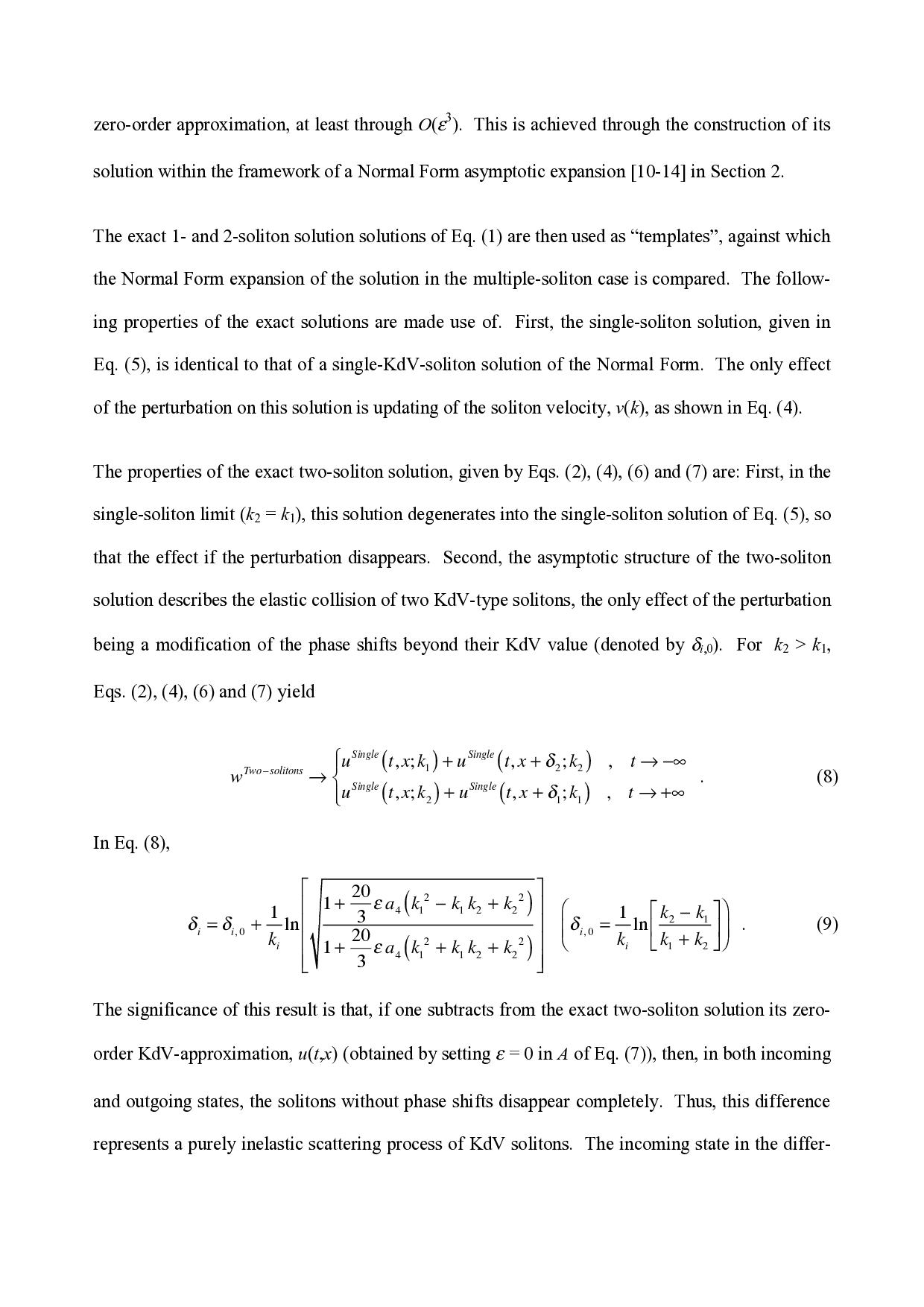
The properties of the exact two-soliton solution, given by Eqs. ( 2), ( 4), ( 6) and ( 7) are: First, in the single-soliton limit (k 2 = k 1 ), this solution degenerates into the single-soliton solution of Eq. ( 5), so that the effect if the perturbation disappears. Second, the asymptotic structure of the two-soliton solution describes the elastic collision of two KdV-type solitons, the only effect of the perturbation being a modification of the phase shifts beyond their KdV value (denoted by δ i,0 ). For
Eqs. ( 2), ( 4), ( 6) and (7) yield
In Eq. ( 8),
( )
The significance of this result is that, if one subtracts from the exact two-soliton solution its zeroorder KdV-approximation, u(t,x) (obtained by setting ε = 0 in A of Eq. ( 7)), then, in both incoming and outgoing states, the solitons without phase shifts disappear completely. Thus, this difference represents a purely inelastic scattering process of KdV solitons. The incoming state in the differ-ence is the faster soliton. It propagates until it hits a localized “scattering potential”, which “absorbs” it, and “emits” the slower soliton as the outgoing state. This inelastic scattering process, represented by the difference (w(t,x)u(t,x)/ε, is shown in Fig. 2.
The higher-order terms in the Normal Form expansion are analyzed in Section 3. The aspects that characterize the exact single-and two-soliton solutions of Eq. ( 1) are obeyed by the Normal-Form asymptotic expansion of the solution when u, the zero-order approximation, is any multiplesoliton solution. First, a solution exists, in which the higher-order correction terms vanish identically in the single-soliton limit; namely, the higher-order terms in Eq. ( 9) vanish if u Single is substituted for u. Whether the higher-order terms do or do not vanish in the single-soliton limit for other solutions of Eq. ( 1) depends on the initial data and boundary conditions imposed on the solution.
The second aspect is the nature of soliton collision processes described by the higher-order corrections in the multiple-soliton case. If in Eq. ( 1) the coefficients of the various monomials are replaced by arbitrary values, then, in a Normal Form analysis, the higher-order corrections contain contributions that correspond to elastic soliton collisions (terms that asymptote into well separated single-soliton contributions, which are unaffected by the existence of other solitons) and inelastic collisions (terms that asymptote into well separated single-soliton contributions, which are affected by the existence of other solitons) [15]. In the case of Eq. ( 1), the higher-order corrections to its solutions represent purely inelastic processes.
Eq. ( 1) is a particular case of the KdV equation, to which a first-order perturbation is added:
In the Normal Form analysis [10][11][12][13][14], one expands the solution of Eq. ( 10) in a power series in ε:
The zero-order approximation, u(t,x), is expected to be governed by an integrable Normal Form [10][11][12][13][14]. As the perturbation contains only an O(ε) contribution, the Normal Form is a sum of two terms:
Eq. ( 12) has the same infinite family of N-soliton solutions, N = 1,2, 3,…, as the unperturbed KdV equation, with soliton velocities updated by the effect of the perturbation as in Eq. ( 4) [10][11][12][13][14].
In addition, it has been hoped that u (k) , k ≥ 1, could be solved for in terms of differential polynomials in u (polynomials in u and its spatial derivatives). However, whereas u (1) can be
…(Full text truncated)…
This content is AI-processed based on ArXiv data.