📝 Original Info
- Title: Financial Time Series Analysis of SV Model by Hybrid Monte Carlo
- ArXiv ID: 0807.4394
- Date: 2008-12-02
- Authors: Researchers from original ArXiv paper
📝 Abstract
We apply the hybrid Monte Carlo (HMC) algorithm to the financial time sires analysis of the stochastic volatility (SV) model for the first time. The HMC algorithm is used for the Markov chain Monte Carlo (MCMC) update of volatility variables of the SV model in the Bayesian inference. We compute parameters of the SV model from the artificial financial data and compare the results from the HMC algorithm with those from the Metropolis algorithm. We find that the HMC decorrelates the volatility variables faster than the Metropolis algorithm. We also make an empirical analysis based on the Yen/Dollar exchange rates.
💡 Deep Analysis
Deep Dive into Financial Time Series Analysis of SV Model by Hybrid Monte Carlo.
We apply the hybrid Monte Carlo (HMC) algorithm to the financial time sires analysis of the stochastic volatility (SV) model for the first time. The HMC algorithm is used for the Markov chain Monte Carlo (MCMC) update of volatility variables of the SV model in the Bayesian inference. We compute parameters of the SV model from the artificial financial data and compare the results from the HMC algorithm with those from the Metropolis algorithm. We find that the HMC decorrelates the volatility variables faster than the Metropolis algorithm. We also make an empirical analysis based on the Yen/Dollar exchange rates.
📄 Full Content
arXiv:0807.4394v1 [q-fin.ST] 28 Jul 2008
Financial Time Series Analysis of SV Model by
Hybrid Monte Carlo
Tetsuya Takaishi
Hiroshima University of Economics,
Hiroshima 731-0192 JAPAN
E-mail: takaishi@hiroshima-u.ac.jp
Abstract. We apply the hybrid Monte Carlo (HMC) algorithm to the
financial time sires analysis of the stochastic volatility (SV) model for the
first time. The HMC algorithm is used for the Markov chain Monte Carlo
(MCMC) update of volatility variables of the SV model in the Bayesian
inference. We compute parameters of the SV model from the artificial
financial data and compare the results from the HMC algorithm with
those from the Metropolis algorithm. We find that the HMC decorrelates
the volatility variables faster than the Metropolis algorithm. We also
make an empirical analysis based on the Yen/Dollar exchange rates.
Key words: Hybrid Monte Carlo Algorithm, Stochastic Volatility Model,
Markov Chain Monte Carlo, Bayesian Inference, Financial Data Analysis
1
Introduction
It is well known that financial time series of asset returns shows various inter-
esting properties which can not be explained from the assumption of that the
time series obeys the Brownian motion. Those properties are classified as styl-
ized facts[1]. Some examples of the stylized facts are (i) fat-tailed distribution
of return (ii) volatility clustering (iii) slow decay of the autocorrelation time of
the absolute returns. The true dynamics behind the stylized facts is not fully
understood. There are some attempts to construct physical models based on spin
dynamics[2]-[5] and they are able to capture some of the stylized facts.
The volatility is an important value to measure the risk in finance. The
volatilities of asset returns change in time and shows the volatility clustering. In
order to mimic these empirical properties of the volatility Engle advocated the
autoregressive conditional hetroskedasticity (ARCH) model[6] where the volatil-
ity variable changes deterministically depending on the past squared value of the
return. Later the ARCH model is generalized by adding also the past volatility
dependence to the volatility change. This model is known as the generalized
ARCH (GARCH) model[7]. The parameters of the GARCH model applied to
financial time series are easily determined by the maximum likelihood method.
The stochastic volatility (SV) model[8,9] is another model which captures the
properties of the volatility. Contrast to the GARCH model of which the volatility
change is deterministic, the volatility of the SV model changes stochastically in
2
Tetsuya Takaishi
time. As a result the likelihood function of the SV model is given as a multiple
integral of the volatility variables. Such an integral in general is not analytically
calculable and thus the determination of the parameters in the SV model by the
maximum likelihood method becomes ineffective.
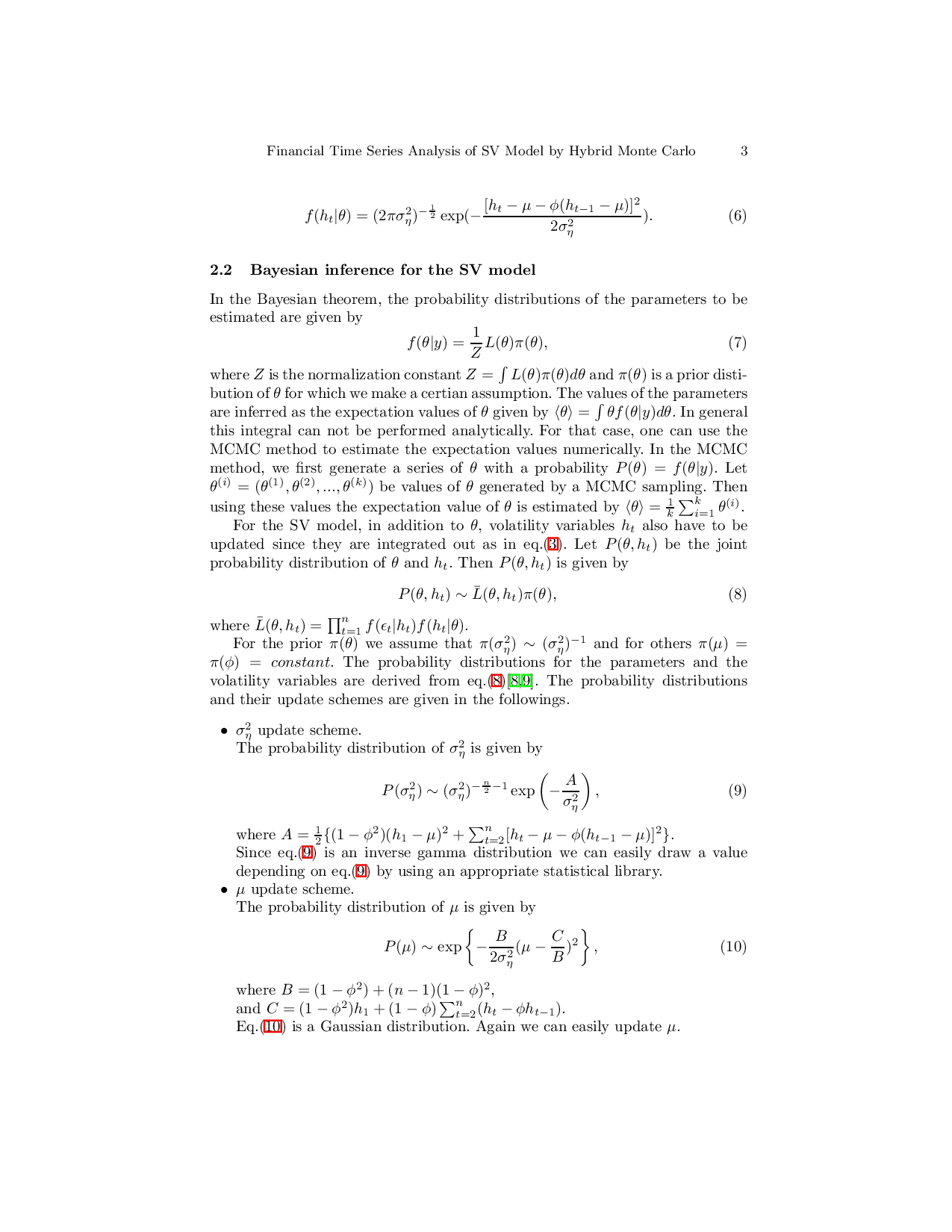
For the SV model the MCMC method based on the Bayesian approach is
developed. In the MCMC of the SV model one has to update the parameter
variables and also the volatility ones. The number of the volatility variables to
be updated increases with the data size of the time series. Usually the update
scheme of the volatility variables is based on the local one such as the Metropolis-
type algorithm[8]. It is however known that when the local update scheme is done
for the volatility variables which have interactions to their neighbor variables in
time, the autocorrelation time of sampled volatility variables becomes high and
thus the local update scheme is not effective. In order to improve the efficiency
of the local update method the blocked scheme which updates several variables
at once is also proposed[10].
In this paper we use the HMC algorithm[11] to update the volatility variables.
There exists an application of the HMC algorithm to the GARCH model[12]
where three GARCH parameters are updated by the HMC scheme. It is more
interesting to apply the HMC for update of the volatility variables because the
HMC algorithm is a global update scheme which can update all variables at once.
To examine the HMC we calculate the autocorrelation function of the volatility
variables and compare the result with that of the Metropolis algorithm.
2
Stochastic Volatility Model and its Bayesian inference
2.1
Stochastic Volatility Model
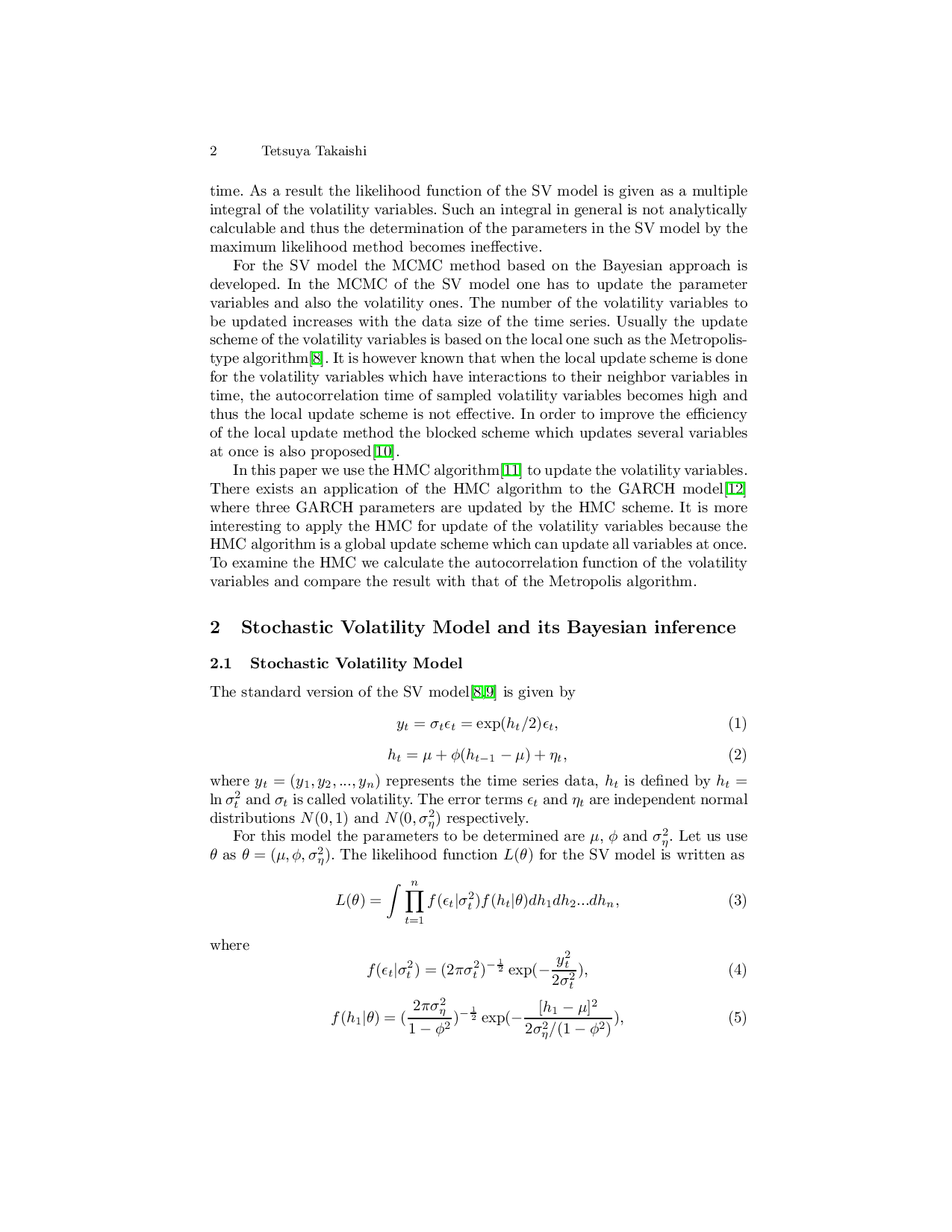
The standard version of the SV model[8,9] is given by
yt = σtǫt = exp(ht/2)ǫt,
(1)
ht = µ + φ(ht−1 −µ) + ηt,
(2)
where yt = (y1, y2, ..., yn) represents the time series data, ht is defined by ht =
ln σ2
t and σt is called volatility. The error terms ǫt and ηt are independent normal
distributions N(0, 1) and N(0, σ2
η) respectively.
For this model the parameters to be determined are µ, φ and σ2
η. Let us use
θ as θ = (µ, φ, σ2
η). The likelihood function L(θ) for the SV model is written as
L(θ) =
Z
n
Y
t=1
f(ǫt|σ2
t )f(ht|θ)dh1dh2...dhn,
(3)
where
f(ǫt|σ2
t ) = (2πσ2
t )−1
2 exp(−y2
t
2σ2
t
),
(4)
f(h1|θ) = ( 2πσ2
η
1 −φ2 )−1
2 exp(−
[h1 −µ]2
2σ2η/(1 −φ2)),
(5)
Financi
…(Full text truncated)…
📸 Image Gallery
Reference
This content is AI-processed based on ArXiv data.