Distributed self-regulation of living tissue. Effects of nonideality
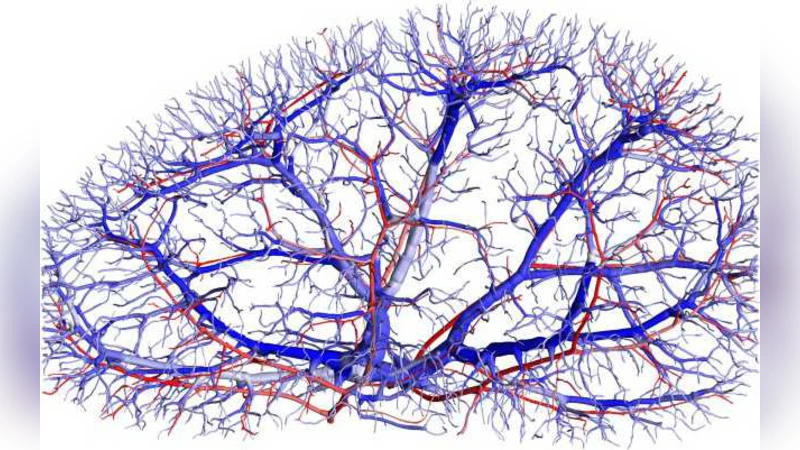
Self-regulation of living tissue as an example of self-organization phenomena in active fractal systems of biological, ecological, and social nature is under consideration. The characteristic feature of these systems is the absence of any governing center and, thereby, their self-regulation is based on a cooperative interaction of all the elements. The paper develops a mathematical theory of a vascular network response to local effects on scales of individual units of peripheral circulation. First, it formulates a model for the self-processing of information about the cellular tissue state and cooperative interaction of blood vessels governing redistribution of blood flow over the vascular network. Mass conservation (conservation of blood flow as well as transported biochemical compounds) plays the key role in implementing these processes. The vascular network is considered to be of the tree form and the blood vessels are assumed to respond individually to an activator in blood flowing though them. Second, the constructed governing equations are analyzed numerically. It is shown that at the first approximation the blood perfusion rate depends locally on the activator concentration in the cellular tissue, which is due to the hierarchical structure of the vascular network. Then the distinction between the reaction threshold of individual vessels and that of the vascular network as a whole is demonstrated. In addition, the nonlocal component of the dependence of the blood perfusion rate on the activator concentration is found to change its form as the activator concentration increases.
💡 Research Summary
The paper presents a theoretical framework for understanding how living tissue self‑regulates blood flow without a central control unit. The authors model the vascular system as a hierarchical tree network, from large arteries down to capillaries, and assume that each vessel responds locally to the concentration of a biochemical “activator” dissolved in the blood. This activator is produced by cells in response to metabolic demand or stress and interacts with receptors on the vessel wall, causing a change in vessel diameter (and thus resistance).
The governing equations are derived from the principle of mass conservation applied both to the blood flow itself and to the transport of the activator. At each branching node the inflow of blood and activator must equal the outflow, leading to a set of coupled nonlinear equations. Each vessel is assigned a response function f(C) that maps the local activator concentration C to a change in hydraulic resistance. The function is sigmoidal, characterized by an individual activation threshold C_thr; when C exceeds this threshold the vessel dilates sharply, reducing resistance and increasing local perfusion.
Two levels of analysis are performed. In the first, a linear approximation is made by assuming small deviations from baseline. Under this approximation the perfusion rate Q in a capillary depends almost exclusively on the activator concentration in the adjacent tissue, reflecting the hierarchical amplification of signals: higher‑order vessels average the signals from many downstream branches, while each downstream vessel reacts to its own local C.
In the second, full nonlinear simulations are carried out. The results reveal two key phenomena. First, there is a distinction between the activation threshold of a single vessel (C_thr) and the effective threshold of the entire network (C_net). Individual vessels begin to dilate at relatively low C, but a noticeable redistribution of blood flow across the whole network requires a higher overall concentration because many vessels must cooperate to lower the global hydraulic resistance. Second, the dependence of perfusion on activator concentration exhibits a non‑local component that changes dramatically as C increases. At low concentrations the response is essentially local; as C approaches and surpasses C_thr, the signal propagates upstream, causing simultaneous dilation of upstream vessels. This creates a nonlinear, “non‑ideal” behavior characterized by saturation and cooperative thresholds.
The authors discuss the physiological relevance of these findings. The model reproduces the rapid, localized vasodilation observed during tissue injury, as well as the more extensive vascular remodeling seen in tumor angiogenesis. Moreover, the distinction between local and network‑wide thresholds suggests strategies for therapeutic manipulation: for example, targeted delivery of vasodilatory agents could be tuned to stay below C_net to avoid systemic side effects, or conversely, to exceed C_net when a global increase in perfusion is desired.
In summary, by combining mass‑conservation constraints with a hierarchical tree representation of the vasculature, the paper provides a quantitative description of self‑organized blood flow regulation. It highlights how individual vessel properties, network architecture, and activator dynamics together generate both local and non‑local control, and it points to potential applications in pathology, drug delivery, and the design of bio‑inspired self‑regulating systems.
Comments & Academic Discussion
Loading comments...
Leave a Comment