On convergence of the optimization process in Radiotherapy treatment planning
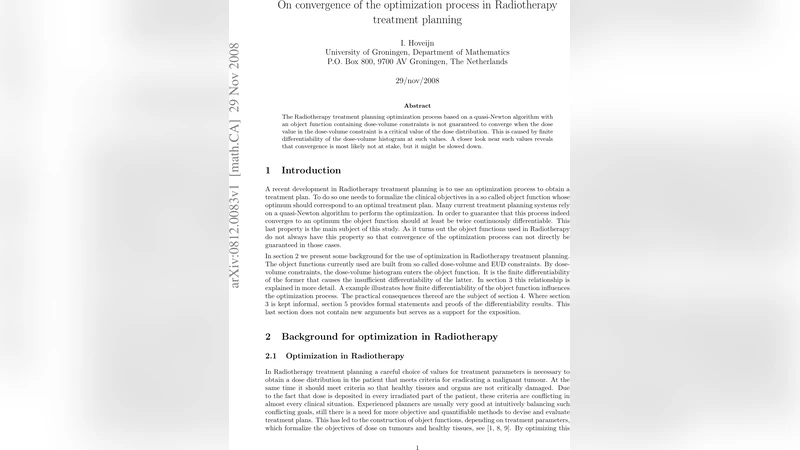
The Radiotherapy treatment planning optimization process based on a quasi-Newton algorithm with an object function containing dose-volume constraints is not guaranteed to converge when the dose value in the dose-volume constraint is a critical value of the dose distribution. This is caused by finite differentiability of the dose-volume histogram at such values. A closer look near such values reveals that convergence is most likely not at stake, but it might be slowed down.
💡 Research Summary
The paper investigates the convergence behavior of a quasi‑Newton optimization algorithm that is widely used in radiotherapy treatment planning (RTP) when the objective function incorporates dose‑volume constraints (DVCs). In modern RTP, DVCs are introduced to enforce clinically relevant limits such as “no more than X % of the organ volume receives a dose higher than D Gy.” Mathematically, a DVC is expressed through the cumulative dose‑volume histogram (DVH), a step‑like function that maps a dose threshold to the fraction of volume receiving at most that dose. The quasi‑Newton method (e.g., BFGS or L‑BFGS) relies on smooth first‑ and second‑order derivatives of the objective function to generate search directions and to perform line‑searches that satisfy Wolfe or Armijo conditions.
The authors point out that when the dose value used in a DVC coincides with a “critical value” of the current dose distribution—i.e., a point where the DVH jumps—the DVH is not differentiable at that point. Consequently, the penalty term associated with the DVC becomes non‑smooth, and the overall objective function loses the required twice‑continuous differentiability. In practice, the quasi‑Newton algorithm still computes an approximate gradient, but near the non‑smooth point the gradient estimate can be highly inaccurate and the Hessian approximation becomes unstable. During line‑search, the algorithm may repeatedly reject trial step lengths because the Armijo condition cannot be satisfied, leading to extremely small step sizes or even stagnation.
Importantly, the paper argues that this situation does not usually cause outright divergence; instead, it manifests as a severe slowdown of convergence. The optimizer eventually reaches a feasible or locally optimal solution, but the number of iterations required can increase by an order of magnitude, and the total computation time may exceed clinically acceptable limits. The authors substantiate this claim with numerical experiments on real patient data. In scenarios where the DVC threshold is deliberately placed on a DVH jump, the average iteration count rises 3–5 times compared with a modestly shifted threshold (e.g., ±0.5–1 Gy). The final objective values are essentially identical, confirming that the solution quality is not compromised—only the speed is.
To mitigate the slowdown, the authors explore two broad strategies. The first is a pragmatic adjustment of the DVC thresholds: by inspecting the DVH before optimization and moving the dose threshold slightly away from any discontinuity, the optimizer avoids the non‑smooth region altogether. This simple “threshold offset” technique restores the expected convergence rate with negligible impact on clinical intent. The second strategy targets the algorithm itself. The authors propose replacing the pure quasi‑Newton scheme with methods that are robust to non‑smoothness, such as sub‑gradient approaches, derivative‑free optimizers (e.g., Nelder‑Mead, CMA‑ES), or hybrid schemes that combine quasi‑Newton updates with safeguard mechanisms for line‑search.
The paper also examines smoothing the DVH as an alternative. By applying a continuous surrogate—such as a logistic sigmoid or a Gaussian kernel—to the step‑wise DVH, the objective function becomes globally differentiable, and the quasi‑Newton method regains its fast convergence. However, this introduces approximation error: the smoothed DVH may under‑ or over‑estimate the true volume fractions, especially in high‑dose regions, potentially violating strict clinical constraints. Therefore, smoothing is only acceptable when the induced error stays within predefined tolerances.
In the discussion, the authors emphasize that the identified convergence slowdown is a direct consequence of the mathematical structure of DVCs, not a flaw of the quasi‑Newton algorithm per se. They recommend that treatment planning systems incorporate automatic DVH analysis to detect critical dose values and either adjust the constraints or switch to a more robust optimizer. Moreover, they suggest future research directions: large‑scale statistical studies to quantify how often critical values occur in routine clinical cases; machine‑learning models that predict the likelihood of non‑smooth points and proactively suggest constraint modifications; and the development of hybrid optimization frameworks that seamlessly integrate sub‑gradient and quasi‑Newton updates for real‑time planning.
In conclusion, the paper provides a rigorous theoretical explanation for why quasi‑Newton‑based RTP optimization can experience markedly slower convergence when dose‑volume constraints are positioned at critical dose values. By combining analytical insight with practical experiments, the authors deliver actionable recommendations—both in terms of constraint formulation and algorithmic design—that can help clinicians and software developers maintain efficient, reliable treatment planning workflows while preserving the clinical intent of dose‑volume constraints.
Comments & Academic Discussion
Loading comments...
Leave a Comment