Review of Flicker Noise Spectroscopy in Electrochemistry
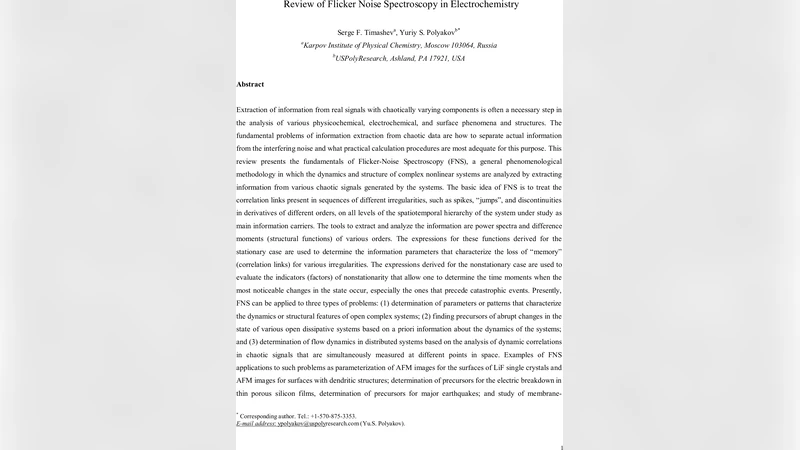
This review presents the fundamentals of Flicker-Noise Spectroscopy (FNS), a general phenomenological methodology in which the dynamics and structure of complex systems, characterized by nonlinear interactions, dissipation, and inertia, are analyzed by extracting information from various signals with stochastically varying components generated by the systems. The basic idea of FNS is to treat the correlation links present in sequences of different irregularities, such as spikes, “jumps”, and discontinuities in derivatives of different orders, on all levels of the spatiotemporal hierarchy of the system under study as main information carriers. The tools to extract and analyze the information are power spectra and difference moments (structural functions) of various orders. Presently, FNS can be applied to three types of problems: (1) determination of parameters or patterns that characterize the dynamics or structural features of complex systems; (2) finding precursors of abrupt changes in the state of various complex systems based on a priori information about the dynamics of the systems; and (3) determination of flow dynamics in distributed systems based on the analysis of dynamic correlations in stochastic signals that are simultaneously measured at different points in space. Examples of FNS applications to such problems as parameterization of the images produced with atomic force microscopy (AFM), determination of precursors for electric breakdowns and major earthquakes, and analysis of electric potential fluctuations in electromembrane systems, as well as to some other problems in electrochemistry and medicine are discussed.
💡 Research Summary
The review provides a comprehensive exposition of Flicker‑Noise Spectroscopy (FNS), a phenomenological framework designed to extract dynamical and structural information from complex, nonlinear, dissipative systems by focusing on stochastic irregularities such as spikes, jumps, and higher‑order derivative discontinuities. The central premise of FNS is that these irregularities act as carriers of correlation links across all levels of a system’s spatiotemporal hierarchy. By converting the raw time‑series into two mathematically tractable descriptors—power spectra S(f) (typically exhibiting a 1/f^α dependence) and difference moments (structural functions) Φ_q(τ)=⟨|x(t+τ)−x(t)|^q⟩—researchers can quantify long‑range memory, scaling behavior, and multi‑scale non‑Gaussian fluctuations.
The methodology is organized around three principal application classes. First, parameterization of complex‑system dynamics: for instance, extracting surface‑roughness scaling exponents from atomic‑force‑microscopy (AFM) images or determining ion‑transport characteristics in electrochemical membranes by analyzing the spectral exponent α and the τ‑dependence of Φ_q. Second, precursor detection for abrupt state changes: as a system approaches a critical transition (electric breakdown, major earthquake, etc.), the flicker‑noise exponent tends toward unity and high‑order moments display pronounced deviations, providing early‑warning signatures. Third, flow‑dynamics inference in distributed media: simultaneous measurements at multiple spatial points generate cross‑structural functions, whose analysis yields propagation speeds, asymmetries, and coupling strengths of material or charge fluxes.
In the electrochemical domain, the review highlights how FNS overcomes the limitations of conventional Fourier analysis. Electro‑membrane potentials comprise intertwined processes—charge transfer at electrode/electrolyte interfaces, ion redistribution, double‑layer dynamics—producing a composite stochastic signal. While a standard FFT offers only an averaged spectral density, FNS isolates instantaneous jumps and spikes via Φ_q(τ), enabling direct mapping of these events to physical phenomena such as active site activation, concentration gradients, or stress accumulation. Moreover, the evolution of the spectral exponent α toward 1 signals the emergence of long‑range correlations, a hallmark of impending breakdown.
Beyond electrochemistry, the review surveys successful FNS deployments in AFM image texture analysis, seismic precursor identification, and biomedical signal monitoring (e.g., EEG, ECG). These examples demonstrate the method’s versatility: it preserves the full complexity of noisy data while extracting robust, scale‑aware descriptors that can be linked to underlying mechanisms.
The authors also discuss current challenges. The definition of “irregularities” and the thresholds for their detection remain largely heuristic, calling for automated, statistically rigorous algorithms. Cross‑correlation structural functions for multi‑point data are computationally intensive, necessitating efficient numerical schemes. Finally, distinguishing flicker noise from other noise types (white, Gaussian) lacks a universally accepted quantitative criterion.
Future directions proposed include integrating machine‑learning classifiers with FNS to automate irregularity detection, developing real‑time monitoring platforms for industrial electrochemical processes, and coupling FNS with mechanistic models to achieve predictive control. By addressing these gaps, FNS could become a standard tool for real‑time diagnosis, early‑warning, and flow‑characterization across a broad spectrum of complex physical, chemical, and biological systems.
Comments & Academic Discussion
Loading comments...
Leave a Comment