The Future of Scientific Simulations: from Artificial Life to Artificial Cosmogenesis
This philosophical paper explores the relation between modern scientific simulations and the future of the universe. We argue that a simulation of an entire universe will result from future scientific activity. This requires us to tackle the challenge of simulating open-ended evolution at all levels in a single simulation. The simulation should encompass not only biological evolution, but also physical evolution (a level below) and cultural evolution (a level above). The simulation would allow us to probe what would happen if we would “replay the tape of the universe” with the same or different laws and initial conditions. We also distinguish between real-world and artificial-world modelling. Assuming that intelligent life could indeed simulate an entire universe, this leads to two tentative hypotheses. Some authors have argued that we may already be in a simulation run by an intelligent entity. Or, if such a simulation could be made real, this would lead to the production of a new universe. This last direction is argued with a careful speculative philosophical approach, emphasizing the imperative to find a solution to the heat death problem in cosmology. The reader is invited to consult Annex 1 for an overview of the logical structure of this paper. – Keywords: far future, future of science, ALife, simulation, realization, cosmology, heat death, fine-tuning, physical eschatology, cosmological natural selection, cosmological artificial selection, artificial cosmogenesis, selfish biocosm hypothesis, meduso-anthropic principle, developmental singularity hypothesis, role of intelligent life.
💡 Research Summary
Clément Vidal’s paper presents a bold, interdisciplinary vision in which future scientific simulations will eventually encompass the entire universe, integrating physical, biological, and cultural evolution into a single computational model. The author begins by outlining the bleak far‑future scenario predicted by contemporary cosmology: the Sun will become a red giant, stars will exhaust their nuclear fuel, black holes will evaporate, and the universe will approach a state of maximum entropy – the so‑called heat death. This trajectory implies that the indefinite continuation of intelligent life in our cosmos is impossible unless we find a way to alter the cosmic trajectory.
Vidal then surveys the exponential growth of computing resources, invoking Moore’s law and its physical limits. He argues that the ultimate computing substrate for an advanced civilization may be a “dense” object such as a black‑hole computer, as suggested by Lloyd and others. Such a substrate would provide the “computational energy” required to run simulations of unprecedented scale.
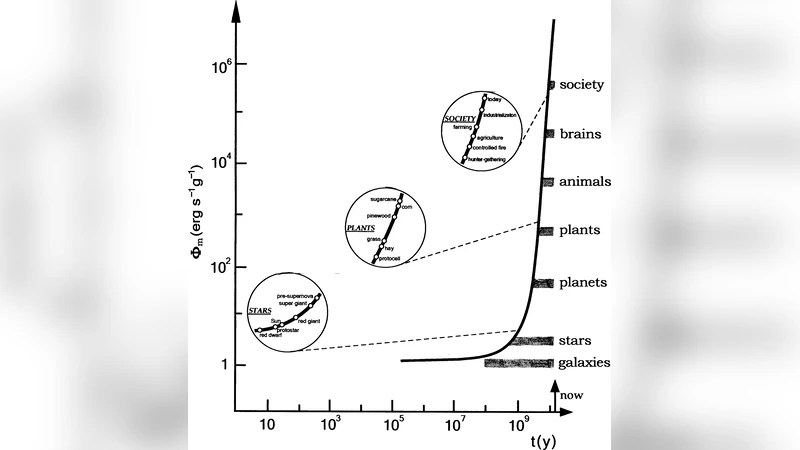
A central conceptual tool is the free‑energy rate density (ΦM), a metric introduced by Chaisson to compare the dynamic complexity of systems ranging from stars to human brains and societies. By placing physical, biological, and cultural systems on a common scale, Vidal demonstrates that complexity has risen faster than exponential in recent epochs, suggesting a natural tendency toward ever‑greater information processing and energy compression (ephemeralization).
Building on this unified complexity framework, the paper revisits Stephen Jay Gould’s “replay the tape of life” metaphor and extends it to the universe as a whole. Vidal argues that by varying fundamental constants and initial conditions in a simulated universe, we can overcome two fundamental limitations identified by Ellis: (1) the universe cannot be subjected to controlled experiments, and (2) we have no comparative sample of other universes. He cites earlier work by Stenger, Aguirre, and others who performed limited parameter sweeps, and calls for a next‑generation simulation that simultaneously varies physical laws, chemical pathways, and cultural dynamics.
The most speculative portion concerns the transition from simulation to physical realization – “artificial cosmogenesis.” Vidal proposes that an advanced civilization could use a black‑hole or quantum‑gravity based computational platform to not only simulate but actually instantiate a new universe. This would involve mechanisms of self‑replication, energy recycling, and the deliberate selection of physical constants – a process he terms Cosmological Artificial Selection, contrasting with Lee Smolin’s Cosmological Natural Selection. He links this to the “selfish biocosm hypothesis” and the “meduso‑anthropic principle,” suggesting that intelligent life could become an active agent in cosmic evolution, creating offspring universes that inherit favorable parameters.
Finally, Vidal situates this scenario within a “developmental singularity” hypothesis: once a civilization reaches a level of technological sophistication capable of whole‑universe simulation and physical implementation, it will be able to avert heat death by spawning a new, low‑entropy cosmos. While the argument is heavily philosophical and currently beyond empirical verification, it serves as a provocative roadmap that ties together trends in computational capacity, complexity theory, artificial life research, and cosmological speculation. The paper invites readers to consider the ethical and existential implications of becoming universe‑makers, and to view the pursuit of ever‑larger simulations not merely as a scientific endeavor but as a potential pathway to ensuring the long‑term survival of intelligence itself.
Comments & Academic Discussion
Loading comments...
Leave a Comment