Channel State Prediction, Feedback and Scheduling for a Multiuser MIMO-OFDM Downlink
We consider the downlink of a MIMO-OFDM wireless systems where the base-station (BS) has M antennas and serves K single-antenna user terminals (UT) with K larger than or equal to M. Users estimate their channel vectors from common downlink pilot symb…
Authors: Hooman Shirani-Mehr, Daniel N. Liu, Giuseppe Caire
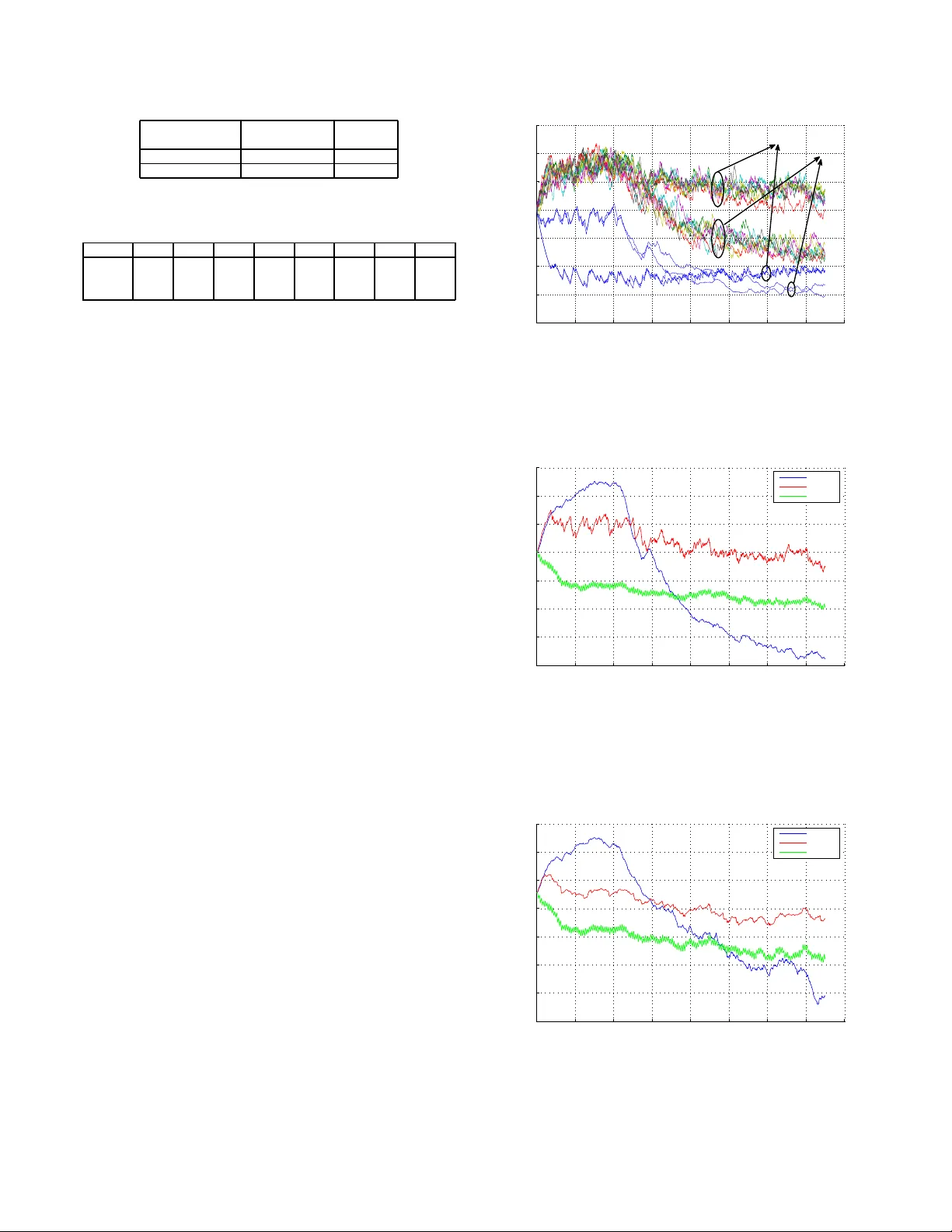
Channel State Predicti on, F eedback and Scheduling for a Multiuser MIMO-OFDM Do wnli nk Hooman Shirani-Mehr shiranim@usc.ed u Daniel N. Liu danielnl@usc.ed u Giuseppe Caire caire@usc.edu Abstract — W e consider the downlink of a MIMO-OFDM wireless systems where the base-station (BS) has M antennas and serves K ≥ M sin gle-antenna user terminals (UTs). Users estimate their channel vectors from comm on downlink pil ot symbols and feed back a prediction, which is used by the BS to compute th e linear b eamf orming matrix fo r the next time slot and to select the users to be served according to the proportional fair schedulin g (PF S) algorithm. W e consider a realistic physical channel model used as a benchmark i n standardization and some alter n ativ es fo r the channel estimation and p rediction scheme. W e sho w that a p arametric method based on ES PRIT is able to accurately p redict t he chann el even for relati vely hi gh user mobility . Howe ver , there exists a class of channels chara cterized by large Doppler sprea d (high mobility) and clustered angular spread f or which prediction is intrinsi cally difficult and all considered methods f ail. W e propose a modifi ed PFS that take into account the “pr edictability” state of the UTs, and si gnificantly ou tperfo rm the classical PFS i n th e presence of prediction errors. The main conclusi on of this work is th at multiuser MIM O downlink yields very good p erf ormance even in the presence of hi gh mobili ty users, provided that th e non- predictable users are handled appropriately . 1 I . I N T R O D U C T I O N Multiuser MIMO do wnlink schemes are expected to become the corner-stone of future wireless cellular systems since they can achiev e a downlink capacity that scales linearly with the number of base station (BS) transmit antennas M , e ven though each user term inal ( UT) has only a single anten na. In orde r to accomplish this linear capacity scaling with M , accurate Channel State Informatio n (CSIT ) needs to be provid ed to the BS [6], [10], [5]. Follo wing the current standardiz ation trend of systems like 3GPP L TE an d IEEE 802.1 6m (mob ile W iMax) [2] and [1], we assum e that the BS br oadcasts downlink pilot sym bols in or der to allow each UT to estimate its own channel state vector . W e assume a freque ncy division duplexing (FDD) scheme, wh ere CSIT feedback must be implemented by explicit closed-lo op fe edback. Since fading channels are generally time-varying, the UTs must predict their chann el state an d feed back this pr ediction via some CSIT feedback ch annel (uplink). In this paper we assume an ideal un quantized feedb ack and fo cus un iquely on the effects of chann el estimatio n and prediction: of course, any form of explicit CSIT feedbac k can only decrease the CSIT a ccuracy with respect to pure pred iction and ideal fee dback. 1 All authors are with the EE Department of the Univ ersity of S outhern Califor nia, Los Angeles, CA. This work was partially supported by the Collab orati ve USC-ETRI Project 53-4503-0781. The BS comp utes the downlink beam forming matrix based on the predicted u ser ch annels. Since in gen eral we h av e K ≥ M users, the BS selects a su bset of S ≤ M users th at are served at each poin t in time. This selection and correspo nding rate allocation is k nown as sc heduling . In this paper we consider the widely used p r oportion al fair schedulin g (PFS) algorithm [ 12], [11]. Observing the perform ance of two rather well-known chan - nel p rediction metho ds applied to the SCM chann el mode l [3], which is used as a benchm ark in standardization, we notice that channels with well separated ang les of arri vals and/or very low m aximum Dop pler spread ar e easy to predict. In contrast, there exist a class of ch annels with high Doppler spread and clustered an gles of arr iv al fo r which a ll pred iction method fail. A more refined analysis b ased on the Cram er-Rao Bou nd [7], not r eported here because of lack o f space , shows th at the “non-p redictability” of these channe ls is an in trinsic p roper ty and not just a shor tcoming of the alg orithms co nsidered. A naive application of the PFS scheme fo r these non -pr edictable users yields large p erform ance degradatio n, because schedul- ing co mputed f rom inaccurate CSIT . W e p ropose a simple modification of the basic PSF alg orithm that is bo th very simple and provid es significant imp rovements. For the ap plication of the prop osed modified PFS (MPFS) scheme it is essential that each UT info rms th e BS whether its channe l is predictable or no n-pred ictable. Fig. 1 illustrates a b lock d iagram of the pr ocess r un at each UTs: the UT keeps pr edicting its channel fro m th e downlink pilot symbols. Also, it com pares its pr ediction with the actual channel in the next time slot, and keeps track of th e prediction error . Th e UT n otifies its predictab ility status to the BS b y comparing the estimated pr ediction e rror with a suitable th reshold. UTs change state ( from pre dictable to non -predictab le and vice versa) at a rate much slower th an the CSIT feed back rate. Notice also that the n on-p redictable u sers need not feeding back th eir CSIT pred iction. Theref ore, as a by-prod uct, this scheme lo wer s the req uiremen t of the CSIT feed back channel by avoiding to f eedback in accurate and useless inform ation. I I . S Y S T E M M O D E L The MIMO-OFDM downlink model with M BS a ntennas, one an tenna at each UT and N subc arriers is g iv en by y k [ t, n ] = h H k [ t, n ] x [ t, n ] + z k [ t, n ] (1) Fig. 1. Block diagram of the predi ction and prediction error trac king process at each UT . for k = 1 , . . . , K , and n = 1 , . . . , N , where t denotes discrete time (tha t ticks at the OFDM symb ol rate), n is the subcarrier index, k is the UT index, y k [ t, n ] is the received signal at UT k , time t a nd sub carrier n , h k [ t, n ] is the correspo nding M × 1 channel vector, x [ t, n ] is the transmit signal vector and z k [ t, n ] ∼ CN (0 , N 0 ) is A WGN. The channel vector h k [ t, n ] has (freq uency-do main) chan nel coefficients H k,m [ t, n ] f or BS antenna index m = 1 , . . . , M . W e consid er the SCM chan nel m odel u sed for urban micr o-cell, urba n macro-ce ll and suburban mac ro-cell fadin g en vironm ents [3]. This model considers P clusters of scatterers where each cluster correspo nds to a p ath ( same relative delay) and each path co nsists of R p subpaths. Each subpath is characterize d by an ang le o f arrival and by a complex amp litude coe fficient. After standard manip ulation, the frequ ency-dom ain channel (drop ping in dices k , m by symmetry and for the sake of notation simplicity ) can be written in the fo rm of H [ t, n ] = P X p =1 R p X r =1 A r,p e − j 2 π τ p n e j 2 π ζ r,p t (2) where A r,p is the complex amplitu de c oefficient of the ( r , p ) - th subpa th, ζ r,p is the D oppler freque ncy shift of the ( r, p ) - th subpath (mu ltiplies by th e OFDM symbol dura tion) and τ p is the delay of the p -th path (m ultiplied b y the subca rrier spacing). The BS makes use of linear ze ro-for cing beamfo rming (ZFBF), i. e., it pr oduces the th e tra nsmitted signa l vector as x [ t, n ] = V [ t, n ] u [ t, n ] wh ere u [ t, n ] is a vecto r of u ser coded symbols an d V [ t, n ] is the beamfor ming matrix. At each time- frequen cy slo t [ t, n ] , a subset of users S [ t, n ] of size S [ t, n ] ≤ M is selected accor ding the sched uling algorithm . Therefore, V [ t, n ] ha s dimen sions M × S [ t, n ] . For a given set of selected users S [ t, n ] of size S [ t, n ] , th e co rrespon ding ZFBF matrix is obtained by first comp uting th e p seudoinverse of the matrix b H [ t, n ] with co lumns { b h k [ t, n ] : k ∈ S [ t, n ] } , wher e b h [ t, n ] indicates the pr ediction of the ac tual chann el h k [ t, n ] available at the BS, and then normalizin g th e pseudo in verse colum ns to unit norm such that the a verage tr ansmit power per subcarrier is E [ | x [ t, n ] | 2 ] = P . Letting b v k [ t, n ] den ote the beam formin g vector for user k ∈ S [ t, n ] , and p k [ t, n ] its alloc ated power , the no minal achiev able rate of user k is given b y e R k [ t, n ] = log 1 + | b h H k [ t, n ] b v k [ t, n ] | 2 p k [ t, n ] (3) W e refer to this rate as “no minal” sinc e this is wh at the BS assumes, ba sed on th e a vailable CSIT in the cur rent slot. In the case of n on-per fect CSIT , user k su ffers fr om multiuser interfer ence since ZFBF is g enerally mismatch ed. Here we make th e o ptimistic assum ption that, no m atter how mismatched the beam forming m atrix is , an in stantaneous rate equal to R k [ t, n ] = lo g 1 + h H k [ t, n ] b v k [ t, n ] 2 p k [ t, n ] 1 + P j 6 = k h H k [ t, n ] b v j [ t, n ] 2 p j [ t, n ] ! (4) is actually achieved. In practice, some mech anism f or fast rate adaptation that co pe with the BS mismatched CSIT can be used in or der to appro ach th e ac tual rate. Such optimistic achiev a bility assump tion provides an upper bound to the perfor mance with any form of rate adap tation, e.g., as obtained by incremen tal red undan cy ARQ an d the use of ra teless c odes [15]. I I I . S C H E D U L I N G If the CSIT o f user k is accurate, i.e., if b h k ≈ h k , then e R k [ t, n ] ≈ R k [ t, n ] . On the oth er hand, if the channel of user k cannot be accur ately p redicted, then R k [ t, n ] ≪ e R k [ t, n ] since the multiuser interf erence in the den ominator of the SINR in (4) is large. The PFS algorithm selects at each [ t, n ] a user subset S [ t, n ] in ord er to ma ximize the weighted rate sum P k e R k [ t,n ] T k [ t ] where { e R k [ t, n ] } a re the no minal rates at time- frequen cy slot [ t, n ] an d { T k [ t ] } are th e a ctually achieved long-ter m throughpu ts at tim e t , which are recu rsiv ely updated accordin g to the rule T k [ t ] = (1 − β ) T k [ t − 1] + β 1 N N X n =1 R k [ t, n ] (5) where β ∈ (0 , 1) is th e factor that contro ls the av erage delay . Th is selection can be perf ormed, fo r example, b y using the gree dy user selection algor ithm of [8]. Consider a “n on- predictable ” u ser k . For wh at observed ab ove, since T k [ t ] is updated b y using the actually achievable rate, it is likely that T k [ t ] will b ecome very small. Hence, user k will have a large weight in th e PFS o bjective function and will be served very frequen tly . It follows that non -predictab le users “eat-up ” a lot o f transmission resources from the system. Unfo rtunately , since they suffer from h igh multiuser interfe rence p ower , the ir rate will remain low . Hence, due to scheduling, the presence of non-p redictable users imp acts negatively also the perfo rmance of pr edictable users. In o rder to av oid this prob lem, we pr opose the MPFS scheme where u sers are p artitioned into a p redictable set of size K p and a non -predictab le set of size K np = K − K p . PFS is app lied with the addition al constrain t that if k ∈ K np is selected on slot [ t, n ] , n o oth er user c an be selected on the same time-freq uency slot. Furtherm ore, since users in the non-p redictable class have unr eliable CSIT , the BS serves them using stan dard transmit diversity (i.e., it does not try to b eamform ). The nomina l rate for these users is g iv en b y e R k [ t, n ] = log 1 + P M | b h k [ t, n ] | 2 . Notice th at in this ca se only a coa rse form of CSIT is nee ded, wh ich in prac tice amounts to knowing the user instanta neous SNR with some degree of a ccuracy . For the sake o f comp arison, we consider also a “har d- fairness” schedulin g ( HFS) scheme th at aims at max imizing the minimum throu ghput over all users, i.e., HFS solves max min k T k . Predictable users and non-p redictable users are served in separated time-frequ ency slots. Gi ven the symmetry of the channe l with respec t to all fr equencies, we can foc us on on e subcarr ier and let α p and α np = 1 − α p denote the fraction of tim e slots allo cated to pred ictable and n on- predictable u sers. No n-pred ictable user s are served in rou nd- robin using tran smit div ersity . Modelin g the u ser channel square mag nitude z = | h k | 2 as a Chi-square R V with 2 M degrees of fr eedom, the in dividual a verage throu ghput of any of the se users, by symmetry , is given by T np = 1 K np E log 1 + P M | h k | 2 = 1 K np M P M 1 ( M − 1)! I M M P (6) where I n ( µ ) = R ∞ 0 t n − 1 ln(1 + t ) e − µt dt = ( n − 1)! e µ P n k =1 Γ( − n + k,µ ) µ k [4], where Γ( ., . ) is the comp lemen- tary in complete ga mma f unction d efined by [9] Γ( α, x ) = R ∞ x t α − 1 e − t dt . Th e p redictable users can be served using regular PFS a pplied in their fraction of allocated slots. The av erage rate per user can be lower bound ed by con sidering equal p ower allocation as 1 K p M X k =1 E log 1 + P M | h H k v k | 2 ≤ T p (7) For i.i.d. Rayleigh fading and using the fact th at | h H k v k | 2 is Chi-squared with 2 degrees of freed om, the LHS o f (7) takes on th e familiar form M K p e M P E i 1 , M P (8) where E i ( n, x ) = R ∞ 1 e − xt t n dt . The max -min solution is achieved by balancing the throu gh- puts. By letting α p T p = (1 − α p ) T np we fin d α p = T np T p + T np . In pr actice, sin ce the statistics of the ch annels may b e non - Rayleigh and the ap plication of PFS for th e pred ictable users may imp rove T p with r espect to th e above lower bou nd, an adaptive slot allocation sho uld take care of updating the v alue of α p in th e HFS scheme. Our simulation s based on the SCM channel model show th at dimensioning α p accordin g to the above rule of thu mb yields values very close to the a ctual rate-balanc ing state. I V . C H A N N E L P R E D I C T I O N S C H E M E S W e consider the downlink commo n p ilot arrang ement of Fig. 2. Pilots are sep arated by D t OFDM symb ols in tim e and by D f subcarriers in frequency . A total of N t × N f pilots per ante nna are collected over a window of du ration N t D t , and u sed for pred iction. Pilots for different transmit an tennas are mutu ally or thogon al. I n ord er to av oid aliasing, we need that D f ≤ 1 τ max and D t ≤ 1 2 ζ max where τ max is the max imum delay an d ζ max is the max imum Dop pler frequ ency shift. Fig. 2. Pilot pattern. By d efining ω r,p = 2 π ζ r,p D t , υ p = 2 π τ p D f , th e o utput of the pilot observation ( up to an irr elev ant phase shift due to the location o f th e pilo t subcarriers) can be written in th e form of a 2-dim ensional sum of sinusoids in add iti ve white Gaussian noise as b H [ q D t , mD f ] = P X p =1 R p X r =1 A r,p e j ( ω r,p l + υ p m ) + z [ l , m ] (9) Channel pred iction u nder this mod el r educes to estima ting the p arameters of the sinusoid al co mpone nts. W e follow the method of [17], based on the repeated application of ESPRIT (details are no t includ ed d ue to lack of sp ace). In [ 7] we have also considered non-lin ear Least-Squar es, and various approx imations of ML estimatio n [13], [19], [ 16], and we conclud ed that, for this pr oblem, th e E SPRIT method offers the best trade off between comp lexity and perfo rmance. An alternative chann el prediction scheme consists of mo del- ing the discrete-time ( time-doma in) channel impulse r esponse as Gaussian stationar y vector process an d u sing MMSE lin - ear pre diction (W iener filter) [18]. T he time-d omain channel impulse respo nse ( h ( t, 0) , . . . , h ( t, L − 1)) is r elated to the frequen cy-domain cha nnel by the DFT H [ t, n ] = L − 1 X l =0 h ( t, l ) e − j 2 π ln/ N (10) Since the ch annel is “sampled ” by the downlink pilot gr id ev ery D t OFDM symbols, it follows that prediction can be done in steps of D t symbols. Then, the BS treats the chan nel as piecewise constant for blocks of leng th D t . For simplicity , we assum e th at the time-d omain chan nel impulse response is measured b y sendin g a sing le imp ulse in tim e followed by N f − 1 zeros, with N f ≥ L , with impulse p ower N f P . In this way , the freque ncy doma in pilot g rid of Fig. 2 an d the time-dom ain p ilot scheme have the same overhead in te rms of pilot symb ols insertion ratio and to tal pilo t power . Both the ESPRIT -based and the W iener-based schemes need to compute and update the sample cov ariance matrix of the recei ved si gnal. This re duces to a recursive co mputation that is very similar to standard RLS. It is interesting to n otice th at, in terms of system design, the two p rediction m ethods y ield to q uite d ifferent CSIT fee dback schemes. Wi ener predic tion produ ces a n ew pr edicted chann el vector every D t OFDM symbols, an d this needs to be fed back within this delay . In contr ast, ESPRIT prod uces a set of ch annel param eters th at is u sed to extrapolate the ch annel over a large b lock (see [17] f or a qu antitative estimate of the duration over which the chann el par ameters can b e consider ed to b e co nstant ). The UT will estimate the chann el parameter s { A r,p , ω r,p , υ p } from a block of pilots of du ration D t N t OFDM sym bols, extrapo late the channe l fo r the next b lock, and feed back any convenient q uantized repr esentation of the e xtrapolate d trajectory . 2 Fig 3 illustrate s the different feedback mod es suited to these predictio n metho ds. As said, the feedback f or ESPRIT is “batch” while for W iener it is a continuo us lo w-rate tran smission. Fig. 3. Batch versus frame by frame feedback. V . S I M U L AT I O N S A N D D I S C U S S I O N W e consider a system with parameter s given in T ab le I . Maximum Doppler frequ ency shif t is giv en b y ζ max = f c v c where c is the speed of lig ht, v is the speed of u ser an d f c is the carrier fr equency . Duration of validity of par ameters is giv en by T v alid = q cr min 3 f c v 2 where r min is th e distance f rom user to n earest scattere r and we assume that r min = 6 00 m. The co rrespond ing v a lues are given in T able II. W e h av e comp ared the two pre diction metho ds by con- sidering 4 different scenarios. Our findin gs are summa rized by T able III. When Dop pler freque ncies ar e well-separated, 2 In general, feeding back the channel coef ficient is not the opti mal strate gy for a giv en target CSIT distortion. A rate-dist ortion approach to channe l state feedbac k when the channel is modeled as a correlated Gaussian source is proposed in [14]. In the case of the SCM channel model, we leav e this intere sting rat e-distor tion prob lem for future work. T ABLE I S Y S T E M S P E C I FI C ATI O N S Descripti on V alue 1 /T , Sampling frequenc y 3 . 84 MHz f c , Carrier frequenc y 2 . 6 GHz N , Number of subcarriers 256 N a , Num ber of acti ve subcarriers 200 Length of CP 64 ∆ f , Subcarrier frequenc y spacing 15 KHz T sy m , OF DM symbol with CP 83 . 33 µ s N f , Number of Pilot subcarriers 50 N t , Num ber of Pilot OFDM symbols 100 D f , Pilot subcarrier spacing 4 D t , Pilot OFDM symbol spacing 20 τ max , Maximum delay 16 . 67 µ s T ABLE II M A X I M U M D O P P L E R F R E Q U E N C Y A N D D U R AT I O N O F V A L I D I T Y O F M O D E L F O R U T W I T H D I FF E R E N T S P E E D S speed v (Km /h) ζ max (Hz) T v ali d (s) T v ali d (OFDM symbols) High 75 180.56 0.231 2700 Low 5 12.04 3.458 41500 the Do ppler freq uency compo nents o f the cha nnel can be accurately estimated by ESPRIT fo r both high speed and low speed user . In co ntrast, when Doppler frequencies are packed, if user is low speed then chan nel v aries slo wly and can be predicted by W ien er or even tre ated as piecewise constant while for high speed u sers bo th predictio n method s fail. This class of ch annels c an be con sidered as ”no n-pred ictable”, i.e. , the accu racy of prediction is no t sufficient fo r the pu rpose of MIMO downlink be amformin g. Next, we consider a BS with M = 4 transmit antenna s, K = 8 single antenna UTs with v = 75 km/h (high mobility), SCM channel model and SNR = 20 d B. K np = 2 users (users 1 and 2) have packed Doppler fre quencies and their p rediction is very poor for bo th ESPRIT and Wiener prediction and K p = 6 users (users 3 -8) have well-separ ated Doppler fre quencies a nd their channels are predicted reliably by applying ESPRIT . Figs. 4, 5 and 6 and T able IV demon strate simulation results for different schedulin g me thods. L ooking at the acti vity fraction s of T able IV, i.e., the fraction of slots in which a gi ven user is scheduled , we n otice th at the naive PFS that makes use of unr eliable CSIT tend s to serve the n on-pr edictable u sers (users 1 and 2 ) very often . This con firm the behavior tha t we described qualitatively in Section II I. This prob lem is eliminated by the pro posed MPFS scheme. W e observe that the prop osed MPFS scheme achieve the best pe rforman ce both in term s of th rough put sum P k T k , an d in term s of sum of log o f th rough puts P k log T k (prop ortional fairness objective function [12], [11]). W e conclud e that by tre ating pred ictable and no n- predictable users in two classes a s in the pr oposed MPFS scheme, and by usin g the app ropriate parametric pred iction scheme, su ch as the one ba sed o n ESPRIT , multiuser MIMO downlink can be successfully applied also to users with relativ ely high mobility . T ABLE III B E S T P R E D I C T I O N M E T H O D W ell-sepa rated Pack ed Dopplers Do pplers Low speed user ESPRIT W iener High speed user ESPRIT Al l fail T ABLE IV A C T I V I T Y F R A C T I O N S 1 2 3 4 5 6 7 8 PFS 0.74 0.79 0.35 0.37 0. 36 0.35 0.36 0.42 MPFS 0.14 0.15 0.44 0.44 0.44 0.44 0. 44 0.53 HFS 0.26 0.26 0.29 0. 29 0.29 0.29 0.29 0.35 R E F E R E N C E S [1] http:// ieee80 2.org/ 16/tgm/ . [2] http:// www .3gpp.or g/highlights/lte/lte .htm . [3] 3GPP , Spatial chan nel model for multiple input multiple output (mimo) simulatio ns , Tr 25.996, 2003. [4] M.S. Alouini and AJ Goldsmith, Capacit y of R aylei gh fading channe ls under dif fer ent adaptive transmission and diversi ty-combi ning tech- niques , IEE E Trans. on V eh ic. T ech. 48 (1999), no. 4, 1165–1181. [5] G. Caire, N. Jindal , M. Kobay ashi, and N. Ra vindran, Multiuser MIMO Downlink Made Practi cal: Achie vable Rates with Simple Chann el State Estimation and F eedback Schemes , Submitted to IEE E Trans. Informa- tion Theory (2007), Arxiv preprint cs.IT/0711.2642v1. [6] G. Caire and S. Shamai, On the achie vable thr oughput of a multiantenna Gaussian bro adcast channel , IE EE Trans. on Inform. Theory 49 (2003), no. 7, 1691–1706. [7] Giuseppe Caire, Hoon Huh, Daniel Liu, K. Raj Kumar , and Hooman Shirani-Me hr , USC-ETRI Collaborati ve Proje ct, Researc h on MIMO- OFDM Cellular Systems , INTERIM REPOR T. [8] G. Dimic and N. Sidiropou los, On Downlink Beamforming with Greed y User Selecti on: Performanc e Analysis and Simple New Algorithm , IEE E Tra ns. on Sig. Proc. 53 (2005), no. 10, 3857–3868. [9] I. S. Gradshteyn and I. M. Ryzhik, T abl e of inte grals, series and pr oducts , fifth ed., Academic Press, 1994. [10] S.A. Jafar and A.J. Goldsmith, Isotro pic F ading V e ctor B r oadcast Channel s: The Scalar Upper Bound and Loss in De gre es of Fr eedom , IEEE Trans. on Inform. Theory 51 (2005), no. 3. [11] V incent K. N. Lau, Pr oportional F air SpaceT ime Sche duling for W ireless Communicat ions , IEEE T ransactions on Communic ations 53 (2005), no. 8, 1353–1360. [12] P . V iswanat h, D.N.C.T se, and R.Laroia, Opportunistic Beamforming Us- ing Dumb A ntennas , IEEE Trans. on Inform. T heory 48 (2002), no. 6. [13] D.C. Rife and R.R. Boorstyn, Multiple tone paramete r estimation fro m discr ete-time observation s , Bell System T echnical Journal 55 (1976), no. 3, 1389–1410. [14] Hooman Shirani-Mehr and Giuseppe Caire, Channel State F eedback Sche mes for Multi user MIMO-OFDM Downl ink , submitte d to IEEE Tra nsaction s on Communications . [15] Amin Shokrollahi, Raptor Codes , IE EE Transact ions on Information Theory 52 (2006), no. 6, 2551–2567. [16] P . Stoica, R.L . Moses, B. Friedlande r , and T . Soderstrom, Maximum lik elihoo d estimation of the parameters of mult iple sinusoids fr om noisy measur ements , IEEE Transacti ons on acoustics, Speech and Signal Processing 37 (1989), no. 3, 387–391. [17] I. C. W ong and B. L . Evans, Sinusoidal Modeling and Adaptive Channel Pred iction in Mobile OFDM Syste ms , IEEE T ransactions on Signa l Processing 56 (2008), no. 41, 1601–1615. [18] I. C. W ong, A. Forenza, R. W . Heath , and B. L. Evans, Long Range Channel Predi ction for Adaptive OFDM Systems , Proc. IEEE Asilomar Conferen ce on Signals, Systems, and Computers 1 (2004), 732–736. [19] I. Ziskind and M. W ax, Maxi mum Lik elihood Localizati on of Mult iple Sour ces by Alternati ng Proj ectio n , IEEE Tra nsacti ons on Acoustics, Speech, and Signal Processing 36 (1988), 1553–1560. 0 2000 4000 6000 8000 10000 12000 14000 16000 0 0.5 1 1.5 2 2.5 3 3.5 PFS MPFS Fig. 4. E volu tion of T k [ t ] over time for differe nt users. 0 2000 4000 6000 8000 10000 12000 14000 16000 8 10 12 14 16 18 20 22 Σ k T k PFS MPFS HFS Fig. 5. Sum rate for PF S, MPFS and HFS for the configurati on with 2 non-predi ctable and 6 predict able high-spe ed users. 0 2000 4000 6000 8000 10000 12000 14000 16000 1 2 3 4 5 6 7 8 Σ k log(T k ) PFS MPFS HFS Fig. 6. Sum lo g rate for PFS, MPFS and HFS for the configuratio n wit h 2 non-predi ctable and 6 predict able high-spe ed users.
Original Paper
Loading high-quality paper...
Comments & Academic Discussion
Loading comments...
Leave a Comment