Effects of confinement and crowding on folding of model proteins
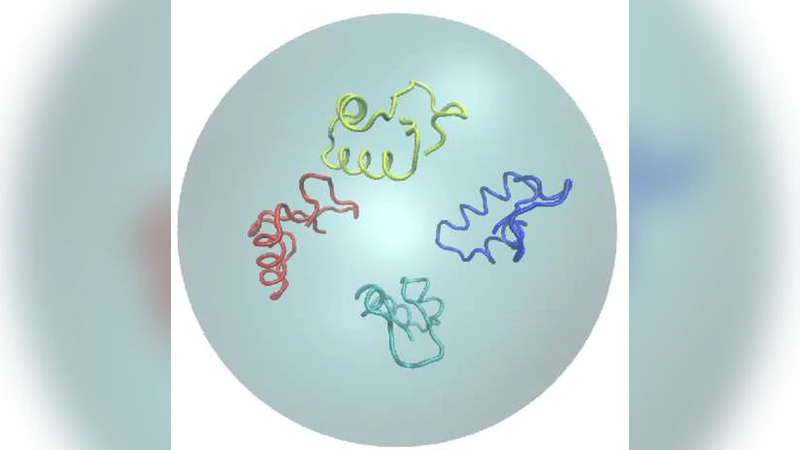
We perform molecular dynamics simulations for a simple coarse-grained model of crambin placed inside of a softly repulsive sphere of radius R. The confinement makes folding at the optimal temperature slower and affects the folding scenarios, but both effects are not dramatic. The influence of crowding on folding are studied by placing several identical proteins within the sphere, denaturing them, and then by monitoring refolding. If the interactions between the proteins are dominated by the excluded volume effects, the net folding times are essentially like for a single protein. An introduction of inter-proteinic attractive contacts hinders folding when the strength of the attraction exceeds about a half of the value of the strength of the single protein contacts. The bigger the strength of the attraction, the more likely is the occurrence of aggregation and misfolding.
💡 Research Summary
The authors investigate how physical confinement and macromolecular crowding influence the folding dynamics of a model protein using coarse‑grained molecular dynamics simulations. The protein studied is crambin, a small 46‑residue protein, represented by a bead‑spring model that captures native contacts and excluded‑volume interactions. Confinement is implemented by placing a single crambin molecule inside a softly repulsive spherical cavity of radius R; varying R allows the authors to explore different degrees of spatial restriction.
The simulations reveal that confinement modestly perturbs the free‑energy landscape. The transition‑state barrier is slightly elevated, leading to a reduction in the optimal‑temperature folding rate by roughly 10–30 % compared with the unconfined case. Nevertheless, the overall folding pathway remains essentially unchanged: the same native topology is reached, and the sequence of contact formation is preserved. Confinement accelerates the early formation of the protein’s hydrophobic core because the chain cannot explore distant conformations, but subsequent steps require occasional collisions with the cavity wall, which introduces a small delay in the final consolidation of the native structure.
To address crowding, the authors place multiple identical crambin molecules inside the same sphere, fully denature them (all residues initially extended), and then monitor simultaneous refolding. Two interaction regimes are examined. In the first, only soft‑repulsive excluded‑volume forces act between different proteins, mimicking the steric crowding of a cellular cytoplasm. Under these conditions, the average folding time per molecule is virtually identical to that of a single isolated protein, and in some runs the presence of neighboring chains even provides a transient “templating” effect that slightly speeds up folding.
In the second regime, an attractive inter‑protein potential is added. The strength of this attraction (ε_inter) is expressed as a fraction of the intra‑protein native contact strength (ε_intra). When ε_inter/ε_intra exceeds roughly 0.5, folding becomes markedly slower. As the attraction grows, non‑specific contacts between different chains proliferate, competing with the formation of native intra‑chain contacts. This competition leads to misfolded intermediates and, at higher attraction levels (ε_inter/ε_intra ≥ 0.8), to the rapid emergence of large aggregates that never achieve the native conformation. The authors thus identify a clear threshold: modest inter‑protein attraction is tolerable, but beyond about half the native contact strength the folding process is severely compromised.
Pathway analysis shows that confinement primarily affects the early core‑formation stage, while crowding with pure steric repulsion does not alter the order of events. However, when attractive forces are present, the early stage is delayed because chains become trapped in inter‑molecular contacts, and the later stage suffers from extensive rearrangements or outright aggregation.
Overall, the study demonstrates that spatial confinement alone produces only a mild slowdown of folding without fundamentally changing the mechanism. Pure volume exclusion in a crowded environment does not impede folding efficiency, suggesting that the cytoplasmic crowding observed in vivo can be compatible with rapid protein folding. In contrast, non‑specific attractive interactions between macromolecules have a dramatic impact: once they exceed a critical strength, they hinder proper folding and promote aggregation. These findings provide a physical basis for the essential role of cellular quality‑control systems—such as molecular chaperones and ionic strength regulation—in suppressing undesirable inter‑protein attractions and maintaining protein homeostasis.
Comments & Academic Discussion
Loading comments...
Leave a Comment