Goodness of fit tests for weighted histograms
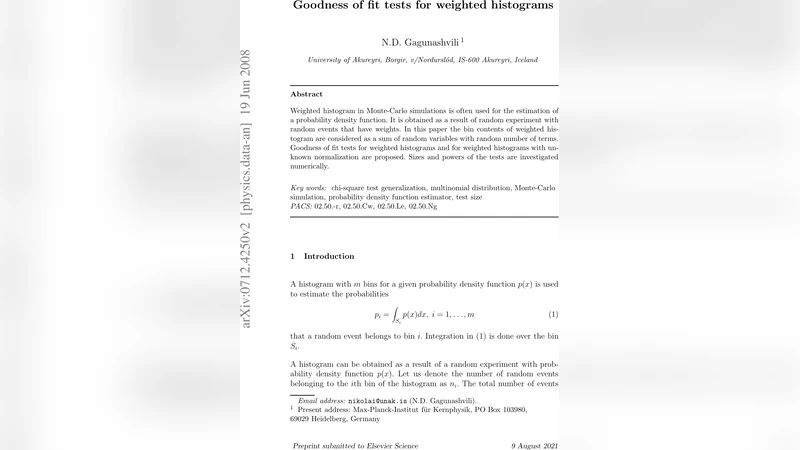
Weighted histogram in Monte-Carlo simulations is often used for the estimation of a probability density function. It is obtained as a result of random experiment with random events that have weights. In this paper the bin contents of weighted histogram are considered as a sum of random variables with random number of terms. Goodness of fit tests for weighted histograms and for weighted histograms with unknown normalization are proposed. Sizes and powers of the tests are investigated numerically.
💡 Research Summary
The paper addresses a fundamental statistical problem that arises when weighted histograms are used to estimate probability density functions in Monte‑Carlo simulations. Unlike ordinary histograms, where each bin simply counts the number of events, a weighted histogram assigns a random weight w_i to each event, allowing the representation of complex distributions with fewer samples. However, the randomness of both the event counts per bin and the weights themselves invalidates the standard Pearson χ² goodness‑of‑fit test, which assumes only Poisson‑distributed counts with known variances.
To overcome this limitation, the authors model the content of each bin as a sum of a random number of independent random variables. Specifically, for bin i they denote the random number of events by N_i (assumed Poisson or multinomial) and the individual weights by w_{ij}, which are independent and identically distributed. The total weighted content of bin i is therefore
S_i = Σ_{j=1}^{N_i} w_{ij}.
From this representation the mean and variance of S_i can be derived analytically:
μ_i = E
Comments & Academic Discussion
Loading comments...
Leave a Comment