Joint Adaptive Modulation Coding and Cooperative ARQ over Relay Channels-Applications to Land Mobile Satellite Communications
In a cooperative relay network, a relay node (R) facilitates data transmission to the destination node (D), when the latter is unable to decode the source node (S) data correctly. This paper considers such a system model and presents a cross-layer ap…
Authors: Morteza Mardani, Jalil S. Harsini, Farshad Lahouti
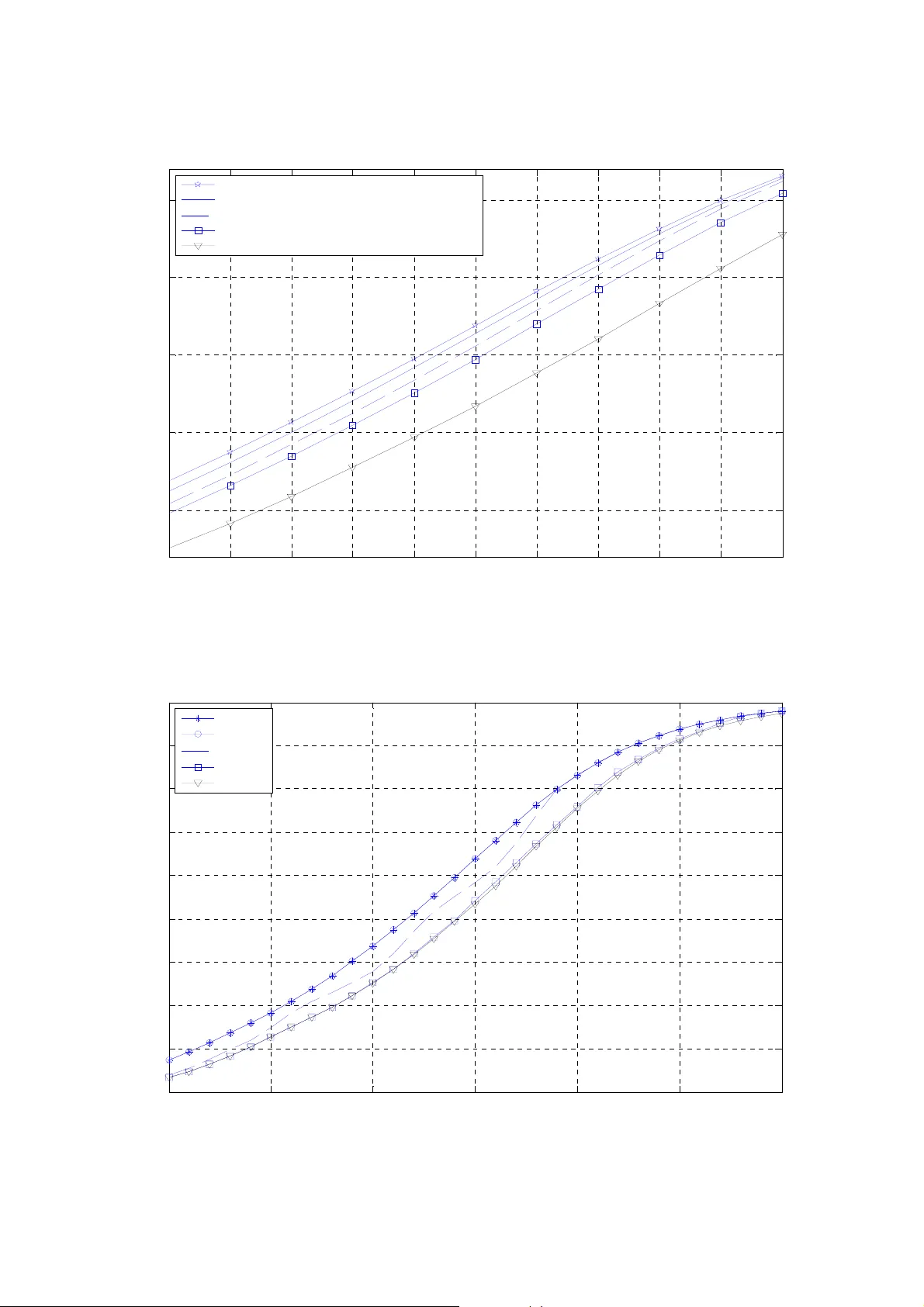
Summary In a cooperative relay network, a rela y node (R) facilitates data transmi ssion to the destination node (D), when the latter is unable to decode the source node (S) data correctly. This pape r considers such a system model and presents a cross-layer app roach to join tly design adaptive modulation and coding (AMC) at the physical layer and cooperative truncated automatic rep eat request (ARQ) protocol at the data link layer. We first derive a closed form expression for the sp ectral efficiency of the joint cooperative ARQ-AMC scheme. Aiming at m aximizing this performance m eas ure, we then optimize two AMC schemes for S-D and R-D links, which directly satisfy a p rescribed packet lo ss rate constraint. As an interesting application, we also consider the pr oblem of joint link adaptation and b l ockage mitigation in land m obile satellite communications (LMSC). We also present a new relay-ass isted transm ission protocol for LMSC, which delivers the source data to th e destination via the relaying link, when the S-D channel is in outage. Numerical results indicate that the proposed schemes noticeably e nhances the spectral efficiency compared to a system, which uses a conventional ARQ-AMC scheme at the S-D link, or a system which employs an optimized fixed rate cooperative-AR Q protocol. Key Words: Cooperative ARQ, adaptive modulation and coding, quality of service, cross-layer design, land mobile satellite channel. 1. Introduction Recently, cooperative communicatio n has attracted a lot of research atten tion as a promising technique to achieve diversity gain in wireless networks. In partic ular, cooperative automatic repeat request (ARQ) is a link-level protocol which exploits the spatial diversity of the relay cha nnel. It outperforms a conventional ARQ scheme when the source to destination channel is sub ject to a high temporal correlation [8], [10]. The main idea behind this protocol is to join tly expl oit the benefits of two re laying protocols: (i) the † This work has been supported in part by the Iran Teleco mmunications Research Center, and has been accepted for presentation in parts at the IEEE International Symposiu m on Telecommunications, Tehran, Iran, August 2008, and IEEE International Symposium on Wireless Communicati on Systems, Reyk javik, Iceland, October 2008. Joint Adaptive Modulation Coding and Cooperative ARQ over Relay Channels-Applications to Land Mobile Satellite Communications † Morteza Mardani*, Jalil S. Harsini *, Farshad Lahouti*, Behrouz Eliasi** *Wireless Multimedia Communication Lab., School of E&CE, University of Tehran **Iran Teleco mmunication Research Center, PO Box 14 155-3961, Teh ran 14399, Iran Emails: m.mardani@ece.ut.ac.ir, j.harsini@ece.ut .ac.i r, lahouti@ut.ac. ir, eliasi@itrc.ac.ir incremental decode and forward rela ying protocol, which prescribes a re transm ission via relay only when the destination decodes the source data in error [6], and (ii) the se le ction decode and forward protocol, which verifies that the data is received corre ctly at the relay, prior to a possible relay to des tination retransmission [6]. However, time varying nature of wireless links limits the comm unication performance over these systems for provisioning of stringent quality of service (QoS) requirem ents. Adaptive Modulation and Coding (AMC) is known as a powerful technique to enhance the system spectral efficiency for communications over wireless fading channels [1 ] , [2] . Thanks to high spectral efficiency, AMC schemes are already included in wireless communication standards such as HIPERLAN/2, IEEE 802.11 and IEEE 802.16e. It is also of great intere st in satellite communications a nd has been adopted in the DVB-S2 standard [3]- [5]. There are several research studies on the topic of cooperative ARQ in the relay channel, e.g., [7]- [12]. Utilizing a distributed space-time coded retransm ission protocol, in [7] a truncated cooperative-ARQ is proposed, which exploits adaptive c ooperative diversity, wher e the relay nodes are sele cted using a cyclic redundancy check (CRC) code. In [8], for several c ooperative ARQ protocols, the link layer performance including both throughput and packet loss rate, is studied over slow fading channels. Their results illustrate that th e cooperative ARQ protocol compared to the conv entional ARQ, achieves bette r performance if the average SNR of the relay to destin ation (R-D) chann el is better than a given threshold. In [9], closed form expressions for the throughput performance of several relay-based retransmission protocols, corresponding to different levels of cooperation, are presente d. Based on the channel statistics (average SNR), they used a simulati on setup to investigate the eff ect of optimized rate selec tion on the system throughput (no AMC is employed). In [ 10], a stop and wait coopera tive ARQ protocol is developed and analyzed, for improved throughput a nd packet delay performance, over time-correlated fading channels. Delay performance of a set of cooperative ARQ protocols is also investig ated in [11], where data frame arrival at the source node is mode led by a Poisson process. The research presented in [12], verifies that utilizing a cooperative retransmission strategy compared to a conventional ARQ, reduces both system load and packet delay in m obile satellite communicati on system s suffering from channel blockage effects. The idea of applying AMC to a wireless relay network is investigated in [14] a nd [15]. In [14] for a cooperative decode and forward relay network, it is de monstrated that both power and rate adaptation at the source and relay nodes, lead to an improved ne twork throughput compared to a direct transmission system. In [15], an OFDM based wireless relay ne twork is considered and aiming at optim izing the end- to-end instantaneous throughput, a joint relaying scheme (without ARQ) and AMC mode selection algorithm is proposed and solutions are provided in the form of lookup tables. As mentioned above, in the lite rature, both the cooperative ARQ pr otocol and AMC over the relay channel are separately investigat ed. Nevertheless, the problem of designing discrete-rate AMC schem es in conjunction with a cooperative ARQ protocol in wire less relay networks has not been addressed so far. This will be promising especially in land mobile satellite c ommunication (LMSC) systems, where the communication channel experiences both bl ockage and multipath f ading effects. The main contribution of this paper is to quantify the potential spec tral efficiency gain achieved by the joint design of discrete-rate AMC with cooperative ARQ, while satisf ying the QoS constraints of higher layers. To this end, we take a cr oss-layer design approach. We firs t derive an exact closed form expression for the spectral efficiency of joint c ooperative ARQ-AMC scheme over block fading channels, when the number of retransmission attem pts per p acket at the relay node is finite. Then aiming at maximizing this performance m easure, we propose an AMC-based rate adaptation policy for the relay channel, which guarantees a prescribed average packet lo ss rate (PLR) constraint. In the case where only the channel statistics are available, we also pr esent an optimized rate selection policy fo r both transmission rates on the source to d estination (S-D ) and R-D links, which guarantees the required PLR. As an interesting application of the proposed sche me, we consider AMC design and blockage mitigation for land mobile satellite communica tions in presence of a relay. Numerical results fo r both terrestrial links with Rayleigh fading and LMSC links show that the proposed cross-layer design for joint cooperative ARQ-AMC scheme achieves considerable spectral efficiency gain. In particular, it outperforms a joint conventional ARQ-AMC scheme designed for direct S-D link, an optimized fixed rate cooperative ARQ when different optim ized transmission rates at the source and relay nodes are chosen ba sed on the channel statistics, an d AMC alone at the physical layer . Also, the results on LMSC system, dem onstrates that if the relay re transmits source data to the des tination node, when the S-D channel is in outage, an even higher spectral efficiency gain is achieved. As a side result on the conventional ARQ-AMC sche me, we also observe that imposing different optimized target packet e rror rates (PER) on the transm ission and th e possible retran smi ssions of a packet leads to higher spectral efficiency com pared to a schem e that considers identical target PERs on all transmissions, as presented in [16]. The rest of this paper is organized as follows. S ection 2 describes the system and channel mo del. In Section 3, we first derive a clos ed-form expression for the spectral efficiency o f an adaptive rate cooperative-ARQ scheme. We then present a cross-layer approach aiming at maxim izing the spectral efficiency subject to packet-level QoS constraints. We also describe the cooperative ARQ in a fixed rate scenario. In section 4, we consider the application of the proposed scheme for LMSC. Numerical results are provided in section 5, while the concluding remarks ar e presented in sections 6. 2. System Model 2.1. System Description As illustrated in Fig.1, we consider an adaptive rate wireless network composed of a S node, a R node and a D node , where each node is equi pped with a single ante nna. At the S node input packets from higher layers of stack are stored in the transmit buffer, grouped into frames, and then transmitted over the wireless channel on a frame by frame basis. We adopt the packet and frame struct ure as in [16], where each frame contains m ultiple packets based on the employed AMC mode, and eac h packet includes a CRC code for error detection. We assume a time-divis ion-duplex (TDD) system for nodes and that each node does not transmit and receive simultaneously. A dopting a decode and forw ard strategy for the R node, the proposed cooperative-retransmission system ope rates as follows: First, the S node broadcasts a data frame to both D and R nodes, and they list en. Upon reception of a da ta frame by the D node, it checks the CRC for each packet separately, and transm its either a positive or negative acknowledgement (ACK or NACK). If the relay receiv es a NACK m essage from the destin ation, and it ha s successfully decoded the corresponding packet, it then retransmits this packet to the destin ation until it is received correctly, or a maximum allowable number of retransm issions is reached. Otherw ise, the node S transmits a new data frame and the above procedure is repeated. In the proposed analysis, it is assumed that the tran smit buffer at the source node is always loaded with packets as in [16]. Therefore, we only consider the effect of ch annel processes on the system performance. 2.2. Channel Models and AMC Modes In Fig. 1, we assume that both S-D and R-D wireless links are modeled as flat-fading channels with AWGN and stationary channel gains and , respectively, while the S-R link is assumed to be an AWGN channel as in [12], and [13] . The latter assumption is valid, e.g., in a setting with fixed source and relay positions and a strong S-R link with a direct line of sight. We adopt a block fading m odel so that the channel gains remain constant over a frame period and vary from one frame to another independently [17]. Let N 0 be the one sided noise power spectral density and W denote the system sp ectral bandwidth. In our analysis, we assume that both S and R nodes have the same constant transm it power level denoted by . As a result, the instantaneous received SNR at the destination for the S-D and R-D channels are and , respectively. At the physical layer, AMC is employed for both S-D and R-D li nks based on thei r corresponding channel state information (CSI). W e assume that perf ect CSI is availab le at the destination and that the selected AMC modes are fedback to the source and re lay nodes reliably and w ithout delay. To employ the AMC, the entire SNR range of S-D and R-D links are divided into N+1 and M+1 non-overlapping consecutive intervals, respectiv ely. When the S-D channel SNR falls in the interv al where and , the m ode n of AMC is chosen and the source transmits with rate from the rate set . Also, when the R-D channel SNR is in the interval where and , the relay transm its with rate from the rate set . No signal is transm itted when the mode index n= 0 ( m= 0) is s elected, corresponding to the link outage mode, i.e., . In the following, without loss of generality, we choose the same rate set for both source and relay nodes, i.e., . In order to simplify the analysis, we approximate the PER for the AMC m ode n, using the following expression [16] (1) where the parameters { , , } are determined by curve fitting to the exact PER of mode . This model is verified in [16]. 3. Joint Design of Cooperative ARQ and AMC In this section, we develop a cr oss-layer approach to jointly de sign AMC at the phys ical layer and cooperative ARQ at the data link la yer, when the following QoS constraints are imposed by the packet service. C1) Delay constraint: The maximum number of retransm ission attempts per packet by the R node is limited to . Accordingly, if a packet is not received correctly after the re lay retransmission s, it is considered lost. C2) PLR QoS constraint: At the data-link la yer, the packet loss probability following possible relay retransmissions is to be less than a target PL R . To this end, we first derive an exact closed form expression for the spectral e fficiency performance of a joint cooperative ARQ-AMC scheme with a maximum of possible retransmissions; we then optim ize this performance measure subject to a PLR constraint described in C2. 3.1. Spectral Efficiency In [2], the spectral efficiency for an adaptive rate scheme is defined as the averag e number of information bits transmitted per symbol. Here, we develop a sim ilar definition for the spectral eff iciency of the proposed joint cooperative ARQ-AMC scheme. Proposition 1 : For the considered adaptive rate cooperative ARQ protocol, when the channel gains for transmission and retransm issions of a packet are i ndependent, the average spectra l efficiency is given by (2) where is the S-R channel SNR, is the PER of S-R channel in mode , , , , and (3) (4) Proof : The proof is provided in Appendix A. For the special case of noiseless S-R channel, i.e., , and the identical positions of the S and R nodes, the system reduces to a jo int conventional ARQ-AMC scheme. In this case, the S-D and R-D channels have identical statistics and the following corollary describ es the perf orm ance of this scheme. Corollary 1 : For an adaptive rate conventional AR Q schem e with a maximum num ber of retransmissions per packet , the average spectral efficien cy is obtained as follows (5) where and . Proof : The proof is straightforward from Proposition 1 by sub stituting and . 3.2. Optimizing the Spectral Efficiency Based on the performance metric derived above, here we propose a cross-layer design for adaptive rate cooperative-ARQ system in Fig. 1, which maximizes th e system spectral efficiency subject to a PLR constraint. The desired optimization pr oblem can be formulated as follows (6) where is the system average PLR, and the constraint states that the average PLR is not greater than the target PLR as described in C2. In the follo wings, we present an analysis for the case of . It is noteworthy that the proposed analysis can be easily ex tended to the case of . Although in general, employing a larger N r may lead to a sm aller achievable PLR. Ho wever, as demonstrated in [18] for the case of a point-to-point bloc k-fading wireless link AMC-ARQ, in the p ractical range of the target PLR in C2, almost achieves the maximum possible spectral efficiency gain for an transm ission scheme over channels. Using (2), the average system spectral efficiency for is given by (7) In order to solve the problem in (6), we first develop the following Proposition. Proposition 2: The average PLR of the considered adap tive rate cooperative ARQ protocol for is given by (8) where , and , denote the probability that the mode n of AMC is chosen, and the average PER of mode n , respectively for the S-D link. The parameters, and , are similarly defined for the R-D link. Proof : The proof is provided in appendix B. Corollary 2 : The average PLR of the adaptive rate convent ional ARQ protocol is obtained as follows (9) where the superscript r ref ers to the retransmissio n parameters. Proof : The proof is straightforwar d from Proposition 2 by substitu ting and . The motivation and implication of distinctive transmission and retransmission parameters in this setting is elaborated in the followings and in section 5.1. Using Proposition 2, in the following we propose an a pproach to convert the total PLR constraint in (6) into two separate PER constraints over S-D and R-D links, so that the AMC design process over each of these links can be solved separately. In this formulation, we design ad aptive schemes over the S-D and R-D links, in order to achieve two different target average PERs, and , i.e., (10) and (11) Inserting the and from (10) and (11), in to the PLR constraint in (8), and equating it with the target PLR P loss , we obtain the following relation between th e target PLR and PERs in the system (12) where, (13) The design problem is to find the optimal target PERs, and , such that the system spectral efficiency is maxim ized, while satisfying the equa tion (12). The following algor ithm describes a search method for this purpose. Step 1) Choose where the set is Step 2) Design AMC for the S-D link based on the given , and equation (10), following the approach suggested in [19] and Remark 1 below. Step 3) Compute using equation (13). Step 4) Given , , , using (12), we obtain (14) Step 5) Design AMC for the R-D link based on the given , and equation (11), following the approach suggested in [19] and Remark 1 below. Step 6) Compute using (7). Step 7) Repeating steps 1 to 6, determine the optim al as follows (15) Once, and subsequently are obtained, the design process is completed. A special case of interest is to consider a S-R channel with high SNR . In this case the system target PLR is divided between S-D and R-D links such that . Since the objective function of the optimization problem in (15) is a complicated function of the target PER , in order to solve it, one may devise more effici ent search algorithms. Specifically, in a similar case in [20], a low comple xity gradient-based sear ch method is presented. Remark 1: For a single wireless link such as the S-D channe l, the AMC design procedure in [19] is based on satisfying the equation (10) for each of the transmission modes (This is also true for the R-D link). However, our experiments show that for large values of the target PER , these equations may not be met with equality over distinct S-D and R-D links. This observation affects the constraint in problem (6) in a way that the achievable sys tem PLR will be sm aller than P loss . In this cas e, the set in step 1 can be reduced to , where and is specified as follows (16) The upper bounds for the mode average PERs in (16) are derived based on the SNR lower bounds for mode switching levels, i.e., . 3.3. Fixed rate cooperative-ARQ Scheme In general, rate adaptation in a wi re less relay network as depicted in Fig. 1, requi res the chann el CSI for both the S-D and R-D links. In some scenarios providing instanta neous (per frame) CSI may not be feasible. In such cases, our design can be modified to obtain the optimized fixed transm ission rates for S- D and R-D links provided that the cha nnel statistics of these channels are available at the S and R nodes, respectively. Let us consider the problem of optimized rate pair selection for the source and relay nodes, based on the following optimization problem, (17) in which, following the same procedure as presen ted in Appendices A and B, the average spectral efficiency and the average PLR for a fixed rate cooperative-ARQ scheme can be obtained as follows (18) where, based on equation (1), we have (19) The value of may be obtained similarly usi ng the R-D channel parameters. Remark 2: In a fixed rate scenario, the average PLR constraint in (17) may not be satisfied for the entire range of ( , ). In fact, given a rate pair , our experiments show that there is a power threshold , for which the PLR constraint is satisfied only when, . As a result, for the spectral efficiency is zero. In order to solve the problem in (17), an iterative pr ocedure similar to the one presented in Section 3.2 for the case of adaptive rate cooperative ARQ, can be devised in a straight forward manner. 4. Applications to Blockage Mitigation in Land Mobile Satellite Links In this section, we consider the application of the proposed joint c ooperative ARQ-AMC scheme in land mobile satellite communications. The aim is to facilitate efficient comm unications in presen ce of satellite channel variations and blockage. Recently, utilizing the AMC in the LMSC system s is well motivated by the advances in ch annel estimation and predication techniques for tracking of tim e varying satelli te channels [4]. On the other hand, satellite to mobile links suffer from channel blockages, which appear as deep fades over long periods of time [27]. As an erro r-control mechanism , conventional ARQ protocol is used to combat the burst errors of such channels [21] , [22]. However, this in turn increases the satellite load and the overall latency in the system, especially given the highly corre lated nature of such cha nnels and potentially large number of required retransmissions [12]. As validated in [12] and [23], c oopera tive relaying appears as a promising technique to m itigate the channel blockage and to extend the satellite coverage, at the expense of involving a relay terminal for packet retransmissions. To apply the proposed cross-layer design to LMSC, we first introduce the LMSC system and channe l model. Then, for this specific application, we present system design considerations to eff iciently mitigate the S-D channel outage with the aid of the relay terminal. 4.1. LMSC System and Channel Model We consider the downlink of a packet based geosync hronous satellite system assisted with a relay terminal. In this system, the satellit e acts as the source node, th e relay node can be an airborne node, i.e., a high altitude platform station [24], [25] or a satellite ground terminal, e.g., a gap filler [26], and the destination node is a mobile terminal. As in [12], we model each of the S-D and R-D channels by a two- state Markov blockage channel, wh ere the states correspond to the unb locked and blockage modes. The satellite-relay channel is also cons id ered as a high SNR AWGN channel. In the unblocked channel state, the channel g ain amp litude for both of the S-D and the R-D links, follow a Rician distribution due to the presence of a line of sight (LOS) path. As a result, the corresponding channel SNR has a Chi-square distribution with the following probability density function (PDF) (20) where is the modified Bessel function of order zero, and the parameters and denote the Rice factor and the average SNR, respectiv ely. In the blockage channel state, due to the shadowing effect and lack of a LOS, the mean received signal power fo llows a Lognorm al distribution, and the amplitude of multipath fading obeys a Rayleigh distribu tion. As a consequence the channel SNR follows the following PDF [27] (21) where ln . The param eters, and denote the mean and standard deviation of the channel SNR in blockage state, respectively. According to the above discussion, each realization of the channel SNR , is governed by the Lutz distribution as follows [27] (22) where A is the blockage state probability. Obviously, when the S-D channel experiences an outage, a direct reliable communication is not possible. In such cases, since the relay term inal may be able to communicate with the source node reliably, we use a relay-assisted transmission protocol for LMSC system, which allows source data transmission via the relay link. The main idea here is that the relay node is positioned such that the outage probability for th e corresponding R-D link is smaller compared to the direct S-D link (see Table I). As elaborated below, in the proposed scheme, a new transmission mode is added to the AMC design for the S-D link, assuming that the source may transmit data in the outage m ode with rate , via the relay. 4.2. Joint AMC-Cooperative ARQ Scheme for LMSC There are two main differences between the LMSC system model considered, and that p resented in section 2 for a terrestrial channel m o del. First, the re lay node in LMSC system is assumed to receive th e source data reliably, i.e., (see eq. (13)), and the second difference is that the source in this system can transmit data in S-D outage mode with rate . Based on these assumptions, the following corollary presents an expression for the spectral efficiency of the joint cooperative ARQ-AMC scheme in LMSC system. Corollary 3: The average spectral efficiency of the considered LMSC system for , is given by (23) where (24) Here is a vector that contains the S-D channel parameters, and the function is defined as (25) where , , is the first order Marcum - function [28], and the expression , is the mom ent generating function of the random variable t which is lognormally distributed with the mean and variance . The probability , is also computed by substituting th e R-D channel p arameters into (24) . The average PER in (23) can be obtained base d on the equation (3) as follows (26) where (27) The average PER , , in the outage mode of S-D channel is also obtained based on the equations (1) and (3) as follows (28) Proof: Following the same approach presented in Appe ndix A and based on the proposed equations in (24)-(28), deriving the expressi on (23) is straightforward. The next corollary also presents a closed form expression fo r the average PLR. Corollary 4: The average system PLR for the considered LMSC system at , is given by (29) where the average PER , is computed based on the R-D channel parameters . Proof: Taking a similar approach as that pr esented in Appendix B, the proof is straightforward. Despite the fact that the performan ce m etrics for LMSC system are different from those in section 3.1, the proposed cross-layer design for this system has the same structure as in section 3.2, except that the step 4 is modified as follows. To derive the equation ( 12 ) in the new scenario, we also consider the eff ect of data transmission in the S- D channel outage mode, over the PLR QoS constraint as follows (30) where . Accordingly, we modify the target PER for the R-D channel, in step 4 of the design algorithm , based on the following equation (31) As a final note, we refer to the fi xed rate cooperative-ARQ as a promis ing scheme in the LMSC, when the required CSI for rate adaptation may not be available due to the rapid channel ga in variations. Using the derivations in section 3.3, it is straightforward to develop an optimized fixed rate ARQ scheme for the LMSC system. The derivations are omitted here due to space limitations, but the results are pres ented and discussed in section 5.2. 5. Numerical Results In this section, we provide numerical results to evaluate the performance of the proposed schemes. We denote the S-D, R-D, and S-R distances in Fig. 1 by , and , respectively. Assu ming an identical noise variance for all channels, the SNR of S-D, R-D and S-R channels are given by , and , respectively, where denote the path losses and the parameters depend on the link param eters [29]. In our experiments, we normalize the aforementioned channel SNRs as , and , where, the parameters and are determined by large-scale p ath losses as and . For both source and relay nodes, we select fi ve AMC modes adopted from the HYPERLAN/2 standard. Table II from [16] presents these AM C modes and the corresponding fitting parameters for a packet length bits. Naturally, one may consider other AMC modes in the presented framework. In all experiments, we consider a target PLR . In the following, we first present the results for terrestria l links w ith Rayleigh fading m odel. We then evaluate packet communications over the LMSC system with a two-state Lutz’s ch annel model. 5.1. Performance Analysis for Rayleigh Fading Channel For this channel model, the S-D and R-D channel SNRs follow independent exponential distributions with the statistical average means , and , respectively. Fig. 2 depicts the average spectral efficiency vers us the average SNR of S-D channel for dif ferent transmission schem es, where the S-D channel varies sl owly as in [30]. In [30], the effect of rate adaptation in conjunction with a conv entional AR Q protocol is examined , where th e channel gain remains constant over transmission and pos sible retransmissions of a packet . The proposed anal ytical design framework may be used in this setting following tw o steps: (1) First, we derive the corresponding performance metrics including spectral efficiency and PLR, using the an alysis presented in Appendices A and B and by considering , as follows where . (2) We then design the AMC and obtain the mode switching levels from following the approach proposed in [19]. This scheme is referred to as conventional ARQ-AMC in Fig. 2. We also use an AMC only scheme [ 19] on the S-D link as a benchmark for performance com parison. As evident in Fig. 2, the proposed joint coopera tive ARQ-AMC scheme considerably improves the spectral efficiency when compared to the two othe r schem es. This in turn signifies the role of retransmission by the relay, which relieves the stringent error perform ance requirements on the S-D link. Fig. 2, also shows that using the pr oposed algorithm to optimize the target PER over S-D and R-D links, improves the system spectral efficien cy in comparison wi th a system that uses equal target PERs for these links ( . From this figure, we also observe that a better position of the relay node, which results in a higher R-D channel SNR, incr eases the system spectral efficiency ( =10 vs. =0). In Fig. 3, we plot the spectral efficiency of the joint cooperative ARQ-AMC scheme for different S-R channel qualities (SNRs). As evident, a better S-R ch annel quality, leads to a hi gher spectral ef ficiency ( =10 vs. =0), and when the S-R channel is of poor quality ( =-10), the performance of the proposed scheme is very close to that of a direct-transmissi on scheme with AMC alone. We also observ e that when the S-R channel SNR exceeds a threshold (here, ), the S-R channel can be considered as error free. Note that for , the search region in the algorithm of section 3.2 is bounded to guarantee that , as a result the corresponding spectral efficien cy curve in Fig. 3 is not perfectly sm ooth. In Fig. 4, we compare the average spectral efficien cy of adaptive rate and optimized fixed rate cooperative ARQ schemes. It is obs erved that the adaptive rate c ooperative ARQ scheme considerably outperforms the optimized fixed rate schemes. Obvious ly, this performance gain is attributed to using instantaneous per frame channel CSI at the source and relay nodes, compared to the case where only channel statistics are used. This observation signifies the role of exploiting chan nel CSI jointly with cooperative ARQ in a relay channel. Specifically, this performance gain is noticeable for low S-D channel SNRs, where a fixed rate scheme cannot satisfy the PLR QoS constraint and results in a poor spectral efficiency. In Fig. 4, we also see that selecting different transmissi on rates for S and R nodes im proves the spectral efficiency, when compared to the sc heme that uses equal rates at these nodes. As specified in Corollaries 1 and 2, the proposed scheme for and r e d u c e s t o a n A M C scheme with conventional ARQ. As stated, in the pr oposed formulation different optimized target PERs are considered for the transmission and possible retransm ission of a packet. In [16] a different approach is proposed, which considers identical target PERs. As depicted in Fig. 5, the proposed scheme outperforms the scheme of [16], especial ly for smaller average SNRs. 5.2. Performance Analysis for LMSC System In the following numerical results, we use the channe l param eters of city and highway environments for S-D and R-D channels, respectively as pr esented in [27]. In this setting, the relay terminal is ass umed to be a high altitude platfo rm station which can provide diff erent R-D channel qualities. Table I shows the channel parameters based on the experimental measurem en ts of [27]. We also se lect the transmiss ion rate in the S-D channel outage mode as . Fig. 6 shows the average spectral efficiency of di fferent adaptive rate c ooperative ARQ schemes in LMSC system. As evident from this figure consideri ng transm ission in the outage mode of S-D channel, the proposed joint cooperative ARQ-AMC scheme drama tically increases the system spectral efficiency when the S-D link has a low average SN R. In fact, in this setting, the ou tage mode of LMSC system has a high probability. Moreov er, the proposed scheme outpe rform s the conventional ARQ scheme when the S- D channel is subject to a high tempor al correlation. These substantial spec tral efficiency gains signify the role of relay retransm ission for blockage mitigation in LMSC system s. In Fig. 7, we plot the spectral efficiency of the ad aptive rate and fixed rate cooperative ARQ schemes. As evident, combining AMC with cooperative ARQ pr ovides much higher spectral efficiency gain when compared to the fixed-rate cooperative ARQ thanks to the us e of CSI at the source and relay transmitters. This figure also shows that a sche me that considers independent and possibly different transmission rates for S and R nodes outperforms the scenario where the S and R nodes are constrained to choose equal transmission rates. Comparing the results in sections 5.1 and 5.2, illust rates that the proposed schem e yields a higher performance gain in LMSC system s. This is because, in this scenario the channel block age effect is compensated effectively using a cooperative ARQ protocol instead of a conventional ARQ. 6. Conclusions In this paper, we developed a cross-layer approach to jointly design AMC at the ph ysical layer and cooperative ARQ at the data link laye r to enhance the system performance for data packet transmission over block fading relay channels. The proposed scheme maximizes the system spectral efficiency subject to a prescribed PLR constraint for delay constrained packet services. We have shown that the presented framework can be well fitted to app lications such as LMSC, where the channel blockage effects severely degrades the performance of conve ntional ARQ schemes. Num erical results indicate a considerable spectral efficiency gain when compared to system s such as AMC at the physical layer alone, fixed (optimized) rate cooperative ARQ, fixed equal rate cooperative ARQ, and joint conventional ARQ-AMC scheme. This in turn validates the efficiency of the proposed cross-layer approach for QoS provisioning in wireless relay packet networks. Currently we are developing simila r cross-layer approaches for adap tive transmission policy design in wireless relay networks with bursty and delay-se nsitive packet traffic. Appendix A For an adaptive rate system that u tilizes Nyquist pulses, th e spectral efficiency is the average num ber of information bits per symbol [2]. Let us now consider a packet based system where each packet contains a fixed number of bits, transmitted using L sym bols. In general, the average number of transm itted bits per symbol is given by (32) where denotes the expectation operator. For an adaptiv e rate cooperative -truncated ARQ protocol, the relay node retransmits the erroneo usly re ceived packets, until it is received correctly or a maximum allowable number of transmissions is reach ed. Therefore, each pack et data, in general, encounters a vector of channe l SNR realizations denoted by . Here, the random variable denotes the SNR of S-D channel and , denotes the SNR of R-D channel for possible retransmissions of a packet. The random variable depends on the channel noise. Let and , ; be random variables, which show the selected rates by the source and relay nodes based on the channel SNRs and , respectively. Then, the number of transmitted symbols per packet f or channel SNR is , and for channel SNR is . Therefore, the instantaneous spectral efficiency is given by (33) where and .The random variable M can be statistically descr ibed as follows (34) where and are the events ind icating the succes s ( ) or failure ( ) of the transmission ove r the S-D channel and ’th retransmission over the R-D channel, respectively. Also, we have In general, the average spectral efficiency of the proposed joint cooperative truncated ARQ-AMC scheme can be written as (35) Averaging with respect to the random variable M , the inner expectation in (35) is given by (36) As a special case for , we have and (36) is reduced to (37) where . The equation (37) is the spectral efficiency of AMC-only scheme [2]. For the general case of , using (34) and (36), we have (38) In deriving the equation (38), we use the fact that the channel gains in transm i ssion and possible retransmissions of a packet are independent, whic h is a consequence of block-fading assumption. The average spectral efficiency in (35) is given by (39) By defining (40) (41) (42) (43) and after following a few steps, we obtain (44) Appendix B Given the instantaneous SNRs , , and a fixed SNR for the S-D, R-D, and S-R channels, respectively, using the total probabi lity theorem, the average PLR of the proposed scheme is given by (45) Where (46) Since the channels noise and channel SNRs and are independent, the equation (46) reduces to (47) where , , , f , and s are described in Appendix A, and n, m are the AMC modes used for S-D and R-D links respectively. In the scenario under consideration, in the outage modes of S-D ( ) and R-D links ( ), no data is transmitted by the S and R nodes. Therefore, using (45) the average PLR can be calculated as = (48) Substituting the equation (47) in (48), we can obtain (49) Using the equations (40) to (43) and following a few steps, the PLR in equation (49) is expressed as (50) References [1] Doufexi A, Arm our S, Butler M, Nix A, Bul l D, McGeehan J, and Karlss on P. A comparison of t he HIPERLAN/2 & IEEE 802.11a wirele ss LAN standards. IEEE Co mmunications Magazine 2002; 40 (5): 172– 180. [2] Goldsmith AJ, Chua S. Variable-rate varia ble-power M-QAM for fa ding channels. I EEE Transact ions on Communications 1997; 45 (10): 1218 –1230. [3] Morello M, Mignon e V. DVB-S2: The second generation standard for satellite br oad-band services. Proceeding of the IEEE 2006 ; 94 (1): 21 0-227. [4] Choi JP, Chan VWS. Predicting and adapting satellite channels with weather induced impairments. IEEE Transactions on Aerospace and Electronic Sys tems 2002; 38 (3): 779–790 . [5] Ibnkahla M, Rahman QM, Sulyman AJ, Al-Asady HA, Yuan J, Safwat A. High-speed satellite mobile communicati ons: technologies and challenges Proceedi ng of the IEEE 2004; 92 (2): 312-339 . [6] Laneman N, Tse D, Wornell G. Co operative diver sity in wireless networks: Effici ent protocols and outage beha vior. IEEE Transactions on I nformation. Theory 2004 ; 50 (12): 3062–3080. [7] Dai L, Letaief KB. Cross-Layer design for combining coop erative diversity with truncated ARQ in Ad-hoc wireless network s . In Proceedings of IEEE Global Telecommunicati ons Conference 2005; 6 : 3175-3179. [8] Yu G, Zhang Z, Qiu. P. Efficient ARQ prot ocols for e xploiting cooperative rel aying in wireless sensor net works. Elsevier Journal of Computer Communicat ions 2007 ; 30 : 2765–2773. [9] Lin Z, Erkip E. R ate adaptation for cooperat ive systems. In Proceedings of IEEE Global telecommunications conference 2006 ; 1-5. [10] Dianati M, Ling X, Naik K, Shen X. A node-coo perative ARQ scheme for wireless A d hoc networks. IEEE Transactions on Vehicular Technology 2 006; 55 (3): 1032-1044. [11] Cerutti I, Fumagalli A, Gupta P. Delay models of single-s ource single-relay cooperative ARQ protocols in slotted radio networks with Poisson fram e arrivals. IEEE/ACM Transactions on Networking 2008 ; 16 (2): 371-382. [12] Pho el. WG. Concepts for reliable satellite communication s over blockage chann els. In Proceedings of IEEE Military Communicati ons Conference 2005 ; 4 : 21 32-2137. [13] Nabar R, Bolcskei H, Kne ubuhler F. Fading relay cha nnels: Performance limit s and space-tim e signal design. IEEE Journal on Selected Ar eas in Communications 2004; 22 (6): 1099-110 9. [14] Ahmed N, Aazhang B. Throughput gains using rate and power control in cooperative relay networks. IEEE Transactions on Communications 2007 ; 55 (4): 645 –656. [15] Can B, Yomo H, Carval ho ED. Link adaptat ion and selecti on method f or OFDM ba sed wireless rel ay networks. Journal of Communic ations and Netw orks 200 7 ; 9 (2): 118–127. [16] Liu Q, Zhou S, Giannakis GB. Cross-laye r combining of adaptive m odulation and coding with truncated ARQ over wireless links. IEEE Transactions on Wireless Communications 2004; 3 (5): 1746–1755. [17] Ozarow LH, Shamai S, Wyner AD. Information theoretic considerations for cellular mobile radio. IEEE Transactions on Vehicular Technology 1994; 43 (2): 359-378. [18] Harsini JS, Lahouti F. Joint optim ization of adaptive modula tion and coding, power control and packet retransmi ssion over block fading channels. In Proceedings of IEEE Information Theory Workshop 2007; 67-71. [19] Liu Q, Zhou S, Giannakis GB. Queuing wit h adaptive modul a tion and codi ng over wireless links: cross-layer analy sis and design. IEEE Transactions on Wireless Communications 2005; 4 (3): 1142–1152. [20] Pack S, Shen X, Mark JW. Optimizing t runcated ARQ scheme over wireless fading channels. IEEE Transactions on Vehicular Technology 2008 ; 57 (2): 1302–1305. [21] Yao H. Link level ARQ for satellite-mobile communications over b lockage channels with memory. In Proceedings of IEEE Military Communic ations Conference 2004 ; 2 : 1066-1072. [22] Zhu J, Roy S. Improving link layer performance on satellite chan nels with shadowing v ia delayed two-copy selective repeat ARQ. IEEE Journal on Selected Areas in Communications 2004 ; 22 (3): 472-481. [23] Vanelli-Corrali A, Corazza GE, Karagianni dis GK, Mat hiopoulos PT, Michalopoolos DS, Mosquera C, Papaharalabos S, Scalise S. Satellite communications: re search trends and open issues. In Proceedings of IEEE In ternational Works hop on Satellite and Spa ce Communications 2007; 71-7 5. [24] Javornik T, Mohorcic M, Svigelj A, Ozim ek I, Kandus G. Adaptive coding and m odulation for mobile wireless access via high altitude platforms. Sprin ger Journal on Wi reless Personal C ommunications 2005 ; 32 (3-4): 301-31 7. [25] Tozer TC, Grace D. High-altitude pl atforms for wireless communications. IEE Electronics and Communications Engineering Journal 2001; 13 (3): 127–13 7. [26] Bazzi A, Giorgetti A, pasolini G, Schena V. Gap fillers for railway tunnels: Technolo gies and performance. In Proceedings of EMC Europe Works hop 2005; 147-150 . [27] Lutz E, Cyg an D, Dippold M, Dolainsky F, Papke W. The land mob ile satellite communication chann el-recording, statistics, and channel modelin g. IEEE Transactions on Vehicular Technology 1991 ; 40 (2): 375–386 . [28] Simon MK, Alouini MS. Digital Communication over Fad ing Channels: A Unified App roach to Performance Ana lysis . Wiley: New York, 200 0. [29] Rappaport TS. Wireless Communications: Principles and Practice . Prentice Hall: New Jersey, 1996 . [30] Zheng H, Viswanathan H. Optim izing the ARQ pe rformance i n downlink pac ket data systems. IEEE Tr ansactions on Wireless Communications 2005 ; 4 (2): 495-50 6. Fig. 1 System model. TABLE I The S-D and R-D channel parameters in LMSC system when the power of unfaded satellite link is normalized to unity [27]. Channel S-D 0.89 3.9 -11.5 2.0 R-D 0.24 10.2 -8.9 5.1 Fig. 2. Spectral efficiency vs. the average SNR of S-D channel for joint cooperative ARQ-AMC and AMC with/without conventional ARQ schemes, α =10 dB. The S-D channel is assumed to be slowly varying [30]. Fig. 3. Spectral efficiency vs. the average SNR of S-D channel for joint cooperative ARQ-AMC scheme with different S-R channel SNRs, λ =10 dB. 10 11 12 13 14 15 16 17 18 19 20 1. 5 2 2. 5 3 3. 5 S-D l i n k av erage SN R ( dB) Average s pect ral eff eci ency ( bps/Hz) A MC+ Cooperat i v e A RQ, Opt i mal t arget P E R, λ = 10 dB A MC+ Cooperat i v e A RQ, Opt i mal t arget P E R, λ =0 d B A MC+ Cooperat i v e A RQ, E qual target P E R, λ = 10 dB A MC+ Conv ent ional A RQ AMC -O nl y 0 5 10 15 20 25 30 0 0. 5 1 1. 5 2 2. 5 3 3. 5 4 4. 5 S-D l i n k av er age SNR ( dB) Average s pect ral ef fec iency (b ps/ H z) α = 20 dB α = 10 dB α =0 dB α = -10dB AMC -On ly Fig. 4. Spectral efficiency vs. the average SNR of S-D channel for adaptive rate c ooperative ARQ and fixed rate cooperative ARQ schemes, α =10 dB, λ =10 dB. Fig. 5. Spectral efficiency vs. the average SNR of S-D channel for the proposed conventional ARQ scheme and that in [16]. 0 5 10 15 20 25 30 0 0. 5 1 1. 5 2 2. 5 3 3. 5 4 4. 5 S-D l in k av erag e SNR (dB) Average spect ral eff eci ency (bps/ H z) Fi x ed opt i mi z ed rat e c ooperat i v e A RQ, E qual rat es for S and R Fi x ed opt i mi z ed rat e c ooperat i v e A RQ, Di ff erent rat es for S and R A dapt iv e rat e c ooperat i v e ARQ 10 11 12 13 14 15 16 17 18 19 20 1. 5 2 2. 5 3 3. 5 4 S-D l in k av erage SN R( dB ) Average Sp ectral E ffecie ncy(bps/Hz) AM C+ Conv ent i onal A RQ (P ropos ed) AM C+ Conv ent i onal A RQ ([ 16] ) Fig. 6. Spectral efficiency vs. the average SNR of S-D channel for different adaptive rate transmission schemes , λ =10 dB. The S-D channel is assumed to be slowly varying [30]. Fig. 7. Spectral efficiency vs. the average SNR of S-D channel for adaptive rate a nd fixed rate cooperative ARQ schemes, λ =10 dB. 0 2 4 6 8 10 12 14 16 18 20 0 0. 5 1 1. 5 2 2. 5 3 S-D l in k av erage SN R ( dB) Average spect ral eff eci ency (bps/ H z) AM C+ Cooperat iv e A RQ, W i t h t rans m is si on in out age mode of S -D li nk AM C+ Cooperat iv e A RQ, W i t hout t rans m is si on i n out age mode of S -D li nk AM C+ Conv ent ional A RQ AMC - Onl y 0 5 10 15 20 25 30 0 0. 5 1 1. 5 2 2. 5 3 3. 5 4 4. 5 S-D l i n k av er age SN R (dB) Average s pect ral eff eciency (bp s/ H z) Fi x ed opt i mi z ed rat e c ooperat i v e A RQ, E qual rat es for S and R Fi x ed opt i mi z ed rat e c ooperat i v e A RQ, Di ff erent rat es for S and R A dapt iv e rat e c ooperat i v e A RQ
Original Paper
Loading high-quality paper...
Comments & Academic Discussion
Loading comments...
Leave a Comment