An infinite branching hierarchy of time-periodic solutions of the Benjamin-Ono equation
We present a new representation of solutions of the Benjamin-Ono equation that are periodic in space and time. Up to an additive constant and a Galilean transformation, each of these solutions is a previously known, multi-periodic solution; however, …
Authors: Jon Wilkening
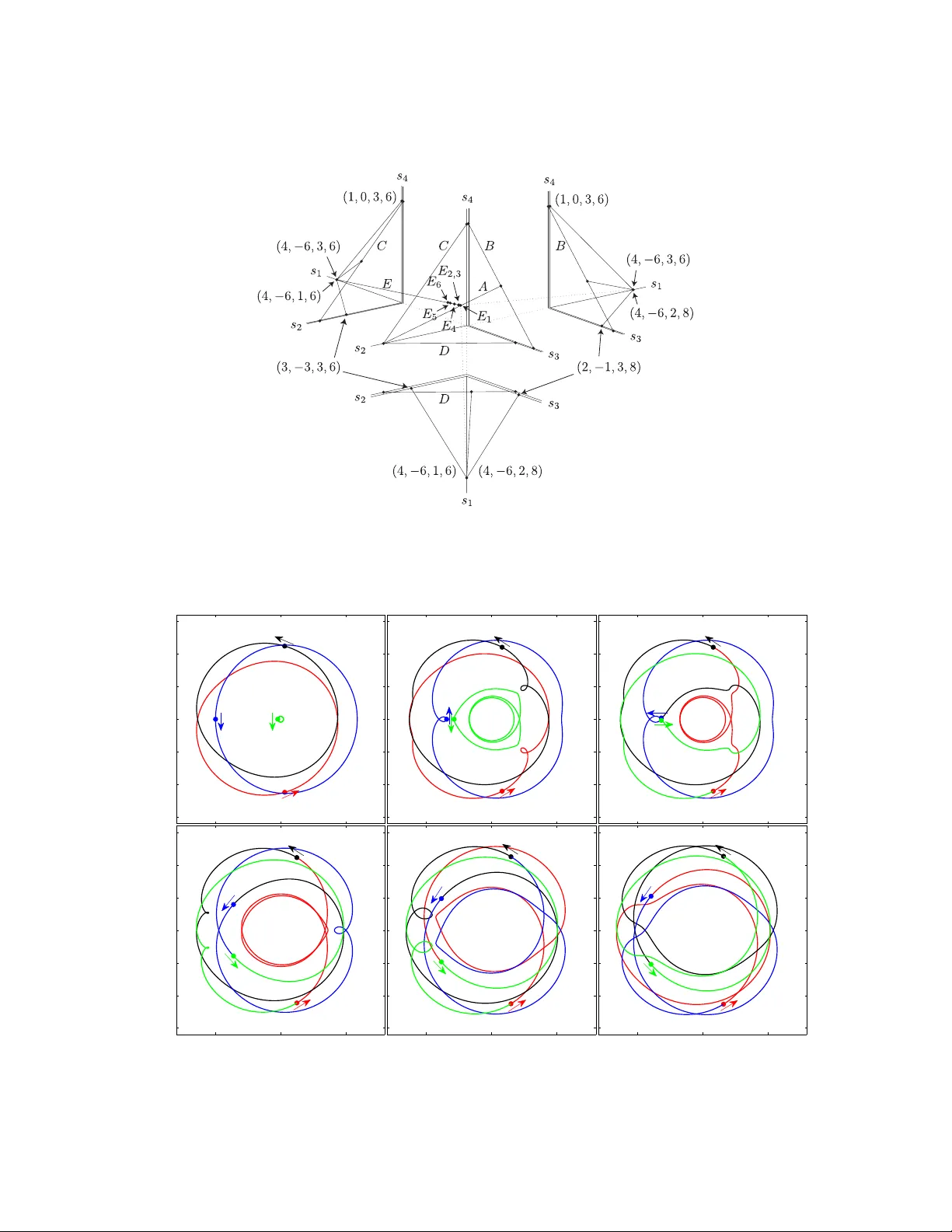
An Infinite Branc hing Hierarc h y of Time-P erio dic Solutions of the Benjamin-Ono Equation Jon Wilk ening ∗ No vem ber 3, 2008 Abstract W e presen t a new representation of solutions of the Benjamin-Ono e quation that are p erio dic in space and time. Up to an additive constant and a Galilean transfor- mation, eac h of these solutions is a previously known, multi-perio dic solution; ho wev er, the new represen tation unifies the subset of suc h solutions with a fixed spatial p erio d and a contin uously v arying temporal perio d in to a single net w ork of smo oth manifolds connected together b y an infinite hierarc hy of bifurcations. Our representation explic- itly describes the ev olution of the F ourier mo des of the solution as w ell as the particle tra jectories in a meromorphic representation of these solutions; therefore, we hav e also solv ed the problem of finding p erio dic solutions of the ordinary differen tial equation go verning these particles, including a description of a bifurcation mechanism for adding or removing particles without destroying p eriodicity . W e illustrate the t yp es of bifurca- tion that o ccur with several examples, including degenerate bifurcations not predicted b y linearization ab out trav eling wa v es. Key w ords. P erio dic solutions, Benjamin-Ono equation, non-linear wa v es, solitons, bifurcation, exact solution AMS sub ject classifications. 35Q53, 35Q51, 37K50, 37G15 1 In tro duction The Benjamin-Ono equation is a mo del w ater w av e equation for the propagation of unidirec- tional, w eakly nonlinear in ternal w av es in a deep, stratified fluid [7, 9, 19]. It is a non-linear, ∗ Departmen t of Mathematics and Lawrence Berkeley National Lab oratory , Universit y of California, Berk eley , CA 94720 ( wilken@math.berkeley.edu ). This work was supp orted in part by the Director, Of- fice of Science, Computational and T echnology Research, U.S. Department of Energy under Contract No. DE-A C02-05CH11231. non-lo cal disp ersiv e equation that, after a suitable c hoice of spatial and temp oral scales, ma y b e written u t = H u xx − uu x , H f ( x ) = 1 π P V Z ∞ −∞ f ( ξ ) x − ξ dξ . (1) Our motiv ation for studying time-p erio dic solutions of this equation w as inspired by the analysis of Plotnik o v, T oland and Io oss [21, 13] using the Nash-Moser implicit function theorem to prov e the existence of non-trivial time p erio dic solutions of the tw o-dimensional w ater wa v e ov er an irrotational, incompressible, inviscid fluid. W e hope to learn more ab out these solutions through direct numerical sim ulation. As a first step, in collab oration with D. Ambrose, the author has developed a numerical contin uation metho d [4, 3] for the computation of time-p erio dic solutions of non-linear PDE and used it to compute families of time-p eriodic solutions of the Benjamin-Ono equation, whic h shares many of the features of the water wa v e such as non-lo calit y , but is muc h less exp ensiv e to compute. Because we came to this problem from the p erspective of dev eloping numerical to ols that can also b e used to study the full w ater wa v e e quation, we did not take adv antage of the existence of solitons or complete integrabilit y in our numerical study of the Benjamin- Ono equation. The purp ose of the current pap er is to bridge this connection, i.e. to show ho w the form of the exact solutions we deduced from n umerical sim ulations is related to previously kno wn, multi-perio dic solutions [22, 10, 16]. Our represen tation is quite differen t, describing time-p eriodic solutions in terms of the tra jectories of the F ourier mo des, whic h are expressed in terms of N particles β j ( t ) moving through the unit disk of the complex plane. Th us, one of the main results of this pap er is to sho w the relationship b et ween the meromorphic solutions describ ed e.g. in [8] and these multi-perio dic solutions. Our represen tation also simplifies the computation and visualization of multi-perio dic solutions. Rather than solve a system of non-linear algebraic equations at each x to find u ( x ) as w as done in [16], we represent u ( x ) through its F ourier co efficien ts by finding the zeros β j of a p olynomial whose coefficients inv olve only a finite num b er of non-zero temporal F ourier mo des. W e find that plotting the tra jectories of the particles β j ( t ) often gives more information ab out the s olution than making movies of u ( x, t ) directly . A key difference in our setup of the problem is that w e wish to fix the spatial p eriod once and for all (using e.g. 2 π ) and desc ribe all families of time-p eriodic solutions in which the temp oral p eriod dep ends contin uously on the parameters of the family . This framework ma y b e p erceiv ed as awkw ard and ov erly restrictive b y some readers, and we agree that the most natural “p erio dic” generalization of the N -soliton solutions [15, 17] of an integrable system such as Benjamin-Ono are the N -phase quasi-p erio dic (or multi-perio dic) solutions [12, 22, 10, 16]. Ho wev er, our goal in this pap er is not to study the b eha vior of these 2 solutions in the long w av e-length limit, but rather to understand how all these families of solutions are connected (con tinuously) together through a hierarch y of bifurcations. The additional restriction of exact p erio dicit y makes the bifurcation problem harder for in te- grable problems, but easier for other problems that can only b e studied n umerically . T o our kno wledge, bifurcation b et ween levels in the hierarch y of m ulti-p erio dic solutions of Benjamin-Ono has not previously b een discussed. Indeed, with the exception of [10], previ- ous representations of these solutions are missing a k ey degree of freedom, the mean, which m ust v ary in order for these solutions to connect with each other. The most in teresting result of this pap er is that counting dimensions of n ullspaces of the linearized problem do es not predict certain degenerate bifurcations that allow for immediate jumps across several lev els of the infinite hierarc h y of time-p erio dic solutions. As a consequence, in our n umerical studies, we found bifurcations from tra veling w av es to the second level of the hierarch y , and in terior bifurcations from these solutions to the third level of the hierarch y , but never saw bifurcations from trav eling w av es directly to the third level of the hierarch y (as we did not kno w where to lo ok for them). This will b e imp ortan t to keep in mind in problems such as the w ater wa ve, where exact solutions are not exp ected to b e found. W e b eliev e we ha v e accounted for all time-p erio dic solutions of the Be njamin-Ono equa- tion with a fixed spatial p erio d, but do not know how to pro ve this. Ev en for the simplest case of a trav eling wa v e, it is surprisingly difficult to prov e that the solitary and perio dic w av es found by Benjamin [7] are the only p ossibilities; see [5] and App endix B. F or the closely related KdV equation [1, 18, 23], substitution of u ( x, t ) = u 0 ( x − ct ) into the equa- tion leads to an ordinary differential equation for u 0 ( x ) with p erio dic solutions in volving Jacobi elliptic functions; see e.g. [20]. How ev er, for Benjamin-Ono, the equation for the tra veling wa ve shap e is non-lo cal due to the Hilb ert transform. Nevertheless, Amic k and T oland [5] ha ve shown that an y tra veling wa ve solution of Benjamin-Ono can b e extended to the upp er half-plane to agree with the real part of a b ounded, holomorphic function satisfying a complex ODE; thus, in spite of non-lo cality , we are able to obtain uniqueness b y solving an initial v alue problem for u 0 ( x ). In terestingly , these tra veling wa v e shap es are rational functions of e ix , which are simpler than the cnoidal solutions of KdV. This analysis of trav eling w av es via holomorphic extension to the upp er half-plane is similar in spirit to the analysis of rapidly decreasing solutions of Benjamin-Ono via the in verse scattering transform [11, 14]. Thus, it may b e p ossible to prov e that we hav e accoun ted for all p eri- o dic solutions of Benjamin-Ono by dev eloping a spatially p erio dic v ersion of the IST that is analogous to the study of Blo c h eigenfunctions and Riemann surfaces for the p eriodic KdV equation [18, 6], but this has not yet b een carried out. This pap er is organized as follo ws. In Section 2, we describ e meromorphic solutions [8] 3 of the Benjamin-Ono equation, whic h are a class of solutions represented by a system of N particles ev olving in the upper half-plane (or, in our represen tation, the unit disk) according to a completely in tegrable ODE. W e also sho w the relationship b et ween the elementary symmetric functions of these particles and the F ourier co efficien ts of the solution, which w ere observed in n umerical exp erimen ts to ha ve tra jectories in the complex plane consisting of epicycles in volving a finite num ber of circular orbits. In Section 3, w e summarize the results of [3] in the form of a theorem (not pro ved in [3]) en umerating all bifurcations from tra veling w a ves to the second lev el of the hierarch y of time-perio dic solutions. The new idea that allows us to pro ve the theorem is to show that all the zeros of a certain p olynomial lie inside the unit circle using Rouch ´ e’s theorem. In Section 4, we state a theorem that parametrizes solutions at lev el M of the hierarc hy through an explicit description of the particle tra jectories β j ( t ). This theorem also describ es the w ay in whic h differen t levels of the hierarch y are connected together through bifurcation. The pro of of this theorem shows the relationship with previous studies of multi-perio dic solutions. In Section 5, we give sev eral examples of degenerate and non-degenerate bifurcations b et ween v arious levels of the hierarch y . W e also use these examples to illustrate some of the top ological changes that o ccur in the particle tra jectories along the paths of solutions b et ween bifurcation states. Finally , in App endix A, we give a direct pro of that the particles β j ( t ) in our formulas lie inside the unit disk in the complex plane; in App endix B, w e discuss uniqueness of trav eling w av e solutions. 2 Meromorphic Solutions and P article T ra jectories In this section, we consider spatially p erio dic solutions of the Benjamin-Ono equation, u t = H u xx − uu x . (2) Here H is the Hilb ert transform defined in (1), which has the symbol ˆ H ( k ) = − i sgn( k ) . It is w ell known [8] that meromorphic solutions of (2) of the form u ( x, t ) = 2 Re ( N X l =1 2 k e ik [ x + k t − x l ( t )] − 1 ) (3) exist, where k is a real wa v e num b er and the particles x l ( t ) evolv e in the upp er half of the complex plane according to the equation dx l dt = N X m =1 m 6 = l 2 k e − ik ( x m − x l ) − 1 + N X m =1 2 k e − ik ( x l − ¯ x m ) − 1 , (1 ≤ l ≤ N ) . (4) 4 This representation is useful for studying the dynamics of solitons of (2) o ver R , whic h may b e obtained from (3) in the long wa v e-length limit k → 0. Ho wev er, ov er a fixed p erio dic domain R 2 π Z , w e hav e found it more conv enien t to w ork with particles β l ( t ) ev olving in the unit disk of the complex plane, β l = e − i ¯ x l ∈ ∆ := { z : | z | < 1 } , (5) where a bar denotes complex conjugation. Up to an additive constan t and a Galilean transformation, the solution u in (3) ma y then b e written u ( x, t ) = α 0 + N X l =1 u β l ( t ) ( x ) , (6) where w e hav e included the mean α 0 as an additional parameter of the solution and u β ( x ) is defined via u β ( x ) = 4 | β |{ cos( x − θ ) − | β |} 1 + | β | 2 − 2 | β | cos( x − θ ) , β = | β | e − iθ . (7) F rom (4) or direct substitution into (2), the β l are readily shown to satisfy ˙ β l = N X m =1 m 6 = l 2 i β − 1 l − β − 1 m + N X m =1 2 iβ 2 l β l − ¯ β − 1 m + i (1 − α 0 ) β l , (1 ≤ l ≤ N ) . (8) It is awkw ard to work with u β ( x ) in physical space; how ev er, in F ourier space, it takes the simple form ˆ u β ,k = 2 ¯ β | k | , k < 0 , 0 , k = 0 , 2 β k , k > 0 . (9) As a result, the F ourier co efficients c k ( t ) of u ( x, t ) in (6) are simply p ow er sums of the particle tra jectories, c k ( t ) = α 0 k = 0 , 2 β k 1 ( t ) + · · · + β k N ( t ) , k > 0 , (10) where c k = ¯ c − k for k < 0. In [3], it was found n umerically that although the β l often execute v ery complicated p erio dic orbits, the elementary symmetric functions σ j defined via σ 0 = 1 , σ j = X l 1 < ··· 0. W e can solve for c and α 0 in terms of the p eriod T > 0 and a sp eed index ν ∈ Z indicating how man y incremen ts of 2 π N the wa v e mov es to the right in one p eriod: cT = 2 π ν N , α 0 = c + N 1 − 3 | β | 2 1 − | β | 2 . (19) In order to bifurcate to a non-trivial time-p erio dic solution, the p erio d T m ust b e related to an eigenv alue ω N ,n = ( n )( N − n ) , 1 ≤ n ≤ N − 1 , ( n + 1 − N ) h n + 1 + N 1 − 1 − 3 | β | 2 1 −| β | 2 i , n ≥ N (20) of the linear op erator [3] go verning the evolution of solutions of the linearization ab out the N -h ump stationary solution: ω N ,n T = 2 π m N , 1 ≤ m ∈ nν + N Z , 1 ≤ n < N , ( n + 1) ν + N Z , n ≥ N . (21) This requirement on the oscillation index m enforces the condition that the linearized solu- tion ov er the stationary solution return to a phase shift of itself to account for the fact that the tra veling wa v e has mo ved during this time; see [3]. Here w e hav e used the fact that if u ( x, t ) = u N ,β ( x ) is a stationary solution and U ( x, t ) = u ( x − ct, t ) + c (22) 7 is a trav eling w av e, then the solutions v and V of the linearizations ab out u and U , re- sp ectiv ely , satisfy V ( x, t ) = v ( x − ct, t ). The parameter β together with the four integers ( N , ν, n, m ) enumerate the bifurcations from tra veling w av es, which comprise the first lev el of the hierarch y of time-p eriodic solutions of the Benjamin-Ono equation, to the second lev el of this hierarc hy . W e will see later that other bifurcations from trav eling wa ves to higher levels of the hierarch y also exist, which is interesting as they are not predicted from coun ting dimensions of n ullspaces in the linearization. After (n umerically) mapping out whic h bifurcations ( N , ν, n, m ) and ( N 0 , ν 0 , n 0 , m 0 ) w ere connected b y paths of non-trivial solutions, it was found that N , N 0 , ν and ν 0 can b e c hosen indep enden tly as long as N 0 < N , ν 0 > N 0 N ν. (23) The other parameters are then given by m = m 0 = N ν 0 − N 0 ν > 0 , n = N − N 0 , n 0 = N − 1 . (24) The follo wing theorem pro ves that these numerical conjectures are correct. Theorem 1 L et N , N 0 , ν and ν 0 b e inte gers satisfying N > N 0 > 0 and m = N ν 0 − N 0 ν > 0 . Ther e is a four-p ar ameter family of time-p erio dic solutions c onne cting the tr aveling wave bifur c ations ( N 0 , ν 0 , N − 1 , m ) and ( N , ν, N − N 0 , m ) . These solutions ar e of the form u ( x, t ) = α 0 + N X l =1 u β l ( t − t 0 ) ( x − x 0 ) , (25) wher e β 1 ( t ) , . . . , β N ( t ) ar e the r o ots of the p olynomial P ( · , e − iω t ) define d by P ( z , λ ) = z N + Aλ ν 0 z N − N 0 + B λ ν − ν 0 z N 0 + C λ ν , (26) with A = r N − N 0 + s + s 0 N + s + s 0 s ( N + s 0 ) s 0 N 0 ( N − N 0 ) + ( N + s 0 ) s 0 , (27) B = s ( N + s 0 ) s 0 N 0 ( N − N 0 ) + ( N + s 0 ) s 0 r s N − N 0 + s , C = r s N − N 0 + s r N − N 0 + s + s 0 N + s + s 0 , α 0 = N 2 ν 0 − ( N 0 ) 2 ν m − 2 s − 2 N 0 ( ν 0 − ν ) m s 0 , ω = 2 π T = N 0 ( N − N 0 )( N + 2 s 0 ) m . The four p ar ameters ar e s ≥ 0 , s 0 ≥ 0 , x 0 ∈ R and t 0 ∈ R . The N - and N 0 -hump tr aveling waves o c cur when s 0 = 0 and s = 0 , r esp e ctively. When b oth ar e zer o, we obtain the c onstant solution u ( x, t ) ≡ N 2 ν 0 − ( N 0 ) 2 ν m . 8 Proof : Without loss of generality , we may assume x 0 = 0 and t 0 = 0. It was shown in [3] that P ( z , λ ) of the form (26) satisfies (15) if γ = (3 N − α 0 ) N − ν ω, (28) [( N 0 ) 2 − 2 N N 0 + N 0 α 0 − ν 0 ω ] B + [( N 0 ) 2 + 2 N N 0 − N 0 α 0 + ν 0 ω ] AC = 0 , (29) 3 N 2 − 4 N N 0 + ( N 0 ) 2 − ( N − N 0 ) α 0 + ( ν − ν 0 ) ω B C − N 2 − ( N 0 ) 2 − ( N − N 0 ) α 0 + ( ν − ν 0 ) ω A = 0 , (30) ( N α 0 − ν ω − N 2 ) + (2 N 0 − N ) α 0 + ( ν − 2 ν 0 ) ω + 3 N 2 − 8 N N 0 + 4( N 0 ) 2 B 2 + ( N − 2 N 0 ) α 0 + 4( N 0 ) 2 − N 2 + (2 ν 0 − ν ) ω A 2 + (3 N − α 0 ) N + ν ω C 2 = 0 . (31) Using a computer algebra system, it is easy to c heck that (29)–(31) hold when A , B , C , α 0 and ω are defined as in (27). When s 0 = 0, w e hav e A = B = 0 and C = r s N + s so that β l ( t ) = N √ − C λ ν = N √ − C e − ict , c = ω ν N = N 0 ( N − N 0 ) ν m = α 0 − N 1 − 3 C 2 1 − C 2 , where eac h β l is assigned a distinct N th ro ot of − C . By (17), this is an N -hump tra veling w av e with sp eed index ν and p eriod T = 2 π ω . Similarly , when s = 0, we hav e B = C = 0 and A = r s 0 N 0 + s 0 so that β l ( t ) = ( N 0 √ − Ae − ict l ≤ N 0 0 l > N 0 ) , c = ω ν 0 N 0 = ( N − N 0 )( N + 2 s 0 ) ν 0 m = α 0 − N 0 1 − 3 A 2 1 − A 2 , whic h is an N 0 -h ump trav eling wa v e with sp eed index ν 0 and p eriod T = 2 π ω . Finally , w e show that the ro ots of P ( · , λ ) are inside the unit disk for an y λ on the unit circle, S 1 . W e will use Rouc h´ e’s theorem [2]. Let f 1 ( z ) = z N + Aλ ν 0 z N − N 0 + B λ ν − ν 0 z N 0 + C λ ν , f 2 ( z ) = z N + Aλ ν 0 z N − N 0 , f 3 ( z ) = z N + B λ ν − ν 0 z N 0 . F rom (27), w e see that { A, B , C } ⊆ [0 , 1), A ≥ B C , B ≥ C A and C ≥ AB . Thus, d 2 ( z ) := | f 2 ( z ) | 2 − | f 1 ( z ) − f 2 ( z ) | 2 = | λ − ν 0 z N 0 + A | 2 − | B λ − ν 0 z N 0 + C | 2 = 1 + A 2 − B 2 − C 2 + 2( A − B C ) cos θ ≥ (1 − A ) 2 − ( B − C ) 2 , (32) where λ − ν 0 z N 0 = e iθ . Similarly , d 3 := | f 3 ( z ) | 2 − | f 1 ( z ) − f 3 ( z ) | 2 ≥ (1 − B ) 2 − ( A − C ) 2 . (33) 9 Note that B ≤ A, C ≤ B ⇒ B − C ≤ B − AB < 1 − A ⇒ d 2 ( z ) > 0 for z ∈ S 1 , B ≤ A, C > B ⇒ | C − A | < 1 − B ⇒ d 3 ( z ) > 0 for z ∈ S 1 , A ≤ B , C ≤ A ⇒ A − C ≤ A − AB < 1 − B ⇒ d 3 ( z ) > 0 for z ∈ S 1 , A ≤ B , C > A ⇒ | C − B | < 1 − A ⇒ d 2 ( z ) > 0 for z ∈ S 1 . Th us, in all cases, f 1 ( z ) = P ( z , λ ) has the same num b er of zeros inside S 1 as f 2 ( z ) or f 3 ( z ), whic h each hav e N roots inside S 1 . Since f 1 ( z ) is a p olynomial of degree N , all the ro ots are inside S 1 . 4 An infinite hierarc h y of in terior bifurcations Next we wish to find all p ossible cascades of interior bifurcations from these already non- trivial solutions to more and more complicated time-p erio dic solutions. The most interesting consequence of the following theorem is that there are some trav eling wa v es with more bifurcations to non-trivial time-perio dic solutions than predicted b y coun ting the dimension of the kernel of the linearization of the map measuring deviation from time-p erio dicit y . This will b e illustrated in v arious examples in Section 5. Theorem 2 L et M ≥ 2 b e an inte ger and cho ose k 1 , . . . , k M ∈ N , (p ositive inte gers, not ne c essarily distinct or monotonic), ν 1 , . . . , ν M ∈ Z , (arbitr ary inte gers satisfying ν j − 1 < k j − 1 k j ν j for j ≥ 2 ) . Now define the p ositive quantities m j = k j − 1 ν j − k j ν j − 1 , τ j = k j ( k j + k j − 1 ) k j − 1 m j , γ j = 2 k j k j − 1 m j , (2 ≤ j ≤ M ) . (34) L et J = argmax 2 ≤ j ≤ M τ j . If ther e is a tie, J c an b e any of the c andidates. Then ther e is an M + 2 p ar ameter family of time-p erio dic solutions of the Benjamin-Ono e quation p ar ametrize d by s 1 ≥ 0 , s J ≥ 0 , x j 0 ∈ R , (1 ≤ j ≤ M ) (35) and c onstructe d as fol lows. First, we define s j = τ J − τ j γ j + γ J γ j s J , (2 ≤ j ≤ M , j 6 = J ) , (36) q 1 = s 1 , p 1 = s 1 + k 1 , q j = p j − 1 + s j , p j = q j + k j , (2 ≤ j ≤ M ) (37) 10 so that s j ≥ 0 for 1 ≤ j ≤ M and 0 s 1 ≤ q 1 k 1 < p 1 s 2 ≤ q 2 k 2 < · · · s M − 1 " " ≤ q M − 1 k M − 1 $ $ < p M − 1 s M " " ≤ q M k M ! ! < p M . (38) F or any subset S of M = { 1 , . . . , M } , we denote the c omplement by S 0 = M \ S and define k S = X j ∈ S k j , ν S 0 = X m ∈ S 0 ν m , C S = Y ( j,m ) ∈ S × S 0 a j m ! Y m ∈ S 0 b m ! , (39) wher e a j m = s ( p m − q j )( q m − p j ) ( q m − q j )( p m − p j ) , b m = r q m p m e − ik m x m 0 . (40) Then u ( x, t ) = α 0 + N X l =1 u β l ( t ) ( x ) (41) is a p erio dic solution of the Benjamin-Ono e quation, wher e N = k M = P M j =1 k j , α 0 = 2 N − k 1 + ν 1 k 1 τ J − 2 s 1 + ν 1 k 1 γ J s J , ω = 2 π T = τ J + γ J s J , (42) and β 1 ( t ) , . . . , β N ( t ) ar e the r o ots of the p olynomial z 7→ P ( z , e − iω t ) given by P ( z , λ ) = X S ∈P ( M ) C S λ ν S 0 z k S . (43) When M = 2 , this r epr esentation c oincides with that of The or em 1 if we set k 1 = N − N 0 , ν 1 = ν − ν 0 , s 1 = s, x 10 = x 0 − ν 1 k 1 ω t 0 , k 2 = N 0 , ν 2 = ν 0 , s 2 = s 0 , x 20 = x 0 − ν 2 k 2 ω t 0 . It r e duc es to a tr aveling wave when s = 0 or s 0 = 0 and to a c onstant solution when b oth ar e zer o. Similarly, when M ≥ 3 , the solution r e duc es to a simpler solution in this same hier ar chy (with M r eplac e d by f M = M − 1 ) when s 1 or s J r e aches zer o. Sp e cific al ly, if s 1 = 0 , then P ( z , λ ) = z k 1 e P ( z , λ ) , wher e e P ( z , λ ) c orr esp onds to the p ar ameters ˜ k j = k j +1 , ˜ ν j = ν j +1 , ˜ s j = s j +1 , ˜ x j 0 = x j +1 , 0 , (1 ≤ j ≤ f M ) . (44) We interpr et this as an annihilation of k 1 p articles β l at the origin. If s J = 0 , we have P ( z , λ ) = e P ( z , λ ) , wher e ˜ k j = k j , ˜ ν j = ν j , ˜ s j = s j , ˜ x j 0 = x j 0 , (1 ≤ j ≤ J − 2) , ˜ k j = k j + k J , ˜ ν j = ν j + ν J , ˜ s j = s j , ˜ x j 0 = k j x j 0 + k J x J 0 k j + k J , ( j = J − 1) , ˜ k j = k j +1 , ˜ ν j = ν j +1 , ˜ s j = s j +1 , ˜ x j 0 = x j +1 , 0 , ( J ≤ j ≤ f M ) . (45) 11 If sever al s j ar e zer o when s J = 0 (i.e. if a tie o c curs when cho osing J = argmax 2 ≤ j ≤ M τ j ), the bifur c ation is de gener ate and any subset of the indic es for which s j = 0 may b e r emove d using the rule (45) r ep e ate d ly (onc e for e ach index r emove d, with J r anging over these indic es in r everse or der to avoid r e-lab eling), al lowing for bifur c ations that jump sever al levels in the hier ar chy at onc e. Proof : Rather than sho w directly that P ( z , λ ) in (43) satisfies (15), we sho w that each of our solutions differs from a multi-perio dic solution [22, 16] by at most a transformation of the form (22). W e give a direct pro of that all the zeros of P ( · , λ ) lie inside the unit circle in App endix A as concluding this from the combined results of [10] and [16] is complicated. If all the inequalities in (38) are strict, then it is known [16] that U = 2 i ∂ ∂ x log f 0 f (46) satisfies the Benjamin-Ono equation (2) with f 0 = X µ =0 , 1 exp M X j =1 µ j iθ j − φ j − 1 2 M X m 6 = j A j m + ( M ) X j 0 whenever s J > 0. F rom α 0 = c + 2 N , c = − c 1 + ν 1 k 1 ω , c 1 = k 1 + 2 s 1 , ω = τ J + γ J s J , (60) w e obtain the form ulas in (42) for α 0 and ω . 13 Finally , w e drop the assumption that the inequalities in (38) are strict and observe what happ ens to these solutions when s 1 = 0 or s J = 0. If s 1 = 0, then b 1 = 0, so 1 6∈ S ⇒ C S = 0 , 1 ∈ S ⇒ C S = Y ( j,m ) ∈ ( S \{ 1 } ) × S 0 a j m ! Y m ∈ S 0 a 1 m b m ! . But since q 1 = 0 and p 1 = k 1 when s 1 = 0, w e hav e a 1 m b m = s ( p m − q 1 )( q m − p 1 ) ( q m − q 1 )( p m − p 1 ) r q m p m e − ik m x m 0 = s q m − k 1 p m − k 1 e − ik m x m 0 . (61) Th us, if we define f M = M − 1 and shift indices down as in (44), the parameters q j and p j will decrease by k 1 as illustrated here, 0 s 1 =0 ! ! = q 1 k 1 ! ! < p 1 s 2 ! ! < q 2 k 2 ! ! < p 2 s 3 ! ! ≤ q 3 k 3 ! ! < · · · s M $ $ ≤ q M k M % % < p M 0 ˜ s 1 = s 2 ; ; ≤ ˜ q 1 ˜ k 1 = k 2 ; ; < ˜ p 1 ˜ s 2 = s 3 ; ; ≤ ˜ q 2 ˜ k 2 = k 3 = = < · · · ˜ s M − 1 = s M 9 9 ≤ ˜ q M − 1 ˜ k M − 1 = k M 7 7 < ˜ p M − 1 (62) and hence ˜ a j m = a j +1 ,m +1 and ˜ b m = a 1 ,m +1 b m +1 for 1 ≤ j, m ≤ f M , j 6 = m . Therefore, with the notation e S 0 = f M \ e S , the only difference b et ween P ( z , λ ) = X S ∈P ( M ) , 1 ∈ S C S λ ν S 0 z k S , e P ( z , λ ) = X e S ∈P ( f M ) e C e S λ ˜ ν e S 0 z ˜ k e S , is that each term in the former sum carries an extra factor of z k 1 when the sets S and e S are matc hed up in the natural wa y . Thus P ( z , λ ) = z k 1 e P ( z , λ ). No w consider the case s J = 0 with J = argmax 2 ≤ j ≤ M τ j . This time a J − 1 ,J = 0 due to q J = p J − 1 , so C S = 0 unless J − 1 and J are b oth in S or b oth in S 0 . Let us define P J ( M ) = { S ∈ P ( M ) : J − 1 , J ∈ S or J − 1 , J ∈ S 0 } . (63) When we perform the sum ov er S ∈ P J ( M ) to construct P ( z , λ ), w e can consider J − 1 and J as a single unit. The follo wing factors alwa ys app ear together in an y C S that con tains one of them: a J − 1 ,m a J m = s ( p m − q J − 1 )( q m − p J ) ( q m − q J − 1 )( p m − p J ) , b J − 1 b J = r q J − 1 p J e − ik J − 1 x J − 1 , 0 e − ik J x J 0 . Th us we can remov e p J − 1 and q J from the sequence if we short circuit the diagram 0 s 1 ≤ q 1 k 1 < p 1 s 2 ≤ · · · s J − 1 ! ! ≤ q J − 1 k J − 1 # # < p J − 1 s J =0 ! ! = q J k J ! ! < p J s J +1 # # ≤ q J +1 k J +1 < · · · s M " " ≤ q M k M $ $ < p M 0 s 1 _ _ ≤ ˜ q 1 k 1 > > < ˜ p 1 s 2 A A ≤ · · · s J − 1 ; ; ≤ ˜ q J − 1 ˜ k J − 1 = k J − 1 + k J 4 4 < ˜ p J − 1 ˜ s J = s J +1 : : ≤ ˜ q J ˜ k J > > < · · · ˜ s M − 1 : : ≤ ˜ q M − 1 ˜ k M − 1 9 9 < ˜ p M − 1 14 and set ˜ k J − 1 = k J − 1 + k J , ˜ ν J − 1 = ν J − 1 + ν J , ˜ x J − 1 , 0 = k J − 1 x J − 1 , 0 + k J x J 0 k J − 1 + k J . (64) The other parameters are simply copied from the original sequence as w as indicated in (45). W e then ha ve P ( z , λ ) = X S ∈P J ( M ) C S λ ν S 0 z k S = X e S ∈P ( f M ) e C e S λ ˜ ν e S 0 z ˜ k e S = e P ( z , λ ) , where again the sets S and e S in these sums are in natural 1-1 corresp ondence. Finally , we v erify that the parameters ˜ k j , ˜ s j and ˜ ν j of the reduced system are consistent with the construction, i.e. if f M ≥ 2 and w e define ˜ J = argmax 2 ≤ j ≤ f M ˜ τ j , then ˜ s j = ˜ τ ˜ J − ˜ τ j ˜ γ j + ˜ γ ˜ J ˜ γ j ˜ s ˜ J , (2 ≤ j ≤ f M , j 6 = ˜ J ) . (65) Recall that these equations are obtained b y eliminating ˜ c and ˜ ω from ˜ k j (˜ c + ˜ c j ) = ˜ ν j ˜ ω, (1 ≤ j ≤ f M ) . (66) In the first case where s 1 = 0, (44) and (53) together with ˜ c j = ˜ p j + ˜ q j = c j +1 − 2 k 1 , (1 ≤ j ≤ f M ) (67) imply that (66) is satisfied if w e define ˜ c = c + 2 k 1 , ˜ ω = ω . (68) Since w e annihilate k 1 particles in this case, e N = N − k 1 , and the mean ˜ α 0 = ˜ c + 2 e N = c + 2 N = α 0 (69) remains unchanged in spite of the change in c and N (as it must for the solution to v ary con tinuously through the bifurcation). In the remaining case where s J = 0, w e hav e ˜ c j = c j , j < J − 1 , c j + k J = c J − k j , j = J − 1 , c j +1 , J ≤ j ≤ f M . (70) Th us, by (45) and (53), all the equations in (66), except p ossibly j = J − 1, are trivially satisfied if we define ˜ c = c, ˜ ω = ω . (71) 15 The remaining equation is ( k J − 1 + k J )( c + c J − 1 + k J ) = ( ν J − 1 + ν J ) ω . (72) T o see that this is true, note that by (53), k J − 1 ( c + c J − 1 ) = ν J − 1 ω , k J ( c + c J ) = ν J ω . (73) Adding these equations and using k J c J = k J ( c J − 1 + k J − 1 + k J ) giv es (72), as required. Since ˜ c = c and e N = N , the mean α 0 = c + 2 N do es not change as a result of the bifurcation. Th us, we hav e shown that when s 1 = 0 or s J = 0, the function u ( x, t ) in (41) agrees with another function in the hierarch y with M reduced by one and the parameter s 1 or s J remo ved. Con tinuing in this fashion, we can remov e all the zero indices, even tually yielding the case where the p j and q j are distinct from one another, or the case that M ∈ { 0 , 1 } . This sho ws that u ( x, t ) is a solution of (2), where we rely on Theorem 1 to handle the reduction from M = 2 to the trav eling wa v e case M = 1, or the constan t solution case M = 0. 5 Examples In this section we present several examples to illustrate the t yp es of bifurcation that o ccur in the hierarch y of time-perio dic solutions described in Theorem 2. W e begin with the simplest example that leads to a degenerate bifurcation, namely M = 3 , ~ k = (1 , 1 , 1) , ~ ν = ( − 2 , − 1 , 0) . (74) This solution and the three M = 2 solutions connected to it ha ve parameters shown in Figure 1. W e hold the mean α 0 = 0 . 544375 fixed, whic h is the v alue used in several of the n umerical simulations in [4, 3], and construct a single bifurcation diagram showing all four solutions; see Figure 2. Note that paths B,C,D are actually parametrized by ˜ s ( B ) 1 = s 2 , ˜ s ( B ) 2 = s 3 , ˜ s ( C ) 1 = s 1 , ˜ s ( C ) 2 = s 3 , ˜ s ( D ) 1 = s 1 , ˜ s ( D ) 2 = s 2 (75) in formulas (34)–(43), but w e use the original v ariables s j here for the con venience of making a single bifurcation diagram. The one confusing asp ect of doing this is that we obtain different tra veling w av es dep ending on the order in which w e set the s j to zero. This is why we drew tw o axes for s 2 and s 3 in Figure 2. F or example, if we start on path A and decrease s 1 to zero (mo ving to path B) and then decrease s 3 to zero, we obtain the tra v eling w av e bifurcation (2 , − 1 , 1 , 1); how ever, if w e first set s 3 = 0 (mo ving to path D) and then set s 1 = 0, w e obtain the bifurcation (2 , − 1 , 2 , 3). Both trav eling wa ves ha ve N = 2 humps and sp eed index ν = − 1, but the amplitude and p eriod of the tw o solutions are differen t as 16 path A path B path C path D k = 1 , 1 , 1 , k = 1 , 1 , k = 2 , 1 , k = 1 , 2 , ν = − 2 , − 1 , 0 , ν = − 1 , 0 , ν = − 3 , 0 , ν = − 2 , − 1 , m = 1 , 1 , m = 1 , m = 3 , m = 3 , τ = 2 , 2 , τ = 2 , τ = 2 , τ = 2 , γ = 2 , 2 , γ = 2 , γ = 4 / 3 , γ = 4 / 3 , s 3 = s 2 , s 1 = 0 , s 2 = 0 , s 3 = 0 , α 0 = 1 − 2 s 1 − 4 s 2 , α 0 = 1 − 2 s 2 − 2 s 3 , α 0 = 1 − 2 s 1 − 2 s 3 , α 0 = 1 − 2 s 1 − 8 3 s 2 , ω = 2 + 2 s 2 , ω = 2 + 2 s 3 , ω = 2 + 4 3 s 3 , ω = 2 + 4 3 s 2 . Figure 1: Parameters of four paths of time-p erio dic solutions connected by bifurcations. they ha ve different bifurcation indices. Similarly , although starting on path A and setting s 2 and s 3 to zero in either order leads to the same stationary solution, the p eriod T is differen t dep ending on whether we follow path B to (1 , 0 , 1 , 1) or path C to (1 , 0 , 2 , 3). This only happ ens at the b ottom ( f M = 1) lev el of the hierarch y , where ˜ k 1 , ˜ ν 1 and ˜ s 1 are not sufficien t to uniquely determine the tra veling wa v e; if we start with M ≥ 4 and follow tw o paths do wn several levels to f M ≥ 2 with the same parameters ˜ k j , ˜ ν j and ˜ s j , the resulting solution is indep enden t of the path. In Figure 3, we plot the particle tra jectories of several solutions on paths C, D and A in the bifurcation diagram of Figure 2. W e parametrize each path linearly b y a v ariable θ ∈ [0 , 1]. F or example, on path A, s 1 = 1 − α 0 2 θ , s 2 = s 3 = 1 − α 0 4 (1 − θ ) , 0 ≤ θ ≤ 1 . (76) P ath C connects the one-h ump stationary solution to the three-h ump tra v eling wa v e. When θ = 4 . 0 × 10 − 6 , tw o particles hav e nucleated at the origin and execute small, nearly circular orbits around each other while the third particle trav els around its original resting p osition. As θ increases, the orbits deform and coalesce in to a single path, as shown in the middle t wo panels of this row. At the critical v alue θ = 0 . 002649485, the particles collide at t = T / 6, t = 3 T / 6 and t = 5 T / 6, so the solution of the ODE (8) ceases to exist for all time; nevertheless, u ( x, t ) in (41) remains smo oth and satisfies (2) for all t . As θ increases to 1, the common tra jectory of the three particles b ecomes more and more circular until the trav eling w av e is reached, where it is exactly circular. The solutions on this path are 17 Figure 2: L eft: degenerate bifurcation from M = 1 to M = 2 (paths C and D) and M = 3 (path A) with α 0 held fixed. Right: three dimensional plot of the solution lab eled D4. −0.6 −0.4 −0.2 0 0.2 0.4 0.6 C1 θ = 0.000004 particle trajectories Im(z) C2 θ = 0.0026 particle trajectories C3 θ = 0.0028 particle trajectories C4 θ = 0.5 particle trajectories −0.6 −0.4 −0.2 0 0.2 0.4 0.6 D1 θ = 0.001 Im(z) D2 θ = 0.04 D3 θ = .0435 D4 θ = 0.5 −0.5 0 0.5 −0.6 −0.4 −0.2 0 0.2 0.4 0.6 A1 θ = 0.0005 Re(z) Im(z) −0.5 0 0.5 A2 θ = 0.0175 Re(z) −0.5 0 0.5 A3 θ = 0.0625 Re(z) −0.5 0 0.5 A4 θ = 0.5 Re(z) Figure 3: Particle tra jectories along paths C,D,A in the bifurcation diagram of Figure 2. 18 reducible in the sense that their natural p erio d is 1 / 3 of the p erio d T used here. Ho w ever, in order to bifurcate to paths A and D, we ha v e to use this solution rather than the reduced solution. P ath D connects the tw o-h ump tra veling wa v e with sp eed index ν = − 1 to the three- h ump trav eling wa v e with sp eed index ν = − 3. When we bifurcate from the t wo-h ump tra veling wa ve, a new particle n ucleates at the origin and gro ws in amplitude until its tra jectory joins up with the orbits of the outer particles. As θ increases further, the three orbits b ecome nearly circular and ev entually coalesce in to a single circular orbit at the three-h ump tra veling wa v e. Note that the particles on path D follow different tra jectories, whic h leads to a “braided” effect in the p eaks and troughs of the solution u ( x, t ) shown in Figure 2; unlike path C, these solutions are not reducible to a shorter p erio d. P ath A connects an interior bifurcation on path B to this same three-h ump tra veling w av e. When θ = 0 . 0005, a particle has nucleated at the origin without destro ying the p eriodicity of the orbit of the other t w o particles. This path in v olves tw o top ological c hanges in the particle tra jectories, as sho wn in the middle t w o panels of the b ottom ro w of Figure 3. As θ → 1, this solution also approac hes the three-hump trav eling wa v e. This is interesting b ecause, up to a phase shift in space and time, the linearized Benjamin-Ono equation ab out this tra veling w av e [3] has only tw o linearly indep enden t, time-p eriodic solutions corresp onding to the bifurcations (3 , − 3 , 1 , 3) and (3 , − 3 , 2 , 3); this degenerate bifurcation is not predicted by linear theory . In a similar w ay , we can construct a bifurcation from a trav eling w av e to an arbitrary lev el of the hierarc hy by taking M arbitrary , ~ k = (1 , 1 , . . . , 1) , ν = ( − M , − M + 1 , . . . , − 2 , − 1 , 0) . (77) W e find that m j = 1, τ j = 2 and γ j = 2 for 2 ≤ j ≤ M , so any subset of the indices J = 2 , . . . , M can b e remo ved to obtain a solution at a low er level of the hierarch y . If all the indices are remov ed, we obtain a trav eling wa v e with 2 M − 1 − 1 bifurcations to higher lev els of the hierarch y , but only M − 1 of them (to the second level) are predicted b y linear theory . The case M = 4 is depicted in the bifurcation diagram of Figure 4, where each tetrahedron contains paths with one of the s j set to zero, and the outermost p oin t of the outer three tetrahedra corresp onds to one and the same tra veling wa v e. Linear theory predicts the bifurcations (4 , − 6 , 1 , 6), (4 , − 6 , 2 , 8), (4 , − 6 , 3 , 6) from this trav eling wa v e to the M = 2 level of the hierarch y , but do es not predict the three M = 3 families of solutions that connect this trav eling wa v e to in terior bifurcations on paths B, C and D, nor the M = 4 solution connecting this trav eling w av e to path A from the previous example. In Figure 5, we show six solutions on this M = 4 path lab eled E in the bifurcation diagram. 19 Figure 4: Degenerate bifurcation from M = 1 to M = 2 , 3 , 4 with α 0 held fixed. −0.75 −0.5 −0.25 0 0.25 0.5 0.75 E1 θ = .0002 particle trajectories E2 θ = .0155 particle trajectories E3 θ = .016 particle trajectories −0.5 0 0.5 −0.75 −0.5 −0.25 0 0.25 0.5 0.75 E4 θ = .05 −0.5 0 0.5 E5 θ = .0815 −0.5 0 0.5 E6 θ = 0.1 Figure 5: Particle tra jectories along path E in the bifurcation diagram of Figure 4. 20 −0.5 0 0.5 −1 −0.5 0 0.5 1 F1 θ = 0.3 particle trajectories −0.5 0 0.5 F2 θ = 0.43 particle trajectories −0.5 0 0.5 F3 θ = 1.0 particle trajectories Figure 6: L eft: Bifurcation diagram sho wing a path of time-p eriodic solutions at level M = 3 connecting tw o M = 2 solutions. Right: Three solutions on this path. When θ = 0 + , (where path E meets path A), a fourth particle nucleates at the origin without destro ying p erio dicit y of the other three. As θ increases to 1, the tra jectories of the particles β j ( t ) undergo sev eral top ological changes (that determine whic h particles exc hange p ositions o ver one p eriod) un til the tra jectories coalesce into a single circular orbit at the degenerate tra v eling w a ve (with eac h particle mo ving coun ter-clo ckwise one and a half times p er p erio d). Finally , in Figure 6, w e show a path of solutions at level M = 3 that connects t wo M = 2 solutions by interior (non-degenerate) bifurcations. The parameters of this path are M = 3 , ~ k = (1 , 1 , 1) , ~ ν = ( − 2 , 0 , 1) . (78) W e parametrize this path b y s 1 = θ 2 , s 2 = 3 − θ 2 , s 3 = 1 − θ 4 , (0 ≤ θ ≤ 1) . (79) When θ = 0, we obtain the M = 2 family of solutions that bifurcates from a tw o-hump, righ t trav eling wa v e with indices (2 , 1 , 1 , 1). F or this family of solutions, the mean is related to the parameters ˜ s 1 = s 2 and ˜ s 2 = s 3 via α 0 = 3 − 2 s 2 ; hence, holding the mean fixed requires that s 2 remains constant. W e will not reach the one-h ump, righ t trav eling wa v e at the bifurcation (1 , 1 , 1 , 1) unless w e increase α 0 to 3. As w e increase θ in (79), the tra jectory of the particle that n ucleates at the origin at θ = 0 + gro ws and merges with the tra jectories of the original tw o particles through three top ological c hanges: one at F1, one not shown, and one at F3. Ev entually , when θ = 1, path F joins path G connecting (2 , 1 , 2 , 5) to (3 , − 1 , 1 , 5). Since the tw o-hump tra veling wa v e mov es to the right while the three-h ump tra veling wa v e mov es to the left, the solution at F3 inv olv es particles mo ving clo ckwise for part of their orbit and coun ter-clo c kwise at other times, leading to an interesting three- particle tra jectory with 5-fold symmetry . 21 A Zeros of the p olynomial P ( · , λ ) As men tioned in the proof of Theorem 2, there is a small gap in the pap er [22] sho wing that the multiperio dic solutions (46) satisfy the Benjamin-Ono equation, for the bilinear formalism used to deriv e these solutions requires that the zeros of f (or f 0 ) in (47) and (48) lie in the upp er (or low er) half of the complex plane. In this app endix, we prov e the equiv alent assertion (in the case that all the k i are in tegers) that the zeros of the polynomial P ( · , λ ) in (43) lie inside the unit disk. The tw o key ideas of this pro of, namely showing that P (or f ) has a representation as a determinant, and that the matrix is non-singular for | z | ≥ 1, are essen tially due to Matsuno [16] and Dobrokhotov/Kric hev er [10], resp ectiv ely . Theorem 3 Supp ose M ≥ 2 , k 1 , . . . , k M ∈ N , ν 1 , . . . , ν M ∈ R , x 10 , . . . , x M 0 ∈ R , and 0 < q 1 < p 1 < q 2 < p 2 < · · · < q M < p M . (80) L et M = { 1 , . . . , M } and define the p olynomial P ( z , λ ) = X S ∈P ( M ) C S λ ν S 0 z k S , C S = Y ( i,j ) ∈ S × S 0 a ij ! Y j ∈ S 0 b j ! , (81) wher e S 0 = M \ S , k S = P i ∈ S k i , ν S 0 = P j ∈ S 0 ν j , and a ij = s ( p j − q i )( q j − p i ) ( q j − q i )( p j − p i ) , b j = r q j p j e − ik j x j 0 . (82) Then al l the zer os β l of P ( · , λ ) lie inside the unit disk ∆ ∈ C pr ovide d | λ | = 1 . Proof : First we show that P ( z , λ ) = M Y j =1 ( p j − q j ) M Y j =1 b j λ ν j ( M ) Y i j ) in the final pro duct cancels with a − 1 ij in the middle pro duct, lea ving b ehind Q ( i,j ) ∈ S × S 0 a ij , as required. Next we show that R ( z , λ ) is inv ertible for | z | ≥ 1 and | λ | = 1. Fix suc h a z and λ . Define d i = | b − 1 i λ − ν i z k i | so that | r i | 2 = d 2 i ( p i − q i ) 2 M Y j 6 = i ( q j − q i )( p j − p i ) ( p j − q i )( q j − p i ) , d i > 1 . (88) Supp ose for the sake of contradiction that there is a non-zero vector γ ∈ C M suc h that Rγ = 0. This means that M X j =1 r i δ ij + 1 p i − q j γ j = r i γ i + ψ ( p i ) = 0 , (1 ≤ i ≤ M ) , ψ ( k ) := M X j =1 γ j k − q j . Then w e define φ ( k ) = X i γ i k − q i ! X m ¯ γ m k − q m ! Y j k − q j k − p j (89) and observ e that res k = p i φ + res k = q i φ = | γ i | 2 p i − q i Y j 6 = i q i − q j q i − p j d 2 i − 1) ≥ 0 , (1 ≤ i ≤ M ) (90) where the inequality is strict if γ i 6 = 0 and w e used | ψ ( p i ) | 2 = | r i | 2 | γ i | 2 . Thus, the sum of all the residues of φ ( k ) is strictly p ositive, contradicting φ ( k ) = O ( k − 2 ) as k → ∞ . 23 B Uniqueness of P erio dic T ra v eling W a ves In this section we elab orate on the paper [5] sho wing that the only tra veling w av e solutions of the Benjamin-Ono equation are the solitary and p erio dic w a ve solutions found b y Benjamin in [7]. The purp ose of this section is to mo dify their argument to prov e that we hav e found all 2 π -p eriodic trav eling solutions, and to simplify part of their analysis. Consider an y non-constant, 2 π -p erio dic tra veling solution of (2). After a transformation of the form (22), we may assume u ( x ) is a stationary solution satisfying uu x = H u xx , ( x ∈ R 2 π Z ) . (91) After a translation, we may assume u x (0) = 0. In tegrating once, there is a constan t c such that 1 2 u 2 = H u x + c 2 2 , ( c > 0) . (92) The integration constan t m ust b e p ositiv e since H u x is the deriv ative of a p eriodic function while the left hand side is p ositiv e. No w define the holomorphic function f 1 ( z ) = 1 π Z 2 π 0 u ( θ ) e iθ e iθ − z dθ , ( z ∈ ∆) . (93) A direct calculation using F ourier series shows that f 1 ( z + ) = α 0 + u ( θ ) + iH u ( θ ) , z = e iθ , α 0 = 1 2 π Z 2 π 0 u ( θ ) dθ , (94) where f 1 ( z + ) is the limit of f 1 ( ζ ) as ζ approaches z from the inside. Now define f 2 ( z ) = f 1 ( e iz ) − α 0 , Im z ≥ 0 . (95) Then f 2 ( z ) is analytic and b ounded in the upp er half-plane and satisfies f 2 ( x ) = u ( x ) + iH u ( x ) , x ∈ R . (96) Next w e extend u ( x ) to the upp er half-plane via u ( x, y ) = Re { f 2 ( x + iy ) } and define U ( x, y ) = u ( x/c, y /c ) + c 2 c , (97) where c was determined by u ( x ) in (92). W e then hav e u y ( x, 0) = Re { if 0 2 ( x ) } = − H u x ( x ) = c 2 − u ( x ) 2 2 , U y ( x, 0) = U ( x, 0) − U ( x, 0) 2 . Amic k and T oland [5] show ed that any non-constant, b ounded, harmonic function U ( x, y ) defined in the upp er half-plane and satisfying the nonlinear Neumann b oundary condition U y = U − U 2 on the real axis as well as U x (0 , 0) = 0, is given by U ( x, y ) = Re { f ( x + iy ) } , ( y ≥ 0) , (98) 24 where f ( z ) is the (unique) solution of the complex ordinary differential equation d f dz ( z ) = i 2 f ( z ) 2 − a 2 , f (0) = U (0 , 0) , a = p 2 U (0 , 0) − U (0 , 0) 2 (99) o ver the upper half-plane. Moreo ver, suc h a solution U ( x, y ) will satisfy U (0 , 0) ∈ (0 , 1) ∪ (1 , 2], and the case U (0 , 0) = 2 corresp onds to the solitary w av e solution U ( x, 0) = 2 / (1 + x 2 ), whic h is ruled out by the assumption that u in (91) is p erio dic. Rather than treat the cases U (0 , 0) ∈ (0 , 1) and U (0 , 0) ∈ (1 , 2) separately as was done in [5], w e choose the unique β ∈ ( − 1 , 1) suc h that U (0 , 0) = (1 + β ) 2 1 + β 2 , a = 1 − β 2 1 + β 2 (100) and c heck directly that f ( z ) = a 1 + 2 β e − iaz − β (101) satisfies (99). Since U ( x, y ) = Re { f ( x + iy ) } is x -p erio dic with (smallest) p erio d 2 π a while u ( x, y ) = [2 cU ( cx, cy ) − c ] is x -p erio dic with p erio d 2 π , it m ust b e the case that c = N /a for some p ositiv e integer N . But then u ( x ) = Re { N f 3 ( N x ) } , f 3 ( z ) = 2 a f z a − 1 a = 1 − 3 β 2 1 − β 2 + 4 β e iz 1 − β e iz , (102) i.e. u ( x ) is one of the N -h ump stationary solutions discussed in Section 3. References [1] Mark J. Ablo witz and Harvey Segur. Solitons and the Inverse Sc attering T r ansform . SIAM, Philadelphia, 1981. [2] Lars Ahlfors. Complex Analysis . McGraw-Hill, New Y ork, 1979. [3] D. M. Am brose and J. Wilkening. Global paths of time-p eriodic solutions of the Benjamin-Ono equation connecting arbitrary trav eling w av es. 2008. (submitted). [4] D. M. Ambrose and J. Wilkening. Time-p erio dic solutions of the Benjamin-Ono equa- tion. 2008. (submitted), arXiv:0804:3623. [5] C. J. Amic k and J. F. T oland. Uniqueness and related analytic prop erties for the Benjamin–Ono equation — a nonlinear Neumann problem in the plane. A cta Math. , 167:107–126, 1991. [6] E. D. Belokolos, A. I. Bob enk o, V. Z. Enol’skii, A. R. Its, and V. B. Matveev. Algebr o- Ge ometric Appr o ach to Nonline ar Inte gr able Equations . Springer-V erlag, New Y ork, 1994. 25 [7] T. B. Benjamin. Internal wa v es of p ermanen t form in fluids of great depth. J. Fluid Me ch. , 29(3):559–592, 1967. [8] K. M. Case. The N-soliton solution of the Benjamin–Ono equation. Pr o c. Natl. A c ad. Sci. USA , 75(8):3562–3563, 1978. [9] R. E. Davis and A. Acriv os. Solitary internal wa v es in deep water. J. Fluid Me ch. , 29(3):593–607, 1967. [10] S. Y u. Dobrokhotov and I. M. Krichev er. Multi-phase solutions of the Benjamin-Ono equation and their av eraging. Math. Notes , 49:583–594, 1991. [11] A. S. F ok as and M. J. Ablowitz. The inv erse scattering transform for the Benjamin– Ono equation — a pivot to multidimensional problems. Stud. Appl. Math. , 68:1–10, 1983. [12] Y. Hino, T. Naito, Nguyen V an Minh, and Jong Son Shin. Almost Perio dic Solutions of Differ ential Equations in Banach Sp ac es . T aylor and F rancis, New Y ork, 2002. [13] G. Io oss, P .I. Plotniko v, and J.F. T oland. Standing wa ves on an infinitely deep p erfect fluid under gravit y . Ar ch. R at. Me ch. Anal. , 177:367–478, 2005. [14] D. J. Kaup and Y. Matsuno. The inv erse scattering transform for the Benjamin–Ono equation. Stud. Appl. Math. , 101:73–98, 1998. [15] Y. Matsuno. Interaction of the Benjamin–Ono solitons. J. Phys. A , 13:1519–1536, 1980. [16] Y. Matsuno. New represen tations of multiperio dic and m ultisoliton solutions for a class of nonlo cal soliton equations. J. Phys. So c. Jpn. , 73(12):3285–3293, 2004. [17] Y. Matsuno. A system of nonlinear algeb eraic equations connected with the multisoli- ton solution of the Benjamin-Ono equation. J. Math. Phys. , 45(2):795–802, 2004. [18] S. No viko v, S. V. Manako v, L. P . Pitaevskii, and V. E. Zakharov. The ory of Solitons, The Inverse Sc attering Metho d . Springer, New Y ork, 1984. [19] H. Ono. Algebraic solitary wa v es in stratified fluids. J. Phys. So c. Jpn. , 39(4):1082– 1091, 1975. [20] A. R. Osb orne. Solitons in the p eriodic Kerteweg–de V ries equation, the Θ-function represen tation, and the analysis of nonlinear, sto c hastic w av e trains. Phys. R ev. E , 52(1):1105–1122, 1995. 26 [21] P .I. Plotniko v and J.F. T oland. Nash-Moser theory for standing water wa v es. A r ch. R at. Me ch. Anal. , 159:1–83, 2001. [22] J. Satsuma and Y. Ishimori. P erio dic wa v e and rational soliton solutions of the Benjamin-Ono equation. J. Phys. So c. Jpn. , 46(2):681–687, 1979. [23] G. B. Whitham. Line ar and nonline ar waves . Wiley , New Y ork, 1974. 27
Original Paper
Loading high-quality paper...
Comments & Academic Discussion
Loading comments...
Leave a Comment