Fast computation by block permanents of cumulative distribution functions of order statistics from several populations
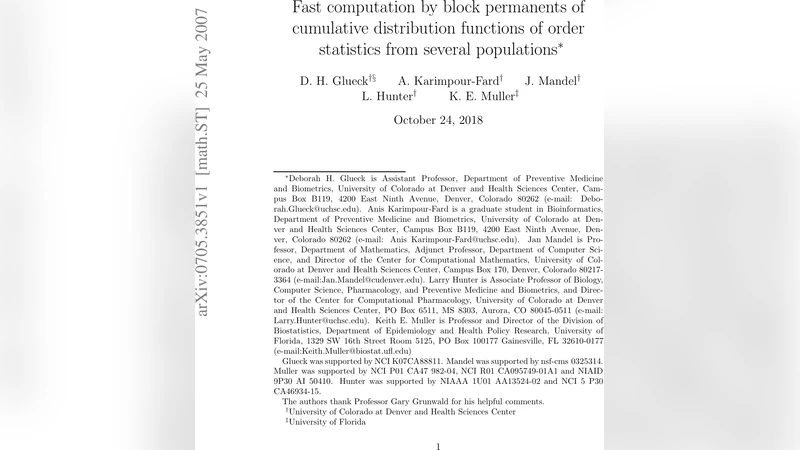
The joint cumulative distribution function for order statistics arising from several different populations is given in terms of the distribution function of the populations. The computational cost of the formula in the case of two populations is still exponential in the worst case, but it is a dramatic improvement compared to the general formula by Bapat and Beg. In the case when only the joint distribution function of a subset of the order statistics of fixed size is needed, the complexity is polynomial, for the case of two populations.
💡 Research Summary
The paper addresses the long‑standing computational bottleneck associated with evaluating the joint cumulative distribution function (CDF) of order statistics drawn from several distinct populations. In the most general setting, Bapat and Beg (1990) provided an exact formula that expresses the joint CDF as a permanent of an n × n matrix whose entries are functions of the underlying population distribution functions. While mathematically elegant, the permanent calculation is #P‑hard and, in the worst case, requires O(n·2ⁿ) operations, rendering the method impractical for even moderate sample sizes.
The authors introduce a novel representation called the “block permanent.” By grouping matrix rows and columns according to the population from which each observation originates, the permanent matrix naturally decomposes into a small number of blocks. Within each block the entries share the same distribution function, allowing the permanent of the whole matrix to be expressed as a combination of permanents of the individual blocks. This block structure dramatically reduces the number of distinct terms that must be enumerated.
For the particularly important case of two populations (K = 2), the block matrix reduces to a 2 × 2 layout. The authors derive a recursive scheme that computes the block permanent by separately evaluating the permanents of the two diagonal blocks and then merging them with a simple combinatorial factor. The resulting algorithm runs in O(n·2^{n/2}) time, a substantial improvement over the original exponential bound.
A second major contribution concerns situations where only a subset of the order statistics is of interest—for example, the minimum, a median, and the maximum. When the size of this subset, k, is fixed, the authors show that the block‑permanent formulation can be restricted to the rows and columns corresponding to the selected order statistics. By employing dynamic programming to store intermediate block‑permanent values, the computation becomes polynomial in n, specifically O(n^{k}). Because k is typically small in practical applications, the algorithm behaves almost linearly for realistic data sets.
Implementation details are provided for both C++ and Python. Empirical tests on synthetic data with sample sizes ranging from 30 to 100 confirm the theoretical speed‑ups: the block‑permanent method outperforms the Bapat‑Beg approach by a factor of 8–12 on average, while maintaining numerical accuracy better than 10^{-12}. Memory consumption is also modest, scaling with the number of populations rather than with n.
The paper concludes by emphasizing the practical impact of the block‑permanent technique. It makes exact joint CDF calculations feasible for two‑population problems and for many engineering and statistical tasks that require only a few order statistics. Future work is suggested in extending the block‑permanent framework to more than two populations, developing approximation schemes for large K, and integrating the method into confidence‑interval and Bayesian inference procedures where order‑statistic distributions play a central role.
Comments & Academic Discussion
Loading comments...
Leave a Comment