We survey results in lattice quantum chromodynamics from groups in the USQCD Collaboration. The main focus is on physics, but many aspects of the discussion are aimed at an audience of computational physicists.
Deep Dive into Quantum chromodynamics with advanced computing.
We survey results in lattice quantum chromodynamics from groups in the USQCD Collaboration. The main focus is on physics, but many aspects of the discussion are aimed at an audience of computational physicists.
arXiv:0807.2220v1 [physics.comp-ph] 14 Jul 2008
Quantum chromodynamics with advanced computing
Andreas S Kronfeld
Fermi National Accelerator Laboratory, Batavia, IL 60510, USA
(for the USQCD Collaboration)
E-mail: ask@fnal.gov
Abstract.
We survey results in lattice quantum chromodynamics from groups in the USQCD
Collaboration. The main focus is on physics, but many aspects of the discussion are aimed at
an audience of computational physicists.
1. Introduction and background
Quantum chromodynamics (QCD) is the modern theory of the strong nuclear force. The physical
degrees of freedom are quarks and gluons. The latter are the quanta of gauge fields, in some
ways analogous to photons. The crucial difference is that gluons couple directly to each other,
whereas photons do not. A consequence of the self-coupling is that the force between quarks
does not vanish at large distances (as the Coulomb force e2/(4πr2) does) but becomes a constant
FQCD ≈800 MeV fm−1 ≈15, 000 N. It would, thus, require a vast amount energy to separate
quarks out to a macroscopic distance. Indeed, long before the separation becomes large enough
to measure, the energy stored in the gluon field “sparks” into quark-antiquark pairs.
This
phenomenon of QCD explains why freely propagating quarks are not observed in nature, and it
is called confinement.
QCD is a quantum field theory, which means that from the outset one must deal with
mathematical objects that are unfamiliar even to many physicists.
The most widely used
theoretical tool for quantum field theories is relativistic perturbation theory, as developed for
quantum electrodynamics (QED) by Feynman, Schwinger, Tomonaga and others sixty years
ago (1). Perturbation theory provides the key connection between the mathematical theory
with experiments in QED (2) and the Glashow-Weinberg-Salam theory merging QED with the
weak nuclear force (3).
A textbook example of perturbative quantum field theory is to calculate how virtual pairs
induce a distance dependence on the coupling in quantum gauge theories. In QED, one considers
the fine structure constant,
α =
e2
4π¯hc,
(1)
where −e is the charge of the electron. In QCD, one has the strong coupling αs, related to the
gauge coupling g by analogy with equation (1). When virtual pairs are taken into account, α
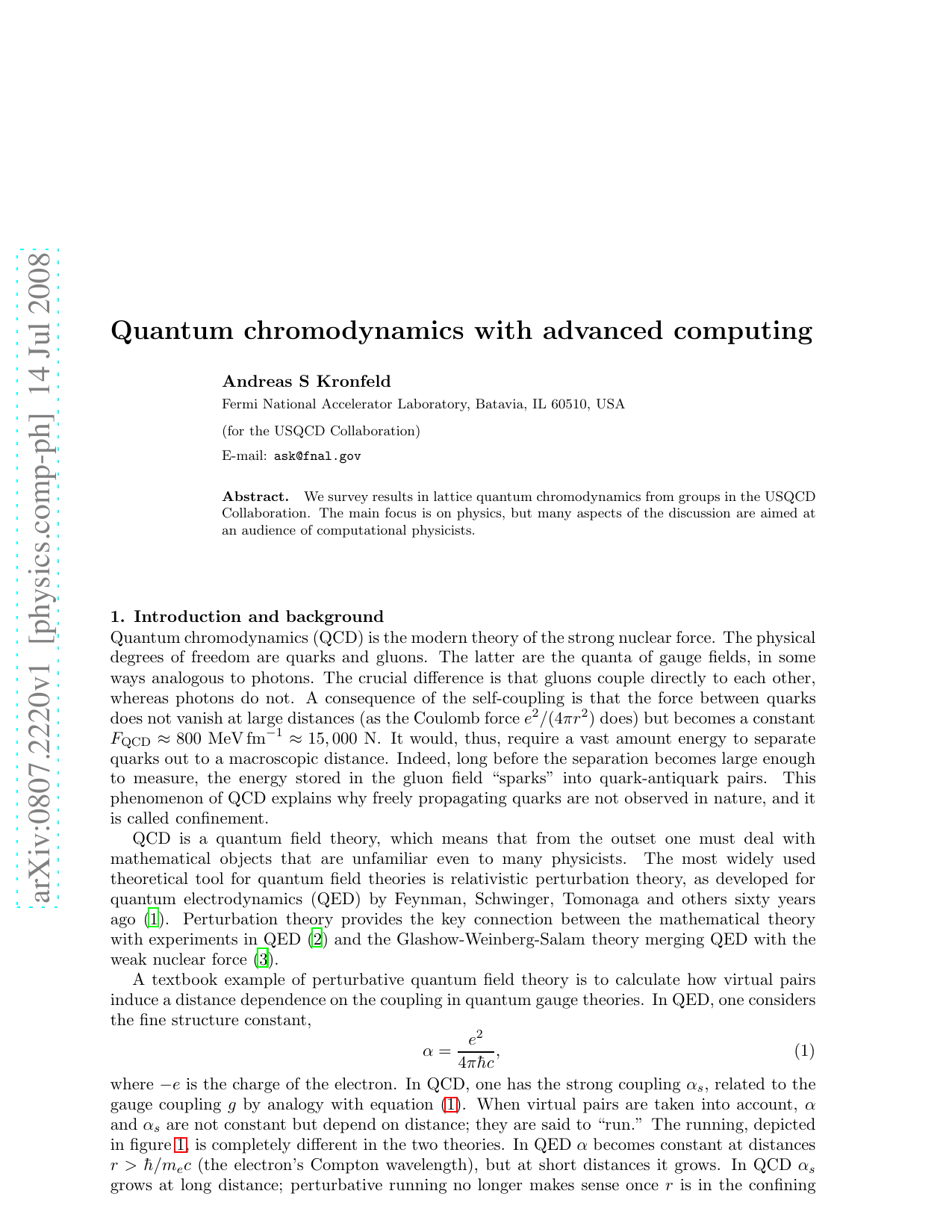
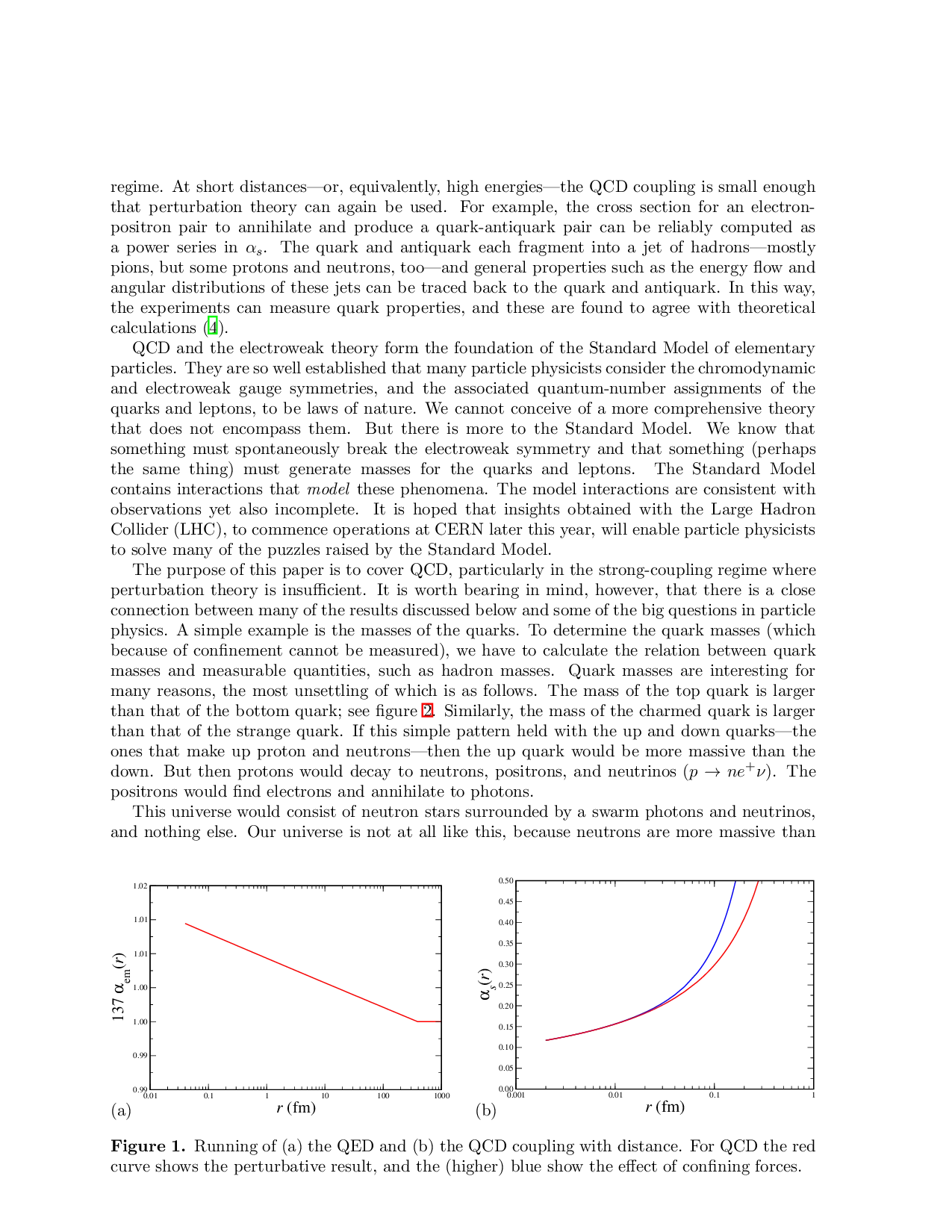
and αs are not constant but depend on distance; they are said to “run.” The running, depicted
in figure 1, is completely different in the two theories. In QED α becomes constant at distances
r > ¯h/mec (the electron’s Compton wavelength), but at short distances it grows. In QCD αs
grows at long distance; perturbative running no longer makes sense once r is in the confining
regime. At short distances—or, equivalently, high energies—the QCD coupling is small enough
that perturbation theory can again be used. For example, the cross section for an electron-
positron pair to annihilate and produce a quark-antiquark pair can be reliably computed as
a power series in αs. The quark and antiquark each fragment into a jet of hadrons—mostly
pions, but some protons and neutrons, too—and general properties such as the energy flow and
angular distributions of these jets can be traced back to the quark and antiquark. In this way,
the experiments can measure quark properties, and these are found to agree with theoretical
calculations (4).
QCD and the electroweak theory form the foundation of the Standard Model of elementary
particles. They are so well established that many particle physicists consider the chromodynamic
and electroweak gauge symmetries, and the associated quantum-number assignments of the
quarks and leptons, to be laws of nature. We cannot conceive of a more comprehensive theory
that does not encompass them.
But there is more to the Standard Model.
We know that
something must spontaneously break the electroweak symmetry and that something (perhaps
the same thing) must generate masses for the quarks and leptons.
The Standard Model
contains interactions that model these phenomena. The model interactions are consistent with
observations yet also incomplete.
It is hoped that insights obtained with the Large Hadron
Collider (LHC), to commence operations at CERN later this year, will enable particle physicists
to solve many of the puzzles raised by the Standard Model.
The purpose of this paper is to cover QCD, particularly in the strong-coupling regime where
perturbation theory is insufficient. It is worth bearing in mind, however, that there is a close
connection between many of the results discussed below and some of the big questions in particle
physics. A simple example is the masses of the quarks. To determine the quark masses (which
because of confinement cannot be measured), we have to calculate the relation between quark
masses and measurable quantities, such as hadron masses. Quark masses are interesting for
many reasons, the most unsettling of which is as follows. The mass of the top quark is larger
than that of the bottom quark; see figure 2. Similarly,
…(Full text truncated)…
This content is AI-processed based on ArXiv data.