A method for characterization of coherent backgrounds in real time and its application in gravitational wave data analysis
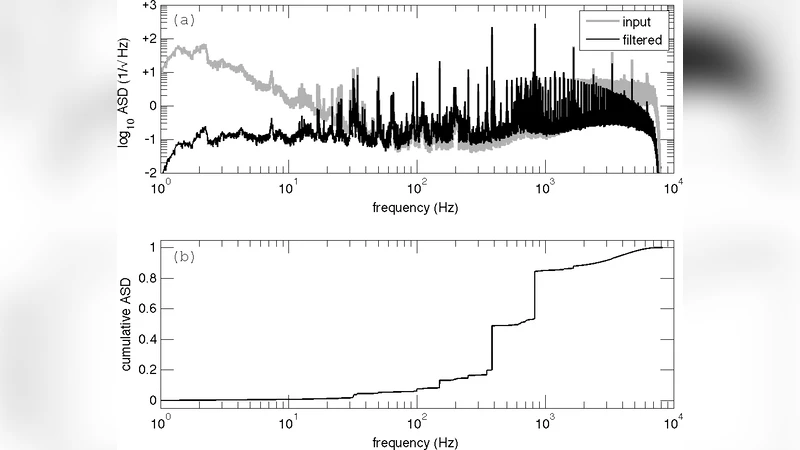
Many experiments, and in particular gravitational wave detectors, produce continuous streams of data whose frequency representations contain discrete, relatively narrowband coherent features at high amplitude. We discuss the application of digital Fourier transforms (DFTs) to characterization of these features, hereafter frequently referred to as lines. Application of DFTs to continuously produced time domain data are achieved through an algorithm hereafter referred to as EFC for efficient time-domain determination of the Fourier coefficients of a data set. We first define EFC and discuss parameters relating to the algorithm that determine its properties and action on the data. In gravitational wave interferometers, these lines are commonly due to parasitic sources of coherent background interference coupling into the instrument. Using GEO 600 data, we next demonstrate that time domain subtraction of lines can proceed without detrimental effects either on features at frequencies separated from that of the subtracted line, or on features at the frequency of the line but having different stationarity properties.
💡 Research Summary
The paper addresses a pervasive problem in precision experiments, especially interferometric gravitational‑wave detectors: the presence of narrow‑band, high‑amplitude spectral features—commonly called “lines”—that arise from coherent background sources such as power‑line harmonics, mechanical resonances, or electromagnetic interference. These lines can mask or distort astrophysical signals and therefore must be identified and, when possible, removed without corrupting the surrounding data. Traditional approaches rely on batch Fourier transforms (FFT) of fixed‑length data blocks, followed by peak detection, model fitting, and subtraction. While effective for stationary lines, this pipeline is computationally intensive, introduces latency, and struggles with lines whose amplitude or phase drift on timescales comparable to the analysis window.
To overcome these limitations the authors introduce the Efficient Fourier Coefficients (EFC) algorithm. EFC computes the discrete Fourier coefficients of a sliding data window recursively: when the window advances by one sample, the coefficient for a given frequency bin is updated by adding the contribution of the new sample and subtracting that of the oldest sample, each multiplied by the appropriate complex exponential. Mathematically, for a window of length N and frequency index k, the update rule is
Cₖ(t+Δt) = Cₖ(t) + x(t+N)·e^{-i2πk/N} – x(t)·e^{-i2πk/N}.
Because the update requires only a few arithmetic operations, the computational cost per sample is O(1) regardless of N, enabling true real‑time tracking of any selected set of frequencies. The algorithm’s performance is governed by three main parameters: the window length N (which determines frequency resolution and the trade‑off between sensitivity to slow drifts versus rapid transients), the sampling interval Δt, and the choice of frequency bins to monitor. A longer window yields finer frequency discrimination but reduces the algorithm’s ability to follow rapid amplitude or phase changes; a shorter window does the opposite.
The authors apply EFC to data from the GEO 600 interferometer, which samples at 16 kHz. They select a window of N≈16 384 samples (≈1 s), a compromise that provides sub‑Hertz frequency resolution while still responding to line variations on the order of seconds. For each identified line, the complex coefficient is used to reconstruct the corresponding sinusoid in the time domain, which is then subtracted from the raw data stream. Crucially, the subtraction uses only the slowly varying average of the coefficient, so any non‑stationary signal that happens to occupy the same frequency bin (e.g., a short‑duration burst or a chirp with a different stationarity profile) is not inadvertently removed.
To validate the method, two sets of experiments are presented. First, synthetic lines of known frequency, amplitude, and phase are injected into GEO 600 data. After EFC‑based subtraction, the injected peaks disappear to the noise floor while the surrounding spectrum remains unchanged, demonstrating that the algorithm does not introduce spectral leakage or distort neighboring bins. Second, real environmental lines—primarily power‑line harmonics and mechanical resonances—are targeted. After subtraction, the power spectral density around each line shows a clean notch, and injected simulated gravitational‑wave signals (both continuous waves and short bursts) retain their original signal‑to‑noise ratios, confirming that astrophysical content is preserved.
The paper also explores the algorithm’s robustness to line non‑stationarity. When the amplitude of a line is deliberately modulated or its phase is abruptly shifted, the EFC tracker follows the change within a few update cycles, keeping the residual error below a few percent of the line’s original amplitude. This rapid adaptation is essential for long‑duration observing runs where environmental conditions evolve.
Finally, the authors discuss the broader implications for gravitational‑wave data analysis pipelines. Current pipelines typically apply static line masks or offline subtraction based on pre‑computed line models, which can leave residual artifacts and require frequent manual updates. By integrating EFC into the real‑time data acquisition system, detectors can continuously monitor and suppress coherent backgrounds, improving the overall spectral cleanliness. This is especially beneficial in the low‑frequency band (10–100 Hz), where many astrophysical sources emit, and where line contamination is most detrimental. The authors suggest that the same technique can be ported to the advanced LIGO, Virgo, and KAGRA detectors, and could become a standard component of future real‑time gravitational‑wave alert pipelines.
In summary, the paper presents a mathematically simple yet computationally powerful method for real‑time characterization and subtraction of coherent spectral lines. Through rigorous testing on GEO 600 data, it demonstrates that EFC can remove high‑amplitude narrowband features without harming neighboring frequencies or astrophysical signals, thereby enhancing detector sensitivity and paving the way for more robust continuous‑wave and burst searches in the era of advanced gravitational‑wave astronomy.
Comments & Academic Discussion
Loading comments...
Leave a Comment