High-speed kinks in a generalized discrete $phi^4$ model
We consider a generalized discrete $\phi^4$ model and demonstrate that it can support exact moving kink solutions in the form of tanh with an arbitrarily large velocity. The constructed exact moving solutions are dependent on the specific value of th…
Authors: Sergey V. Dmitriev, Avinash Khare, Panayotis G. Kevrekidis
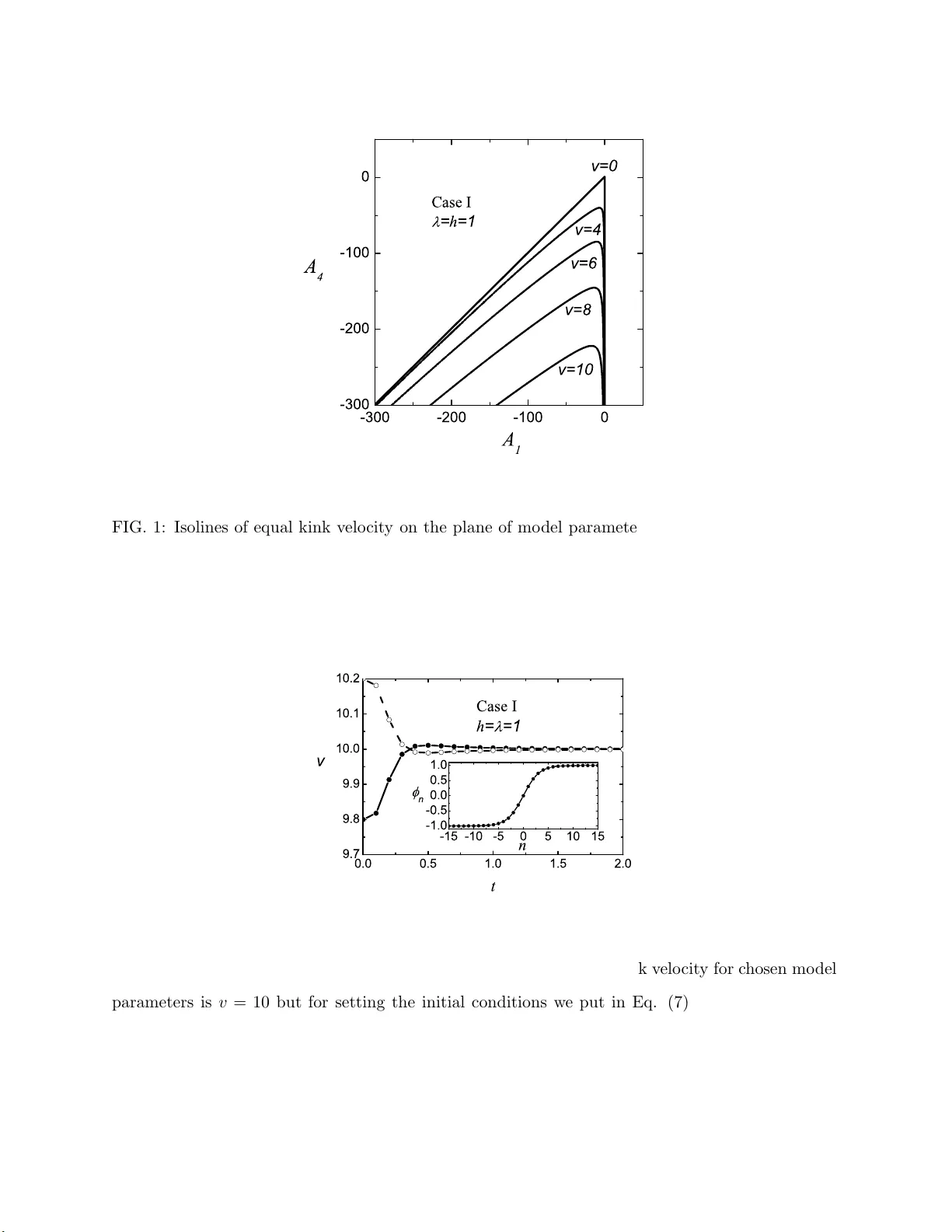
APS/123-QED High-sp eed kinks in a g eneralized discrete φ 4 mo del Sergey V. Dmitriev 1 , Avinash K ha re 2 , P ana y otis G. Kevrekidis 3 , Av adh Saxena 4 and Ljup´ co Hadˇ zievsk i 5 1 Institute for Metals Sup erplasticity Pr oblems RAS, 39 Khalturina, Ufa 450001, R ussia 2 Institute of Physics, Bhub aneswar, Orissa 75 1005, In d ia 3 Dep artment o f Mathematics an d Statistics, University of Massachusetts, A mherst, MA 0100 3-4515, USA 4 Center fo r Nonline ar Studies and T he or etic al Division, L os A la mos National L ab or atory, L os Alamos, New Mexic o 87545, USA 5 Vinc a I nstit ute of Nucle ar Sci e n c e, PO Box 522,11001 B elgr ade, Serbia (Dated: August 14, 2021) Abstract W e co nsider a generaliz ed discrete φ 4 mo del and d emo nstrate that it can supp ort exact moving kink solutions in t he form o f tanh with a n arbitrarily large v elo ci t y . T h e constructed exact mo ving solutions are dep enden t o n the sp ecific v alue of the propagation ve lo city . W e demonstrate that in this class of mo dels, giv en a sp ecific ve lo c it y , th e p roblem of fin d ing the exact moving solution is in tegrable. Namely , this pr o blem originally expressed as a three-p oin t map can b e r e duced to a tw o-p oin t map, from which the exact m oving solutions can b e d eriv ed iterativ ely . It w as also found that these high-sp eed kinks can b e stable and robust against p erturb at ions introd uced in the initial conditions. P ACS num b ers: 05.45.-a , 05.45.Yv, 63.20.-e 1 I. INTR ODUCTION Solitary wa v es pla y imp ortant role in a great v ariet y of applications b ec ause they are robust against perturbations and they can transp ort v arious phy sical quantities suc h a s mass, energy , momen tum, electrical c harge, and also info rmation [1, 2]. Many p opular con t inuum nonlinear equations supp ort tra v eling solutions, but for their discrete analogs the existence of trav eling solutions w as no t systematically studied un t il recen tly . Previously , only a few in tegrable lattices were kno wn to supp ort mov ing solitons, e.g., the T o da lattice [3] and the Ablowitz-Ladik lattice [4], the former b eing the discrete v ersion of the K d V equation and the la tter of the nonlinear Sc hr¨ odinger (NLS) equation. While integrable lattices of other k ey con t inuum models are also av ailable [5, 6], these integrable situatio ns are still rather exceptional and typic ally not directly relev an t to exp e rimen tal settings. On the other hand, recen tly sev eral wide classes of discrete mo dels supp orting translatio n ally in v ariant (TI) static or stationary solutions ha v e been discov ered and in v estigated for the discrete Klein-Gordon equation [7, 8, 9 , 10, 11, 12, 13, 1 4 , 15, 1 6, 17 , 18 , 19] and the discrete NLS equation [20, 21, 22, 2 3 , 24, 25]. Static solitary w a ve s in suc h lattices p ossess the translational Goldstone mo de [10, 18 , 19, 20, 21, 22], which means that the solitary w av es mo ving with vanishing v elo cit y can b e regarded as the exact solutions to these discrete equations (althoug h there are issues for finite but small v elo cities as explained e.g., in [26, 27]). Mo ving solutions pr o pagating along a lattice at finite v elo cit y ha ve also b een found analytically in [21, 22] and with the help of sp e cially tuned n umerical approache s in [2 4 , 26, 27, 28, 29, 30 , 31, 32]. T ra velin g bright solitons in the NLS lattice mo del with saturable nonlinearit y are also v ery interesting [27, 33, 34]. F o r this mo del the existence of soliton frequencies with v anishing Peie rls-Nabarro energy barrier w a s demonstrated. It w as sho wn that fo r the sp ecifi c f re quencies the static version of the mo del equation coincides with that of the integrable Ablowitz -Ladik equation [3 4]. This implies in the mapping analysis a p ossibilit y to reduce the three-p oin t map to a t wo-p oin t map. Ho wev er, the studied mo del equation is not integrable and while t he solitary w av es mo ving with small v elo cit y w ere nu merically obtained for the sp e cific frequencies, the question ab out the existence of solitary w av es mov ing with finite v elo cities remains op en. Existence of la ttice s supp orting the static TI solutions and t h e exact solutions mo ving with finite v elo cit y p oses a natural question, ab out whether there is a relation b et w een them. 2 In the presen t study w e answ er this question in the p ositiv e, creating a link b et w een these t wo classes of solutions b elo w. On the other hand, as regards the solitar y wa v e motion, another in teresting question is the existence of upp er b ound for the propagatio n v elo cit y . In view of Loren tz in v ariance, clearly the solitary w a ves in contin uum nonlinear equations of t he Klein-Gordon type hav e limitations on their pro pagation v elo cit y . One of the questions that w e examine b elo w is whether a similar restriction exists in the corresp onding discrete mo dels. Since the L o re n tz in v ariance is no longer a symmetry of the discre te nonlinear systems, strictly sp eakin g there need not be a ny restriction on the propaga tion v elo cit y . Ho w ev er, naiv ely one w ould exp ect that ty pically the propagation velocity in the discrete nonlinear system s w ould b e similar to the ones supp orted by their con tinuous counterparts and not dev elop sup e rsonic v alues. Recen tly , three o f us [22] confirmed t h is naiv e expectation in a generalized discrete NLS equation. A natura l question, how ev er, is whether this alwa ys holds true. Althoug h in some case examples, this has already b een a dd ressed [26 ], here w e address this question (and its negativ e answ er) more systematically in the framew o r k o f the recen tly studied discrete φ 4 mo del [19]: d 2 φ n dt 2 = 1 h 2 ( φ n +1 + φ n − 1 − 2 φ n ) + λφ n − A 1 φ 3 n − A 2 2 φ 2 n ( φ n +1 + φ n − 1 ) − A 3 2 φ n ( φ 2 n +1 + φ 2 n − 1 ) − A 4 φ n φ n +1 φ n − 1 − A 5 2 φ n +1 φ n − 1 ( φ n +1 + φ n − 1 ) − A 6 2 ( φ 3 n +1 + φ 3 n − 1 ) , (1) with the mo del parameters satisfying the normalization constraint 6 X k =1 A k = λ . (2) In Eq. (1) , φ n ( t ) is the unkno wn function defined on the lattice x n = hn with the lattice spacing h > 0. Without loss of generality it is sufficien t to consider the cases λ = 1 and λ = − 1. Our results will b e displa ye d a s follows. Analytical results are collected in Sec. I I. Examples of the exact mov ing solutions to Eq. (1) ar e giv en in Sec. I I A to Sec. II C. Then, in Sec. I I D, w e deriv e a con tinuum analog of Eq. (1) and find its kink solution. In Sec. I I E sp ectrum o f t he v acuum solution of Eq. ( 1 ) is obtained. The relatio n b et w een 3 the exact mo ving solutions and in tegrable maps is established in Sec. I I F. Section I I I is dev oted to the num erical analysis o f stabilit y and robustness of mo ving kinks. W e presen t our conclusions in Sec. IV. I I. ANAL YTICAL RESUL TS Our appro a c h to deriving analytical solutions will b e, at least in the b eginning of this section somewhat similar in spirit to the inv erse metho d of [35]. That is, w e will p ostulate the desired solution and will identify the mo de l parameters for whic h this solution will b e a v alid one, as w e explain in more detail b elo w. A. Mo ving sn solution It is easy to sho w that an exact solutio n t o Eq. (1) is φ n = A sn[ β ( hn + hx 0 − v t ) , m ] , (3) pro vided the f ollo wing relations are satisfied: A 5 ns(2 hβ , m ) = − A 3 ns( hβ , m ) , A 1 A 2 = − 2 mβ 2 v 2 , A 6 = 0 , (4) 2 A 2 h 2 = 2 A 4 ns( hβ , m )ns(2 hβ , m ) + A 2 ns 2 ( hβ , m ) − A 3 cs( hβ , m )ds( hβ , m ) − A 5 [cs(2 hβ , m )ds(2 hβ , m ) − ns 2 (2 hβ , m )] , (5) 2 − λh 2 A 2 h 2 = A 4 ns 2 ( hβ , m ) + A 2 cs( hβ , m )ds( hβ , m ) − A 3 ns 2 ( hβ , m ) + (1 + m ) β 2 v 2 A 2 . (6) In Eq. (3), A is the amplitude, v is the propagat io n v elo cit y , β is a parameter relat ed to the (in v erse) width, x 0 is an arbitrary p osition shift, 0 ≤ m ≤ 1 is the Jacobi elliptic function (JEF) mo dulus. F urther, ns( x, m ) = 1 / s n( x, m ) , cs( x, m ) = cn( x, m ) / sn ( x, m ) and ds ( x, m ) = dn( x, m ) / sn( x, m ), where sn( x, m ), cn( x, m ), and dn( x, m ) denote standard JEFs. 4 Solution parameters x 0 and m can b e chos en arbitrarily . Equations (4) to (6) establish fiv e constraints f rom whic h one can find the three solution parameters A , v , a n d β , and t w o constrain ts on mo del parameters h , λ , and A i ( i = 1 , 2 , ..., 6 ). It is po s sible to construct some other moving JEF solutions, fo r example, mo ving cn a n d dn solutions (and hence hyperb olic pulse solutions of the sec h t yp e) but w e do not discuss these here. B. Exact moving kink solution In the limit m → 1, the ab o ve movin g sn solution reduces to the mo ving kink solution φ ( x, t ) = tanh [ β ( hn + hx 0 − v t )] , (7) and the relations (4) to (6) take the simpler form β 2 = − A 1 2 v 2 , 2 A 3 = − A 5 (1 + T ) , A 6 = 0 , (8) 2 T h 2 = A 4 (1 + T ) + A 2 + A 5 2 (1 + 2 T − T 2 ) , (9) (2 − h 2 λ ) T h 2 = A 4 + A 2 (1 − T ) + A 5 2 (1 + T ) − A 1 T , (10) where T = tanh 2 ( hβ ) . (11) One can see that the solution is defined only if A 1 ≤ 0. It is w orth p oin ting out that the static [22] and the moving JEF as w ell as hyperb olic soliton solutions exist in this mo del in the follo wing sev en cases: (i) only A 2 nonzero (ii) only A 4 nonzero (iii) A 3 , A 5 nonzero (iv) A 2 , A 4 nonzero (v) A 2 , A 3 , A 5 nonzero (vi) A 3 , A 4 , A 5 nonzero (vii) as discussed ab o v e A 2 , A 3 , A 4 , A 5 all nonzero. F urther, while in t he static case, solutions exist only if A 1 , A 6 = 0, in the moving case solutions exist o nly if A 6 = 0 , A 1 6 = 0. It may b e noted that these conclusions are v alid for sn , cn , dn as w ell a s t a nh , sec h solutions. Moreo ver, while in the static case, the kink solution exists only if λ > 0, the mo ving kink solution is p ossible ev en when λ < 0. In fa c t, it turns o ut that in cases (i), ( ii) and (iii) kink solution with a large velocity v is p ossible only if λ < 0. While Eqs. (8) to (10) give a general set of restrictions on the mo del parameters sup- p orting the exact mo ving kink, b elo w w e extract and analyze three par t icular cases where the r estrictions attain a v ery simple and transparent fo r m . 5 Case I. Only A 1 , A 2 , and A 4 are nonzero. These parameters are sub ject to the constrain t of Eq. (2) and one can take A 1 ≤ 0 a nd A 4 ≤ A 1 − λ + 2 /h 2 as free parameters. F rom equations (8) to (1 0) and ( 2 ) w e get β 2 = − A 1 2 v 2 , A 4 = 2 h 2 − λ − A 1 T , A 2 = λ − A 1 − A 4 . (12) W e note that the kink v elo cit y v can hav e an arbitrary v alue in case λ > 0. Indeed, for c hosen λ and h , one can take any v and then, using the express ions of Eq. (12), find subsequen tly the in v erse kink width β and the remaining mo del parameters A 4 and A 2 . As a sub case of case I, one can tak e only A 1 and A 2 nonzero. F rom Eq. (12) w e get β 2 = − A 1 2 v 2 , 2 T = h 2 λ + 2 v 2 h 2 β 2 , A 2 = λ − A 1 . (13) F r o m here it is clear that the kink solution with large v is only p ossible in this case if λ < 0. Similar argumen ts are a ls o v alid in cases (ii) and (iii) discussed ab o v e. Case I I. Another intere sting case is when ( A 2 , A 3 , A 5 nonzero): A 2 = λ − 2 h 2 − A 1 , A 3 = λ − 2 h 2 − A 1 + A 4 , A 5 = − λ + 4 h 2 + A 1 − 2 A 4 , A 6 = 0 , (14) with A 1 and A 4 b eing free para m eters. It is clear that the constrain t o f Eq. (2) is satisfied for a n y A 1 and A 4 . Conditions (8) to (10) reduce to β 2 = − A 1 2 v 2 , A 5 = A 1 − λ T . (15) Th us, w e hav e a t wo-parameter set of mo ving kinks. Kink solution exists f or A 1 < 0 a nd A 4 > 2 /h 2 . In this case to o the kink v elo cit y v can o btain an y v alue. As it w as found in [1 9], for A 1 = 4 γ 1 λ, A 2 = 6 γ 2 λ, A 3 = (1 − 4 γ 1 − 8 γ 2 ) λ, A 4 = A 5 = 0 , A 6 = 2 γ 2 λ , (16) with a r b itrary γ 1 and γ 2 , the mo del Eq. (1) has the Hamiltonian H = X n h ˙ φ 2 n 2 + ( φ n − φ n − 1 ) 2 2 h 2 + λ 4 − λ 2 φ 2 n + γ 1 φ 4 n + γ 2 φ n φ n − 1 ( φ 2 n + φ 2 n − 1 ) + 1 4 − γ 1 − 2 γ 2 φ 2 n φ 2 n − 1 i , (17) 6 and hence energy is conserv ed in this mo del. Simple analysis o f Eqs. (8) to (10) suggests that among the mo dels supp orting t he exact movin g kink solutions there are no Hamiltonian mo dels. C. Exact moving trigonometric solution and mo ving four-p eriodic solution Exact moving trigon ometric solution. The discrete mo del of Eq. (1) supp orts an exact mo ving solution of the form φ n = A sin[ hβ ( n + x 0 ) − v t ] , (18) ev en when A i , i = 1 , ..., 6 are all no nzero provided λh 2 − 2 + 2 cos( hβ ) + v 2 = A 2 h 2 sin 2 ( hβ )[ A 3 − A 4 + (3 A 6 − A 5 ) cos( hβ )] , (19) A 1 + A 4 + A 3 cos(2 hβ ) + ( A 2 + A 5 ) cos( hβ ) + A 6 cos( hβ )[4 cos 3 ( hβ ) − 3] = 0 . (20) F r o m here, one can w ork out sp ec ific relations in the case of v arious mo dels. F or example, consider the Hamiltonian mo del with t he parameters satisfying Eq. (16) . It is easy to chec k that the moving sin e solution exists in this mo del provided λh 2 − 2 + 2 cos( hβ ) + v 2 = A 2 λh 2 sin 2 ( hβ )[1 − 4 γ 1 − 8 γ 2 + 6 γ 2 cos( hβ )] , (21) 4 γ 1 + (1 − 4 γ 1 − 8 γ 2 ) cos(2 hβ ) + 8 γ 2 cos 3 ( hβ ) = 0 . (22) Exact moving four-site p erio di c solution. F or β h = π / 2 the ab o v e moving tr ig onometric solution reduces to the mo ving fo ur-perio dic solution of the form φ n = A sin h π 2 ( n + x 0 ) − v t i , (23) with A 1 + A 4 = A 3 , A 2 = λh 2 − 2 + v 2 A 1 h 2 . (24) 7 F o r the Hamiltonian mo del, Eq. (24) reduces to γ 1 + γ 2 = 1 8 , A 2 = λh 2 − 2 + v 2 4 γ 1 λh 2 . (25) Ev en in t he Hamiltonian case the trigonometric solutio n can hav e a n arbitrarily large v elo c- it y . D. Appro ximate moving kink solution The discrete mo del of Eq. (1) with finite h can supp ort the solutio ns v arying slowly with n (the same class o f solutions can b e studied near the con tinuum limit, using h as a small expansion para m eter). F or suc h solutions one can use the expansion φ ( h ) ≈ φ + hφ x + (1 / 2) h 2 φ xx and substitute in Eq. (1) φ n = φ (0), φ n ± 1 = φ ( ± h ) to obtain φ tt = φ xx + λφ − λφ 3 − 1 2 h 2 B φ 2 φ xx − h 2 D φφ 2 x , (26) where B = A 2 + 2 A 3 + 2 A 4 + 3 A 5 + 3 A 6 , D = A 3 − A 4 − A 5 + 3 A 6 , (27) and Eq. (2) w as used. F or B = D = 0 Eq. (26) reduces to the con tin uum φ 4 equation. This equation a ls o stems from Eq. (26) in the limit h → 0. Equation ( 2 6 ) supp orts the follo wing kink solution φ ( x, t ) = tanh [ β ( x + x 0 − v t )] , (28) pro vided the f ollo wing t wo conditions ar e satisfied β 2 = λ 2 (1 − v 2 ) + h 2 D , B + D = 0 . (29) This is the quasi-contin uum analog of the solution of Eq. (7 ). Let us analyze the case of λ = 1, whic h corresp onds to the double-w ell p oten tial. F or D = B = 0 or/and h = 0 w e ha ve the classical con t inuum φ 4 kink with the propag ation velocity limited as | v | < 1. On the o the r hand, for nonzero D = − B and nonzero h , there is no limitation on the kink propagation v elo cit y . In other w ords, fast kinks are p ossible in Eq. (26) only in the presence 8 of sev era l comp eting nonlinear terms. Note that in case B , D 6 = 0, Eq. (26) is no t Loren tz in v ariant. F o r wide kinks, i.e. when β ≪ h , one can use the kink solution of Eq. (26) to write do wn the appr oxima t e solution to the discrete mo del Eq. (1) of the form of Eq. (7), whose parameters are g iv en b y Eq. (2 9 ) . The correspo nding wide, fast kinks are p ossible in Eq. (1) o nly fo r finite h and only for D = − B 6 = 0. Substituting the Hamiltonian conditio ns of Eq. (16) into Eq. (27) we find B = 2 D while, according to Eq. (29), the appro ximate moving kink solution exists at B = − D , i.e., it exists only in non- Hamiltonian discrete mo dels. E. Sp ectrum of v acuum The discrete mo del of Eq. (1) supp orts the v acuum solutions φ n = ± 1. The spectrum of the small-amplitude w av es (phonons) of the f orm ε n ( t ) ∼ exp( ik n ± iω t ), propa gating in the v acuum, is ω 2 = 2 λ + 2 2 h 2 − B sin 2 k 2 , (30) where k denotes w av en umber, ω is frequency and B is a s giv en by Eq. (27). Another v acuum solution, φ n = 0, supp orts the phonons with the disp ersion relation ω 2 = − λ + 4 h 2 sin 2 k 2 , (31) and this v acuum is stable for λ < 0. F. Relation t o TI mo dels Note that fo r v = 0 the exact moving solutions Eq. (3), Eq. (7 ), and Eq. (18) reduce to the static TI solutions, i.e., solutions whic h, due to the presence of arbitrary shift x 0 , can b e placed an ywhere with resp ect to the lattice. TI solutions o f Eq. (1) w ere discussed in detail in [19]. P a rticu larly , it w a s established that an y TI static solution can b e obtained iterativ ely from a t wo-p oin t nonlinear map. Let us demonstrate that the exact mo ving solutions (including JEF solutions) can also b e deriv ed from a map. Let us generalize the ansatz Eq. (3) and lo ok for moving solutions to Eq. (1 ) of the form φ n = AF ( ξ ) , ξ = β ( hn + hx 0 − v t ) , (32) 9 with constant a m plitude A , where F is suc h a function that d 2 φ n dt 2 = − β 2 v 2 ( α 0 φ n + α 1 φ 3 n ) , (33) with constan t co efficien ts α 0 , α 1 . If this is the case, the substitution of Eq. (32) into Eq. (1) will result in a static pro ble m essen tially identical to the static form of Eq. (1), namely , in the pro ble m 0 = 2 h 2 ( φ n − 1 − 2 φ n + φ n +1 ) + 2( λ + α 0 β 2 v 2 ) φ n − 2( A 1 − α 1 β 2 v 2 ) φ 3 n − A 2 φ 2 n ( φ n − 1 + φ n +1 ) − A 3 φ n ( φ 2 n − 1 + φ 2 n +1 ) − 2 A 4 φ n − 1 φ n φ n +1 − A 5 φ n − 1 φ n +1 ( φ n − 1 + φ n +1 ) − A 6 ( φ 3 n − 1 + φ 3 n +1 ) . (34) This effectiv e separatio n of the spatial and temp oral pa r t with each of them satisfying appropriate conditions is reminiscen t of the metho d of [36]. The Jacobi elliptic functions a nd some of their complexes do p ossess this prop ert y . F or example, Eq. (33) is v alid f or α 0 = 1 + m , α 1 = − 2 m A 2 , for F = sn ; α 0 = 1 − 2 m , α 1 = 2 m A 2 , for F = cn ; α 0 = m − 2 , α 1 = 2 A 2 , for F = dn; α 0 = 1 + m , α 1 = − 2 A 2 , for F = 1 sn ; α 0 = 1 − 2 m , α 1 = 2( m − 1) A 2 , for F = 1 cn ; α 0 = 2(2 m − 1) , α 1 = − 2 A 2 , for F = sndn cn . (35) In the limit m = 1 w e get from the first line of Eq. (35) α 0 = 2 , α 1 = − 2 , for F = tanh . (3 6) A solution mo ving along the c hain con tin uo us ly passes through all configurations betw een the o n- s ite and the inter-site ones. If one finds a static solution to Eq. (34) t ha t exists fo r an y lo cation with respect to the lattice, then one finds the corresp onding mo ving solutio n to Eq. (1). V arious static solutions to Eq. (34) that ha ve the desired prop ert y o f translational 10 in v ariance hav e b een recently constructed. Let us discuss the tw o simple cases sp ecified in Sec. I I B. Case I . F o r nonzero A 1 , A 2 , and A 4 = λ − A 1 − A 2 , Eq. (1) reduces to d 2 φ n dt 2 = 1 h 2 ( φ n − 1 − 2 φ n + φ n +1 ) + λφ n − A 1 φ 3 n − A 2 2 φ 2 n ( φ n +1 + φ n − 1 ) − A 4 φ n − 1 φ n φ n +1 , (37) while from Eq. (34) we get 1 h 2 ( φ n − 1 − 2 φ n + φ n +1 ) + ( λ + α 0 β 2 v 2 ) φ n − ( A 1 − α 1 β 2 v 2 ) φ 3 n − A 2 2 φ 2 n ( φ n +1 + φ n − 1 ) − A 4 φ n − 1 φ n φ n +1 = 0 . (38) Setting A 1 = α 1 β 2 v 2 , α 0 = − α 1 , (39) w e r educe Eq. (38) to the in tegrable static equation [17] 1 h 2 ( φ n − 1 − 2 φ n + φ n +1 ) + P φ n − A 2 2 φ 2 n ( φ n +1 + φ n − 1 ) − ( P − A 2 ) φ n − 1 φ n φ n +1 = 0 , (4 0) with P = λ − A 1 . (41) An y static TI solution to Eq. (40) generates the corresp onding mo v i n g solution to Eq. (3 7), pro vided that Eq. (33) is satisfied. All static solutions of Eq. ( 4 0) can b e found from its first integral [19 ], φ 2 n + φ 2 n +1 − Y φ 2 n φ 2 n +1 2 − P h 2 − 2 Z φ n φ n +1 − C Y 2 − P h 2 = 0 , Z = (2 − P h 2 ) 2 − C h 4 ( P − A 2 ) 2 2 (2 − P h 2 ) + C h 4 A 2 ( P − A 2 ) , Y = h 2 ( P − A 2 + A 2 Z ) , (42) where C is the in tegr a tion constant. The first integral can b e view ed as a nonlinear map from whic h a particular solution can b e f ound iterativ ely for an admissible initial v a lue φ 0 and for a chos en v a lue of C . 11 Th us, Eq. (42) is a general solution to Eq. (40 ), while to mak e it also a solution of Eq. (38) one needs to satisfy Eq. (39). This can b e achiev ed b y calculating d 2 φ n /dξ 2 from the map Eq. (42) a nd equalizing it to − α 0 φ n +1 − α 1 φ 3 n +1 according to Eq. (33). T o calculate d 2 φ n /dξ 2 w e consider a static solution cen tered at the lattice p oin t with the n um b er n so that φ n = 0. F r o m the map Eq. (42 ) one can find φ n +1 (0) = p C Y / (2 − P h 2 ). W e then consider the initial v alues φ n = − ε and φ n = ε and similarly , fro m the map Eq. (42), find the correspo nding v alues of φ n +1 ( − ε ) a nd φ n +1 ( ε ). F inally , w e calculate the second deriv a tiv e at the p oin t n + 1 as d 2 φ n /dξ 2 = lim ε 2 → 0 [ φ n +1 ( − ε ) − 2 φ n +1 (0) + φ n +1 ( ε )] /ε 2 = − α 0 φ n +1 − α 1 φ 3 n +1 , where the v alues of the co efficien ts are α 0 = C Y 2 − (2 − P h 2 ) 2 ( Z 2 − 1) (2 − P h 2 ) C Y , α 1 = − 2 C . (43) Let us summarize our findings. F rom Eq. (43) and the second expression of Eq. (39), taking in to accoun t Eq. (41), w e find the relation b et w een the integration constant C and mo del parameters A 1 , A 2 , λ , and h when a mov ing solution is p ossible : (1 − C ) P 2 − P h 2 2 × h h 4 ( C − 1) P 3 + C h 4 A 2 5 A 2 P − 4 P 2 − 2 A 2 2 +4 2 A 2 − 3 P − A 2 P h 2 + 2 P 2 h 2 i = 0 . (44) The solution profile is fo u nd for this C from Eq. (42) iteratively for an admissible initial v alue φ 0 , and the pro pagation v elo cit y v is fo und from the first expression of Eq. (39) and the second expression of Eq. (43). F ollow ing this wa y , any mov ing solution to Eq. (37) can b e constructed (p ossibly , except for some v ery sp ecial solutions that may arise from factorized equations [1 9 ]) . Note that in [17] we could express many but not all the solutions of Eq. (40) in terms of JEF. The approac h deve lop ed in this section allows one to obtain iterativ ely ev en those mo ving solutions whose corresp onding static problems w ere not solv ed in terms of JEF. The simplest case is C = 1 when Eq. (44) is satisfied and this case corr esp onds to the kink solution. F rom Eq. (43) w e find α 0 = 2 , α 1 = − 2 , (45) whic h coincides with Eq. (36). The map Eq. (42) in this case reduces t o ± s (2 /h 2 ) − A 4 λ − A 1 ( φ n − φ n +1 ) − φ n φ n +1 + 1 = 0 . (46) 12 One can chec k that Eq. (46 ) suppor t s the static solution φ n = tanh[ hβ ( n + x 0 )] with tanh 2 ( β h ) = λ − A 1 2 /h 2 − A 4 , (47) and this coincides with the second expression of Eq. (12 ). The static solution Eq. (47), that can also b e found iteratively from Eq. (4 6 ), giv es the profile of the moving kink that satisfies Eq. (37). The kink v elo cit y v is found from Eq. (39) and Eq. (45) and this a gree s with the first expression o f Eq. (12). Case I I. The mo del parameters are related b y Eq. (14) with A 1 and A 4 b eing free parameters. F o r A 1 = − 2 β 2 v 2 , Eq. (34) reduces to 2 h 2 ( φ n − 1 − 2 φ n + φ n +1 ) + 2 ( λ − A 1 ) φ n − A 2 φ 2 n ( φ n − 1 + φ n +1 ) − A 3 φ n φ 2 n − 1 + φ 2 n +1 − 2 A 4 φ n − 1 φ n φ n +1 − A 5 φ n − 1 φ n +1 ( φ n − 1 + φ n +1 ) = 0 , (48) whic h is a particular form of the case (vii) static equation studied in [19 ]. The first in tegra l of the static mo del (vii) for the general case is not kno wn, but it is known for an y particular JEF solution [19]. Let us further simplify t he pro ble m considering only the kink solution of Eq. (48), for whic h one has tanh 2 ( hβ ) = A 1 − λ A 5 . (49) This relation coincides with the second expression of Eq. (15). F rom the kno wn static tanh solution one can deduce the following t w o-p oin t map that generates this solution for any initial v a lue | φ 0 | < 1: φ n +1 = φ n ± p ( A 1 − λ ) / A 5 1 ± φ n p ( A 1 − λ ) / A 5 , (50) where one can inte rc hange φ n and φ n +1 and tak e either the upp er or the low er sign. The static kink solutio n to Eq. (48) with β satisfying Eq. (49), that can also b e found iterativ ely from Eq. (50 ), giv es the profile of the moving kink that satisfies Eq. (1) with the parameters related b y Eq. (14). The kink v elo cit y v is found from Eq. (39) and Eq. (45). I I I. NUMERICS Let us analyze t he kink solutions for the cases I and I I describ ed in Sec. I I B. Only the case of λ = 1 will b e ana ly zed. 13 - 3 0 0 - 2 0 0 - 1 0 0 0 - 3 0 0 - 2 0 0 - 1 0 0 0 C a s e I = h = 1 v= 4 v= 6 v= 8 v= 1 0 v= 0 A 4 A 1 FIG. 1: Isolines of equal kink vel o c it y on the p la ne of mo del parameters A 1 , A 4 for the Case I at λ = h = 1, A 2 = λ − A 1 − A 4 , A 3 = A 5 = A 6 = 0. 0 . 0 0 . 5 1 . 0 1 . 5 2 . 0 9 . 7 9 . 8 9 . 9 1 0 . 0 1 0 . 1 1 0 . 2 - 1 5 - 1 0 - 5 0 5 1 0 1 5 - 1 . 0 - 0 . 5 0 . 0 0 . 5 1 . 0 n C a s e I h = = 1 v t n FIG. 2: Kink v elo cit y as a fu nctio n of time for the C a se I. The exact kink v elo cit y for c h o sen model parameters is v = 10 but for setting the initial conditions w e p ut in Eq. (7) v = 9 . 8 (dots) and v = 10 . 2 (op en circles). In b oth cases, regardless of the sign of p erturbation, the kink ve lo city rapidly approac hes the exact v alue. T he inset sho ws th e moving kin k profile. Mod el parameters: λ = h = 1, A 1 = − 20, A 4 ≈ − 222 . 1, A 2 = λ − A 1 − A 4 , A 3 = A 5 = A 6 = 0. 14 In our simulations we solve the set of equations of mot io n, Eq. (1), numeric ally with a sufficien tly small time step τ using the Stormer in tegration sc heme of order O ( τ 6 ). Initial conditions a re set b y utilizing Eq. (7) with v arious parameters. Anti-perio dic or fixed b oundary conditions ar e emplo y ed. A. Exact mo ving kinks in C ase I In this case, a s it was already men tio ned, the exact mo ving kink solution exists for the free mo del parameters satisfying A 1 ≤ 0 and A 4 ≤ A 1 − λ + 2 /h 2 (see Fig. 1 where for λ = h = 1 we show the isolines of equal kink v elo cit y o n the plane of mo del para me ters A 1 , A 4 ). On the line A 1 = 0, according to the first expression of Eq. (12), the kink v elo cit y v v anishes. On the line A 4 = A 1 − λ + 2 / h 2 the kink ve lo cit y also v anishes. This is so b ecaus e, as it can b e seen from the second expression of Eq. (12 ), on this line we hav e T = 1, i.e. β → ∞ a nd kink width v anishes. On the line A 4 = A 1 − λ + 2 /h 2 w e a lso hav e B = 2 /h 2 , whic h corresp onds to v anishing of the width of the phonon sp ectrum g iv en b y Eq. (30). The v acuum φ n = ± 1 is stable, i.e. the sp ectrum Eq. (30) do es not ha ve imaginary frequencies, if A 4 < A 1 + 2 /h 2 , i.e., it is stable in the whole region where the exact mo ving kink solution is defined. As it w as already men tioned, the kink propagation velocity is unlimited a nd fr om Fig. 1 one can see tha t | A 4 | increases fo r higher kink ve lo cities while A 1 can hav e a n y negativ e v alue. F or example, for v = 10 the mov ing kink exists for A 1 < 0 and A 4 < − 221 . 9. Let us now turn to the discussion of the stabilit y of moving kinks. Case of λ = h = 1 and v = 10 . Mo ving kink solutions are stable not in the whole range of parameters of their existence but for eac h studied v alue o f propagation v elo cit y w e w ere able to find a range of para m eters where the mo ving kink is stable in the sense that ev en a p erturb ed kink solution (with a reasonably large p erturbation amplitude) in course of time tends to t he exact solution (i.e., it is effectiv ely “attra c tiv e”). The ev olution of t he kink velocity in such self-regulated kink dynamics is sho wn in Fig. 2 for a v elo cit y a s large as v = 10 for A 1 = − 20 at λ = h = 1 . F o r this c hoice, w e ha ve f rom Eq. (12) β ≈ 0 . 316, A 4 ≈ − 222 . 1, A 2 ≈ 2 4 3 . 1. The moving kink profile is sho wn in the inset of Fig. 2. The p erturbation w as in t r o duced in to the initial conditions b y setting in the exact solution o f Eq. (7), a “wrong” propaga t ion v elo cit y , 15 smaller or hig her than the exact v alue v = 10. It can b e seen that in course of time the propagation velocity approac hes the exact v alue regardless of the sign of p erturbation. The increase of kink velocity launc hed with v = 9 . 8 ma y lo ok coun terin tuitiv e but one should k eep in mind that moving kinks are the solutions to a non-Hamiltonian ( o pen) system with the p ossibilit y to hav e energy exc hange with the surroundings with gain or loss, dep en ding on the tra jectories of particles (see, e.g., [10]). W e found that the absolutely stable, self-r egula t e d motion of kink, similar to that sho wn in Fig. 2, for v = 10 and λ = h = 1 tak es place within the range of − 164 < A 1 < − 1 . 1. The in ve rse kink width at the low er edge of the stability windo w is β ≈ 0 . 9 0 6, whic h corresp onds to a rather sharp kink, while for A 1 = − 1 . 1 (the upp er edge of the stabilit y windo w) one has β ≈ 0 . 0742 and the kink is m uch wider than the lattice spacing h . F or comparison, the kink sho wn in the inset o f Fig. 2 has β ≈ 0 . 3 1 6. F or A 1 < − 164 the mo ving kink solution b ecome s unstable and displacemen ts of particles b ehind the kink grow rapidly with time resulting in the stopping of nume rical run due to floating p oin t ov erflo w. F or − 1 . 1 < A 1 < 0 kink dynamics is as describ ed in Sec. 6 of [10 ] for the non-Hamiltonian case. In this region of parameter A 1 , after a transition p eriod, the kink starts to excite in the v acuum in its w a k e a wa v e with constant amplitude. In this regime, the kink attains a constan t ve lo cit y whose v alue is, generally sp eaking, different from that prescribed b y Eq. (1 2). Kink dynamics in the t w o unstable regimes describ ed ab o ve will b e illustrated below for the kinks mo ving with v < 1. Case of λ = h = 1 and v < 1 . Similar results w ere obtained fo r the kinks mo ving with small v elo cities ( v < 1). F or smaller v elo cities the range of A 1 with stable, self-regulated motion b ecomes narrow er. F or instance, a kink with v = 0 . 8 is stable (in the ab o v e men tio ne d sense) for − 2 . 4 < A 1 < − 0 . 10, while the one with v = 0 . 5 for − 0 . 19 < A 1 < − 0 . 06. In Fig. 3 w e sho w the time v ariation of the mo ving kink profile to demonstrate the instabilit y of the exact kink solution mo ving with v = 0 . 8 at A 1 = − 2 . 6. This solution is unstable and, due to the presence of rounding error p erturbation, the w av e b ehind the kink is excited. The amplitude of the w av e rapidly grows with time and it b ecomes noticeable in the scale of the figure a t t > 100. A t t ≈ 130 the n umerical r u n stops due to the floating p oin t ov erflow. Kink v elo cit y is nearly equal to v = 0 . 8 practically un til the collapse of the w av e b ehind it. 16 In Fig. 4 w e show the kink v elo cit y a s a function o f time t o illustrate the instabilit y o f the exact mo ving kink solution at v = 0 . 8 and A 1 = − 0 . 07. This solution is unstable and, due to the presence of r oundin g error p erturbation, at t ≈ 4 00 it starts to t r ans form in to an oscillating kink (with the p erio d T ≈ 5 . 01) moving with differen t velocity and exciting a constan t-a mp litude wa v e b ehind it. The transformation is essen tially complete b y t ≈ 50 00 and the kink v elo cit y b ecomes v ≈ 0 . 96. The inset shows the profiles of an oscillating mo ving kink in the tw o configura t io ns with t he most deviation from the av erage in time configuration. Case of λ = 1 , h = 0 . 1 , and v = 1 0 . Stable, self-regulated motion o f high-sp eed kinks w as a ls o observ ed for a s small lattice spacing as h = 0 . 1. This may app ear surprising at first sight b e cause for small h one w ould exp ect the discrete mo del to b e close to the contin uum φ 4 mo del where pro pa g ation with the velocity faster than v = 1 is imp ossible. But lo oking at Eq. (26), one can no tic e that the t wo last non-Lor e n tz-inv arian t terms hav e the co efficie n ts h 2 B and h 2 D , a nd they are not small ev en for small h if B and D are large. The high-sp eed kink in the considered case indeed exists for B ≈ − 19833 . 1 and D ≈ 2 0034 . 1. These v a lue s corresp ond to the follo wing pa rame ters considered in this n umerical run: A 1 = − 200 . 0, A 4 ≈ − 20034 . 1 , A 2 = λ − A 1 − A 4 ≈ 20235 . 1, A 3 = A 5 = A 6 = 0, β = 1. B. E xac t mo ving kinks in Case I I In the case I I, the mo del parameters a re related b y Eq. (14) and w e find B = − 2 A 4 + 6 /h 2 . As it w as already men tioned, the exact mo ving kink solution exists fo r A 1 < 0 and A 4 > 2 /h 2 . Isolines of equal kink velocity on the plane of the free mo del parameters A 1 , A 4 can b e seen in Fig. 5 for λ = h = 1. In t he Case I I, similarly to the Case I, on the borders of the existence of the kink solutio n the kink velocity v anishes. Moreo v er, on the b order A 4 = 2 /h 2 , b oth the width of the phonon sp ectrum given b y Eq. (30) and the kink width v a nis h, and this is also similar to what we saw in Case I. As was men tioned ab o ve , the exact mo ving kink solutio n in the Case I I can also hav e arbitrary v elo cit y . Kink dynamics in the Case I I w as observ ed to b e qualitativ ely similar to that of t he Case I. F or the kink with sp eed as large as v = 1 0 for λ = h = 1 w e found that the absolutely stable self-regulated motion is observ ed within the range of − 82 < A 1 < − 1 . 0. 17 - 1 0 1 - 1 0 1 - 1 0 1 - 4 0 - 3 0 - 2 0 - 1 0 0 1 0 2 0 - 1 0 1 t = 0 ( a ) n t = 1 0 0 ( b) n t = 1 1 0 ( c ) n t = 1 2 0 ( d) n n FIG. 3: Change of the mo ving kink p rofile d emons t rating the instabilit y of the exact solution for the follo wing set of mod e l parameters: λ = h = 1, A 1 = − 2 . 6, A 4 ≈ − 2 . 538, A 2 = λ − A 1 − A 4 ≈ 6 . 138, A 3 = A 5 = A 6 = 0. Exact kink p a rameters are v = 0 . 8, β ≈ 1 . 425. This solution is unstable and, d ue to the p resence of roundin g err o r p erturbation, the w av e b ehind the kink is excited. The amplitude of the wa v e rapidly gro wths with time and it b ecomes noticeable in the scale of the figure at t > 10 0. A t t ≈ 13 0 the numerical run stops due to the floating p o in t ov erflo w. The correspo nding inv erse kink width v aries in the range 0 . 640 < β < 0 . 0707. F or A 1 < − 82 the mo ving kink solution b ec omes unstable and displacemen ts of particles in the w a ke of the kink grow ra pidly with time resulting in the termination of nume rical run due t o floating p oin t o verflo w. F or − 1 . 0 < A 1 < 0, after a transition p erio d, the kink starts to excite in the v acuum b ehind itself a wa v e with constan t amplitude. In this regime, the kink propa gates with a constan t ve lo cit y whose v alue is, generally sp e aking, differen t from that prescrib ed b y Eq. (15). C. Exact moving four-p erio dic solution W e ha v e studied the dynamics of the exact moving four- s ite p erio dic solutio n Eq. (23) in the Hamiltonian mo del, i.e., with the parameters satisfying Eq. (2 5). Pe rio dic b oundary conditions w ere emplo y ed for a c hain of 40 particles. A small p erturbation w as introduced 18 0 1 0 0 0 2 0 0 0 3 0 0 0 4 0 0 0 5 0 0 0 0 . 8 0 0 . 8 4 0 . 8 8 0 . 9 2 0 . 9 6 - 1 5 - 1 0 - 5 0 5 1 0 1 5 - 1 . 0 - 0 . 5 0 . 0 0 . 5 1 . 0 C a s e I h = = 1 v t n n FIG. 4: Kink velocit y as a function of time demonstrating the instability of the exact moving kink solution for th e follo win g set of m odel p arameters: λ = h = 1, A 1 = − 0 . 07, A 4 ≈ − 18 . 28, A 2 = λ − A 1 − A 4 ≈ 19 . 35, A 3 = A 5 = A 6 = 0. Exact kink parameters are v = 0 . 8, β ≈ 0 . 234. This solution is u nstable and , du e to th e presence of roun ding error p erturbation, at t ≈ 400 it starts to transform to an oscillating mo ving kink (with the p erio d T ≈ 5 . 01). The transformation is essen tially complete by t ≈ 5000. Inset shows the pr o files of the oscillating moving kink in the t wo configurations with th e m o st deviation from the a v erage in time configuration. - 1 0 0 - 8 0 - 6 0 - 4 0 - 2 0 0 0 2 0 4 0 6 0 8 0 1 0 0 v= 2 C a s e I I = h = 1 v= 4 v= 6 v= 8 v= 1 0 v= 0 A 4 A 1 FIG. 5: Isolines of equal kink v elo cit y on the p la ne of mo del parameters A 1 , A 4 at λ = h = 1 for the case I I when mo del parameters satisfy Eq. (14). 19 in t he amplitude of particles at t = 0 and w e alw ays observ ed a growth of deviation of the p erturbed solution aw ay from the exact one. W e v aried the free mo del parameter γ 1 and the solutio n pa rame ter v in wide ranges at λ = h = 1 but could not find a stable regime. IV. CONCLUSIO NS F o r the discrete mo del of Eq. (1), in Sec. I I A w e obtained exact mo ving solutions in the form of the sn Jacobi elliptic function. Solutions in the fo rm of cn and dn Jacobi elliptic functions can also b e constructed as well as the solutions having the form of 1/sn, 1/cn, and sndn/cn in analogy with [17]. In Sec. I I B, from the sn solution, in the limit of m → 1, w e extracted the exact mo ving kink solution in t h e form of tanh, i.e., the corresp onding h yp erb olic function solution. Setting v = 0 in the exact mo ving solutions o btained in this w o rk one obtains the TI static solutions r ep orted in [19]. In this sense, the results rep orted here generalize o ur previous results. W e th us reve al the hidden connection b et w een the static TI solutions a nd the exact mo ving solutions. Suc h solutions can b e deriv ed from a t hr ee-p oin t map reducible to a t wo-po in t map (see Sec. I I F) i.e., f r o m an integrable map [3 7 ]. W e ha ve demonstrated t ha t the exact moving solutions to lattice and contin uo us equa- tions with comp eting nonlinear terms can ha ve any large propagation v elo cit y . Most of the hig h-speed solutions rep orted in the presen t study are solutions t o the non- Hamiltonian v aria nt of the considered φ 4 mo dels. How eve r, the trigo no m etric solution describ ed in Sec. I I C exists also in t he Hamiltonia n lattice and it a lso can hav e an arbitrary sp eed. While the problem of iden tifying trav eling solutions in the one-dimensional con text by no w has a considerable literatur e asso ciated with it, as evidenced ab ov e, identifyin g suc h solutions in higher dimensional pr o ble ms is to a large exten t an op en question. While initial studies ha ve demonstrated the p ossibilit y in some of these systems for trav eling in b oth on- and off- lattice directions [3 8], analytical results along the lines discussed here are essen t ia lly absen t in tha t problem and could certainly a s sist in clarifying the p oten tial of coheren t structures f or unhindered propagatio n in these higher dimensional settings. 20 Ac kno wledgemen ts SVD gr a tefully ac knowle dges the financial supp ort pro vided by the Russian F ounda- tion for Basic Researc h, grant 07- 08-12152. PGK gratefully ac kno wledges supp ort from NSF-DMS, NSF-CAREER and the Alexander-v on-Hum b oldt F oundation. This work w a s supp orted in part by the U.S. D e partmen t of Energy . [1] E . Infeld and G. Ro w land s, Nonlinear W a ve s, Solitons and Chaos, C ambridge Un iversit y Pr ess (Cam b r idge , 2000) [2] T . Dauxois and M. Pe yrard, Ph ysics of S o litons, Cambridge Universit y Press (Cam b r idge , 2006) . [3] M. T o da, The ory of Nonline ar L attic es (Sprin ger-V erlag, Berlin, 1981). [4] M. J . Ab lo witz and J. F. Ladik, J. Math. Ph ys. 16 , 598 (1975 ); M. J. Ablo witz and J. F. Ladik, J. Math. Ph ys. 17 , 1011 (19 76). [5] S . J. Orf an id is, Ph ys. Rev. D 18 , 3828 (1978 ). [6] E ncyclo p e dia of Nonline ar Scienc e , Edited b y A. Scott (Routledge, New Y ork, 2005). [7] P . G. Kevrekidis, Physica D 183 , 68 (2003). [8] J . M. Sp eigh t and R. S . W ard, Nonlinearit y 7 , 475 (1994 ); J. M. Sp eigh t, Nonlinearit y 10 , 1615 (199 7); J. M. S p eigh t, Nonlinearity 12 , 137 3 (1999). [9] C . M. Bender and A. T ovbis, J. Math. Ph ys. 38 , 3700 (1997). [10] S . V. Dmitriev, P . G. Kevrekidis, and N. Y oshik a wa, J. Ph ys. A 38 , 1 (2005). [11] F. Co op er, A. Kh are, B. Mihaila, and A. Saxena, Ph ys. Rev. E 72 , 36605 (2005 ). [12] I. V. Barashenko v, O. F. Oxtob y , and D. E. P elino vsky , Phys. Rev. E 72 , 3560 2R (2005). [13] S . V. Dmitriev, P . G. Kevrekidis, and N. Y oshik a wa, J. Ph ys. A 39 , 7217 (2006). [14] O.F. Oxtoby , D.E. Peli no vsk y , an d I.V. Barashenko v, Nonlinearit y 19 , 217 (2006). [15] S . V. Dmitriev, P . G. K evr e kidis, N. Y oshik a wa, and D. J. F ran tzesk akis, Phys. Rev. E 74 , 04660 9 (2006). [16] J. M. Sp eigh t and Y. Zolotaryuk, Nonlinearit y 19 , 1365 (2006). [17] S . V. Dmitriev, P . G. Kevrekidis, A. Khare, and A. S a xena, J. Math. Ph y s . 40 , 6267 (200 7). [18] I. Roy , S. V. Dmitriev, P . G. Kevrekidis, and A. S a xena, P h ys. Rev. E 76 , 0266 01 (2007). 21 [19] A. Khare, S . V. Dmitriev, A. Saxena, Exact Static Solutions of a Generalized Discrete φ 4 Mo del In c luding Short-P erio d ic Solutions, arXiv:0710.1 460 . [20] S .V. Dmitriev, P .G. Kevrekidis, A.A. Sukh o ruko v, N. Y oshik a wa, and S. T akeno, Ph ys. Lett. A 356 , 324 (200 6). [21] S . V. Dmitriev, P . G. Kevrekidis, N. Y oshik a wa, and D. F ran tzesk akis, J. Phys. A 40 , 1727 (2007 ). [22] A. Kh a re, S. V. Dmitriev, and A. S a xena, J. Ph ys. A 40 , 11301 (2007). [23] A. Khare, K.O. Rasm uss e n, M.R. Sam u e lsen, A. S axe na, J . Phys. A 38 , 807 (2005); A. Khare, K.O. Rasmussen, M. Salerno, M.R. Samuelsen, and A. Saxena, Phys. Rev. E 74 , 01660 7 (2006). [24] D.E. Peli no vsky , Nonlinearit y 19 , 2695 (2006 ). [25] P .G. Kevrekidis, S.V. Dmitriev, and A.A. Sukh o ruk o v, Math. C omp ut. S im ulat. 74 , 343 (2007 ). [26] A.A. Aigner, A.R. Champ n eys, and V.M. Rothos, Ph ys i ca D 186 , 148 (2003). [27] T. R. Melvin, A. R. C hampneys, P . G. Kevrekidis, and J. Cu e v as, Ph y s . Rev. Lett. 97 , 124101 (2006 ); T.R.O. Me lvin, A.R. Champneys, P .G. Kevrekidis, and J. C uev as, Ph ysica D, in pr e ss (2008 ). [28] G. Io oss and D.E. Pelino vsky , Physica D 216 , 327 (2006). [29] D.E. Peli no vsky and V.M. Rothos, Physic a D 202 , 16 (200 5). [30] O. F. Oxtoby and I. V. Barashenk o v, Ph ys. Rev. E 76 , 036603 (2007 ). [31] I. V. Barashenko v, O. F. Oxtob y , and D. E. P elino vsky , Phys. Rev. E 72 , 0356 02 (2005). [32] O. F. Oxtoby , D. E. P elinovsky , and I. V. Barashenk o v, Nonlinearit y 19 , 217 (2006 ). [33] L. Hadˇ zievski, A. Maluc ko v, M. S t epi ´ c, and D. K ip, Phys. Rev. Lett. 93 , 03390 1 (2004); M. Stepi ´ c, D. Kip, L. Had ˇ zievski, and A. Maluc k ov, Phys. Rev E 69 (2004 ) 066618; [34] A. Maluc k ov, L. Had ˇ zievski, and M. S te pi ´ c, Physica D 216 , 95 (2006). [35] S . Flac h, Y. Zolotaryuk, and K. Kladk o, Phys. Rev. E 59 , 6105 (1999). [36] G.P . Tsiron is, J. Phys. A 35 , 951 (200 2). [37] G.R.W. Q u ispel, J.A.G. Rob erts, and C.J. Thomp s o n, Physica D 34 , 183 (1989). [38] H. Susanto, P .G. Kevr ekid is, R. Carretero-Gonz´ alez, B.A. Malomed, and D.J. F ran tzesk akis, Ph ys. Rev. Lett. 99 , 214 103 (2007). 22
Original Paper
Loading high-quality paper...
Comments & Academic Discussion
Loading comments...
Leave a Comment