Identification of photon-tagged jets in the ALICE experiment
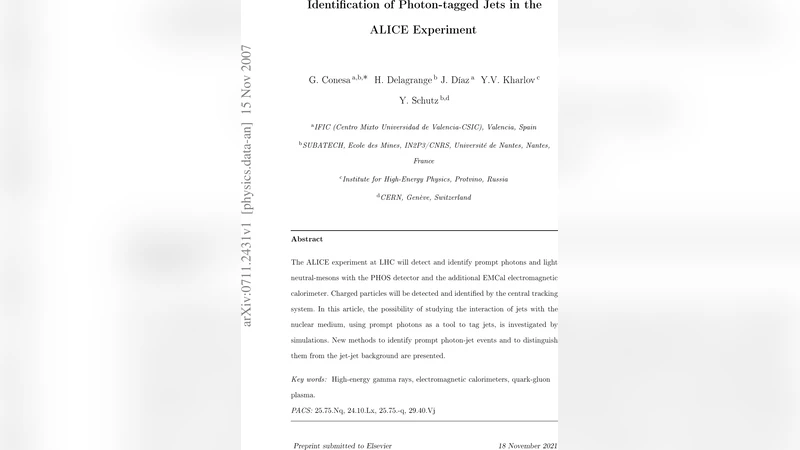
The ALICE experiment at LHC will detect and identify prompt photons and light neutral-mesons with the PHOS detector and the additional EMCal electromagnetic calorimeter. Charged particles will be detected and identified by the central tracking system. In this article, the possibility of studying the interaction of jets with the nuclear medium, using prompt photons as a tool to tag jets, is investigated by simulations. New methods to identify prompt photon-jet events and to distinguish them from the jet-jet background are presented.
💡 Research Summary
The paper investigates the feasibility of using prompt photons as tags for jets in order to study jet–medium interactions in the ALICE experiment at the LHC. The authors exploit the capabilities of the PHOS electromagnetic calorimeter, the additional EMCal, and the central tracking system (ITS and TPC) to identify prompt photons and reconstruct the associated opposite‑direction jets. The study is performed through a detailed Monte‑Carlo simulation that combines PYTHIA‑generated γ+jet events with a heavy‑ion background simulated by HIJING, followed by a full GEANT4 detector response model that reproduces the realistic energy resolution, acceptance, and particle‑identification efficiencies of ALICE.
Photon candidates are first selected as electromagnetic clusters in PHOS or EMCal. To suppress contamination from electrons, charged hadrons, and decay photons (π⁰, η), the analysis applies a two‑step discrimination. The first step uses shower‑shape variables (longitudinal and transverse width, σ_long², σ_short²) and the ratio of cluster energy to matched track momentum to separate single‑photon showers from overlapping decay‑photon showers. The second step imposes an isolation cut: within a cone of ΔR = 0.4 around the photon candidate, the summed transverse momentum of all tracks and calorimeter deposits must be below a threshold (typically 2 GeV). This isolation criterion dramatically reduces the jet‑jet background, which otherwise mimics γ+jet topologies.
Jets are reconstructed with the anti‑k_T algorithm (R = 0.4) using both track‑based inputs (high efficiency for low‑p_T charged particles) and calorimeter‑based inputs (sensitive to neutral energy). The combined approach yields a robust jet energy measurement across a wide p_T range. To associate a jet with a photon, the analysis requires the jet to be roughly back‑to‑back with the photon (Δφ ≈ π ± 0.2) and to satisfy a minimum p_T threshold (e.g., p_T^jet > 20 GeV). The ratio z_γj = p_T^jet / p_T^γ and the jet fragmentation function are then studied as observables sensitive to parton energy loss in the quark‑gluon plasma.
Simulation results show that the isolation efficiency for true prompt photons is about 70 % while the rejection of background photons from hadron decays exceeds 85 %. After applying the back‑to‑back jet requirement, the signal‑to‑background ratio (S/B) for γ+jet events in central Pb‑Pb collisions remains around 3–4, indicating that a statistically significant sample can be collected with the existing ALICE data set. The authors also demonstrate that the z_γj distribution is shifted toward lower values in the heavy‑ion environment compared with pp collisions, consistent with jet quenching effects.
The paper concludes that photon‑tagged jet measurements are a powerful and experimentally viable tool for probing the properties of the QGP. The presented methodology—combining shower‑shape discrimination, isolation cuts, and sophisticated jet reconstruction—provides a clear path toward extracting medium‑induced modifications of jet energy, angular broadening, and fragmentation patterns. The authors suggest that future upgrades to EMCal (increased granularity and coverage) and refined isolation criteria could extend the reach to higher photon energies (>50 GeV), further enhancing the sensitivity to the underlying color‑charge transport mechanisms in the hot nuclear medium.
Comments & Academic Discussion
Loading comments...
Leave a Comment