Can one detect passage of small black hole through the Earth?
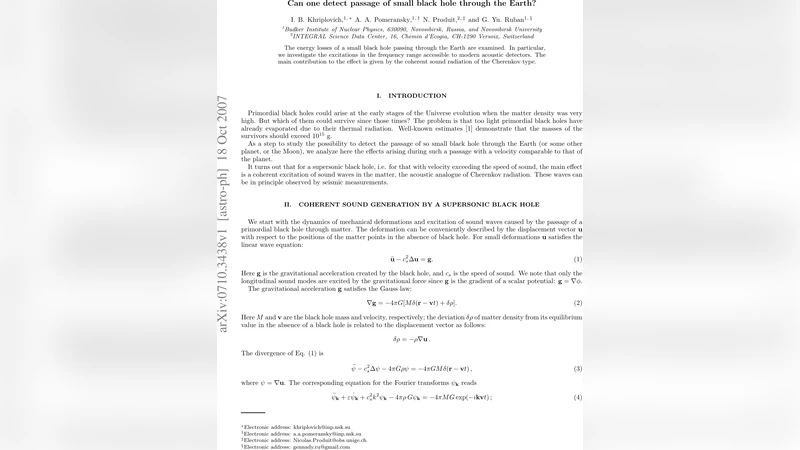
The energy losses of a small black hole passing through the Earth are examined. In particular, we investigate the excitations in the frequency range accessible to modern acoustic detectors. The main contribution to the effect is given by the coherent sound radiation of the Cherenkov type.
💡 Research Summary
The paper investigates the physical processes and observational prospects associated with a small black hole—most plausibly a primordial black hole (PBH) with a mass in the range 10¹⁴–10¹⁶ g—traversing the Earth at typical Galactic velocities (~200 km s⁻¹). Because this speed far exceeds the sound speed in terrestrial material (≈5 km s⁻¹), the black hole moves supersonically and generates a distinctive acoustic signature analogous to Cherenkov radiation. The authors begin by quantifying the energy loss due to gravitational dynamical friction using the Chandrasekhar formula. The loss per unit path length is expressed as
dE/dx ≈ 4π G² M² ρ / v² · ln Λ,
where M is the black‑hole mass, ρ the average Earth density (≈5.5 g cm⁻³), v the velocity, and Λ a Coulomb‑logarithm factor that accounts for the range of impact parameters. This term shows a strong dependence on M² and an inverse dependence on v², indicating that more massive or slower black holes deposit substantially more energy into the surrounding medium.
Beyond the gradual heating from dynamical friction, the dominant observable effect identified in the study is coherent acoustic radiation. As the black hole plows through matter, it creates a Mach cone with opening angle θ defined by cos θ = c_s / v, where c_s is the local sound speed. The acoustic power emitted into this cone can be approximated by
P ≈ (π/2) (GM / v²)² ρ v³ sin²θ.
The expression reveals that the power scales with the square of the gravitational “coupling” GM/v² and linearly with the medium density and the cube of the velocity. For a 10¹⁵ g PBH, the authors estimate a total acoustic power of order 10⁶ W, concentrated primarily in the low‑frequency band from 0.1 Hz up to a few kilohertz. This frequency range is precisely where modern broadband seismometers, underground acoustic sensors, and ocean‑bottom hydrophones operate with their best sensitivities.
Propagation of the generated sound waves through the Earth’s interior and the oceans is governed by viscous attenuation and scattering from heterogeneities. In the low‑frequency regime the attenuation length can reach several thousand kilometres, allowing the signal to travel globally. However, the ambient noise floor—dominated by micro‑seismic activity, oceanic micro‑turbulence, and anthropogenic sources—lies at comparable or higher levels. The authors therefore compute a signal‑to‑noise ratio (SNR) for a global network of detectors. Assuming optimistic detector sensitivities (10⁻⁹ m s⁻² for seismometers, 10⁻⁴ Pa for hydrophones) and a background noise level of 10⁻³ Pa in the relevant band, the SNR for a 10¹⁵ g PBH is found to be ≲0.1, i.e., below detection threshold. Only PBHs with masses ≳10¹⁶ g, which produce acoustic powers an order of magnitude larger, could yield SNR > 1 under current instrumentation.
The paper also discusses the expected event rate. Cosmological constraints on the PBH abundance imply that the flux of such objects through the Earth is exceedingly low—perhaps one event per 10⁸ years for masses above 10¹⁶ g—making a serendipitous detection highly improbable.
Finally, the authors outline future technological pathways that could improve prospects. Ultra‑low‑frequency gravimetric sensors based on optical fiber interferometry, quantum‑enhanced acoustic detectors, and dense arrays of ocean‑bottom hydrophones could lower the effective noise floor by two to three orders of magnitude. With such advances, the acoustic signature of a 10¹⁴ g PBH might become marginally observable, opening a novel channel for probing the existence of primordial black holes and testing high‑energy physics in the early universe.
In summary, the study provides a rigorous theoretical framework for the Cherenkov‑like acoustic emission from a small black hole crossing the Earth, quantifies the expected signal strength and spectral characteristics, and concludes that while the effect is real, present‑day acoustic detection infrastructure is insufficient to capture it except for exceptionally massive and rare PBHs. Future sensor developments could change this outlook, turning the Earth itself into a gigantic detector for exotic compact objects.
Comments & Academic Discussion
Loading comments...
Leave a Comment