Superintegrability on N-dimensional spaces of constant curvature from so(N+1) and its contractions
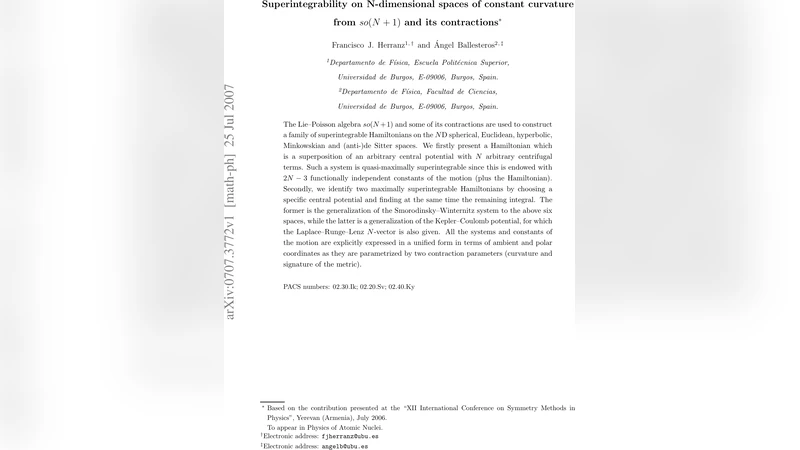
The Lie-Poisson algebra so(N+1) and some of its contractions are used to construct a family of superintegrable Hamiltonians on the ND spherical, Euclidean, hyperbolic, Minkowskian and (anti-)de Sitter spaces. We firstly present a Hamiltonian which is a superposition of an arbitrary central potential with N arbitrary centrifugal terms. Such a system is quasi-maximally superintegrable since this is endowed with 2N-3 functionally independent constants of the motion (plus the Hamiltonian). Secondly, we identify two maximally superintegrable Hamiltonians by choosing a specific central potential and finding at the same time the remaining integral. The former is the generalization of the Smorodinsky-Winternitz system to the above six spaces, while the latter is a generalization of the Kepler-Coulomb potential, for which the Laplace-Runge-Lenz N-vector is also given. All the systems and constants of the motion are explicitly expressed in a unified form in terms of ambient and polar coordinates as they are parametrized by two contraction parameters (curvature and signature of the metric).
💡 Research Summary
This paper presents a unified algebraic framework for constructing superintegrable Hamiltonian systems on a broad class of N‑dimensional constant‑curvature spaces, including spherical, Euclidean, hyperbolic, Minkowskian, de Sitter and anti‑de Sitter manifolds. The authors start from the Lie‑Poisson algebra so(N + 1), whose generators encode the symmetries of an (N + 1)‑dimensional rotation group. By introducing two contraction parameters—curvature κ and metric signature σ—they obtain six inequivalent contracted algebras that correspond precisely to the six geometries mentioned above (κ > 0, σ = +1 → Sⁿ; κ < 0, σ = +1 → Hⁿ; κ = 0, σ = +1 → Eⁿ; σ = −1 gives the Lorentzian counterparts). This double‑parameter contraction allows the same algebraic expressions to be used for all cases, with κ and σ simply inserted as numerical values.
The first family of Hamiltonians considered is
H = T_{κ,σ} + V(r) + ∑{i=1}^{N} α_i / x_i²,
where T{κ,σ} is the kinetic energy appropriate to the chosen curvature and signature, V(r) is an arbitrary central potential, and the α_i‑terms are N independent centrifugal barriers. By exploiting the underlying so(N + 1) structure, the authors construct 2N − 3 functionally independent quadratic integrals of motion (generalised angular momenta and combinations involving the centrifugal terms) in addition to the Hamiltonian itself. Consequently, this system is classified as quasi‑maximally superintegrable.
To achieve maximal superintegrability, the central potential is specialised in two distinct ways. The first specialization yields a multidimensional Smorodinsky‑Winternitz (SW) model:
V_{SW}(r) = ω² r² + ∑_{i=1}^{N} β_i / x_i².
For this choice, the authors identify an additional N − 1 quadratic integrals, bringing the total number of independent constants to 2N − 2, which meets the maximal superintegrability criterion. The SW system thus obtained is a direct curvature‑ and signature‑dependent extension of the well‑known flat‑space SW oscillator, and its symmetry algebra can be interpreted as a deformation of so(2N).
The second specialization corresponds to the Kepler‑Coulomb (KC) potential:
V_{KC}(r) = −γ / r.
In this case the usual angular‑momentum integrals are supplemented by an N‑component Laplace‑Runge‑Lenz (LRL) vector that the authors construct explicitly for arbitrary κ and σ. The LRL vector remains conserved even on curved backgrounds, demonstrating that the hidden symmetry responsible for the closed Keplerian orbits survives the curvature deformation. Together with the angular momenta, the LRL vector provides the full set of 2N − 2 independent integrals required for maximal superintegrability.
A notable technical achievement of the work is the expression of all Hamiltonians, integrals and equations of motion in a unified coordinate language. Using ambient coordinates X_A (A = 0,…,N) together with polar (or hyperspherical) coordinates (r, θ_1,…,θ_{N‑1}), the authors write compact formulas where κ and σ appear only as parameters. This eliminates the need for separate derivations for each geometry and makes the transition between spaces a trivial substitution.
The paper concludes by discussing the broader implications of the framework. By providing a systematic method to generate both quasi‑maximal and maximal superintegrable systems on any constant‑curvature manifold, it opens avenues for quantum‑mechanical investigations (e.g., exact solvability of the corresponding Schrödinger equations), for the study of classical trajectories in curved spacetimes, and for possible applications in cosmology where curvature effects are non‑negligible. Moreover, the double‑parameter contraction technique may be extended to other Lie algebras, potentially yielding new families of integrable models with richer symmetry structures. Future work is suggested on quantisation issues, spectral analysis, and connections with supersymmetric extensions.
Comments & Academic Discussion
Loading comments...
Leave a Comment