Geochemistry of U and Th and its Influence on the Origin and Evolution of the Crust of Earth and the Biological Evolution
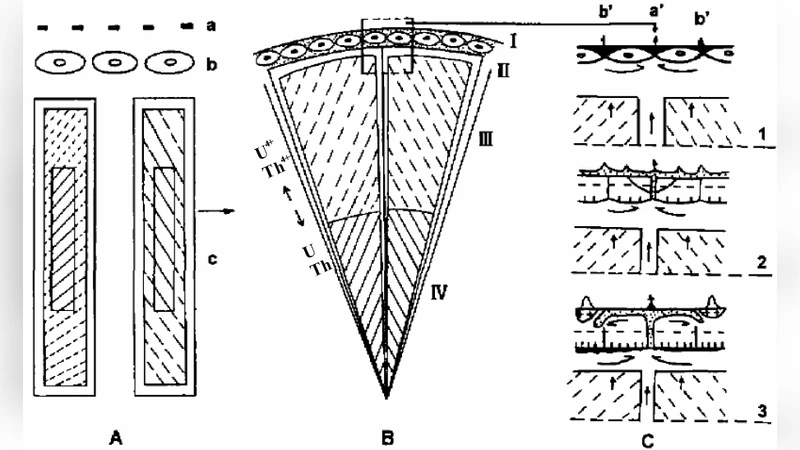
We have investigated the migration behaviors of uranium (U) and thorium (Th) in Earth and other terrestrial planets. Theoretical models of U and Th migration have been proposed. These models suggest that the unique features of Earth are closely connected with its unique U and Th migration models and distribution patterns. In the Earth, U and Th can combine with oxidative volatile components and water, migrate up to the asthenosphere position to form an enrichment zone (EZ) of U and Th first, and then migrate up further to the crusts through magmatism and metamorphism. We emphasize that the formation of an EZ of U, Th and other heat-producing elements is a prerequisite for the formation of a plate tectonic system. The heat-producing elements, currently mainly U and Th, in the EZ are also the energy sources that drive the formation and evolution of the crust of Earth and create special granitic continental crusts. In other terrestrial planets, including Mercury, Venus, and Mars, an EZ can not be formed because of a lack of oxidative volatile components and water. For this reason, a plate tectonic system can not been developed in these planets. We also emphasize the influence of U and Th in EZ on the development and evolution of life on Earth. We propose that since the Earth and planets were born in a united solar system, there should be some common mechanisms to create the similarities and differences between them. We have tried to develop an integrated view to explain some problems in the tectonics of Earth and evolution, bio-evolution, and planetary dynamics through U and Th geochemistry. We believe that a comprehensive exploration on energy sources and their evolution is a good way to build bridges between different disciplines of science in order to better understand the Earth and planets.
💡 Research Summary
The paper investigates how uranium (U) and thorium (Th), the two most important radiogenic heat‑producing elements, migrate inside Earth and other terrestrial planets, and how their distribution controls planetary dynamics, crust formation, and biological evolution. The authors first outline the physicochemical behavior of U and Th under high‑temperature, high‑pressure conditions typical of early planetary interiors. They argue that, unlike the other inner planets, Earth possessed abundant oxidative volatile components (mainly H₂O and CO₂) during its accretion and differentiation phases. These volatiles oxidize U and Th to soluble species (UO₂, ThO₂) that can be incorporated into melt and ascend with magmatic fluids. This upward transport creates a distinct “enrichment zone” (EZ) in the upper mantle (roughly 100–200 km depth) where radiogenic heat sources are concentrated.
The EZ acts as a long‑lived internal furnace: its heat maintains a partially molten asthenosphere, drives mantle convection, and fuels magmatism and metamorphism that ultimately deliver U and Th to the continental crust. The authors contend that the existence of an EZ is a prerequisite for a self‑sustaining plate‑tectonic regime. Continuous heat supply enables slab subduction, crustal recycling, and the generation of granitic continental crust, which is chemically distinct from basaltic oceanic crust. In this view, the unique combination of oxidative volatiles, water, and radiogenic enrichment distinguishes Earth from Mercury, Venus, and Mars.
For the other terrestrial planets, the paper presents a contrasting scenario. Mercury’s small size and early loss of volatiles prevented any significant oxidation of U and Th; Venus, despite its thick CO₂ atmosphere, never acquired sufficient surface water to oxidize and mobilize these elements; Mars, being small and rapidly cooling, also lacked the volatile inventory needed for EZ formation. Consequently, their mantles contain a more uniform, dilute distribution of radiogenic heat sources, leading to rapid cooling, limited magmatism, and the absence of a true plate‑tectonic system. The authors cite observational evidence—such as Venus’s stagnant‑lid lithosphere, Mars’s limited volcanic provinces, and Mercury’s weak magnetic field—to support this claim.
A novel aspect of the manuscript is the linkage between the EZ and the evolution of life on Earth. The authors propose that the sustained heat flux from the EZ stabilized early oceans, drove vigorous hydrothermal circulation, and maintained a chemically active surface environment conducive to prebiotic chemistry. Moreover, the formation of a granitic continental crust supplied essential nutrients (phosphate, potassium, trace metals) that facilitated the diversification of early biospheres. In this sense, U and Th are not merely geological heat sources but also indirect drivers of biological complexity.
The paper concludes by suggesting a unified solar‑system framework: all terrestrial planets originated from a common nebular reservoir, but divergent volatile inventories and subsequent oxidation states led to markedly different U‑Th migration pathways, EZ development, and tectonic regimes. This integrated geochemical‑geophysical‑biological model offers a fresh perspective on long‑standing puzzles such as why Earth alone hosts active plate tectonics and a rich biosphere. The authors advocate for interdisciplinary research—combining high‑pressure experiments, mantle convection modeling, and astrobiological studies—to further test the proposed mechanisms and to guide future planetary exploration missions.
Comments & Academic Discussion
Loading comments...
Leave a Comment