The Relationship between Tsallis Statistics, the Fourier Transform, and Nonlinear Coupling
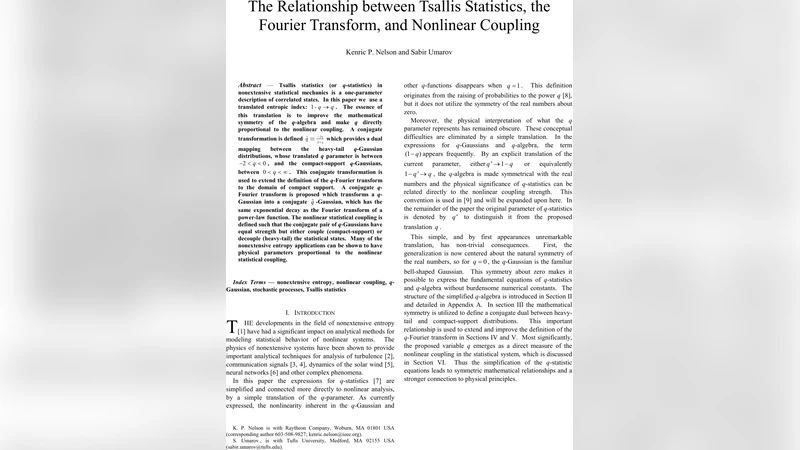
Tsallis statistics (or q-statistics) in nonextensive statistical mechanics is a one-parameter description of correlated states. In this paper we use a translated entropic index: $1 - q \to q$ . The essence of this translation is to improve the mathematical symmetry of the q-algebra and make q directly proportional to the nonlinear coupling. A conjugate transformation is defined $\hat q \equiv \frac{{- 2q}}{{2 + q}}$ which provides a dual mapping between the heavy-tail q-Gaussian distributions, whose translated q parameter is between $ - 2 < q < 0$, and the compact-support q-Gaussians, between $0 < q < \infty $ . This conjugate transformation is used to extend the definition of the q-Fourier transform to the domain of compact support. A conjugate q-Fourier transform is proposed which transforms a q-Gaussian into a conjugate $\hat q$ -Gaussian, which has the same exponential decay as the Fourier transform of a power-law function. The nonlinear statistical coupling is defined such that the conjugate pair of q-Gaussians have equal strength but either couple (compact-support) or decouple (heavy-tail) the statistical states. Many of the nonextensive entropy applications can be shown to have physical parameters proportional to the nonlinear statistical coupling.
💡 Research Summary
The paper revisits the mathematical foundations of Tsallis (or q‑) statistics, introducing a simple yet powerful re‑parameterization and a conjugate transformation that together bridge the gap between heavy‑tail and compact‑support probability distributions and extend the q‑Fourier transform to a broader domain.
First, the authors replace the conventional entropic index (q) by the translated quantity (1-q\to q). This translation is not merely cosmetic; it restores a hidden symmetry in the q‑algebra and makes the new (q) directly proportional to a “nonlinear statistical coupling” parameter. In this framework, positive (q) corresponds to compact‑support q‑Gaussian distributions (finite support), while negative (q) in the interval (-2<q<0) yields heavy‑tail q‑Gaussians that decay as power laws.
The central technical device is the conjugate transformation
\
Comments & Academic Discussion
Loading comments...
Leave a Comment