Bicategory of entwinings
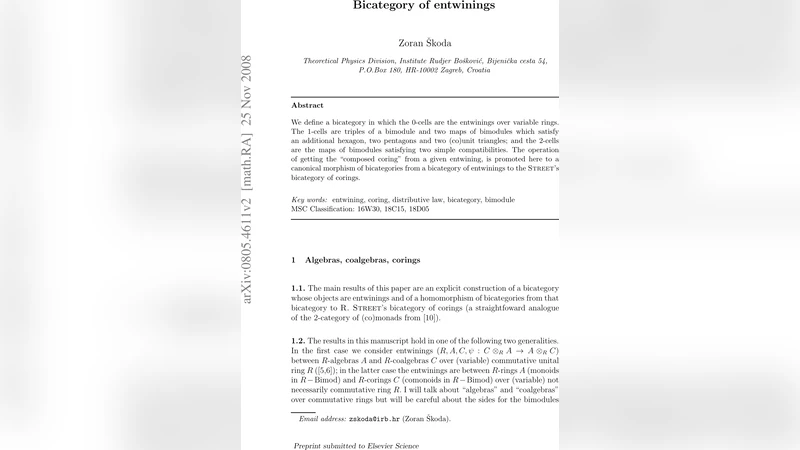
We define a bicategory in which the 0-cells are the entwinings over variable rings. The 1-cells are triples of a bimodule and two maps of bimodules which satisfy an additional hexagon, two pentagons and two (co)unit triangles; and the 2-cells are the maps of bimodules satisfying two simple compatibilities. The operation of getting the “composed coring” from a given entwining, is promoted here to a canonical morphism of bicategories from a bicategory of entwinings to the Street’s bicategory of corings.
💡 Research Summary
The paper introduces a new bicategory, denoted Entw, whose objects (0‑cells) are entwinings over variable base rings. An entwining consists of a base ring R, an R‑algebra A, an R‑coalgebra C, and a mixed distributive law ψ : C⊗₍R₎A → A⊗₍R₎C. The authors’ aim is to lift the well‑known construction that associates to any entwining a “composed coring” into a fully functorial morphism of bicategories, thereby linking the theory of entwinings with Street’s bicategory of corings.
1‑Cells.
A 1‑cell from an entwining (R,A,C,ψ) to another (S,B,D,φ) is a triple (M,α,β) where M is an (R,S)‑bimodule, α : C⊗₍R₎M → M⊗₍S₎D and β : M⊗₍S₎B → A⊗₍R₎M are bimodule maps. These maps must satisfy a collection of coherence conditions:
- a hexagon expressing the compatibility of α and β with the two mixed distributive laws ψ and φ;
- two pentagons, one for α and one for β, guaranteeing that each respects the associativity of the coalgebra (for α) or the algebra (for β);
- two (co)unit triangles ensuring that α and β interact correctly with the counit of C/D and the unit of A/B.
These equations are precisely the higher‑dimensional analogues of the usual entwining axioms, now lifted to the level of morphisms between entwinings.
2‑Cells.
Given two 1‑cells (M,α,β) and (N,α′,β′) between the same pair of entwinings, a 2‑cell is an (R,S)‑bimodule homomorphism θ : M → N that makes the obvious squares commute:
θ⊗id ∘ α = α′ ∘ (id⊗θ) and
id⊗θ ∘ β = β′ ∘ (θ⊗id).
Thus a 2‑cell is simply a compatible bimodule map; no extra higher coherence is required.
Bicategorical Structure.
Horizontal composition of 1‑cells is defined by tensoring the underlying bimodules and composing the α,β maps using the tensor product. The coherence axioms for the hexagon, pentagons and triangles are shown to be preserved under this composition, guaranteeing associativity up to canonical isomorphism. Vertical composition of 2‑cells is ordinary composition of bimodule maps, and the interchange law holds because all diagrams are built from tensor products and the given coherence equations. The authors verify the existence of identity 1‑cells (given by the regular bimodule R with identity α,β) and identity 2‑cells, thereby establishing that Entw is indeed a bicategory.
From Entw to Street’s Coring Bicategory.
The central construction of the paper is a bicategorical morphism
Φ : Entw → Coring,
where Coring is the bicategory introduced by Street whose objects are corings (A‑coring structures on an algebra A), 1‑cells are bimodules equipped with compatible comultiplication and counit maps, and 2‑cells are bimodule maps respecting those structures. Φ acts on objects by sending an entwining (R,A,C,ψ) to the composed coring (A⊗₍R₎C, Δ, ε) obtained in the classical way: the comultiplication Δ and counit ε are built from ψ, the coalgebra structure of C and the algebra structure of A. On 1‑cells, Φ sends (M,α,β) to the bimodule M equipped with a comultiplication Δ_M and counit ε_M defined by pasting α and β with the underlying coalgebra and algebra maps. The coherence conditions for (M,α,β) guarantee that (M,Δ_M,ε_M) satisfies the axioms of a coring 1‑cell. On 2‑cells, Φ is simply the identity on the underlying bimodule map, which automatically respects the coring structures because of the 2‑cell compatibility conditions.
The authors prove that Φ preserves both horizontal and vertical composition, and that it sends identity 1‑cells and 2‑cells to identities. Consequently Φ is a strict morphism of bicategories. This result upgrades the classical “entwining → coring” construction from a set‑theoretic or categorical level to a fully functorial bicategorical level.
Examples and Applications.
Several illustrative examples are provided. For a Hopf algebra H over a commutative ring k, the standard entwining between H and its dual yields the well‑known Sweedler coring; Φ reproduces this construction within the bicategorical framework. The paper also discusses non‑commutative base rings, showing that the bicategory Entw accommodates entwinings where the base ring varies, a situation that arises in the study of Hopf algebroids and quantum groupoids. Moreover, the authors hint at potential applications to non‑commutative geometry, where corings model quasi‑coherent sheaves over non‑commutative spaces, and entwinings encode actions of quantum symmetries.
Conclusion and Outlook.
By defining Entw and constructing the canonical bicategorical morphism Φ to Street’s Coring bicategory, the paper provides a unifying categorical framework that simultaneously captures entwinings, their associated corings, and the morphisms between them. This bicategorical perspective clarifies the functorial nature of the entwining‑to‑coring passage, opens the door to higher‑dimensional generalisations (e.g., double corings, multi‑entwinings), and suggests new avenues for applying these ideas in Hopf algebroid theory, quantum groupoids, and non‑commutative algebraic geometry.
Comments & Academic Discussion
Loading comments...
Leave a Comment