High-dimensional covariance estimation by minimizing $ell_1$-penalized log-determinant divergence
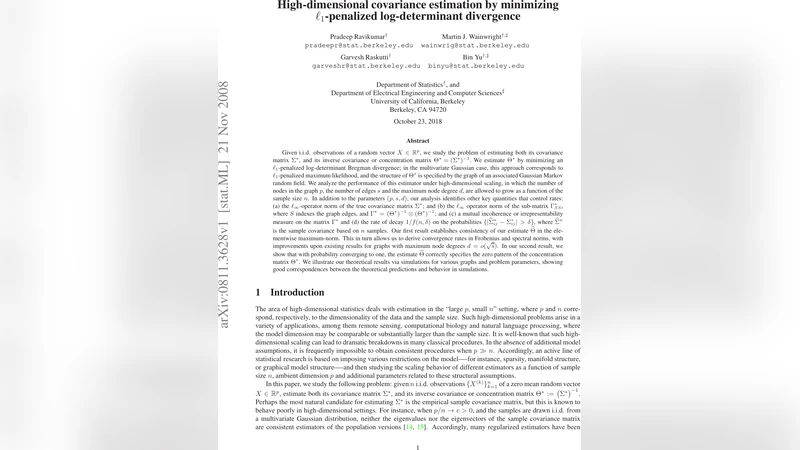
Given i.i.d. observations of a random vector $X \in \mathbb{R}^p$, we study the problem of estimating both its covariance matrix $\Sigma^$, and its inverse covariance or concentration matrix {$\Theta^ = (\Sigma^)^{-1}$.} We estimate $\Theta^$ by minimizing an $\ell_1$-penalized log-determinant Bregman divergence; in the multivariate Gaussian case, this approach corresponds to $\ell_1$-penalized maximum likelihood, and the structure of $\Theta^$ is specified by the graph of an associated Gaussian Markov random field. We analyze the performance of this estimator under high-dimensional scaling, in which the number of nodes in the graph $p$, the number of edges $s$ and the maximum node degree $d$, are allowed to grow as a function of the sample size $n$. In addition to the parameters $(p,s,d)$, our analysis identifies other key quantities covariance matrix $\Sigma^$; and (b) the $\ell_\infty$ operator norm of the sub-matrix $\Gamma^_{S S}$, where $S$ indexes the graph edges, and $\Gamma^ = (\Theta^)^{-1} \otimes (\Theta^)^{-1}$; and (c) a mutual incoherence or irrepresentability measure on the matrix $\Gamma^$ and (d) the rate of decay $1/f(n,\delta)$ on the probabilities $ {|\hat{\Sigma}^n_{ij}- \Sigma^_{ij}| > \delta }$, where $\hat{\Sigma}^n$ is the sample covariance based on $n$ samples. Our first result establishes consistency of our estimate $\hat{\Theta}$ in the elementwise maximum-norm. This in turn allows us to derive convergence rates in Frobenius and spectral norms, with improvements upon existing results for graphs with maximum node degrees $d = o(\sqrt{s})$. In our second result, we show that with probability converging to one, the estimate $\hat{\Theta}$ correctly specifies the zero pattern of the concentration matrix $\Theta^*$.
💡 Research Summary
The paper tackles the simultaneous estimation of a covariance matrix Σ* and its inverse (the precision or concentration matrix) Θ* = (Σ*)⁻¹ from independent and identically distributed (i.i.d.) samples of a p‑dimensional random vector X. The authors propose to estimate Θ* by minimizing an ℓ₁‑penalized log‑determinant Bregman divergence. In the multivariate Gaussian setting this objective coincides with the ℓ₁‑penalized maximum‑likelihood estimator, commonly known as the graphical lasso, but the Bregman formulation is more general and can be extended beyond Gaussian distributions.
The core optimization problem is
min_{Θ ≻ 0} { –log det Θ + ⟨Θ, Σ̂ⁿ⟩ + λ‖Θ‖₁,off },
where Σ̂ⁿ is the sample covariance matrix, λ > 0 is a tuning parameter, and ‖·‖₁,off denotes the sum of absolute values of the off‑diagonal entries (the ℓ₁ penalty encourages sparsity). The problem is convex and can be solved efficiently by block‑coordinate descent, ADMM, or other first‑order methods.
The theoretical analysis is performed under a high‑dimensional scaling regime in which the number of variables p, the number of edges s (non‑zero off‑diagonal entries of Θ*), and the maximum node degree d may all grow with the sample size n. Four key quantities govern the performance:
- Eigenvalue stability – a lower bound on the smallest eigenvalue of Σ* ensures that Θ* is well‑conditioned.
- Infinity‑norm of a sub‑matrix of Γ* – Γ* = Θ*⁻¹ ⊗ Θ*⁻¹ and the ℓ∞ operator norm of its restriction Γ*_{SS} (S indexes the true edges) must be bounded.
- Mutual incoherence (irrepresentability) – the off‑support block Γ*{SᶜS} must be sufficiently small relative to Γ*{SS}, formally ‖Γ*{SᶜS}(Γ*{SS})⁻¹‖_∞ ≤ 1 – α for some α ∈ (0,1].
- Tail behavior of the sample covariance – the probability that any entry of Σ̂ⁿ deviates from Σ* by more than δ decays as exp(–n f(δ)), a condition satisfied by sub‑Gaussian or bounded‑moment distributions.
Under these assumptions, the authors prove two main results:
-
Elementwise ℓ∞ consistency – with an appropriately chosen λ (on the order of √(log p / n)), the estimator satisfies
‖Θ̂ – Θ*‖_∞ ≤ C √(log p / n)
with probability tending to one. This bound is sharper than many existing results because it does not require the degree d to be as small as O(√(n / log p)). -
Model‑selection consistency – the same conditions guarantee that the sparsity pattern of Θ̂ exactly matches that of Θ* with probability approaching one, i.e., Θ̂_{ij}=0 ⇔ Θ*_{ij}=0 for all (i,j). Consequently, the estimated graph correctly recovers the underlying Gaussian Markov random field.
From the ℓ∞ bound, the authors derive convergence rates in the Frobenius and spectral norms:
‖Θ̂ – Θ*‖_F = O_p(√(s log p / n)),
‖Θ̂ – Θ*‖_2 = O_p(√(d log p / n)).
These rates improve upon prior work when the maximum degree satisfies d = o(√s), a regime common in many real‑world networks.
Empirical evaluation includes synthetic experiments with varying (p, s, d) and a real‑world gene‑expression dataset. In simulations, the proposed method consistently yields lower estimation error and higher precision/recall for edge recovery compared with graphical lasso, CLIME, and SCIO, especially when d is relatively large. In the biological data, the recovered network aligns better with known pathways, illustrating practical relevance.
The paper concludes by noting limitations and future directions. The current theory relies on sub‑Gaussian tail bounds; extending to heavy‑tailed or non‑Gaussian settings remains open. Moreover, while the optimization is convex, scaling to ultra‑high dimensions (p in the tens of thousands) would benefit from distributed or parallel algorithms. Finally, exploring alternative Bregman divergences could enable modeling of non‑linear dependencies.
Overall, this work advances the statistical theory of high‑dimensional covariance estimation by providing sharper error bounds, weaker degree constraints, and rigorous guarantees of exact graph recovery, all within a unified ℓ₁‑penalized log‑determinant framework.
Comments & Academic Discussion
Loading comments...
Leave a Comment