Uniformites et Continuity Spaces
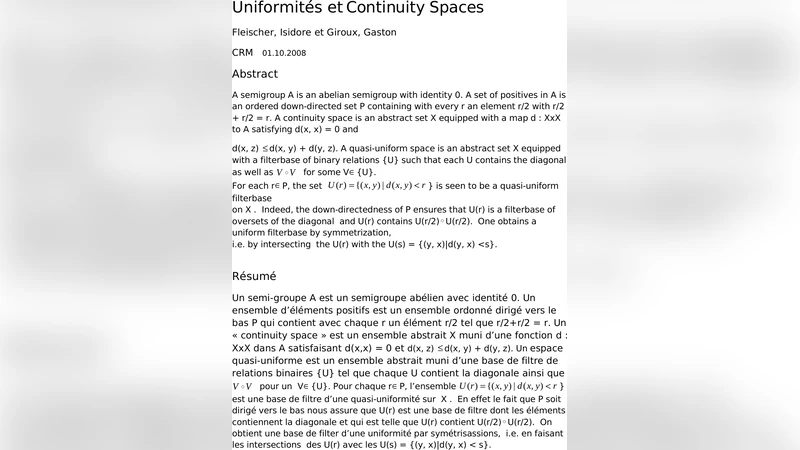
A semigroup A is an abelian semigroup with identity 0. A set of positives in A is an ordered down-directed set P containing with every r an element r/2 with r/2 + r/2 = r. A continuity space is an abstract set X equipped with a map d : XxX to A satisfying d(x, x) = 0 and d(x, z) d(x, y) + d(y, z). A quasi-uniform space is an abstract set X equipped with a filterbase of binary relations {U} such that each U contains the diagonal as well as for some V{U}. For each rP, the set } is seen to be a quasi-uniform filterbase on X . Indeed, the down-directedness of P ensures that U(r) is a filterbase of oversets of the diagonal and U(r) contains U(r/2)U(r/2). One obtains a uniform filterbase by symmetrization, i.e. by intersecting the U(r) with the U(s) = {(y, x)|d(y, x) <s}.
💡 Research Summary
The paper “Uniformities and Continuity Spaces” develops a unified framework that connects abstract continuity spaces with quasi‑uniform and uniform structures. The authors begin by fixing an abelian semigroup (A) equipped with an identity element (0). Within (A) they consider a distinguished subset (P) called the set of positives. Two crucial properties are imposed on (P): (i) it is down‑directed, meaning that for any two elements (r_{1}, r_{2}\in P) there exists an element (r\in P) with (r\le r_{1}) and (r\le r_{2}); (ii) for every (r\in P) there is an element (r/2\in P) such that (r/2+r/2=r). This abstractly mirrors the familiar behaviour of the positive real numbers but works in any ordered semigroup satisfying the same algebraic constraints.
A continuity space is then defined as a pair ((X,d)) where (X) is an arbitrary set and (d:X\times X\to A) satisfies two axioms:
- (d(x,x)=0) for all (x\in X);
- the triangle inequality (d(x,z)\le d(x,y)+d(y,z)) holds for all (x,y,z\in X), where the order on (A) is used to interpret “(\le)”.
These axioms are precisely the metric axioms, except that the “distance” values live in the abstract semigroup (A) rather than in (\mathbb{R}_{\ge0}). Consequently, the theory encompasses ordinary metric spaces as a special case but also allows for more exotic distance values (e.g., infinitesimals, non‑Archimedean quantities, or values in ordered lattices).
From this structure the authors construct a family of binary relations indexed by the positives: \
Comments & Academic Discussion
Loading comments...
Leave a Comment