Toy quantum categories
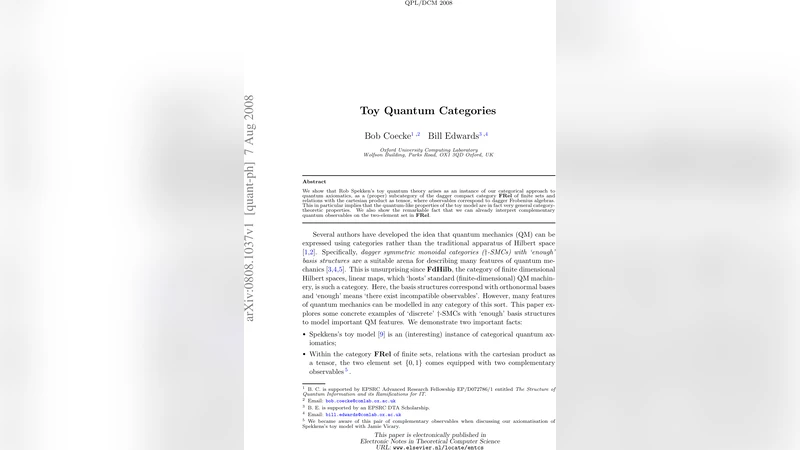
We show that Rob Spekken’s toy quantum theory arises as an instance of our categorical approach to quantum axiomatics, as a (proper) subcategory of the dagger compact category FRel of finite sets and relations with the cartesian product as tensor, where observables correspond to dagger Frobenius algebras. This in particular implies that the quantum-like properties of the toy model are in fact very general category-theoretic properties. We also show the remarkable fact that we can already interpret complementary quantum observables on the two-element set FRel.
💡 Research Summary
This paper establishes a precise categorical embedding of Rob Spekkens’s toy quantum theory within the dagger‑compact category FRel, whose objects are finite sets and morphisms are relations, and whose monoidal product is the Cartesian product. By interpreting observables as dagger Frobenius algebras in FRel, the authors show that the structural ingredients of the toy model—states, measurements, and the epistemic restriction known as the knowledge‑balance principle—arise naturally from purely categorical data.
The construction proceeds in several steps. First, the authors recall the definition of a dagger‑compact category and the notion of a dagger Frobenius algebra, emphasizing that such algebras capture the algebraic essence of orthonormal bases in Hilbert‑space quantum mechanics. They then exhibit explicit dagger Frobenius algebras on finite sets: the multiplication is given by a relation that “copies” elements of a chosen basis, while the comultiplication is its relational converse. These algebras satisfy the Frobenius, associativity, unit, and dagger‑compatibility equations, thereby providing a categorical analogue of a measurement context.
Next, the paper identifies a subcategory of FRel that precisely matches Spekkens’s toy theory. Objects are the same finite sets, but morphisms are restricted to those relations that respect the epistemic constraint—namely, relations that map each epistemic state (a subset of size half the underlying set) to another epistemic state of the same size. Composition of such relations coincides with the usual relational composition, and the dagger is simply relational converse. Within this subcategory, the dagger Frobenius algebras described above become the “X‑basis” and “Z‑basis” of the toy model.
A striking result is that complementary observables can already be realized on the two‑element set {0,1}. The authors construct two distinct dagger Frobenius algebras on this set: one copies the element 0 and 1 (the X‑basis), the other copies the parity‑flipped elements (the Z‑basis). These algebras are not simultaneously diagonalizable; their interaction reproduces the familiar complementarity relations of Pauli X and Z, including the inability to jointly measure both sharply. Consequently, phenomena such as uncertainty, non‑cloning, and even a toy version of teleportation can be expressed diagrammatically using only the categorical machinery of FRel.
By showing that the toy model is a proper subcategory of FRel, the authors demonstrate that the “quantum‑like” behaviour of Spekkens’s construction does not depend on any specific Hilbert‑space structure; rather, it follows from very general categorical properties: dagger compactness, the existence of Frobenius algebras, and a simple size‑preserving restriction on relations. This insight explains why many quantum information protocols have analogues in the toy theory and suggests that the categorical framework captures the essential logical backbone of quantum theory.
Finally, the paper discusses broader implications. Since dagger Frobenius algebras in any dagger‑compact category give rise to complementary observables, the authors argue that the toy model can be viewed as a concrete illustration of a universal phenomenon: the emergence of quantum‑style interference and contextuality from abstract compositional principles. This opens the door to exploring other “toy” theories by selecting different subcategories of FRel or by moving to alternative dagger‑compact categories, potentially shedding light on which categorical features are truly indispensable for quantum mechanics and which are artefacts of the Hilbert‑space formalism.
Comments & Academic Discussion
Loading comments...
Leave a Comment