Rapidly rotating spherical Couette flow in a dipolar magnetic field: an experimental study of the mean axisymmetric flow
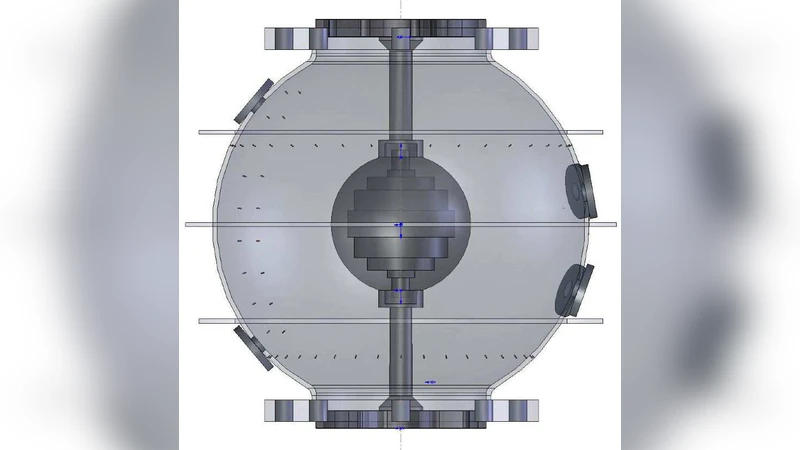
In order to explore the magnetostrophic regime expected for planetary cores, experiments have been conducted in a rotating sphere filled with liquid sodium, with an imposed dipolar magnetic field (the DTS setup). The field is produced by a permanent magnet enclosed in an inner sphere, which can rotate at a separate rate, producing a spherical Couette flow. The flow properties are investigated by measuring electric potentials on the outer sphere, the induced magnetic field in the laboratory frame, and velocity profiles inside the liquid sodium using ultrasonic Doppler velocimetry. The present article focuses on the time-averaged axisymmetric part of the flow. The Doppler profiles show that the angular velocity of the fluid is relatively uniform in most of the fluid shell, but rises near the inner sphere, revealing the presence of a magnetic wind, and gently drops towards the outer sphere. The transition from a magnetostrophic flow near the inner sphere to a geostrophic flow near the outer sphere is controlled by the local Elsasser number. For Rossby numbers up to order 1, the observed velocity profiles all show a similar shape. Numerical simulations in the linear regime are computed, and synthetic velocity profiles are compared with the measured ones. In the geostrophic region, a torque-balance model provides very good predictions. We find that the induced magnetic field varies in a consistent fashion, and displays a peculiar peak in the counter-rotating regime. This happens when the fluid rotation rate is almost equal and opposite to the outer sphere rotation rate. The fluid is then almost at rest in the laboratory frame, and the Proudman-Taylor constraint vanishes, enabling a strong meridional flow. We suggest that dynamo action might be favored in such a situation.
💡 Research Summary
The paper presents a laboratory investigation of magnetostrophic dynamics—where magnetic, Coriolis, and inertial forces are of comparable magnitude—using the DTS (Derviche Tourneur Sodium) experiment. A spherical shell filled with liquid sodium is subjected to a dipolar magnetic field generated by a permanent magnet housed in the inner sphere, while the inner and outer spheres rotate independently, creating a spherical Couette flow. The authors diagnose the flow by measuring electric potentials on the outer sphere, the induced magnetic field in the laboratory frame, and internal velocity profiles with ultrasonic Doppler velocimetry (UDV).
Time‑averaged, axisymmetric results reveal that the fluid’s angular velocity is nearly uniform throughout most of the shell but exhibits a sharp increase near the inner sphere, a phenomenon the authors term a “magnetic wind.” This region is dominated by a local Elsasser number Λ > 1, indicating that magnetic forces control the dynamics. Moving outward, Λ falls below unity, the Coriolis force dominates, and the flow becomes geostrophic. The transition between magnetostrophic and geostrophic regimes occurs smoothly where Λ ≈ 1, demonstrating that the local Elsasser number governs the spatial structure of the flow.
For Rossby numbers up to order unity (|Ro| ≲ 1), all experiments display remarkably similar velocity profiles, suggesting that non‑linear inertial effects remain modest and that linear magnetohydrodynamic theory can capture the essential physics. The authors corroborate this by performing linear numerical simulations; synthetic velocity profiles from the model agree well with the UDV measurements. In the geostrophic region, a torque‑balance model that equates viscous, magnetic, and Coriolis torques accurately predicts the observed shear and matches independent torque measurements.
A striking feature emerges in the counter‑rotating regime, where the outer sphere rotates opposite to the inner sphere. When the fluid’s absolute rotation rate approaches zero, the Proudman‑Taylor constraint—normally suppressing meridional motions in rapidly rotating systems—vanishes. Consequently, a strong meridional circulation develops, and the induced magnetic field exhibits a pronounced peak. The authors argue that this state, with the fluid nearly at rest in the laboratory frame, may be especially favorable for dynamo action because the enhanced meridional flow can more efficiently stretch and fold magnetic field lines.
In summary, the study demonstrates that (i) the local Elsasser number dictates the transition from magnetic‑wind‑dominated flow near the inner sphere to geostrophic flow near the outer sphere, (ii) linear MHD models and a simple torque‑balance framework successfully reproduce the measured axisymmetric velocity fields, and (iii) counter‑rotation creates conditions—minimal absolute rotation and strong meridional flow—that could promote dynamo generation. These findings provide valuable experimental validation for theories of planetary core dynamics and offer practical guidance for designing laboratory dynamos.
Comments & Academic Discussion
Loading comments...
Leave a Comment