Action Theory Evolution
Like any other logical theory, domain descriptions in reasoning about actions may evolve, and thus need revision methods to adequately accommodate new information about the behavior of actions. The present work is about changing action domain descrip…
Authors: Ivan Varzinczak
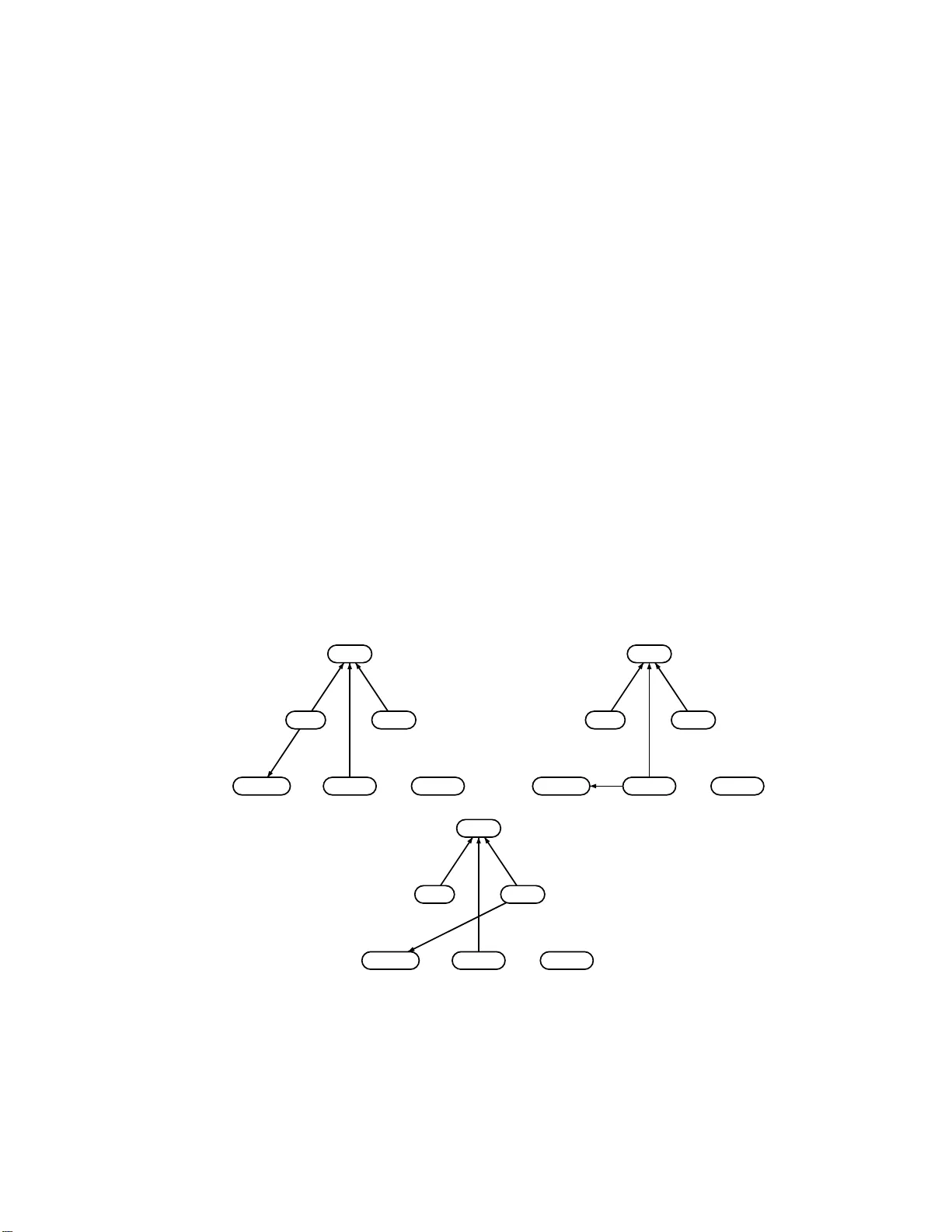
Action Theory Ev olution Iv an Jos ´ e V arzinczak Merak a Institute CSIR Pretoria, South Africa ivan.varzin czak@meraka. org.za Abstract Like an y other logical theory , domain descriptions in rea soning ab out actions may ev olv e, and th us need revision methods to ade- quately accommo date new informatio n ab out the b ehavior of actions. The pr esent w ork is ab out changing action domain descr iptions in prop ositional dynamic lo gic. Its contribution is threefold: first we revisit the semantics o f a ction theory contraction that has b een do ne in previo us work, giving more r o bust op erator s that expre ss minimal change based on a notion of distance b etw een Kripke-models . Second we give algorithms for syntactical actio n theor y contraction a nd estab- lish their correctness w.r.t. our semantics. Finally we state postulates for action theory con traction and assess the behavior of our operato rs w.r.t. them. Moreov er, w e also addr ess the revision co un terpart of action theo ry change, showing that it b enefits from our semantics for contraction. 1 Con ten ts 1 In tro duction 4 2 Logical Preliminaries 6 2.1 Action Theories in Dynamic Logic . . . . . . . . . . . . . . . 6 2.2 Essen tial A toms . . . . . . . . . . . . . . . . . . . . . . . . . . 11 2.3 Prime V aluations . . . . . . . . . . . . . . . . . . . . . . . . . 12 2.4 Closeness b et w een Mo dels . . . . . . . . . . . . . . . . . . . . 1 3 3 Seman tics of Action Theory Change 13 3.1 Mo del Contrac tion of Ex ecutabilit y La ws . . . . . . . . . . . 1 4 3.2 Mo del Contrac tion of Effect L a w s . . . . . . . . . . . . . . . . 1 6 3.3 Mo del Contrac tion of S tatic Laws . . . . . . . . . . . . . . . . 20 4 Syn tactic Op erators for Con traction of La ws 21 4.1 Con tracting Executabilit y Laws . . . . . . . . . . . . . . . . . 22 4.2 Con tracting Effect Laws . . . . . . . . . . . . . . . . . . . . . 23 4.3 Con tracting Static La ws . . . . . . . . . . . . . . . . . . . . . 27 5 Correctness of the Op e ra tors 28 5.1 Tw o C oun ter-Examples . . . . . . . . . . . . . . . . . . . . . 28 5.2 Mo dular Theories . . . . . . . . . . . . . . . . . . . . . . . . . 30 5.3 Correctness Under Mo du larit y . . . . . . . . . . . . . . . . . 31 6 Assessmen t of Postulates for Change 32 6.1 Con traction or Erasur e? . . . . . . . . . . . . . . . . . . . . . 32 6.2 The P ostulates . . . . . . . . . . . . . . . . . . . . . . . . . . 33 7 A Semantics for Ac tion Theory Revision 37 7.1 Revising a Mo del by a S tatic La w . . . . . . . . . . . . . . . 38 7.2 Revising a Mo del by an Effect La w . . . . . . . . . . . . . . . 40 7.3 Revising a Mo del by an Executabilit y La w . . . . . . . . . . . 41 7.4 Revising Sets of Mo d els . . . . . . . . . . . . . . . . . . . . . 42 8 Related W ork 43 9 Commen ts 46 9.1 Other Distance Notions . . . . . . . . . . . . . . . . . . . . . 46 9.2 Inducing Executabilit y . . . . . . . . . . . . . . . . . . . . . . 47 10 Concluding Remarks 49 A Pro of of Theorem 5.2 56 B Pro of of Theorem 5.3 61 3 1 In tro duction Consider an in telligen t agent designed to p erform rationally in a dynamic w orld, and su pp ose she should reason ab ou t the dy n amics of an automatic coffee mac hin e (Figure 1). S u pp ose, for examp le, that th e agen t b eliev es that coffee is al w a ys a hot b ev erage. Sup p ose no w that some da y she ge ts a coffee an d observ es that it is cold. In suc h a case, the agent must change her b eliefs about the relat ion b et w een the p rop ositions “I h old a coffee” and “I hold a hot b everag e”. This example is an instance of the problem of c hanging prop ositional b elief bases and is largely addr essed in the literat ure ab out b elief change [15 ] and b elief up date [31]. Figure 1: The coffee d eliv er er agen t. Next, let our agen t b eliev e that wh enev er she buys a coffee f rom the mac h ine, sh e gets a hot b ev erage. This means th at in ev ery state of the w orld that follo ws the execution of bu ying a coffee, the agen t p ossesses a hot b eve rage. Then, in a situation wh ere the machine is r unnin g out of cups, after b uying, the coffe e runs thr ough the shelf and th e agen t does not hold a hot b ev erage in h er hands. Imagine no w that the agen t nev er consid er ed any relatio n b et w een b uying a coffee on the mac hine and its service a v ailabilit y , in the sense that the agen t al w a ys b eliev ed that buying do es n ot prev en t other u sers from u sing the mac hine. Neve rtheless, someda y our agen t is queuing to buy a coffee and observes that j u st after the agen t b efore h er has b ough t, the mac h ine w en t out of ord er (ma yb e due to a lack of coffee p owder). Completing our agen t’s struggle in disco v erin g the intricac ies of a coffee mac h ine, supp ose she alw ays b eliev ed that if she has a tok en, then it is 4 p ossible to buy coffe e, pro vided that some other conditions lik e b eing close enough to the b utton, h aving a fr ee h and, etc, are satisfied. Ho wev er, dur ing a blac ko ut, the agen t, ev en with a tok en , do es n ot m anage to buy her coffee. The last thr ee examples illustrate situations where c hanging the b eliefs ab out the b ehavior of th e action of buy in g coffee is mandatory . In the fir s t one, buying coffe e, once b eliev ed to b e deterministic, has no w to b e seen as nondeterministic, or alternativ ely to ha v e a d ifferen t outcome in a more sp ecific con text (e.g. if there is no cup in the machine). In the second example, buying a coffee is n o w kno wn to ha ve side-effects (ramifications) one was n ot aw are of. Fin ally , in the last example, the executa bilit y of the action u nder concern is questioned in the light of n ew information sho w ing a con text that was n ot kno wn to pr eclude its execution. Suc h cases of theory change are v ery imp ortant when one deals with logica l descriptions of dynamic domains: i t ma y alw a ys happ en that one disco v ers that an action actually has a b eha vior that is different from that one has alw a ys b eliev ed it had. Up to n o w , theory change has b een studied mainly for kn o wledge bases in classical logics, b oth in terms of revision and up d ate. Sin ce the w ork b y F uhrm ann [14], only in a few recen t studies has it b een considered in the realm of m o dal logics, viz. in epistemic logic [19] an d in dyn amic logics [21]. Recen tly some studies hav e inv estigated revision of b eliefs ab out facts of the w orld [47, 28] or the agen t’s goals [46]. In our scenario, this would concern for instance the truth of token in a giv en state: th e agen t b eliev es that she has a toke n, but is actually wrong ab out that. Then sh e might su b sequen tly b e forced to revise her beliefs ab out the current state of affairs or c hange her goals according to what she can p erform in th at state. S uc h b elief revision op erations do n ot mo d ify the agen t’s b eliefs ab ou t the action laws . In opp osition to that, here w e are intereste d exactly in suc h mo difications. Starting with Baral and Lob o’s work [4 ], some recen t studies h a v e b een done on that issu e [12, 13] for d omain d escriptions in action languages [16]. W e here tak e a s tep further in this d irection and prop ose a metho d based on th at given by Herzig et al. [21] that is more robu st by in tegrating a notion of minimal change and complying w ith p ostulates of th eory c h ange. The pr esen t text is structur ed as follo ws: in S ection 2 w e establish the formal bac kgrou n d that will b e u sed throughout this work. Secti ons 3 – 5 are the core of the work: in S ection 3 w e present the cen tral defin itions for a seman tics of act ion theory c h ange, Section 4 is dev oted to its synta ctical coun terpart while Section 5 to the pro of of its corresp ond ence with the se- man tics. In Section 6 w e discuss some p ostulates f or con traction/erasure and 5 then p resen t a seman tics for action theory r evision (S ection 7). In Section 8 w e add ress existing w ork in th e fi eld. After making some commen ts on our metho d (Sectio n 9), w e finish with some conclusions an d future directio ns of researc h. 2 Logical Preliminarie s F ollo win g the tradition in the reasoning ab out actions (RAA) comm unity , w e consider ac tion theories to b e finite collections of statemen ts that ha v e the particular f orm: • if c ontext , then effe ct after e v ery exe cution of action (effect laws); • if pr e c ondition , then action exe cu table (executabilit y la ws). Statemen ts mentio ning n o action at all r epresen t la ws ab out the un derlying structure of the world, i.e., its p ossible states (static laws). Sev eral logical framewo rks h a v e been pr op osed to formalize suc h state- men ts. Among the most prominent on es are the Situation Calculus [39, 45], the family of Action Languages [16, 30, 17], the Fluent Calculus [49, 50], and the dynamic log ic-based app roac h es [10, 6, 57]. Here w e opt to formalize action theories us in g a v ers ion of Pr op ositional Dynamic Logic ( PDL ) [20]. 2.1 Action Theories in Dynamic Logic Let Act = { a 1 , a 2 , . . . } b e the set of all atomic action c onstants of a giv en domain. An example of atomic action is buy . T o eac h atomic action a th ere is asso ciated a mo dal op erator [ a ]. 1 Prop = { p 1 , p 2 , . . . } denotes the set of all pr op ositional c onstants , also called fluents or atoms . Examp les of those are token (“the agent has a tok en ”) and c offe e (“the agent holds a coffee”) . T he set of all literals is Lit = { ℓ 1 , ℓ 2 , . . . } , where eac h ℓ i is either p or ¬ p , for some p ∈ Prop . If ℓ = ¬ p , then we id entify ¬ ℓ with p . By | ℓ | we denote the atom in ℓ . W e use small Greek letters ϕ, ψ, . . . to denote Bo ole an formulas . They are recursively defin ed in th e usual w a y: ϕ ::= p | ⊤ | ⊥ | ¬ ϕ | ϕ ∧ ϕ | ϕ ∨ ϕ | ϕ → ϕ | ϕ ↔ ϕ 1 W e here supp ose t h at our m ultimod al logic is indep endently axiomatized [32], i.e., the logic is a fusion an d there is no interaction b etw een th e mo dal op erators. This is a requirement to achiev e mod ularit y of action theories [25] (see further). 6 Fml is the set of all Bo olean formulas. An example of a Bo olean form ula is c offe e → hot . A prop ositional v aluation v is a maximal ly c onsistent set of literals. W e denote by v ϕ the fact that v satisfies a p rop ositional form ula ϕ . By val ( ϕ ) w e d en ote the set of all v aluations satisfying ϕ . | = CPL denotes the classical consequence relation. Cn ( ϕ ) den otes all logical consequences of ϕ in classical prop ositional logic. If ϕ is a pr op ositional form ula, atm ( ϕ ) d enotes the set of element ary atoms actual ly o ccurring in ϕ . F or example, atm ( ¬ p 1 ∧ ( ¬ p 1 ∨ p 2 )) = { p 1 , p 2 } . F or ϕ a Bo olean formula, IP ( ϕ ) denotes the set of its prime impli- c ants [43], i.e., the w eak est terms (conjunctions of literals) that im p ly ϕ . As an example, IP ( p 1 ⊕ p 2 ) = { p 1 ∧ ¬ p 2 , ¬ p 1 ∧ p 2 } . F or more on prime implican ts, their prop erties and ho w to compute them see the c hapter b y Marquis [36]. By π we denote a prime imp lican t, and given ℓ and π , ℓ ∈ π abbreviates ‘ ℓ is a literal of π ’. W e den ote complex formula s (p ossibly w ith m o dal op erators) by Φ, Ψ , . . . They are recurs iv ely d efined in the follo wing w a y: Φ ::= ϕ | [ a ] Φ | ¬ Φ | Φ ∧ Φ | Φ ∨ Φ | Φ → Φ | Φ ↔ Φ h a i is the dual op erator of [ a ], defined as h a i Φ = def ¬ [ a ] ¬ Φ . An example of a complex formula is ¬ c offe e → [ buy ] c offe e . The seman tics is th at of PDL w ith ou t the ∗ op erator, wh ic h amounts to multimodal logic K n [42]. In th e follo w ing we will refer to PDL bu t our underlying logical formalism is essentia lly the simpler multimod al logic K n , whic h turns out to b e exp ressiv e enough for our p urp oses here. Definition 2.1 ( PDL -mo del) A PDL -mo d el is a tuple M = h W , R i wher e W is a set of valuations (also c al le d p ossible world s), and R maps action c onstants a to ac c essibility r e lations R a ⊆ W × W. As an example, for Act = { a 1 , a 2 } and Prop = { p 1 , p 2 } , we ha v e the PDL -mo del M = h W , R i , where W = {{ p 1 , p 2 } , { p 1 , ¬ p 2 } , {¬ p 1 , p 2 }} , R ( a 1 ) = ( { p 1 , p 2 } , { p 1 , ¬ p 2 } ) , ( { p 1 , p 2 } , {¬ p 1 , p 2 } ) , ( { p 1 , ¬ p 2 } , { p 1 , ¬ p 2 } ) , ( { p 1 , ¬ p 2 } , {¬ p 1 , p 2 } ) R ( a 2 ) = { ( { p 1 , p 2 } , {¬ p 1 , p 2 } ) , ( {¬ p 1 , p 2 } , {¬ p 1 , p 2 } ) } Figure 2 giv es a graph ical r epresen tation of M . 2 2 Notice th at our notion of PDL - model do es not follow the standard notion from mo dal 7 M : p 1 , p 2 p 1 , ¬ p 2 ¬ p 1 , p 2 a 1 a 1 a 2 a 1 a 1 a 2 Figure 2: Example of a PD L -mo del for Act = { a 1 , a 2 } , and Prop = { p 1 , p 2 } . Definition 2.2 (T ruth conditions) Given a PD L -mo del M = h W , R i , • | = M w p (p is true at world w of mo del M ) if w p (the valuation w satisfies p, i . e., p ∈ w ); • | = M w [ a ] Φ if | = M w ′ Φ for ev e ry w ′ s.t. ( w, w ′ ) ∈ R a ; • | = M w Φ ∧ Ψ if | = M w Φ and | = M w Ψ ; • | = M w Φ ∨ Ψ if | = M w Φ or | = M w Ψ , or b oth; • | = M w ¬ Φ i f 6| = M w Φ , i.e., not | = M w Φ ; • truth c onditions for the other c onne ctives ar e as usu al. By M we will d enote a set of PDL -mo dels. A PDL -mo del M is a mo del of Φ (denoted | = M Φ ) if an d only if for all w ∈ W , | = M w Φ . In the mo del dep icted in Figure 2, w e hav e | = M p 1 → [ a 2 ] p 2 and | = M p 1 ∨ p 2 . Definition 2.3 (Global c onsequence) M is a mo del of a set of formulas Σ (note d | = M Σ ) if and only if | = M Φ for e v ery Φ ∈ Σ . A formula Φ is a consequence of a set of global axioms Σ in the class of al l PD L -mo dels (note d Σ | = PDL Φ ) if and only if for every PDL -mo del M , if | = M Σ , then | = M Φ . logics: here n o tw o worlds satisfy the same va luation. This is a p ragmatic choice (see Sec- tion 4). Nevertheless, all w e are ab out to state in the sequel can b e straigh tforw ard ly form ulated for standard PDL mo dels as well. 8 With PDL we can state laws describing the b ehavior of actions. One wa y of doing this is by stating some formulas as global axioms. 3 As usually done in the RAA comm u nit y , w e her e distinguish three t yp es of la ws. Th e first kind of statement s are sta tic laws , whic h are Bo olean formulas that m ust hold in ev ery p ossible state of the world. Definition 2.4 (Static L aw) A static la w is a formula ϕ ∈ Fml . An example of a static law is c offe e → hot , sa ying that if the agen t h olds a coffee, then s h e holds a hot b eve rage. The set of all static la ws of a domain is denoted by S ⊆ Fml . In our example w e will h a ve S = { c offe e → hot } . The second kind of act ion la w w e consider is giv en by th e effe ct laws . These are form ulas relating an action to its effects, w hic h can b e conditional. Definition 2.5 (Effect L aw) A n effect law for action a is of the f orm ϕ → [ a ] ψ , wher e ϕ, ψ ∈ Fm l . The consequent ψ is th e effe ct whic h alw a ys obtai ns when action a is exe- cuted in a state wh ere the an tece dent ϕ holds. If a is a nondeterministic action, then th e consequent ψ is typica lly a disjun ction. An example of an effect la w is ¬ c offe e → [ buy ] c offe e , sa ying that in a situation wh ere the agen t has no coffee, after b uying, the agen t h as a coffee. If ψ is inconsisten t, then w e h av e a sp ecial kind of effect law that w e call an inexe cutability law . F or example, w e could also ha v e ¬ token → [ buy ] ⊥ , expressing that buy cannot b e executed if the agen t h as n o tok en. The set of effect la ws of a domain is denoted by E . I n our coffee machine scenario, we could hav e for example: E = ¬ c offe e → [ buy ] c offe e , token → [ buy ] ¬ token , ¬ token → [ buy ] ⊥ Finally , we also define exe cutability laws , whic h stipulate the con text where an action is guarante ed to b e executable. In PD L , the op erator h a i is used to exp ress executabilit y . h a i⊤ th us reads “the execution of a is p ossi- ble”. Definition 2.6 (Executability La w) An executabilit y la w for action a is of the form ϕ → h a i⊤ , wher e ϕ ∈ Fml . 3 An alternative to that is given by Castilho et al. [6], with laws b eing stated with the aid of an extra universal mo dality and lo cal consequen ce b eing thus considered. 9 F or instance, token → h buy i⊤ s a y s that buying can b e executed wheneve r the agent has a token. The set of all executabilit y la ws of a giv en domain is denoted b y X . In our scenario example w e w ould ha ve X = { token → h buy i⊤} . With ou r thr ee b asic types of la ws, we are able to defi ne action theories: Definition 2.7 (Action Theory) Given a domain and any (p ossibly empty) sets of laws S , E , and X , T = S ∪ E ∪ X is an actio n theory . F or giv en action a , E a (resp. X a ) w ill denote th e set of only those effect (resp. executabilit y) laws ab out a . T a = S ∪ E a ∪ X a is then the action theory for a . 4 F or the sak e of clarit y , we abstract here from the f rame and ramifica- tion problems, and su pp ose the agen t’s theory a lready en tails all the rele- v an t frame axioms. W e could ha v e used any su itable solution to the frame problem, lik e e.g. the dep endence relati on [6], which is used in the w ork of Herzig e t al. [21], or a k in d of successor state axioms in a sligh tly m o dified setting [11]. T o m ak e the presentat ion more clear to the r eader, h ere we do not b other with a solution to the frame problem and ju st assume all frame axioms ca n b e inferr ed from the theory . Actually w e can supp ose that all in tended frame axioms are auto matically reco v er ed and stated in th e the- ory , more sp ecific, in the set of effect la ws. 5 Hence the action theory of our example will b e: T = c offe e → hot , token → h buy i⊤ , ¬ c offe e → [ buy ] c offe e , token → [ buy ] ¬ token , ¬ token → [ buy ] ⊥ , c offe e → [ buy ] c offe e , hot → [ buy ] hot (W e ha v e not stated the frame axiom ¬ token → [ buy ] ¬ token b ecause it can b e trivially deduced from the inexecutabilit y la w ¬ token → [ bu y ] ⊥ .) Figure 3 b elo w sho ws a PDL -mo del for the theory T . Giv en an action theory T , s ometimes it will b e useful to consider mo dels whose p ossible wo rlds are al l the p ossible w orlds allo wed by T : 4 Notice that for a 1 , a 2 ∈ A ct , a 1 6 = a 2 , the intuition is indeed that T a 1 and T a 2 o verla p only on S , i.e., the only laws th at are common to b oth T a 1 and T a 2 are th e laws ab out the structure of th e worl d. This req uirement is someho w related with th e logic being indep endently axiomatized (see ab ov e). 5 F rame axioms are a sp ecial type of effect law, having t he form ℓ → [ a ] ℓ , for ℓ ∈ L it . 10 M : t , c , h ¬ t , c , h t , ¬ c , h t , ¬ c , ¬ h b b b Figure 3: A m o del for our coffee mac hine scenario: b , t , c , and h stand for, resp ectiv ely , buy , token , c offe e , and hot . Definition 2.8 (Big Mo de l) L et T = S ∪ E ∪ X b e an action the ory. M big = h W big , R big i is the b ig mo del of T if and only if: • W big = val ( S ) ; and • R big = S a ∈ A c t R a s.t. R a = { ( w , w ′ ) : for al l ϕ → [ a ] ψ ∈ E a , if | = M w ϕ, then | = M w ′ ψ } . Figure 4 b elo w sho ws the big mo d el of T . M : t , c , h ¬ t , c , h t , ¬ c , h ¬ t , ¬ c , ¬ h ¬ t , ¬ c , h t , ¬ c , ¬ h b b b Figure 4: The big mod el for the coffee mac hin e scenario. 2.2 Essen tial A toms An atom p is essential to a form ula ϕ if and only if p ∈ atm ( ϕ ′ ) f or ev ery ϕ ′ suc h that | = CPL ϕ ↔ ϕ ′ . F or instance, p 1 is essen tial to ¬ p 1 ∧ ( ¬ p 1 ∨ p 2 ). Give n ϕ , atm !( ϕ ) denotes the set of essen tial atoms of ϕ . (If ϕ is not con tingent, i.e., ϕ is a tautol ogy or a contradictio n, then atm !( ϕ ) = ∅ .) 11 Giv en ϕ a Boolean formula, ϕ ∗ is the set of all formulas ϕ ′ suc h that ϕ | = CPL ϕ ′ and atm ( ϕ ′ ) ⊆ atm !( ϕ ). F o r instance, p 1 ∨ p 2 / ∈ p 1 ∗ , as p 1 | = CPL p 1 ∨ p 2 but atm ( p 1 ∨ p 2 ) 6⊆ atm !( p 1 ). C learly , atm ( V ϕ ∗ ) = atm !( V ϕ ∗ ), moreo ver when ev er | = CPL ϕ ↔ ϕ ′ is the case, then atm !( ϕ ) = atm !( ϕ ′ ) and also ϕ ∗ = ϕ ′ ∗ . Theorem 2.1 (Least atom-set theorem [41 ]) Given ϕ a pr op ositional formula, | = CPL ϕ ↔ V ϕ ∗ , and for ev e ry ϕ ′ s.t. | = CPL ϕ ↔ ϕ ′ , atm ( ϕ ∗ ) ⊆ atm ( ϕ ′ ) . A pro of of this theorem is giv en b y Ma kinson [35] and we do not state it here. Essentiall y , the theorem establishes that for every form ula ϕ , there is a unique least set of elementa ry atoms suc h that ϕ ma y equiv alen tly b e expressed using only letters fr om that set. 6 Hence, Cn ( ϕ ) = Cn ( ϕ ∗ ). 2.3 Prime V aluations Giv en a v aluation v , v ′ ⊆ v is a subvaluation . Giv en a set of v aluations W , a subv aluation v ′ satisfies a prop ositional formula ϕ m o dulo W (noted v ′ W ϕ ) if and only if v ϕ for all v ∈ W such that v ′ ⊆ v . W e sa y that a su b v aluation v e ssential ly satisfies ϕ (mo du lo W ), noted v ! W ϕ , if and only if v W ϕ and {| ℓ | : ℓ ∈ v } ⊆ atm !( ϕ ). If v ! W ϕ , w e call v an essential subvaluation of ϕ (mo dulo W ). Definition 2.9 (Prime Subv aluat ion) L et ϕ b e a pr op ositional formula and W a set of valuations. A subvaluation v is a pr ime subv aluation of ϕ (mo dulo W) if and only i f v ! W ϕ and ther e is no v ′ ⊆ v s.t. v ′ ! W ϕ . Our notion of prime sub v aluation is closely related to V eltman’s defini- tion of b asis for a formula [54]. 7 A p rime subv aluation of a f orm ula ϕ is th us one of the w eak est states of truth in w hic h ϕ is true. Hence, prime subv aluations are j ust another wa y of seeing pr ime implicant s [43] of ϕ . By b ase ( ϕ, W ) we will den ote the set of all prime su b v aluations of ϕ mo dulo W . Theorem 2.2 L e t ϕ ∈ Fml and W b e a set of valuations. Then for al l w ∈ W, w ϕ if and only if w W v ∈ b ase ( ϕ, W ) V ℓ ∈ v ℓ . 6 The dual n otion, i.e., t hat of redundant atoms is also addressed in the literature [22], with similar purp oses. 7 The author is ind ebted t o A ndreas H erzig for p ointing this out. 12 Pro of: Right to left direction is straight forw ard. F or the left to righ t d i- rection, if w ϕ , then w ϕ ∗ . Let w ′ ⊆ w b e the least sub s et of w still satisfying ϕ ∗ . Clearly , w ′ is a prime su b v aluation of ϕ mo d ulo W , and then b ecause w V ℓ ∈ w ′ ℓ , the result follo ws. 2.4 Closeness b et w een Mo dels When con tracting a formula from a mo d el, we will p erform a c hange in its structure. Because there can b e sev eral different w a y s of mo difying a mo d el (not all of them minimal), w e need a notion of d istance b et w een mo dels to iden tify those that are closest to th e original one. As we are going to see in more depth in wh at follo ws, changing a mo del amoun ts to mo difying its p ossible w orlds or its accessibilit y rela- tion. Hence, the d istance b et w een t w o PDL -mo d els will dep end up on the distance b et w een their s ets of w orlds and accessibilit y r elations. These here will b e based on the symmetric differ enc e b et w een sets, d efi ned as X ˙ − Y = ( X \ Y ) ∪ ( Y \ X ). Definition 2.10 (Closeness betw een PDL -Models) L et M = h W , R i b e a mo del. Then M ′ = h W ′ , R ′ i is at least as close to M as M ′′ = h W ′′ , R ′′ i , note d M ′ M M ′′ , if and only if • either W ˙ − W ′ ⊆ W ˙ − W ′′ • or W ˙ − W ′ = W ˙ − W ′′ and R ˙ − R ′ ⊆ R ˙ − R ′′ Although simple, this notion of closeness is sufficien t for our pur p oses here, as w e will see in the sequel. Notice that other d istance notions could ha v e b een consider ed as we ll, lik e e.g. the c ar dinality of sym m etric differ- ences. (See S ection 9 for a discu s sion on this.) 3 Seman tics of Action Theory Change When admitting the p ossibilit y of a la w Φ failing, one must ensure that Φ b ecomes inv alid, i.e., not true in at least one mo d el of the dynamic domain. Because there can b e lots of suc h mo dels, w e ma y hav e a set M of mo d els in whic h Φ is (p oten tiall y) v alid. Th us con tracting Φ amounts to making it no longer v alid in this set of mo d els. W hat are the op er ations that must b e carried out to ac hiev e that? Throwing mo dels out of M do es not w ork, since Φ will keep on b eing v alid in all mo dels of the remaining set. Thus one should add new mo dels to M . Wh ich mod els? W ell, mod els in which Φ is 13 not true. But not any of suc h mo dels: taking mo d els falsifying Φ that are to o d ifferen t fr om our original mo d els will certainly violate minimal c hange. Hence, w e sh all take some mo del M ∈ M as basis and manipu late it to get a new mo del M ′ in which Φ is not tru e. In dynamic logic, th e remov al of a law Φ from a mo del M = h W , R i means mo difyin g the p ossible worlds or the accessibilit y relation in M so that Φ b ecomes false. Suc h an op eration giv es as result a set M − Φ of m o dels eac h of wh ich is no longer a mo del of Φ . But if there are several candidates, which ones sh ould we choose? W e s hall tak e those mo dels that are minimal mo d ifi cations of the original M , i.e., those m inimal w .r.t. M . Note that there can b e more than one M ′ that is minimal. Hence, b ecause adding ju st one of these new mo dels is en ough to in v alidate Φ , we tak e all p ossible combinatio ns M ∪ { M ′ } of exp an d ing our original set of mo d els by one of these minimal mo dels. Th e r esult will b e a set of sets of mo dels . In eac h set of mod els there will b e one M ′ falsifying Φ . 3.1 Mo del Con traction of Execut abilit y Laws T o contrac t an executabilit y la w ϕ → h a i⊤ f r om one mo del, one intuitiv ely r emoves arr ows lea v in g ϕ -wo rlds. In order to succeed in the op eration, we ha v e to guarantee that in the r esulting mo del th ere will b e at least one ϕ -w orld with no departing a -arro w. Definition 3.1 L et M = h W , R i . M ′ = h W ′ , R ′ i ∈ M − ϕ →h a i⊤ if and only if • W ′ = W • R ′ ⊆ R • If ( w , w ′ ) ∈ R \ R ′ , then | = M w ϕ • Ther e is w ∈ W ′ s.t. 6| = M ′ w ϕ → h a i⊤ Observe that M − ϕ →h a i⊤ 6 = ∅ if and only if ϕ is satisfiable in W . Moreo v er, M ∈ M − ϕ →h a i⊤ if and only if 6| = M ϕ → h a i⊤ . T o get minimal change, we w an t su c h an op eration to b e minimal w.r.t. the original mo del: one should remo ve a minimum set of arrows su fficien t to get the desired result. Definition 3.2 c ontr act ( M , ϕ → h a i⊤ ) = S min { M − ϕ →h a i⊤ , M } 14 And no w we define the set s of p ossible models resulting from th e con- traction of an executabilit y la w in a set of mo d els: Definition 3.3 L et M b e a set of mo dels, and ϕ → h a i⊤ an exe cutability law. Then M − ϕ →h a i⊤ = {M ′ : M ′ = M∪ { M ′ } , M ′ ∈ c ontr act ( M , ϕ → h a i⊤ ) , M ∈ M} In our running example, consider M = { M } , wh ere M is the mo del in Figure 4. When the agent disco v ers that ev en with a tok en she do es n ot manage to buy a coffee any more, she has to c hange her mo dels in order to admit (new) m o dels with state s wh ere token is the case but from w h ic h there is n o buy -transition at all. Because ha ving just one su c h world in eac h new mo d el is enough, taking those resulting mo dels whose accessibil- it y relatio ns are maximal guarantee s minimal c h an ge. Hence w e will hav e M − token →h buy i⊤ = {M ∪ { M ′ 1 } , M ∪ { M ′ 2 } , M ∪ { M ′ 3 }} , where eac h M ′ i is depicted in Figure 5. M ′ 1 : t , c , h ¬ t , c , h t , ¬ c , h ¬ t , ¬ c , ¬ h ¬ t , ¬ c , h t , ¬ c , ¬ h b b M ′ 2 : t , c , h ¬ t , c , h t , ¬ c , h ¬ t , ¬ c , ¬ h ¬ t , ¬ c , h t , ¬ c , ¬ h b b M ′ 3 : t , c , h ¬ t , c , h t , ¬ c , h ¬ t , ¬ c , ¬ h ¬ t , ¬ c , h t , ¬ c , ¬ h b b Figure 5: Mo dels r esu lting fr om contrac ting token → h buy i⊤ in the mo del M of Figure 4. Clearly , if ϕ is not satisfied in M , i.e., | = M ¬ ϕ for all M ∈ M , then the con traction of ϕ → h a i⊤ do es not succeed. In this c ase, ¬ ϕ should b e con tracted fr om the set of mo d els (see fur th er in this section). 15 3.2 Mo del Con traction of Effect La ws When the agen t discov ers that there ma y b e cases where after buying she gets n o h ot b eve rage, she must e.g. giv e up the b elief token → [ buy ] hot in her set of mo dels. Th is means that token ∧ h buy i¬ hot shall now b e admitted in at least one wo rld of some of her new mod els of b eliefs. Hence, to con tract an effect law ϕ → [ a ] ψ from a giv en mo del, int uitiv ely we ha v e to add arr ows lea ving ϕ -w orlds to w orlds satisfying ¬ ψ . The challe nge in suc h an op eration is how to guarant ee min imal c hange. In our example, when con tracting token → [ buy ] hot in the mo del of Figure 4 we add arro ws from token -w orlds to ¬ hot -worlds. Because c offe e → hot , and th en ¬ hot → ¬ c offe e , this should also giv e h buy i¬ c offe e in some token -w orld ( ¬ c offe e is r elevant to ¬ hot , i.e., to h av e ¬ hot w e m ust ha v e ¬ c offe e ). Th is means that if we allo w for h buy i¬ hot in some token -world, we also hav e to allo w for h buy i¬ c offe e in th at same world. Hence, in our example one can add arro w s from token -wo rlds to ¬ hot ∧ ¬ c offe e ∧ to ken -w orlds, as w ell as to ¬ hot ∧ ¬ c offe e ∧ ¬ token (Figure 6). F or instance, one can add a buy -arro w from { token , ¬ c offe e , ¬ hot } to one of these candidates (Figure 7). M : t , c , h ¬ t , c , h t , ¬ c , h ¬ t , ¬ c , ¬ h ¬ t , ¬ c , h t , ¬ c , ¬ h b b b Figure 6: Candid ate wo rlds to r eceiv e arro ws from token -w orlds. Notice that adding the arr o w to { token , ¬ c offe e , ¬ hot } itself w ould make us lose the effect ¬ token , tr u e after ev ery execution of buy in the original mo del ( | = M token → [ buy ] ¬ token ). How d o we pr eserv e th is law wh ile allo wing for the new transition to a ¬ hot -wo rld? That is, ho w d o we get rid of the effect hot without losing effects that are not relev ant for th at? W e here dev elop an app r oac h for this issue. When addin g a new arro w lea ving a w orld w we in tuitiv ely wa n t to preserve as many effe cts as we had b efore doing so. T o ac hiev e this, it is enough to pr eserve old effects only in w (b ecause the remaining structure of 16 M : t , c , h ¬ t , c , h t , ¬ c , h ¬ t , ¬ c , ¬ h ¬ t , ¬ c , h t , ¬ c , ¬ h b b b b b Figure 7: T w o candid ate n ew buy -arro ws to falsify token → [ buy ] hot in M . the mo del remains u nc hanged after adding the new arr o w). Of co urse, w e cannot p reserv e effects that are in consistent with ¬ ψ (those will all b e lost). So, it suffi ces to preserv e only the effect s that are consisten t with ¬ ψ . T o ac h iev e that w e m ust obs er ve w hat is true in w and in the target world w ′ : • What change s fr om w to w ′ ( w ′ \ w ) must b e what is obliged to d o so: either b ecause that is n ecessary to h a ving ¬ ψ in w ′ or b ecause that is necessary to ha vin g another effect (indep enden t of ¬ ψ ) in w ′ that we w an t to preserve. • What do es not c hange from w to w ′ ( w ∩ w ′ ) should b e wh at is al- lo wed to do so: certain literals are nev er p reserv ed (lik e token in o ur example), then wh en p oin ting the arrow to a world wh ere it do es not c hange w.r.t. th e lea ving world ( ¬ hot ∧ ¬ c offe e ∧ token in our example), w e lose effects that held in w b efore adding the arr o w . This means that the only things allo w ed to c hange in the candidate target w orld m ust b e those that are forced to c hange, either b y some non-related la w o r b ecause of ha ving ¬ ψ mo dulo a set of states W . In other w ords, w e w an t the literals that c hange to b e at most those that are su fficien t to get ¬ ψ mo dulo W , while pr eserving th e maximum of effects. Every change ou tsid e that is not an in tended one. S imilarly , we wan t the literals that are preserved in the target world to b e at most those that are usu ally preserved in a give n set of mo dels. Ev ery pr eserv ation outside those ma y mak e us lose some la w. This lo oks like prime implican ts, and that is wh ere prim e subv aluations pla y their role: the w orlds to w hic h the n ew arro w will p oint are those whose difference w.r.t. the dep arting wo rld are literals that are relev ant and whose similarit y w.r.t. it are literals that we kn o w d o not c hange. 17 Definition 3.4 (Relev an t T arget W orlds) L et M = h W , R i b e a mo del, w, w ′ ∈ W, M a set of mo dels such that M ∈ M , and ϕ → [ a ] ψ an effe ct law. Then w ′ is a relev ant target wo rld of w w.r.t. ϕ → [ a ] ψ for M in M if and only if • | = M w ϕ , 6| = M w ′ ψ • for al l ℓ ∈ w ′ \ w – either ther e i s v ∈ b ase ( ¬ ψ , W ) s.t. v ⊆ w ′ and ℓ ∈ v – or ther e is ψ ′ ∈ Fm l s.t. ther e is v ′ ∈ b ase ( ψ ′ , W ) s.t. v ′ ⊆ w ′ , ℓ ∈ v ′ , and f or every M i ∈ M , | = M i w [ a ] ψ ′ • for al l ℓ ∈ w ∩ w ′ – either ther e i s v ∈ b ase ( ¬ ψ , W ) s.t. v ⊆ w ′ and ℓ ∈ v – or ther e is M i ∈ M such that 6| = M i w [ a ] ¬ ℓ By R elT ar get ( w , ϕ → [ a ] ψ , M , M ) we denote the set of al l r elevant tar get worlds of w w.r.t. ϕ → [ a ] ψ for M in M . Note that we n eed the set of mod els M (and here we can sup p ose it con tains all mo dels of the theory w e w an t to c hange) b ecause preserving effects dep ends on what other effects hold in the other mo dels that inte rest us. W e need to tak e them in to account in the lo cal op eration of c hanging one mo del: 8 Definition 3.5 L et M = h W , R i , and M b e such that M ∈ M . Then M ′ = h W ′ , R ′ i ∈ M − ϕ → [ a ] ψ if and only if • W ′ = W • R ⊆ R ′ • If ( w , w ′ ) ∈ R ′ \ R, then w ′ ∈ R elT ar get ( w , ϕ → [ a ] ψ , M , M ) • Ther e is w ∈ W ′ s.t. 6| = M ′ w ϕ → [ a ] ψ 8 The reason we do not need M in the d efinition of the lo cal (one mo del) contraction of executability law s M − ϕ →h a i⊤ is that when removing arro ws there is n o wa y of losing effects, as every effect law that held in the world from whic h an arro w has b een remov ed remains true in the same w orld in the resulting mo del. 18 Observe that M − ϕ → [ a ] ψ 6 = ∅ if and only if ϕ and ¬ ψ are b oth satisfiable in W . Moreo v er, M ∈ M − ϕ → [ a ] ψ if and only if 6| = M ϕ → [ a ] ψ . Because ha ving just one w orld where the la w is no longer true in eac h mo del is enou gh , taking those resulting mo dels wh ose accessibilit y relations are minimal w .r .t. the original one guaran tees minimal change. Definition 3.6 c ontr act ( M , ϕ → [ a ] ψ ) = S min { M − ϕ → [ a ] ψ , M } No w we can defin e the p ossible sets of mo dels resu lting f r om con tracting an effect la w f rom a s et of mo d els: Definition 3.7 L et M b e a set of mo dels, and ϕ → [ a ] ψ an effe ct law. Then M − ϕ → [ a ] ψ = {M ′ : M ′ = M ∪{ M ′ } , M ′ ∈ c ontr act ( M , ϕ → [ a ] ψ ) , M ∈ M} T aking agai n M = { M } , wh ere M is the mo d el in Figure 4, after con- tracting token → [ buy ] hot f rom M we get M − token → [ buy ] hot = {M ∪{ M ′ 1 } , M∪ { M ′ 2 } , M ∪ { M ′ 3 }} , w here all M ′ i s are as d epicted in Figure 8. M ′ 1 : t , c , h ¬ t , c , h t , ¬ c , h ¬ t , ¬ c , ¬ h ¬ t , ¬ c , h t , ¬ c , ¬ h b b b b M ′ 2 : t , c , h ¬ t , c , h t , ¬ c , h ¬ t , ¬ c , ¬ h ¬ t , ¬ c , h t , ¬ c , ¬ h b b b b M ′ 3 : t , c , h ¬ t , c , h t , ¬ c , h ¬ t , ¬ c , ¬ h ¬ t , ¬ c , h t , ¬ c , ¬ h b b b b Figure 8: Models resulting from con tracting token → [ buy ] hot in the mod el M of Figure 4. 19 In b oth cases wh ere ϕ is n ot s atisfiable in M or ψ is v alid in M , of course our op erator do es not succeed in falsifying ϕ → [ a ] ψ (cf. end of Section 3.1 ). In tuitiv ely , pr ior to doing that w e hav e to c hange our set of p ossible states. This is what w e add ress in the n ext section. 3.3 Mo del Con traction of Static Laws When contract ing a static la w from a mo del, w e wa nt to admit the existence of at least one (new) p ossible state falsifying it. This means that in tuitiv ely w e should add new worlds to the original mod el. This is quite easy . A v ery delicate issue ho wev er is what to do with th e ac cessibilit y relation: should new arr o ws lea ve/ arriv e at the new wo rld? If n o arrow lea v es th e n ew add ed w orld, we may lose some executabilit y la w. If some arro w lea v es it, then w e ma y lose some effect la w, th e same holding if w e add an arro w p ointing to the new w orld. On the other hand, if no arro w arriv es at th e n ew wo rld, what ab out th e intuition? Is it int uitiv e to h av e an u nreac hable state? All this discussion shows ho w drastic a c hange in the static la ws may b e: it is a change in the u nderlying structure (p ossible states) of the world! Changing it ma y hav e as consequence the loss of an effect la w or an exe- cutabilit y law. What we can do is c ho ose whic h laws we accept to lose and p ostp one their change (by the other op erators). F ollo wing th e tradition in the RAA comm u n it y whic h states that executabilit y la ws are, in general, more difficult to formalize than effect la w s , and hence are more lik ely to b e incorr ect, here w e prefer not to c hange th e accessibilit y relation, whic h means preservin g effect la ws an d p ostp onin g correction of executabilit y la ws, if needed. (cf. S ections 4.3 and 10 b elo w). Definition 3.8 L et M = h W , R i . M ′ = h W ′ , R ′ i ∈ M − ϕ if and only if • W ⊆ W ′ • R = R ′ • Ther e is w ∈ W ′ s.t. 6| = M ′ w ϕ Notice that we ha v e M − ϕ = ∅ if and only if ϕ is a tautolo gy . Moreo ver, M ∈ M − ϕ if and only if 6| = M ϕ . The minimal mo difications of one mo del are defi n ed as us u al: Definition 3.9 c ontr act ( M , ϕ ) = S min { M − ϕ , M } 20 And now w e d efine the s ets of m o dels resu lting from contrac ting a static la w from a giv en set of mo dels: Definition 3.10 L et M b e a set of mo dels, and ϕ a static law. Then M − ϕ = {M ′ : M ′ = M ∪ { M ′ } , M ′ ∈ c ontr act ( M , ϕ ) , M ∈ M} In our s cenario examp le, if M = { M } , where M is the m o del in Figure 4, then cont racting c offe e → hot from M wo uld give us M − c offee → hot = {M ∪ { M ′ 1 } , M ∪ { M ′ 2 }} , w here eac h M ′ i is as depicted in Figure 9. M ′ 1 : t , c , h ¬ t , c , h t , ¬ c , h ¬ t , ¬ c , ¬ h ¬ t , ¬ c , h t , ¬ c , ¬ h t , c , ¬ h b b b M ′ 2 : t , c , h ¬ t , c , h t , ¬ c , h ¬ t , ¬ c , ¬ h ¬ t , ¬ c , h t , ¬ c , ¬ h ¬ t , c , ¬ h b b b Figure 9: Mo dels r esu lting from contrac ting c offe e → hot in the mod el M of Figure 4. Notice that b y not mo d ifying the accessibilit y r elation all the effect la w s are p reserv ed with minimal c hange. Moreo v er, our approac h is in line with in tuition: wh en learning that a new state is n o w p ossible, w e do n ot nec- essarily kno w all the b eha vior of the actions in the new added state. W e ma y exp ect some action la ws to hold in the new state (see Sectio n 10 for an alternativ e solution), but, with the information w e disp ose, not touc hing the accessibilit y r elation is the safest w ay of con tracting static la ws. 4 Syn tactic Op erators for Con traction of La ws No w that we ha v e defined the semanti cs of our theory c h an ge, w e tur n our atte nt ion to th e definition of syn tactic op erators for changing sets of form ulas. As Neb el [40] sa ys, “[. . . ] fi nite bases us u ally represen t [. . . ] la w s, and when w e are f orced to c hange the theory w e w ould like to sta y as close as p ossib le to the original [. . . ] b ase.” Hence, b esides the definition of syn tactical op erators, w e should also guaran tee that they p erform minimal c hange. 21 By T − Φ w e denote in the sequel the r esult of cont racting a la w Φ f rom the set of la ws T . 4.1 Con tracting Executabilit y La ws F or the case of contrac ting ϕ → h a i⊤ from an action theory , first w e ha v e to ensure that the action a is still executable in all those con texts wh er e ¬ ϕ is the case. Second, in order to get minimalit y , we must make a executable in some cont exts where ϕ is true, viz. all ϕ -wo rlds bu t one. This means that w e can hav e sev eral action theories as outcome. Algorithm 1 giv es a syn tactical op erator to ac hiev e this. Algorithm 1 Erasure of an executabilit y la w input: T , ϕ → h a i⊤ output: T − ϕ →h a i⊤ 1: T − ϕ →h a i⊤ : = ∅ 2: if T | = PDL ϕ → h a i⊤ t hen 3: for all π ∈ IP ( S ∧ ϕ ) do 4: for all A ⊆ atm ( π ) do 5: ϕ A : = V p i ∈ atm ( π ) p i ∈ A p i ∧ V p i ∈ atm ( π ) p i / ∈ A ¬ p i 6: if S 6| = CPL ( π ∧ ϕ A ) → ⊥ t hen 7: T ′ : = ( T \ X a ) ∪ { ( ϕ i ∧ ¬ ( π ∧ ϕ A )) → h a i⊤ : ϕ i → h a i⊤ ∈ X a } ! 8: T − ϕ →h a i⊤ : = T − ϕ →h a i⊤ ∪ {T ′ } 9: else 10: T − ϕ →h a i⊤ : = {T } return T − ϕ →h a i⊤ Observe that from the finiteness o f T and that of atm ( π ), for an y π ∈ IP ( S ∧ ϕ ), and the decidabilit y of PDL [20] and of classical pr op ositional logic, it follo ws th at Algo rithm 1 termin ates. In our runn in g example, con tracting the executabilit y la w token → h buy i⊤ from th e action theory T w ould give us T − token →h buy i⊤ = {T ′ 1 , T ′ 2 , T ′ 3 } , 22 where: T ′ 1 = c offe e → hot , ¬ c offe e → [ bu y ] c offe e , token → [ buy ] ¬ token , ¬ token → [ buy ] ⊥ , c offe e → [ buy ] c offe e , hot → [ buy ] hot , ( token ∧ ¬ c offe e ∧ hot ) → h buy i⊤ , ( token ∧ ¬ c offe e ∧ ¬ hot ) → h buy i⊤ T ′ 2 = c offe e → hot , ¬ c offe e → [ bu y ] c offe e , token → [ buy ] ¬ token , ¬ token → [ buy ] ⊥ , c offe e → [ buy ] c offe e , hot → [ buy ] hot , ( token ∧ c offe e ∧ hot ) → h buy i⊤ , ( token ∧ ¬ c offe e ∧ ¬ hot ) → h buy i⊤ T ′ 3 = c offe e → hot , ¬ c offe e → [ bu y ] c offe e , token → [ buy ] ¬ token , ¬ token → [ buy ] ⊥ , c offe e → [ buy ] c offe e , hot → [ buy ] hot , ( token ∧ c offe e ∧ hot ) → h buy i⊤ , ( token ∧ ¬ c offe e ∧ hot ) → h buy i⊤ No w the kno wledge engineer has only to c ho ose whic h theory is more in line with her intuitions and implement the change s (cf. Figure 5). 4.2 Con tracting Effect La ws When contrac ting ϕ → [ a ] ψ from a theory T , in tuitiv ely we should con tract some effect la ws that p reclude ¬ ψ in ta rget w orlds. In order to cop e with minimalit y , w e must c hange only those laws that are relev ant to ϕ → [ a ] ψ . Let E ϕ,ψ a denote a minimum subset of E a suc h that S , E ϕ,ψ a | = PDL ϕ → [ a ] ψ . In the case the theory is mo du lar [25] (see furth er), such a set alwa ys exists. Moreo ver, note that th ere can b e more than one suc h a set, in whic h case w e denote them ( E ϕ,ψ a ) 1 , . . . , ( E ϕ,ψ a ) n . Let E − a = [ 1 ≤ i ≤ n ( E ϕ,ψ a ) i The laws in E − a will s er ve as guid elines to get rid of ϕ → [ a ] ψ in the theory . The first thing w e must do is to ensu r e that acti on a still has effect ψ in all those conte xts in which ϕ do es not hold. This m eans we sh all wea k en the laws in E ϕ,ψ a sp ecializing th em to ¬ ϕ . No w, w e need to preserve all old effects in all ϕ -w orlds but one. T o ac hieve that w e sp ecialize the ab o v e 23 la w s to eac h p ossib le v aluation (maximal conjunction of literals) satisfying ϕ b u t one. Then, in th e left ϕ -v aluation, we must ensure that action a has either its old effects or ¬ ψ as outcome. W e ac hieve that b y w eak enin g the c onse quent of the la ws in E − a . Finally , in order to get min imal change , we m ust ens u re that all literals in this ϕ -v aluation that are not forced to c hange in ¬ ψ -worlds sh ould b e p reserv ed. W e do this by stating an effect law of the form ( ϕ k ∧ ℓ ) → [ a ]( ψ ∨ ℓ ), wh ere ϕ k is the ab o v e ϕ -v aluation. Th e r eason this is needed is clear: there can b e several ¬ ψ -v aluations, and as far as we w an t at most one to b e reac hable fr om the ϕ k -w orld, we should force it to b e the one wh ose d ifference to this ϕ k -v aluation is min imal. Again, the result will b e a set of action theories. Algorithm 2 b elow giv es the op erator. The reader is in vited to c hec k that Algorithm 2 a lw a ys te rminates (cf. Section 4.1). F or an example of execution of the alg orithm, supp ose we wa n t to con- tract the effect la w token → [ buy ] hot fr om our theory T . W e fi rst determin e the min im um sets of effect la ws that together with S en tail token → [ bu y ] hot . They are ( E token , hot buy ) 1 = c offe e → [ buy ] c offe e , ¬ c offe e → [ buy ] c offe e ( E token , hot buy ) 2 = hot → [ buy ] hot , ¬ c offe e → [ buy ] c offe e No w for eac h con text where token is the case, w e weak en the effect la ws in E − buy = ( E token , hot buy ) 1 ∪ ( E token , hot buy ) 2 . Giv en S = { c offe e → hot } , such con texts are token ∧ c offe e ∧ hot , token ∧ ¬ c offe e ∧ ¬ hot and token ∧ ¬ c offe e ∧ hot . F or token ∧ c offe e ∧ hot : w e replace in T the laws fr om E − buy b y ( c offe e ∧ ¬ ( token ∧ c offe e ∧ hot )) → [ buy ] c offe e , ( hot ∧ ¬ ( token ∧ c offe e ∧ hot )) → [ buy ] hot , ( ¬ c offe e ∧ ¬ ( token ∧ c offe e ∧ hot )) → [ buy ] c offe e so that we preserve their effects in all p ossible cont exts but token ∧ c offe e ∧ hot . No w , in order to pr eserv e some effects in token ∧ c offe e ∧ hot -con texts while allo wing for r eac hable ¬ hot -worlds, w e add the la ws: ( token ∧ c offe e ∧ hot ) → [ buy ]( c offe e ∨ ¬ hot ) , ( token ∧ c offe e ∧ hot ) → [ buy ]( hot ∨ ¬ c offe e ) 24 Algorithm 2 Cont raction of an effect la w input: T , ϕ → [ a ] ψ output: T − ϕ → [ a ] ψ 1: T − ϕ → [ a ] ψ : = ∅ 2: if T | = PDL ϕ → [ a ] ψ then 3: for all π ∈ IP ( S ∧ ϕ ) do 4: for all A ⊆ atm ( π ) do 5: ϕ A : = V p i ∈ atm ( π ) p i ∈ A p i ∧ V p i ∈ atm ( π ) p i / ∈ A ¬ p i 6: if S 6| = CPL ( π ∧ ϕ A ) → ⊥ t hen 7: for all π ′ ∈ IP ( S ∧ ¬ ψ ) do 8: T ′ : = ( T \ E − a ) ∪ { ( ϕ i ∧ ¬ ( π ∧ ϕ A )) → [ a ] ψ i : ϕ i → [ a ] ψ i ∈ E − a } ∪ { ( ϕ i ∧ π ∧ ϕ A ) → [ a ]( ψ i ∨ π ′ ) : ϕ i → [ a ] ψ i ∈ E − a } 9: for all L ⊆ Lit do 10: if S | = CPL ( π ∧ ϕ A ) → V ℓ ∈ L ℓ and S 6| = CPL ( π ′ ∧ V ℓ ∈ L ℓ ) → ⊥ then 11: for all ℓ ∈ L do 12: if T 6| = PDL ( π ∧ ϕ A ∧ ℓ ) → [ a ] ¬ ℓ or ℓ ∈ π ′ then 13: T ′ : = T ′ ∪ { ( π ∧ ϕ A ∧ ℓ ) → [ a ]( ψ ∨ ℓ ) } 14: T − ϕ → [ a ] ψ : = T − ϕ → [ a ] ψ ∪ {T ′ } 15: else 16: T − ϕ → [ a ] ψ : = {T } return T − ϕ → [ a ] ψ 25 No w , we searc h all p ossible com bin ations of la ws from E buy that apply on token ∧ c offe e ∧ hot con texts and fi nd token → [ buy ] ¬ token . Because ¬ token m ust b e true after every execution of b u y , we d o not state the la w ( token ∧ c offe e ∧ hot ) → [ buy ]( hot ∨ token ), and end up with the theory: T ′ 1 = c offe e → hot , token → h buy i⊤ , token → [ buy ] ¬ token , ¬ token → [ buy ] ⊥ , ( c offe e ∧ ¬ ( token ∧ c offe e ∧ hot )) → [ bu y ] c offe e , ( hot ∧ ¬ ( token ∧ c offe e ∧ hot )) → [ buy ] hot , ( ¬ c offe e ∧ ¬ ( token ∧ c offe e ∧ hot )) → [ buy ] c offe e , ( token ∧ c offe e ∧ hot ) → [ buy ]( c offe e ∨ ¬ hot ) , ( token ∧ c offe e ∧ hot ) → [ buy ]( hot ∨ ¬ c offe e ) On the other hand , if in our language w e also had an atom p with the same theory T , then we shou ld add a la w ( token ∧ c offe e ∧ hot ∧ p ) → [ buy ]( hot ∨ p ) to meet min imal change b y preserving effects th at are n ot relev an t to ¬ ψ . The execution for con texts token ∧ ¬ c offe e ∧ ¬ hot and token ∧ ¬ c offe e ∧ hot are analogous and the algorithm ends with T − token → [ buy ] hot = {T ′ 1 , T ′ 2 , T ′ 3 } , where: T ′ 2 = c offe e → hot , token → h buy i⊤ , token → [ buy ] ¬ token , ¬ token → [ buy ] ⊥ , ( c offe e ∧ ¬ ( token ∧ ¬ c offe e ∧ ¬ hot )) → [ bu y ] c offe e , ( hot ∧ ¬ ( token ∧ ¬ c offe e ∧ ¬ hot )) → [ buy ] hot , ( ¬ c offe e ∧ ¬ ( token ∧ ¬ c offe e ∧ ¬ hot )) → [ buy ] c offe e , ( token ∧ ¬ c offe e ∧ ¬ hot ) → [ buy ]( c offe e ∨ ¬ hot ) T ′ 3 = c offe e → hot , token → h buy i⊤ , token → [ buy ] ¬ token , ¬ token → [ buy ] ⊥ , ( c offe e ∧ ¬ ( token ∧ ¬ c offe e ∧ hot )) → [ buy ] c offe e , ( hot ∧ ¬ ( token ∧ ¬ c offe e ∧ hot )) → [ buy ] hot , ( ¬ c offe e ∧ ¬ ( token ∧ ¬ c offe e ∧ hot )) → [ buy ] c offe e , ( token ∧ ¬ c offe e ∧ hot ) → [ buy ]( hot ∨ ¬ c offe e ) , ( token ∧ ¬ c offe e ∧ hot ) → [ buy ]( c offe e ∨ ¬ hot ) Lo oking at Figur e 8, we can see the corresp ondence b et w een th ese the- ories and their resp ectiv e mo dels. 26 4.3 Con tracting Static La ws Finally , in order to con tract a static la w from a theory , we can use an y con tractio n/erasure op er ator ⊖ for classical logic. Because con tracting static la w s means admitting new p ossible states (cf. the seman tics), ju st mo d ifying the set S of static laws ma y not b e enough for the dynamic logic case. Since w e in general do n ot necessarily kno w the b eha vior of the actions in a new disco v ered state of the w orld, a careful approac h is to c hange the th eory so that all ac tion la ws remain the s ame in the cont exts where the con tracted la w is the case. In our example, if when cont racting the law c offe e → hot w e are not sur e wh ether b u y is still executable or n ot, th en we sh ould w eak en our executabilit y la ws sp ecializing them to the con text c offe e → hot , and mak e buy a p riori inexecutable in all ¬ ( c offe e → hot ) con texts. The op erator give n in Algorithm 3 form alizes this. Algorithm 3 Cont raction of a static law input: T , ϕ output: T − ϕ 1: T − ϕ : = ∅ 2: if S | = CPL ϕ the n 3: for all S − ∈ S ⊖ ϕ do 4: T ′ : = (( T \ S ) ∪ S − ) \ X a ∪ { ( ϕ i ∧ ϕ ) → h a i⊤ : ϕ i → h a i⊤ ∈ X a } ∪ {¬ ϕ → [ a ] ⊥} 5: T − ϕ : = T − ϕ ∪ {T ′ } 6: else 7: T − ϕ : = {T } return T − ϕ In our running example, con tracting the la w c offe e → hot from T p ro- duces T − c offee → hot = {T ′ 1 , T ′ 2 } , where 27 T ′ 1 = ¬ ( ¬ token ∧ c offe e ∧ ¬ hot ) , ( token ∧ c offe e → hot ) → h buy i⊤ , ¬ c offe e → [ buy ] c offe e , token → [ buy ] ¬ token , ¬ token → [ buy ] ⊥ , c offe e → [ buy ] c offe e , hot → [ buy ] hot , ( c offe e ∧ ¬ hot ) → [ buy ] ⊥ T ′ 2 = ¬ ( token ∧ c offe e ∧ ¬ hot ) , ( token ∧ c offe e → hot ) → h buy i⊤ , ¬ c offe e → [ buy ] c offe e , token → [ buy ] ¬ token , ¬ token → [ buy ] ⊥ , c offe e → [ buy ] c offe e , hot → [ buy ] hot , ( c offe e ∧ ¬ hot ) → [ buy ] ⊥ Observe that the effect la ws are not affected by th e c hange: as far as we do not pronounce ourselv es ab out the executabilit y of some action in th e new added world, all the effect laws r emain tr ue in it. If the kno wledge engineer is not happ y with ( c offe e ∧ ¬ hot ) → [ buy ] ⊥ , she can contract this formula from the theo ry using Al gorithm 2. Ideally , b esides stating th at buy is executable in the con text c offe e ∧ ¬ hot , we should w an t to sp ecify its outcome in this conte xt as w ell. F or example, we could w an t ( c offe e ∧ ¬ hot ) → h buy i hot to b e true in the result. This wo uld require theory r evision . S ee Section 7 for th e seman tics of suc h an op eration. 5 Correctness of the Op erators W e here address th e correctness of our algorithms w.r.t. our seman tics for con tractio n. 5.1 Tw o Coun t er-Examples Let the theory T = { p 1 → h a i⊤ , ( ¬ p 1 ∨ p 2 ) → [ a ] ⊥ , [ a ] ¬ p 2 } and consider its mo del M depicted in Figure 10. (Notice that T | = PDL ¬ ( p 1 ∧ p 2 ).) When con tracting p 1 → [ a ] ¬ p 2 in M , w e get M ′ in Figure 10. No w con tracting p 1 → [ a ] ¬ p 2 from T using Algorithm 2 give s T − p 1 → [ a ] ¬ p 2 = {T ′ } , where T ′ = p 1 → h a i⊤ , ( ¬ p 1 ∨ p 2 ) → [ a ] ⊥ , ( p 1 ∧ ¬ p 2 ) → [ a ]( ¬ p 2 ∨ p 2 ) , ( p 1 ∧ ¬ p 2 ) → [ a ]( ¬ p 2 ∨ p 1 ) Notice that the formula ( p 1 ∧ ¬ p 2 ) → [ a ]( ¬ p 2 ∨ p 1 ) is pu t in T ′ b y Algorithm 2 b ecause there is { p 1 } ⊆ Lit suc h that S 6| = CPL ( p 1 ∧ p 2 ) → ⊥ and T 6| = PDL 28 M : p 1 , ¬ p 2 ¬ p 1 , ¬ p 2 ¬ p 1 , p 2 a a M ′ : p 1 , ¬ p 2 ¬ p 1 , ¬ p 2 ¬ p 1 , p 2 a a a Figure 10: A mod el M of T and the result M ′ of contract ing p 1 → [ a ] ¬ p 2 in it. ( p 1 ∧ ¬ p 2 ) → [ a ] ¬ p 1 . Clearly 6| = M ′ T ′ and n o theory in T − p 1 → [ a ] ¬ p 2 has M ′ as mo del. This means that the contrac tion op erators are not correct. This issu e arises b ecause Algorithm 2 tries to allo w an arro w from the p 1 ∧ ¬ p 2 -w orld to a p 2 -w orld that is closest to it, viz. { p 1 , p 2 } , but has n o wa y of knowing that suc h a world do es not exist. A remedy for that is replacing the test T 6⊢ PDL ( π ′ ∧ V ℓ ∈ L ℓ ) → ⊥ for S 6⊢ CPL ( π ′ ∧ V ℓ ∈ L ℓ ) → ⊥ , bu t that w ould increase ev en more the complexit y of the algorithm. A b etter option w ould b e to ha ve S ‘complete enough’ to allo w the algorithm to determine the wo rlds to wh ic h a new tr ansition could exist. The other wa y round , it do es not hold in general that the mo dels of eac h T ′ ∈ T − Φ result from the seman tic contrac tion of mo d els of T by Φ . T o see this supp ose that there is on ly one atom p and one actio n a , and consider the action theory T = { p → [ a ] ⊥ , h a i⊤} . The only mo del of T is M = h{{¬ p }} , { ( { ¬ p } , {¬ p } ) }i in Figur e 11. M : ¬ p a M ′ : ¬ p p a Figure 11: Incompleteness of con traction: a mo d el M of T and a mo del M ′ of the theory r esulting from con tracting p → h a i⊤ from T . By d efinition, c ontr act ( M , p → h a i⊤ ) = { M } . On the other hand, T − p →h a i⊤ is the singleton {T ′ } su c h that T ′ = { p → [ a ] ⊥ , ¬ p → h a i⊤} . Then 29 M ′ = h{{¬ p } , { p }} , ( {¬ p } , {¬ p } ) i in Figure 11 is a mo del of th e con tracted theory . Clearly , M ′ do es not result from the seman tic co n traction of p → h a i⊤ from M : while ¬ p is v alid in the con traction of the mo dels of T , it is not v alid in the mo d els of T ′ . This means that the op erators are not complete. This problem occurs b ecause, in our exa mple, the w orlds that are for- bidden by T , e.g. { p } , are not preserved as such in T ′ . When con tracting an executabilit y or an effect la w, w e are not supp osed to c hange the p ossib le w orlds of a th eory (cf. Section 3). F ortunately correctness of the algorithms w.r.t. our seman tics can b e guaran teed for th ose theories wh ose S is maximal, i.e. , th e set of static la ws in S alone determine what wo rlds are authorized in the mo dels of the theory . This is the pr inciple of mo dularity [25] and w e b riefly review it in the next section. 5.2 Mo dular Theories Definition 5.1 (Mo dularity [25]) An action th e ory T is modu lar if and only if for eve ry ϕ ∈ Fml , if T | = PDL ϕ , then S | = CPL ϕ . F or an example of a n on-mo dular theory , sup p ose th at the action theory T of our coffee mac hine scenario were stated as T = c offe e → hot , h buy i⊤ , ¬ c offe e → [ buy ] c offe e , token → [ buy ] ¬ token , ¬ token → [ buy ] ⊥ , c offe e → [ buy ] c offe e , hot → [ buy ] hot The mo d ified law is u nderlined: w e hav e (in this case wr on gly) stated that the agen t can alw a ys buy at the mac hine. Th en T | = PDL token and S 6| = CPL token . As th e un derlying multimod al logic is indep endentl y axiomatized (see Section 2.1), we can use the algorithms giv en by Herzig and V arzinczak [25] to c hec k whether an action theory s atisfies the principle of mo dularit y . Whenev er this is not the case, th e algo rithms return the Boolean formu- las entai led b y th e theory that are not consequences of S alone. F or the theory T ab o v e, they w ou ld return { token } : as we stated h buy i⊤ , from th is and ¬ token → [ buy ] ⊥ w e get T | = PDL token . Because S 6| = CPL token , token is what is called an implicit static law [23] of T . 9 9 Implicit static law s are very closely related to veridical p arado xes [44]. It turns ou t 30 Mo dular theories hav e in teresting pr op erties. F or e xample, consistency can b e c hec ked by just c hec king consistency of the static la ws in S : if T is mo dular, then T | = PDL ⊥ if and only if S | = CPL ⊥ . Deduction of effect la w s do es not need th e executabilit y ones and vice v ersa. Deduction of an effect of a sequence of actions a 1 ; . . . ; a n (prediction) do es not need to tak e in to account the effect la ws for ac tions other than a 1 , . . . , a n . Th is applies in particular to plan v alidation when deciding whether h a 1 ; . . . ; a n i ϕ is the case. Similar notions to mo dularity hav e b een inv estigated in th e literature on regulation consistency [7], Situation C alculus [2, 24], DL on tologies [8, 26] and also in dynamic logic [56]. F or more details on mo d ularit y in action theories, see th e work b y V arzinczak [51 ]. Theorem 5.1 T is mo dular if and only if the bi g mo del of T is a mo del of T . Pro of: Let M big = h W big , R big i b e the big mo d el of T . ( ⇒ ): By defin ition, M big is suc h that | = M big S ∧ E . It remains to sh o w that | = M big X . Let ϕ i → h a i⊤ ∈ X a , and let w ∈ W big b e such that | = M big w ϕ i . T h ere- fore for all ϕ j ∈ Fm l suc h that T | = PDL ϕ j → [ a ] ⊥ , w e m ust h a ve 6| = M big w ϕ j , b ecause T | = PDL ¬ ( ϕ i ∧ ϕ j ), and as T is mo d ular, S | = CPL ¬ ( ϕ i ∧ ϕ j ), and h ence | = M big ¬ ( ϕ i ∧ ϕ j ). Then by the construction of M big , th ere is some w ′ ∈ W big suc h that | = M big w ′ ψ for all ϕ → [ a ] ψ ∈ E a suc h that | = M big w ϕ . Thus R a ( w ) 6 = ∅ and | = M big ϕ i → h a i⊤ . ( ⇐ ): Supp ose T is not mo dular. Then there must b e some ϕ ∈ Fml suc h that T | = PDL ϕ and S 6| = CPL ϕ . This means that there is v ∈ val ( S ) suc h that v 6 ϕ . As v ∈ W big (b ecause W big con tains all p ossible v aluations of S ), M big is not a mo d el of T . 5.3 Correctness Under Mo dularity The follo wing theorem establishes that the semant ic con traction of a formula Φ fr om the set of mo d els of an action th eory T pr o duces mo dels of some con tracted theory in T − Φ . Theorem 5.2 L e t T b e mo dular, and Φ b e a la w. F or a l l M ′ ∈ M − Φ such that | = M T for every M ∈ M , ther e is T ′ ∈ T − Φ such that | = M ′ T ′ for every M ′ ∈ M ′ . that they are not alw a ys intuitive. F or a deep d iscussion on implicit static la ws, see t he article by Herzig and V arzinczak [27]. 31 Pro of: See App endix A. The next theorem establishes the other w a y round: mo dels of th eories in T − Φ are all mo dels of the seman tic con tractio n of Φ from mo d els of T . Theorem 5.3 L e t T b e mo dular, Φ a law, and T ′ ∈ T − Φ . F or al l M ′ such that | = M ′ T ′ , ther e is M ′ ∈ M − Φ such that M ′ ∈ M ′ and | = M T for every M ∈ M . Pro of: See App endix B. With these tw o theorems one gets correctness of the op erators: Corollary 5.1 L e t T b e mo dular, Φ a law, and T ′ ∈ T − Φ . Then T ′ | = PDL Ψ if and o nly if | = M ′ Ψ for every M ′ ∈ M ′ such tha t M ′ ∈ M − Φ for so me M such that | = M T for al l M ∈ M . Pro of: ( ⇒ ): Let M ′ b e such that | = M ′ T ′ . By Theorem 5.3, there is M ′ ∈ M − Φ suc h that M ′ ∈ M ′ for some M suc h th at | = M T for all M ∈ M . F rom this and T ′ | = PDL Ψ , we h a v e | = M ′ Ψ . ( ⇐ ): Su pp ose T ′ 6| = PDL Ψ . (W e sho w that there is some mo del M ′ ∈ M ′ suc h that M ′ ∈ M − Φ for some M w ith | = M T for all M ∈ M , and 6| = M ′ Ψ .) Giv en that T is mo dular, by Lemma B.1 T ′ is mo dular, to o. Then , b y Lemma B.3, there is M ′ = h val ( S ′ ) , R ′ i suc h th at 6| = M ′ Ψ . Clearly | = M ′ T ′ , and from Lemma B.4 the result follo ws. 6 Assessmen t of P ostulate s for Change Do our action theory c h ange op erators satisfy the classical p ostulates for c hange? Before answ ering this q u estion, one should ask: do our op erators b ehav e lik e r evision or up date o p erators? W e here add ress this issue and then sho w which p ostulates for theory change are satisfied by our d efinitions. 6.1 Con traction or Erasure? The distinction b etw een revision/con tractio n and up date/erasure for classi- cal th eories is historically contro ve rsial in th e literature. The same is true for the case of mo dal theories describing acti ons and th eir effects. W e her e 32 rephrase Katsuno and Mendelzon’s definitions [31] in our terms so th at w e can see to wh ic h one our m etho d is closer. In Katsun o and Mendelzon’s view, con tracting a la w Φ from an action theory T in tu itiv ely means that the description of the p ossible b eha vior of the dynamic w orld T must be adjusted to the p ossibilit y of Φ b eing false . This amount s to selecting from the mo dels of ¬ Φ those that are closest to mo dels of T and allo w them as mo d els of the result. In co n trast, u p date metho d s sel ect, for eac h mo d el M of T , the set of mo dels of Φ that are closest to M . Erasing Φ f rom T means adding mo dels to T ; for eac h m o del M , w e add all those mo dels closest to M in whic h Φ is false. Hence, from our constructions so far it seems that our op erators are closer to u p date than to revision. Moreo ver, acco rding to Katsuno and Mendelzon’s view [31], our c hange op erators would also b e classified as u p date b ecause we make mo difications in eac h mo del indep end en tly , i.e., withou t c hanging other mo dels. 10 Besides that, in our setting a different ordering on the resulting mo dels is in duced b y eac h mo del of T (see Definitions 3.3, 3.7 and 3.10), which acco rding to Katsuno and Mendelzon is a typica l pr op ert y of an up d ate/erasure metho d . Nev ertheless, things get qu ite differen t when it comes to the p ostulates for theory change . 6.2 The P ostulates W e here analyze the beh avior of our action theory c h ange op erators w.r.t. Katsuno and Mendelzon’s p ostulates and v ariants. Let T = S ∪ E ∪ X denote an action theory an d Φ d enote a law. Monotonicit y Pos tulate: T | = PDL T ′ , f or all T ′ ∈ T − Φ . This p ostulate is our v ersion of Katsuno and Mendelzon’s (C1) and (E1) p ostulates for contract ion and erasure, resp ectiv ely , and is satisfied b y our c hange op erators. The p ro of is in L emm a A.1. Suc h a p ostulate is not sat- isfied by the op erators p rop osed b y Herzig et al. [21]: there when removing e.g. an executabilit y la w ϕ → h a i⊤ one ma y make ϕ → [ a ] ⊥ v alid in all mo dels of the resu lting theory . Preserv ation P ostulate: If T 6| = PDL Φ , then | = PDL T ↔ T ′ , for all T ′ ∈ T − Φ . 10 Even if when contracting an effect la w from one particular mo del we need to chec k the other mod els of the theory , those are not mo dified. 33 This is K atsuno and Mendelzon’s (C2) p ostulate. Our op erators satisfy it as f ar as wheneve r T 6| = PDL Φ , then the models of the resulting theory are exactly the mo dels of T , b ecause th ese are the minimal mo d els falsifying Φ . The corresp onding v ersion of Katsuno and Mendelzon’s (E2) p ostulate ab out erasu r e, i.e., if T | = PDL ¬ Φ , th en | = PDL T ↔ T ′ , f or all T ′ ∈ T − Φ , is clearly also satisfied b y our op erators as a sp ecial case of the p ostulate ab o v e. Satisfaction of (C2) indicates th at our op erators are closer to con tractio n than to erasur e. Success P ostulate: If T 6| = PDL ⊥ and 6| = PDL Φ , then T ′ 6| = PDL Φ , f or all T ′ ∈ T − Φ . This p ostulate is our v ersion of Katsuno and Mendelzon’s (C3) and (E3) p ostulates. If Φ is a pr op ositional ϕ ∈ Fml , our op erators satisfy it, as long as the classical prop ositional change op erator satisfies it. F or the general case, ho w ev er, as stated th e p ostulate is not alw a ys satisfied. This is shown by the follo win g example: let T = {¬ p , h a i⊤ , p → [ a ] ⊥} . Note that T is mod ular and consistent. Now, con tracting the (co n tingen t) form ula p → h a i⊤ from T give s us T ′ = T . Clearly T ′ | = PDL p → h a i⊤ . This h ap p ens b ecause, despite not b eing a ta utology , p → h a i⊤ is a ‘trivial’ form ula w.r.t. T : s ince ¬ p is v alid in all T -mo d els, p → h a i⊤ is trivially true in these mo dels. F ortunately , for all those f ormulas that are non-trivial consequences of the theory , our op erators guarant ee success of con traction: Theorem 6.1 L e t T b e c onsistent, and Φ b e an exe cutability or an effe ct law such that S 6| = PDL Φ . If T is mo dular, then T ′ 6| = PDL Φ for ev e ry T ′ ∈ T − Φ . Pro of: Supp ose there is T ′ ∈ T − Φ suc h that T ′ | = PDL Φ . As T is mo dular, Corollary 5.1 giv es u s | = M ′ Φ for ev ery M ′ ∈ M ′ suc h that M ′ ∈ M − Φ , where M = { M : | = M T and M = h val ( S ) , R i} . If | = M ′ Φ f or ev ery M ′ ∈ M ′ , then ev en for M ′′ ∈ M ′ \ M we h a v e | = M ′′ Φ . But M ′′ ∈ M − Φ for some M ∈ M , and by defin ition 6| = M ′′ Φ . Hence M − Φ = ∅ , and th en the truth of Φ in M do es not dep en d on R a . Then, w h ether Φ has the form ϕ → h a i⊤ or ϕ → [ a ] ψ , for ϕ, ψ ∈ Fml , this h olds only if S | = CPL ¬ ϕ (see Definitions 3.1 and 3.5), in wh ic h case we get S | = PDL Φ . Equiv alences P ostulate: If | = PDL T 1 ↔ T 2 and | = PDL Φ 1 ↔ Φ 2 , then | = PDL T ′ 1 ↔ T ′ 2 , f or T ′ 1 ∈ ( T 1 ) − Φ 2 and T ′ 2 ∈ ( T 2 ) − Φ 1 . This p ostulate corresp onds to Katsun o and Mendelzon’s (C4) and (E4) p ostulates. Under m o dularit y and the assump tion that the prop ositional c hange op erator satisfies (C 4)/(E4), our op erations satisfy this p ostulate: 34 Theorem 6.2 L e t T 1 and T 2 b e mo dular. If | = PDL T 1 ↔ T 2 and | = PDL Φ 1 ↔ Φ 2 , then for e ach T ′ 1 ∈ ( T 1 ) − Φ 2 ther e is T ′ 2 ∈ ( T 2 ) − Φ 1 such that | = PDL T ′ 1 ↔ T ′ 2 , and vic e-ve rsa. Pro of: The pr o of follo ws straigh t from our results: since | = PDL T 1 ↔ T 2 and | = PDL Φ 1 ↔ Φ 2 , they ha v e pairwise the same mod els. Hence, giv en M such that | = M T 1 and | = M T 2 , the seman tic contrac tion of Φ 1 and that of Φ 2 from M ha v e the same op erations on M . As T 1 and T 2 are mo dular, Corollary 5.1 guaran tees w e get the same syntact ical results. Moreo v er , as the cl assical op erator ⊖ satisfies (C4)/( E4), if follo ws that | = PDL T ′ 1 ↔ T ′ 2 . Reco very P ostulate: T ′ ∪ { Φ } | = PDL T , for all T ′ ∈ T − Φ . This is the action theory counterpart of Katsun o and Mendelzon’s (C5) and (E5) p ostulates. Again w e rely on mo d u larit y in order to satisfy it. Theorem 6.3 L e t T b e mo dular. T ′ ∪ { Φ } | = PDL T , f or al l T ′ ∈ T − Φ . Pro of: If T 6| = PDL Φ , b ecause our op erators satisfy the preserv ation p ostulate, T ′ = T , and then the resu lt follo ws b y mon otonicit y . Let T | = PDL Φ , and let M ′ denote the set of all mod els of T ′ . As T is mo dular, b y Corollary 5.1 eve ry M ′ ∈ M ′ is suc h that either | = M ′ T (and then | = M ′ Φ ) or M ′ ∈ c ontr act ( M , Φ ) (and then M ′ ∈ M − Φ ) for some M suc h that | = M T . Let M ′′ denote the set of all models of T ′ ∪ { Φ } . Clearly M ′′ ⊆ M ′ , b y monotonicit y . Moreo v er, ev ery M ′′ ∈ M ′′ is such that | = M ′′ Φ , hence M ′′ / ∈ M − Φ for e v ery M such that | = M T , and then M ′′ / ∈ c ontr act ( M , Φ ), for an y M m o del of T . Thus M ′′ is a mo del of T a nd then T ′ ∪ { Φ } | = PDL T . Let W T − Φ denote the d isj unction of all T ′ in T − Φ . Disjunctiv e rule : ( T 1 ∨ T 2 ) − Φ is equiv alen t to W ( T 1 ) − Φ ∨ W ( T 2 ) − Φ . This is our version of (E8) erasure p ostulate b y K atsun o and Mendelzon. Clearly our s yn tactica l op erators do not man age to con tract a la w from a disjunction of theories T 1 ∨ T 2 . Nev ertheless, by pr o ving th at it holds in the semantics, from the c orrectness o f our op erators, w e get an equiv alent op eration. Again the fact that the th eories und er concern are mo du lar giv es us the r esu lt. 35 Theorem 6.4 L e t T 1 and T 2 b e mo dular, and Φ b e a law. Then | = PDL _ ( T 1 ∨ T 2 ) − Φ ↔ ( _ ( T 1 ) − Φ ∨ _ ( T 2 ) − Φ ) Pro of: ( ⇐ ): Let M ′ b e such that | = M ′ W ( T 1 ) − Φ ∨ W ( T 2 ) − Φ . T hen | = M ′ W ( T 1 ) − Φ or | = M ′ W ( T 2 ) − Φ . S upp ose | = M ′ W ( T 1 ) − Φ (the other case is analogous). Then there is ( T 1 ) ′ ∈ ( T 1 ) − Φ suc h that | = M ′ ( T 1 ) ′ . Then by Corollary 5.1, there is M ′ ∈ M − Φ suc h that M ′ ∈ M ′ , for M a set of mo dels of T 1 . Then M ′ is a mo del resulting from contract ing Φ from mo dels of T 1 , and then M ′ also results from con tracting Φ in mo dels of T 1 ∨ T 2 , viz. those mo d els of T 1 . Then b y Corollary 5.1, there is ( T 1 ∨ T 2 ) ′ ∈ ( T 1 ∨ T 2 ) − Φ suc h that | = M ′ ( T 1 ∨ T 2 ) ′ , and then | = M ′ W ( T 1 ∨ T 2 ) − Φ . ( ⇒ ): L et M ′ b e such that | = M ′ W ( T 1 ∨ T 2 ) − Φ . Then there is ( T 1 ∨ T 2 ) ′ ∈ ( T 1 ∨ T 2 ) − Φ suc h that | = M ′ ( T 1 ∨ T 2 ) ′ . By Corollary 5.1, there is M ′ ∈ M − Φ suc h that M ′ ∈ M ′ , f or M a set of mo d els of T 1 ∨ T 2 . Then M ′ is a mo del resulting from con tracting Φ from mo dels of T 1 ∨ T 2 . Hence M ′ results from con tracting Φ fr om mod els of T 1 or from models of T 2 . Su p p ose the former is the case (the second is analogous). T hen by C orollary 5.1 there is ( T 1 ) ′ ∈ ( T 1 ) − Φ suc h that | = M ′ ( T 1 ) ′ , and then | = M ′ W ( T 1 ) − Φ . W e ha v e th us shown that our constru ctions satisfy (E8) p ostulate. Nev- ertheless there is no evidence whether it is really exp ected here. This sup- p orts our p osition that our op erators’ b eha v ior is closer to con tractio n than to erasure. T o fi nish up w e state a new p ostulate: Preserv ation of mo dularity: If T is mo dular, then ev ery T ′ ∈ T − Φ is mo dular. Changing a mo d ular theory should n ot mak e it nonmo dular. Th is is not a standard p ostulate, bu t we think that as a go o d pr op ert y mo d ularit y should b e p reserv ed across changing an action theory . If so, this m eans that wh ether a theory is m o dular or not can b e c hec k ed once for all and one do es not need to care ab out it d uring the future ev olution of the action theory , i.e., when o ther c h anges will b e made on it. O ur op erators sat isfy this p ostulate and the pro of is giv en in App endix B. 36 7 A Seman tics for A c tion Th eory Revision So f ar we h a v e analyzed the case of con traction: wh en evo lving a theory one r ealizes that it is too strong and hence it has to b e w eak ened. Let ’s no w take a lo ok at the other w a y round, i.e., the theory is too liberal and the agen t disco v ers new laws ab out the w orld that should b e added to her b eliefs, wh ic h amoun ts to strengthening them. Supp ose the actio n theory of our scenario example w ere in itially stated as follo ws: T = c offe e → hot , token → h buy i⊤ , ¬ c offe e → [ buy ] c offe e , ¬ token → [ bu y ] ⊥ , c offe e → [ buy ] c offe e , hot → [ buy ] hot Then the big-mo del of T is as sho w n in Figure 12. M : t , c , h ¬ t , c , h t , ¬ c , h ¬ t , ¬ c , ¬ h ¬ t , ¬ c , h t , ¬ c , ¬ h b b b b b b Figure 12: Mo del of the new initial actio n domain description. Lo oking at mo del M in Figure 12 we can see that, for example, the agen t does not know that she loses h er tok en ev ery time she b uys coffee at the mac hine. Th is is a new la w that she should incorp orate to her kno wledge base at some s tage of her action theory evol ution. Con trary to con traction, where w e wa n t the negation of some law to b ecome satisfiable , in r evision w e w an t to mak e a new la w v alid . This means that one has to eliminate all cases satisfying its n egation. This dep icts the d ualit y b et ween revision and contract ion: wh er eas in the latter one in v alidates a formula b y m aking its n egation satisfiable, in the former one mak es a formula v alid b y f orcing its negation to b e un satisfiable pr ior to adding the new la w to the theory . The idea b ehind our seman tics is as follo ws: we initially hav e a set of mo dels M in whic h a gi v en form ula Φ is (p oten tially) not v alid, i.e., Φ is 37 (p ossibly) not true in eve ry mo del in M . In the result we wa n t to ha v e only mo dels of Φ . Adding Φ -mo dels to M is of no help. Moreo ver, adding mo dels makes us lose la ws: the corresp onding resu lting theory would b e more lib eral. One solution amoun ts to d eleting fr om M those mo dels that are n ot Φ - mo dels. Of cour se r emo v in g only some of them d o es not s olv e the problem, w e must d elete ev ery suc h a mo d el. By d oing that, all resulting m o dels will b e mo dels of Φ . (This corresp onds to the ory exp ansion , when the resulting theory is satisfiable.) Ho wev er, if M c on tains no mod el of Φ , w e will end up w ith ∅ . C onsequence: th e resulting theory is inconsisten t. (Th is is the main revision p roblem.) In this case the solution is to su bstitute eac h mo del M in M b y its ne ar est mo dific ation M ⋆ Φ that mak es Φ true. This lets us to kee p as close as p ossib le to the original mo dels we had. But, wh at if for one mo del in M there are sev eral min im al (incomparable) mo difications of it v alidating Φ ? In that ca se w e will consider all of them. The result will also b e a list of mo dels M ⋆ Φ , all b eing m o dels of Φ . Before defi ning r evision of s ets of mo dels, w e pr esen t what mo d ifi cations of (individu al) mo d els are. 7.1 Revising a Mo del by a Static La w Supp ose that our coffee deliv erer agen t disco v ers that the only hot b ev erage that is served on the mac hine is coffee. In this case, she migh t wa n t to revise her b eliefs with the new static la w ¬ c offe e → ¬ hot : sh e cannot hold a hot b eve rage that is n ot a coffee. Considering th e mo del depicted in Figure 12, one sees th at the f orm ula ¬ c offe e ∧ hot is satisfiable. As we do n ot wan t this, the fi rst step is to r emove all w orlds in whic h ¬ c offe e ∧ hot is true. The second step is to guarante e that all the remaining w orlds satisfy the n ew la w. S uc h an issue has b een largely add ressed in the literature on prop ositional b elief base revision and up d ate [15, 55 , 31, 22]. Here w e can ac hiev e that with a seman tics similar to that of classical revision op erators: basically one ca n c h ange the set of p ossible v aluations, b y r emo v in g or add ing worlds. In our example, remo vin g the p ossible w orld s { t , ¬ c , h } and {¬ t , ¬ c , h } w ould do th e job (there is no n eed to add new v aluations since the new incoming la w is s atisfied in at least one w orld of the resulting mo d el). The delicate p oin t in remo ving w orlds is that this ma y h a v e as conse- quence the loss of some executabilit y la w s: in th e example, if there w ere some arro w p oin ting fr om some world w to sa y {¬ t , ¬ c , h } , then removing the latter from the mod el w ould mak e the ac tion under concern n o longer 38 executable in w , if it wa s the on ly arro w lab eled by that actio n lea ving it. F rom a seman tic p oint of view, this is in tuitiv e: if the state of th e w orld to whic h we could mov e is n o longer p ossible, then w e d o not hav e a transition to that state anymore. Hence, if that transition was the only one we had, it is natural to lose it. Similarly , one could ask what to do w ith the accessibilit y relation if new w orlds are added , i.e., wh en e xpansion is not p ossible. F ollo w ing the discussion in S ection 3.3, w e here p refer not to systematically add new arr o w s to the accessibilit y relation, and p ostp one correction of executa bilit y la ws, if needed. This appr oac h is d ebatable, bu t with the information w e h a v e at hand, this is the safest wa y of c hanging static la ws. The seman tics for r evision of one mo d el by a stati c law is as follo ws: Definition 7.1 L et M = h W , R i . M ′ = h W ′ , R ′ i ∈ M ⋆ ϕ if and only if: • W ′ = ( W \ v al ( ¬ ϕ )) ∪ val ( ϕ ) • R ′ ⊆ R Clearly | = M ′ ϕ for eac h M ′ ∈ M ⋆ ϕ . The minimal mo dels resulting from revising a mo del M by ϕ are those closest to M w.r.t. M : Definition 7.2 L et M b e a mo del and ϕ a static law. r evi se ( M , ϕ ) = S min { M ⋆ ϕ , M } . In the example of mo del M in Figure 12, r evise ( M , ¬ c offe e → ¬ hot ) is the singleton { M ′ } , where M ′ is as shown in Figure 13. M ′ : t , c , h ¬ t , c , h ¬ t , ¬ c , ¬ h t , ¬ c , ¬ h b b b b Figure 13: Mo del resu lting fr om revising the mo del M in Figure 12 with ¬ c offe e → ¬ hot . 39 7.2 Revising a Mo del by an Effect La w Let’s supp ose n o w that our agen t ev entually disco v er s that after buying coffee she do es not ke ep her toke n. This means that her theory s h ould n ow b e revised by the new effect la w token → [ buy ] ¬ token . Lo oking at mo del M in Figure 12, this amount s to guarantee ing that the formula token ∧ h buy i token is satisfiable in n on e of its w orld s. T o do that, we h av e to lo ok at all the w orlds satisfying this form ula (if an y) and • either make token false in eac h of these worlds, • or make h buy i token f alse in all of them. If w e c hose the first option, w e will essent ially flip the truth v alue of literal token in the resp ectiv e w orlds, whic h changes the set of v aluations of the mo del. I f we c hose the latter, w e will basically remo v e buy -arro w s leading to token -w orlds . In that case, a c hange in the acce ssibilit y relation will b e mad e. In our example, we ha v e that the p ossib le w orlds { token , c offe e , hot } , { token , ¬ c offe e , hot } an d { token , ¬ c offe e , ¬ hot } satisfy token ∧ h buy i token and all they hav e to change. Flipping token in all these w orlds to ¬ token would do the job, but would also ha v e as consequen ce the introd uction of a new static la w : ¬ token would no w b e v alid, i.e. , the agen t n ev er h as a tok en. Here we think that changing action la ws sh ould not h a v e as side effect a c hange in the static la ws. Giv en their sp ecial status, th ese should change only if explicitly r equ ired (see ab o v e). In this case, eac h w orld satisfying token ∧ h buy i token h as to b e c hanged so that h buy i token is no longer true in it. In our example, w e should remo v e the arro ws ( { token , c offe e , hot } , { token , c offe e , hot } ), ( { token , ¬ c offe e , hot } , { token , c offe e , hot } ) and ( { token , ¬ c offe e , ¬ hot } , { token , c offe e , hot } ). The seman tics of one mod el r evision for the case of a new effect la w is: Definition 7.3 L et M = h W , R i . M ′ = h W ′ , R ′ i ∈ M ⋆ ϕ → [ a ] ψ if and only i f: • W ′ = W • R ′ ⊆ R • If ( w , w ′ ) ∈ R \ R ′ , then | = M w ϕ • | = M ′ ϕ → [ a ] ψ 40 The minimal mo dels resulting from th e r evision of a mo del M by a new effect la w are those that are closest to M w.r.t. M : Definition 7.4 L et M b e a mo del and ϕ → [ a ] ψ an effe ct law. r evise ( M , ϕ → [ a ] ψ ) = S min { M ⋆ ϕ → [ a ] ψ , M } . T aking again M as in Fig ure 12, r evise ( M , token → [ buy ] ¬ token ) will b e the sin gleton { M ′ } (Figure 14). M ′ : t , c , h ¬ t , c , h t , ¬ c , h ¬ t , ¬ c , ¬ h ¬ t , ¬ c , h t , ¬ c , ¬ h b b b Figure 14: Mo del resu lting fr om revising the mo del M in Figure 12 with the new effect la w token → [ buy ] ¬ token . 7.3 Revising a Mo del by an Executabilit y La w Let us now sup p ose that in some stage it has b een decided to gran t free coffee to ev eryb o dy . F ace d with this information, the agen t will no w revise her la w s to reflect the fact that buy can also b e executed in ¬ token -con texts: ¬ token → h bu y i⊤ is a new executabilit y la w (and h ence we will hav e h buy i⊤ in all n ew mod els of the agen t’s b eliefs). Considering again th e m o del in Figure 12 , we ob s erv e that ¬ ( ¬ token → h buy i⊤ ) is satisfiable in M . Hence we must th ro w ¬ token ∧ [ buy ] ⊥ a w a y to ensure the new formula b ecomes true. T o remo v e ¬ token ∧ [ bu y ] ⊥ we ha v e to look at all worlds satisfying it and mo dify M so that they no lo nger satisfy that form ula. Giv en w orlds {¬ token , ¬ c offe e , ¬ hot } and {¬ token , ¬ c offe e , hot } , we ha v e t w o options: c hange the inte rpretation of token or add new arr o w s lea v in g these w orlds. A ques- tion that arises is ‘wh at c hoice is more drastic: c hange a w orld or an ar- ro w’ ? Again, here we thin k that changing the w orld’s con ten t (the v alua- tion) is more dr astic, as the existence of such a world w as f oreseen by some static la w and is hence assumed to b e as it is, unless w e ha v e enough in- formation supp orting the con trary , in whic h case w e explicitly c hange the 41 static la ws (see ab ov e). Th us w e shall add a new buy -arro w from eac h of {¬ token , ¬ c offe e , ¬ hot } and {¬ token , ¬ c offe e , hot } . Ha vin g agreed on that, the issue no w is: wh ic h wo rlds should the new arro ws p oin t to? Recalling the reasoning dev elop ed in S ection 3.2, in order to comply w ith minim al c hange, the new arro ws shall p oin t to w orlds th at are relev an t ta rgets of eac h of the ¬ token -w orlds in question. In our example, {¬ token , c offe e , hot } is th e only relev an t target world h er e: the tw o other ¬ token -w orlds v iolate the effect c offe e of buy , wh ile the thr ee token -wo rlds w ould mak e us viola te the frame axiom ¬ token → [ bu y ] ¬ token . The seman tics for one model revision b y a new executabilit y la w is as follo ws : Definition 7.5 L et M = h W , R i . M ′ = h W ′ , R ′ i ∈ M ⋆ ϕ →h a i⊤ if and only if: • W ′ = W • R ⊆ R ′ • If ( w, w ′ ) ∈ R ′ \ R, then w ′ ∈ R elT ar get ( w , ϕ → [ a ] ⊥ , M , M ) • | = M ′ ϕ → h a i⊤ The minim al mo d els resulting from revising a m o del M by a n ew exe- cutabilit y la w are those close st to M w.r.t. M : Definition 7.6 L et M b e a mo del and ϕ → h a i⊤ b e an exe cu tability law. r evise ( M , ϕ → h a i⊤ ) = S min { M ⋆ ϕ →h a i⊤ , M } . In our runnin g exa mple, r evise ( M , ¬ token → h buy i⊤ ) is th e singleton { M ′ } , where M ′ is as shown in Figure 15. 7.4 Revising Sets of Mo dels Up u n til now w e h a v e seen what the revision of single mo d els means. This is needed when expansion by the new la w is not p ossible d u e to inconsistency . W e h ere give a unifi ed defin ition of revision of a set of mod els M by a new la w Φ : Definition 7.7 L et M b e a set of mo dels and Φ a law. Then M ⋆ Φ = ( M \ { M : 6| = M Φ } , if ther e is M ∈ M s.t. | = M Φ S M ∈M r evise ( M , Φ ) , otherwise 42 M ′ : t , c , h ¬ t , c , h t , ¬ c , h ¬ t , ¬ c , ¬ h ¬ t , ¬ c , h t , ¬ c , ¬ h b b b b b b b b b Figure 15: The result of revising mod el M in Figure 12 b y the new exe- cutabilit y la w ¬ token → h buy i⊤ . Observe that Definition 7.7 comprises b oth exp ansion and r evi si on : in the first one, simple addition of the new la w give s a satisfiable theory; in the latter a deep er change is n eeded to get rid of inconsistency . 8 Related W ork T o the b est of our kn o w ledge, the firs t work on up dating an action domain description is that b y Li and P ereira [33] in a narrativ e-based action de- scription language [16 ]. Con trary to u s, h o w ev er, th ey mainly inv estigate the problem of up dating the narrative w ith n ew observ ed facts and (p ossi- bly) with o ccurrences of actions that explain those facts. This amoun ts to up d ating a given state/co nfiguration of the world (in our terms, w hat is true in a p ossible world) and fo cus ing on the mo dels of the narr ativ e in wh ic h some actions to ok place (in our terms , the mo dels of the action theory w ith a p articular sequence of action executions). Clearly the mo dels of th e action la w s remain the same. Baral and Lob o [4] in tro duce extensions of action languages that allo w for some causal la ws to b e stated as defeasible. Their work is similar to ours in that they also allo w for w eak enin g of la ws: in their setting, effect prop ositions can b e replaced by w hat they call defeasible (wea k ened versions of ) effect prop ositions. Our appr oac h is d ifferen t from theirs in the wa y executabilit y la ws are d ealt with. Here exe cutabilit y la w s are explicit and w e are also able to con tract them. This feature is imp ortan t when the qualification problem [37] is considered: we ma y alw a ys discov er con texts that preclude the executio n of a giv en action (cf. the Introd uction). Lib eratore [34] prop oses a framew ork for reasoning ab out actions in 43 whic h it is p ossible to express a giv en s eman tics of b elief u p date, lik e Winslett’s [55] and Katsuno and Mendelzon’s [31]. This means it is th e formalism, essen- tially an actio n description language, that is used to describ e up dates (the c hange of prop ositions from one state of th e world to another) by expressing them as la ws in th e actio n theory . The main difference b et w een Lib eratore’s work and Li and P ereira’s is that, despite not b eing concerned, at least a priori, w ith c hanging action la w s, Lib eratore’s fr amew ork allo ws for ab ductiv ely in tro ducing in the action theory n ew effect prop ositions (effect la ws, in our te rms) that consisten tly explain the o ccurrence of an ev en t. The wo rk by Eiter et al. [12 , 13] is s imilar to ours in that they also prop ose a f ramew ork that is orien ted to u p dating action la ws. Th ey m ainly in v estigat e the case wh ere e.g. a new effect la w is add ed to the description (and th en has to b e true in all mo d els of the mo dified theory). This problem is the du al of cont raction and is then closer to our defin ition of r evision (cf. Section 7). In Eiter et al. ’s fr amework, action theories are describ ed in a v arian t of a narr ativ e-based action description language. Lik e in the presen t w ork, the semant ics is also in terms of tr an s ition systems: directed graphs ha v- ing arr o ws (action occur r ences) linkin g n o des (configur ations of the world). Con trary to us , ho w ev er, the minimalit y condition on the outcome of the up d ate is in terms of in clus ion of sets of la ws, wh ic h means the appr oac h is more syntax oriente d. In their setting, du ring an up date an action theory T is seen as comp osed of tw o pieces, T u and T m , where T u stands for the part of T that is n ot supp osed to change and T m con tains the la ws that may b e mo d ified. In our terms, when con tr acting a static la w w e would ha v e T m = S ∪ X a , when con tracting an executabilit y T m = X a , and w hen con tracting effects la ws T m = E − a . T h e difference here is that in our approac h it is alwa ys clear what la w s should not c hange in a giv en type of con tractio n, and T u and T m do not need to b e explicitly sp ecified p rior to th e up date. Their approac h and ours can b oth b e describ ed as c onstr aint-b ase d up- date, in that the theory c h ange is carried out relativ e to some restrictions (a set of la ws that w e w an t to hold in the r esult). In our framew ork, f or example, all changes in the action la ws are relativ e to the set of static la ws S (and that is why we concen trate on mo dels of T h a ving val ( S ) as worlds). When c hanging a law, we w ant to keep the same set of state s. T he differ- ence w.r.t. Eiter et al. ’s appr oac h is that there it is also p ossible to up d ate a theory relativ ely to e.g. executabilit y la ws: when expan d ing T with a new 44 effect la w, one ma y w an t to constrain the c hange s o that the actio n under concern is guarantee d to b e executable in the result. 11 As shown in the referred w ork, this ma y r equire the w ithdra w al of some static law. Hence, in Eiter e t al. ’s framew ork, static la w s do not ha v e the same status as in ours. Herzig et al. [21] d efine a metho d for action theory con tractio n that, despite the similarit y with the curr ent work and the common underlying motiv ations, is more limited than the p resen t constructions. First, with the referred appr oac h we do not get minimal change. F or example, in the referred w ork the op erator for cont racting executabilit y la w s is su c h that in the resulting theory the mo d ified set of executabilitie s is giv en by X − a = { ( ϕ i ∧ ¬ ϕ ) → h a i⊤ : ϕ i → h a i⊤ ∈ X a } whic h, acc ording to its seman tics, giv es th eories among whose models are those resulting from removing arr ows from al l ϕ -worlds. A s imilar commen t can b e made w.r .t. con traction of effect la ws. Second, Herzig et al. ’s con traction met ho d do es not satisfy most of the p ostulates f or theory change that w e hav e addressed in Section 6. Besides not satisfying the monotonicit y p ostulate, it do es not satisfy the pr eserv ation one. T o witness, supp ose we ha v e a language with only one atom p , and th e mo del M depicted in Figure 16. M : p ¬ p a a a M ′ : p ¬ p a a a a Figure 16: Counter-exa mple to preserv ation in the metho d of contract ion b y Herzig et al. [21]. Then | = M p → [ a ] ¬ p and 6| = M [ a ] ¬ p . Now the cont raction op erator defined there is su c h that when remo ving [ a ] ¬ p from M yields the mo del M ′ in Figure 16 suc h that R ′ a = W × W . Th en 6| = M ′ p → [ a ] ¬ p , i.e., the effect la w p → [ a ] ¬ p is n ot preserv ed. 11 W e could simulate t hat in our approach with tw o successive mo difications of T : first adding the effect law and then an execut abilit y law (cf. S ection 7). 45 9 Commen ts In this section we mak e some comments ab out p ossible mo difications or impro v emen ts in our constructions so f ar. 9.1 Other Distance Notions Here we ha v e u sed a m o del distance b ased on sy m metric differences b etw een sets. T his distance is quite close to Winslett’s [55] notion of closeness b e- t w een in terp r etations in the P ossible Mo dels Approac h (PMA). Instead of it, how ev er, w e could ha v e considered other distance n otions as we ll, like e.g. Dalal’s [9] distance, Hamming distance [18], or weigh ted distance. Due to space limitations, we do not deve lop a throu gh comparison among all these distances here. W e nevertheless d o s ho w that with a cardinalit y-based distance, for example, w e ma y not alwa ys get the in tended r esult. Let c ar d ( X ) d en ote the n um b er of elemen ts in set X . Then supp ose our closeness b et w een PDL -mo dels w as defin ed as follo ws: Definition 9.1 (Cardinality-based closeness b et w een PDL -Mo dels) L et M = h W , R i b e a mo del. Then M ′ = h W ′ , R ′ i is at least as close to M as M ′′ = h W ′′ , R ′′ i , note d M ′ ≤ M M ′′ , if and only if • either c ar d ( W ˙ − W ′ ) ≤ c ar d ( W ˙ − W ′′ ) • or c ar d ( W ˙ − W ′ ) = c ar d ( W ˙ − W ′′ ) and c ar d ( R ˙ − R ′ ) ≤ c ar d ( R ˙ − R ′′ ) Suc h a notion of distance is closely related to Dalal’s [9] closeness. Since when con tracting a static law ϕ from a mod el M we usu ally add one new p ossible w orld, it is easy to see th at with this cardinalit y-based distance we get the same resu lt in c ontr act ( M , ϕ ) as with th e d istance fr om Definition 2.10. When it comes to con traction of action laws, and then changing the ac- cessibilit y r elations, ho w ev er, this cardinalit y-based distance do es n ot seem to fit with the intuitio ns. T o witness, c onsider the mo del M in Figure 17, whic h satisfies the executa bilit y la w p 1 → h a i⊤ . Then, M − p 1 →h a i⊤ = { M ′ , M ′′ } , where M ′ and M ′′ are as depicted in Figure 18. Note that M ′′ is an inte nded con tracted mo del. Ho wev er, with the cardinalit y -b ased distance ab o v e we will get { M } − p 1 →h a i⊤ = {{ M , M ′ }} . W e do not hav e { M , M ′′ } in the result since M ′ ≤ M M ′′ : in M ′ only one arro w has b een r emo v ed, while in M ′′ two . 46 M : p 1 , p 2 p 1 , ¬ p 2 ¬ p 1 , ¬ p 2 a a a Figure 17: A mo d el M satisfying p 1 → h a i⊤ . M ′ : p 1 , p 2 p 1 , ¬ p 2 ¬ p 1 , ¬ p 2 a a M ′′ : p 1 , p 2 p 1 , ¬ p 2 ¬ p 1 , ¬ p 2 a Figure 18: Mo dels resulting fr om con tracting p 1 → h a i⊤ in the mo del M of Figure 17. 9.2 Inducing Executabilit y Regarding the semantics for contrac ting static la ws, w e could tr y to go further and at least mak e a guess ab out w hat executabilit y la ws w e sh ould preserve . Before d oing that, w e need a definition. Definition 9.2 (Closeness betw e e n V aluations) L et v b e a pr op ositional valuation. The valuation v ′ is as close to v as v ′′ , note d v ′ v v ′′ , if and only if v ˙ − v ′ ⊆ v ˙ − v ′′ . So the distance b et w een v aluations v 1 and v 2 is th e set of literals on whic h they differ: v 1 ˙ − v 2 = { ℓ : v 1 ℓ an d v 2 6 ℓ } ∪ { ℓ : v 2 ℓ an d v 1 6 ℓ } . Our argument now is as follo ws: when adding a n ew w orld, w e can lo ok at its con tents and see wh at happ en s in worlds that are similar to it (b y 47 similar here we mean the p ossible wo rlds that are closest to it). A priori and in tuitive ly w e ca n exp ect that if w e put a new arro w lea ving the new w orld, it will neither p oin t to a w orld that is the target of no other w orld, nor p oin t to a world that is not closest to it. It is reasonable to exp ect th at in the n ew w orld a give n action m a y ha v e a b eha vior that is quite similar to that wh ic h it has in th e w orlds that are closest to the n ew one. Hence w e select the worlds whose distance to the new one is minimal, lo ok at where the arrows lea vin g them p oint to, and then p oin t the n ew arro w th er e. With a similar argument, we can decide wh ic h arro ws targeting the new w orld add to the mo d el. The d efinition b elo w formalizes this. Definition 9.3 L et M = h W , R i . M ′ = h W ′ , R ′ i ∈ M − ϕ if and only if • W ⊆ W ′ • R ⊆ R ′ • If w ′ ∈ W ′ \ W , then R ′ ( w ′ ) ⊆ R ( w ) and R ′− 1 ( w ′ ) ⊆ R − 1 ( w ) , wher e w ∈ S min { W , w ′ } • Ther e is w ∈ W ′ s.t. 6| = M ′ w ϕ With th is new definition, what w e do is su pp ose that some of the kno wn la w s for the other wo rlds can still b e tr ue in the new sta te, by analogy to the other p ossible s tates. In a similar wa y , when facing a new situation, we ma y w onder ho w w e got there. Again, by a nalogy with kno wn states, we could exp ect that we get to the new state coming from a state th at usu ally pro du ces something similar to wh at w e ha v e no w in f ron t of u s. In this case w e h a v e a kind of ab du ction-lik e reasoning that m a y of course b e w rong bu t that is n ot illegal. Although intuitiv e, at least in its motiv ation, adopting Definition 9.3 could h a v e some undesirable side effect s. F or example, if in the semant ics w e decide to add new arro ws p ointi ng fr om and to the new added world, then our corresp ondin g op erator ma y not satisfy the monotonicit y p ostulate. T o see, let T = p 1 ⊗ p 2 , p 1 → [ a ] p 2 , p 1 → h a i⊤ , p 2 → [ a ] ⊥ The only mo d el of T is M = h W , R i such that W = {{ p 1 , ¬ p 2 } , {¬ p 1 , p 2 }} and R = { ( { p 1 , ¬ p 2 } , {¬ p 1 , p 2 } ) } (Figure 19). 48 M : p 1 , ¬ p 2 ¬ p 1 , p 2 a M ′ : p 1 , ¬ p 2 ¬ p 1 , p 2 p 1 , p 2 a a a Figure 19: Counte r-example to monotonicit y wh en ad d ing arr o ws to/from new wo rlds in the semantic s of static la w con traction. M denotes the orig- inal mo del of T , while M ′ sho ws the new added w orld and the candidate arro ws to add to R a . If we contract p 1 → ¬ p 2 from T , in th e semant ic r esult w e ha v e only the mo del M ′ in Figure 19 su c h th at | = M ′ p 1 → h a ih a i p 2 . Then, we would hav e T ′ | = PDL p 1 → h a ih a i p 2 , and then T 6| = PDL T ′ . The very iss ue with suc h a seman tic c haracterization ho w ev er would b e ho w to capture it at the syntacti c lev el: what synta x op erator for c h ange should w e ha ve in ord er to capture this closeness b etw een p ossib le worlds? More imp ortan tly , since we m a y b e wrong ab out a guess regarding the exe- cutabilit y or an effect of a giv en action, h o w can it b e rolled bac k in the n ew theory? These are op en questions that we lea v e for fu rther inv estigation. 10 Concluding Remarks In this w ork w e h a v e giv en a seman tics for action theory c hange in terms of distances b et w een mod els th at captures the notion of minim al c hange. W e ha v e giv en algorithms to co n tract a formula f r om a theory that terminate and are correct w.r.t. the s eman tics (Corollary 5.1 ). W e ha v e sho wn the imp ortance that m o dularit y has in this result and in others. Under m o dularit y , our op er ators satisfy all the p ostulates for contrac tion. This sup p orts the thesis that our mod ularit y notion is fr uitful. By forcing form ulas to b e explicitly stated in their resp ectiv e mo dules (and th us p ossibly m aking them in ferable in ind ep endently d ifferent wa ys), mo dularity in tuitiv ely could b e seen to d iminish elab oration tolerance [38]. 49 F or instance, when contrac ting a Bo olean form ula ϕ in a n on-mo dular the- ory , it seems reasonable to exp ect not to c h ange the set of static la ws S , while the theory b eing m o dular s u rely forces c hanging such a m o dule. It is not difficult, ho w ev er, to concei v e non-mo dular theories in whic h con tractio n of a form ula ϕ ma y demand a change in S as w ell. As an example, su p p ose S = { ϕ 1 → ϕ 2 } in an action theory fr om whose dyn amic part w e (implicitly) infer ¬ ϕ 2 . In this case, con tracting ¬ ϕ 1 while k eeping ¬ ϕ 2 w ould necessarily ask for a change in S . W e p oint out n ev ertheless that in b oth cases (mo du lar and n on-mo dular) the extra wo rk in changing other mo du les sta y s in th e mec hanical lev el, i.e., in the algorithms that carry out the mo dification, and do es not augmen t in a significan t wa y the amount of work the kno wledge engineer is exp ected to d o. Moreo ver, considering the evo lution of the theory , i.e., futu re mo difications one should p erform in it, mo dularit y has to b e c hec ked/ensured only once, since it is pr eserv ed by our op er ators (cf. L emm a B.1). While terminating, our algo rithms come with a considerable computa- tional cost: th e entai lmen t test in K n with global axioms is kno w n to b e psp ace -complete. Although this ma y b e acceptable (theory c h ange can b e carried out offline), the computation of IP ( . ) might result in exp onentia l gro wth. W e hav e also extended V arzinczak’s stud ies [52] by d efining a seman tics for action theory r evision based on minimal m o difications of mo dels. F or the corr esp onding revision algorithms, the r eader is referred to the w ork by V arzinczak [53]. One of our o ngoing researc h es is on assessing our revision op erators’ b eha vior w.r.t. the A GM p ostulates for r evision [1]. Another issue that d riv es our futu r e researc h on the s ub ject is ho w to con tract n ot only la ws bu t any PD L -form ula. As defined, the ord er of appli- cation of our op erators matter in the fi n al result: if we con tract ϕ and then ϕ → [ a ] ψ from a theory T , the result ma y not b e the same as contract ing ϕ → [ a ] ψ fir st and then remo ving ϕ . This problem w ould not app ear in a more general fr amew ork in whic h an y formula could b e contrac ted: remo ving ϕ ∧ ( ϕ → [ a ] ψ ) should giv e the same result as ( ϕ → [ a ] ψ ) ∧ ϕ . Definitions 3.1, 3.5 and 3.8 app ear to b e imp ortan t for b etter under - standing the problem of co nt racting general formulas: basically the set of mo difications to p erform in a giv en mo del in order to force it to falsify a general form ula will compr ise r emov al/a ddition of arro ws /w orlds. The def- inition of a general r evision/con traction method will then b enefit from our constructions. 50 Giv en the connection b et w een m ultimo dal logics and Description Log- ics [3], we b eliev e that the definitions here giv en ma y also con tribute to on tolog y ev olution and d ebugging in DLs. Ac kno wledgemen ts The author is grateful to Arin a Britz and Ken Halland for pro ofreadin g an earlier version of th is article. Th eir commen ts help ed v ery muc h in improv- ing the text. References [1] C. Alchourr´ on, P . G¨ ardenfors, and D. Makinson. On the logic of theory c hange: Partial meet con traction and revision functions. J . of Symb olic L o gic , 50: 510–53 0, 1985. [2] E. Amir. (De)comp osition of situation calculus theories. In P r o c. 17th Natl. Conf. on Artificial Intel ligenc e (AA A I’2000) , pages 456–46 3, Austin, 2000. AAAI Press/MIT Press. [3] F. Baader, D. Calv anese, D. McGuinness, D. Nardi, and P . Pat el- Sc hneider, editors. Description L o gic Handb o ok . Cam bridge Unive rsit y Press, 2003. [4] C. Baral and J. Lob o. Defeasible sp ecifications in action theories. In M.E. P ollac k, editor, Pr o c. 15th Intl. Joint Conf. on Artificial Intel li- genc e (IJCAI’97) , pages 1441– 1446, Nago ya , 1997. Morgan Kaufmann Publishers. [5] G. Brewk a, S. Coradesc hi, A. P erini, and P . T ra verso, editors. Pr o c. 17th Eur. Conf. on A rtificial Intel lig e nc e (ECAI’06) , Riv a del Garda, 2006. IOS Press. [6] M. Castilho, O. Gasqu et, and A. Herzig. F ormalizing action and c hange in m o dal logic I: the frame problem. J. of L o gic and Computation , 9(5):7 01–735 , 199 9. [7] L. Cholvy . Ch ec kin g regulation consistency b y using SOL-resolution. In Pr o c. 7th Intl. Conf. on AI and L aw , p ages 73–79, Oslo, 1999. 51 [8] B. Cuenca Grau, B. P arsia, E. Sirin, and A. Kaly anpur. Mo d ularit y and web on tolog ies. In P . D ohert y , J. Mylop oulos, and C. W elty , edi- tors, P r o c. 10th Intl. Conf. on Know le dge R epr esentation and R e ason- ing (KR’2006) , pages 198–208 , Lak e District, 2006. Morgan K aufmann Publishers. [9] M. Dalal. In v estigat ions in to a theory of knowledge base revision: pre- liminary rep ort. In Sm ith and Mitc hell [48], p ages 475–479. [10] G. De Giacomo and M. Lenzerini. PDL-based framework for reasoning ab out actions. In M. Gori and G. So da, editors, Pr o c . 4th Congr esss of the Italian Asso ciation for A rtificial Intel lige nc e (IA*AI’95) , num b er 992 in LNAI, pages 103–114. S pringer-V erlag, 199 5. [11] R. Demolom b e, A. Herzig, and I. V arzinczak. Regression in mo dal logic. J. of A pplie d Non-Classic al L o gi cs (JANCL) , 13(2):16 5–185 , 200 3. [12] T. Eiter, E. Erdem, M. Fink, and J. Senko. Up dating action domain descriptions. In Kaelbling and Saffiotti [29], pages 418–423. [13] T. Eiter, E. E r dem, M. Fink , and J. Senko. Resolving conflicts in action descriptions. In Brewk a et al. [5 ], pages 367–3 71. [14] A. F uh rmann. On the mo dal logic of theory c h ange. In Th e L o gic of The ory Change , pages 259–281, 1989. [15] P . G¨ ard enfors. Know le dge in Flux: M o deling the Dynamics of E pistemic States . MIT Press, Cambridge, MA, 1988. [16] M. Gelfond and V. Lifschitz. Representing action and change by logic programs. Journal of L o gic Pr o gr amming , 17(2/3&4) :301–32 1, 1993. [17] E. Giun chiglia , G. Kartha, and V. Lifsc hitz. Representing action: in- determinacy and ramificatio ns. A rtificial Intel ligenc e , 95(2):409–4 38, 1997. [18] R.W. Hamming. Er ror detecting and er r or correcting co d es. Bel l Sys- tem T e c hnic al Journal , 26(2):14 7–160 , 195 0. [19] S. Hanss on. A T extb o ok of Belief Dynamics: The ory Change and Datab ase Up dating . K luw er Academic Publishers, 1999. [20] D. Harel, J. Tiuryn, and D. Kozen. Dynamic L o gic . MIT Press, Cam- bridge, MA, 2000. 52 [21] A. Herzig, L. P errussel, and I . V arzinczak. Elab orating d omain descrip- tions. In Brewk a et al. [5 ], p ages 397–4 01. [22] A. Herzig and O. Rifi. Prop ositional b elief base up date and minimal c hange. Artificial Intel ligenc e , 115(1):107 –138, 1999. [23] A. Herzig and I. V arzinczak. Domain descriptions sh ould b e mo dular. In R. L´ op ez d e M´ an taras and L. S aitta, editors, P r o c. 16th Eur. Conf. on A rtificial Intel ligenc e (ECAI’04) , pages 348–352, V alencia, 2004. IOS Press. [24] A. Herzig and I. V arzinczak. Cohesion, coupling and the meta-theory of actions. In Kaelbling and Saffiotti [29 ], p ages 442–4 47. [25] A. Herzig and I. V arzinczak. On the mo du larity of th eories. In R. Sc hmidt, I. P r att-Hartmann, M. Reynolds, and H. W ansing, edi- tors, A dvanc es in Mo dal L o gic , v olume 5, pages 93–109 . King’s College Publications, 2005. Selected pap ers of AiML 2004 (also a v ailable at http://w ww.aiml.n et/volumes/volume5 ). [26] A. Herzig and I. V arzinczak. A mo du larit y ap p roac h for a fragment of ALC . In M. Fisher, W. v an der Ho ek, B. Konev, and A. Lisitsa, editors, Pr o c. 10th Eur. Conf. on L o gics in Artificial Intel ligenc e (JELIA’2006) , n um b er 4160 in LNAI, pages 216–228. Springer-V erlag, 2006. [27] A. Herzig and I. V arzinczak. Metatheory of actions: b eyo nd consistency . Artificial Intel ligenc e , 171:951–98 4, 20 07. [28] Y. Jin and M. Th ielsc h er. Iterated b elief r evision, revised. In K aelbling and Saffiotti [29], pages 478–483. [29] L. Kaelbling and A. Saffiotti, editors. Pr o c. 19th Intl. Joint Conf. on Artificial Intel ligenc e (IJCAI’05) , Edinburgh, 2005. Morgan Kaufmann Publishers. [30] N. Kartha and V. Lifsc hitz. Actions with indirect effects (preliminary rep ort). In J. Do yle, E. Sandew all, and P . T orasso, edito rs, Pr o c. 4th Intl. Conf. on Know le dge R epr esentation and R e asoning (KR’94) , pages 341–3 50, Bonn, 1994. Morgan Kauf mann P ublishers. [31] H. Katsuno and A. Mendelzon. On the difference b et ween up dating a kno wledge b ase and revising it. In P . G¨ ardenfors, editor, Belief r evision , pages 183–20 3. Cam bridge Unive rsit y P r ess, 1992. 53 [32] M. Krac ht and F. W olter. Prop erties of ind ep endently axiomatiza ble bimo dal logics. J. of Symb olic L o gic , 56(4 ):1469– 1485, 1991. [33] R. Li and L.M. P ereira. What is b eliev ed is wh at is explained. In H. Shr ob e an d T. Senator, editors, Pr o c . 13th Natl. Conf. on Ar ti- ficial Intel lig enc e (AAA I’ 96) , pages 550 –555, Po rtland, 1996. AAAI Press/MIT Press. [34] P . Lib eratore. A fr amew ork for b elief up date. In P r o c. 7th Eur. Conf. on L o gics in Artificial Intel ligenc e (JELIA’2000) , pages 361–3 75, 2000. [35] D. Makinson. F riendliness and sympathy in logic. In J .-Y. Beziau, editor, L o gic a Universalis . Spr in ger-V erlag, 2nd edition, 2007. [36] P . Marquis. Consequen ce fin ding algo rithms. In D. Gabbay and P h. Smets, editors, Algorithm s f or Defe asible and U nc ertain R e asoning, in S. Mor al, J. Kohlas (Eds), Handb o ok of Defe asible R e asoning and Un- c ertainty Management Systems , vol ume 5, c hapter 2, pages 41– 145. Klu w er Academic Pub lishers, 2000. [37] J. McCarthy . Ep istemologic al problems of artificial in tellig ence. In N. Sridh aran, editor, Pr o c. 5th Intl. Joint Conf. on Artificial Intel- ligenc e (IJCAI’77) , pages 1038 –1044, Cam bridge, MA, 1977 . Morga n Kaufmann Publish ers. [38] J. McCarth y . Elab oration tolerance. In P r o c. Common Sense’98 , London, 1998 . Av ailable at http://w ww- formal.st anford.edu/jmc/elaboration.html . [39] J. McCarthy an d P . Ha ye s. S ome ph ilosophical problems from the standp oint of artifi cial intelli gence. In B. Meltzer and D. Mitchie, ed- itors, Machine Intel ligenc e , v olume 4, pages 463–502. Edin burgh Uni- v ersit y Press, 1969. [40] B. Neb el. A kn o wledge lev el analysis of b elief r evision. In R. Brac hman, H. Lev esqu e, and R. Reiter, editors, Pr o c . Intl. Conf. on Know le dge R epr esentation and R e asoning (KR’89) , pages 301–311, T oronto , 1989. Morgan Kaufmann Pub lishers. [41] R. Parikh. Beli efs, b elief revision, and splitting languages. In L. Moss, editor, L o g i c, L anguage and Computation , v olume 2 of CSLI L e ctur e Notes , pages 266–278. C SLI P ublications, 1999. 54 [42] S. Po pk orn. First Steps i n Mo dal L o gic . Cambridge Univ ersit y Press, 1994. [43] W. V. O. Quin e. Th e pr oblem of simplifying truth functions. Americ an Mathematic al Monthly , 59:521–531 , 1952. [44] W. V. O. Quin e. P aradox. Scientific Am eric an , pages 84–96, 196 2. [45] R. Reiter. The frame problem in the situation ca lculus: A simple so- lution (sometimes) and a completeness result for goal regression. In V. Lifs chitz, editor, Artificial Intel lige nc e and Mathematic al Th e ory o f Computation : Pap ers in H onor of John McCarthy , pages 359–38 0. Aca- demic Press, San Dieg o, 1991. [46] S. Shapiro, Y. Lesp´ er an ce, and H. Lev esque. Goal c hange. In Kaelbling and Saffiotti [29], pages 582–588. [47] S. Shapiro, M. P agnucco , Y. Lesp´ eran ce, and H. Leve sque. Iterated b elief c hange in the situation calculus. In T. Cohn, F. Giunc higlia, and B. Selman, editors, Pr o c. 7th Intl. Conf. on K now le dge R e pr ese ntation and R e asoning (KR’2000) , pages 527–538 , Brec k enridge, 2000. Morgan Kaufmann Publish ers. [48] R. Smith and T. Mitc hell, editors. Pr o c. 7th Natl. Conf. on Artificial Intel ligenc e (AAAI’88) , St. Paul, 1988. Morgan Kaufman n Publish ers. [49] M. Th ielsc h er. Comp uting ramifi cations by p ostpr o cessing. In C. Mel- lish, editor, Pr o c. 14th Intl. Joint Conf. on A rtificial Intel ligenc e (IJ- CAI’95) , pages 1994–2000 , Mon treal, 1995. Morgan Kaufmann Pub- lishers. [50] M. T h ielsc h er. Ramification and causalit y . Artificial Intel ligenc e , 89(1– 2):317 –364, 1997. [51] I. V arzinczak. W hat i s a go o d domain description? E valuating and r evising action the ories in dyna mic lo g ic . PhD thesis, Un iversit ´ e P aul Sabatier, T oulouse, 200 6. [52] I. V arzincza k. Action theory cont raction and minimal c hange. In G. Brewk a and J. Lang, editors, Pr o c. 11th Intl. Conf. on Know l- e dge R epr esentation and R e asoning (KR’2008) , pages 651–661, Sydn ey , 2008. AAAI Press/MIT Press. 55 [53] I. V arzincza k. Action theory r evision in dynamic lo gic. In Workshop on Nonmono tonic R e asoning (NMR’08) , Sydn ey , 2008. [54] F. V eltman. Making counterfactual assu m ptions. Journal of Semantics , 22(2): 159–18 0, 20 05. [55] M.-A. Winslett. Reasoning ab out action using a p ossible mo d els ap- proac h. In Smith and Mitc hell [48], pages 89–93. [56] D. Zhang, S. Chopra, and N. F o o. Consistency of action descriptions. In M. Ishizuk a and A. Sattar, editors, Pr o c. 7th Pacific Rim Intl. Conf. on Artificial Intel ligenc e : T r ends in Artificial Intel ligenc e , num b er 2417 in LNCS, pages 70–79. Springer-V erlag, 2002. [57] D. Z hang and N. F oo. EPDL: A logic for causal r easoning. In B. Neb el, editor, Pr o c. 17th Intl. Joint Conf. on A rtificial Intel ligenc e (IJCAI’01) , pages 131–138, S eattle, 2001. Morgan Kauf m ann Pu blish- ers. A Pro of of Theorem 5.2 L et T b e mo dular, and Φ b e a law. F or al l M ′ ∈ M − Φ such that | = M T for every M ∈ M , ther e is T ′ ∈ T − Φ such that | = M ′ T ′ for every M ′ ∈ M ′ . Lemma A.1 T | = PDL T ′ . Pro of: Let T b e an a ction theory , and T ′ ∈ T − Φ , for Φ a la w. W e analyze eac h case. Let Φ b e of the form ϕ → h a i⊤ , for some ϕ ∈ Fml . Then T ′ is suc h th at T ′ = ( T \ X a ) ∪ { ( ϕ i ∧ ¬ ( π ∧ ϕ A )) → h a i⊤ : ϕ i → h a i⊤ ∈ X a } where π ∈ IP ( S ∧ ϕ ) and ϕ A = V p i ∈ atm ( π ) p i ∈ A p i ∧ V p i ∈ atm ( π ) p i / ∈ A ¬ p i , for some A ⊆ atm ( π ). Let M = h W , R i b e su c h that | = M T . It is enough to show th at M is a mo del of the new la ws. F or every ( ϕ i ∧ ¬ ( π ∧ ϕ A )) → h a i⊤ , for eve ry w ∈ W , if | = M w ϕ i ∧ ¬ ( π ∧ ϕ A ), then | = M w ϕ i . Because T | = PDL ϕ i → h a i⊤ , | = M ϕ i → h a i⊤ , and then R a ( w ) 6 = ∅ . Hence | = M T ′ . 56 Let now Φ ha v e the form ϕ → [ a ] ψ , for ϕ, ψ ∈ Fml . Then T ′ is suc h that T ′ = ( T \ E − a ) ∪ { ( ϕ i ∧ ¬ ( π ∧ ϕ A )) → [ a ] ψ i : ϕ i → [ a ] ψ i ∈ E − a } ∪ { ( ϕ i ∧ π ∧ ϕ A ) → [ a ]( ψ i ∨ π ′ ) : ϕ i → [ a ] ψ i ∈ E − a } ∪ ℓ ∈ L, for some L ⊆ Lit s.t. ( π ∧ ϕ A ∧ ℓ ) → [ a ]( ψ ∨ ℓ ) : S 6⊢ ( π ′ ∧ V ℓ ∈ L ℓ ) → ⊥ , and ℓ ∈ π ′ or T 6⊢ PDL ( π ∧ ϕ A ∧ ℓ ) → [ a ] ¬ ℓ where E − a = S 1 ≤ i ≤ n ( E ϕ,ψ a ) i , π ∈ IP ( S ∧ ϕ ), ϕ A = V p i ∈ atm ( π ) p i ∈ A p i ∧ V p i ∈ atm ( π ) p i / ∈ A ¬ p i , for some A ⊆ atm ( π ), and π ′ ∈ IP ( S ∧ ¬ ψ ). Let M = h W , R i b e su c h that | = M T . It is enough to show th at M is a mo del of the add ed la ws. Giv en ( ϕ i ∧ ¬ ( π ∧ ϕ A )) → [ a ] ψ i , for ev ery w ∈ W , if | = M w ϕ i ∧ ¬ ( π ∧ ϕ A ), then | = M w ϕ i . Because T | = PDL ϕ i → [ a ] ψ i , | = M ϕ i → [ a ] ψ i , and then | = M w ′ ψ i for ev ery w ′ ∈ W suc h that ( w , w ′ ) ∈ R a . F or ( ϕ i ∧ π ∧ ϕ A ) → [ a ]( ψ i ∨ π ′ ), for ev ery w ∈ W , if | = M w ϕ i ∧ π ∧ ϕ A , then again | = M w ′ ψ i for eve ry w ′ ∈ W suc h that ( w , w ′ ) ∈ R a . No w , giv en ( π ∧ ϕ A ∧ ℓ ) → [ a ]( ψ ∨ ℓ ), for every w ∈ W , if | = M w π ∧ ϕ A ∧ ℓ , then | = M w π , and then | = M w ϕ . Since T | = PDL ϕ → [ a ] ψ , we ha v e | = M ϕ → [ a ] ψ , and then | = M w ′ ψ for ev ery w ′ ∈ W such that ( w , w ′ ) ∈ R a . Hence | = M T ′ . Let Φ b e a prop ositional ϕ . Then T ′ is such that T ′ = (( T \ S ) ∪ S − ) \ X a ∪ { ( ϕ i ∧ ϕ ) → h a i⊤ : ϕ i → h a i⊤ ∈ X a } ∪ {¬ ϕ → [ a ] ⊥} for some S − ∈ S ⊖ ϕ . Let M = h W , R i b e su c h that | = M T . It su ffi ces to s ho w that M satisfies the added laws. Since we assu me ⊖ b eha ves lik e a classical contrac tion op erator, lik e e.g. Katsuno and Mendelzon’s [31], w e h a v e | = CPL S → S − , and then, b ecause | = M S , w e hav e | = M S − . 57 No w giv en ( ϕ i ∧ ϕ ) → h a i⊤ , for every w ∈ W , if | = M w ϕ i ∧ ϕ , then | = M w ϕ i , and b ecause | = M ϕ i → h a i⊤ , w e ha v e R a ( w ) 6 = ∅ . Finally , f or ¬ ϕ → [ a ] ⊥ , b ecause | = M ϕ , M trivially satisfies ¬ ϕ → [ a ] ⊥ . Hence, | = M T ′ . Pro of of Theorem 5.2 Let M = { M : | = M T } , and M ′ ∈ M − Φ . W e sho w that there is T ′ ∈ T − Φ suc h that | = M ′ T ′ for ev ery M ′ ∈ M ′ . By d efinition, eac h M ′ ∈ M ′ is such that either | = M ′ T or 6| = M ′ Φ . Because T − Φ 6 = ∅ , th ere must b e T ′ ∈ T − Φ . If | = M ′ T , by Lemma A.1 | = M ′ T ′ and we are done. Let’s then su pp ose that 6| = M ′ Φ . W e analyze eac h case. Let Φ h a v e the form ϕ → h a i⊤ for some ϕ ∈ Fml . T hen M ′ = h W ′ , R ′ i , where W ′ = W , R ′ = R \ R ϕ a , with R ϕ a = { ( w , w ′ ) : | = M w ϕ and ( w , w ′ ) ∈ R a } , for some M ∈ M . Let u ∈ W ′ b e such that 6| = M ′ u ϕ → h a i⊤ , i.e., | = M ′ u ϕ and R ′ a ( u ) = ∅ . Because u ϕ , there m ust b e v ∈ b ase ( ϕ, W ′ ) su c h that v ⊆ u . Let π = V ℓ ∈ v ℓ . Clearly π is a prime implicant of S ∧ ϕ . Let also ϕ A = V ℓ ∈ u \ v ℓ , and consider T ′ = ( T \ X a ) ∪ { ( ϕ i ∧ ¬ ( π ∧ ϕ A )) → h a i⊤ : ϕ i → h a i⊤ ∈ X a } (Clearly , T ′ is a theory p ro duced by Algorithm 1.) It is enough to show that M ′ is a mo del of the new add ed la ws. Giv en ( ϕ i ∧ ¬ ( π ∧ ϕ A )) → h a i⊤ ∈ T ′ , for eve ry w ∈ W ′ , if | = M ′ w ϕ i ∧ ¬ ( π ∧ ϕ A ), then | = M ′ w ϕ i , from wh at it follo ws | = M w ϕ i . Because | = M ϕ i → h a i⊤ , there is w ′ ∈ W suc h that w ′ ∈ R a ( w ). W e need to show that ( w, w ′ ) ∈ R ′ a . If 6| = M w ϕ , then R ϕ a = ∅ , an d ( w , w ′ ) ∈ R ′ a . If | = M w ϕ , either w = u , and then from | = M ′ u π ∧ ϕ A w e conclude | = M ′ u ( ϕ i ∧ ¬ ( π ∧ ϕ A )) → h a i⊤ , or w 6 = u and then we must h a v e ( w, w ′ ) ∈ R ′ a , otherwise there is S ϕ a ⊂ R ϕ a suc h that R ˙ − ( R \ S ϕ a ) ⊂ R ˙ − ( R \ R ϕ a ), and then M ′′ = h W ′ , R \ S ϕ a i is su c h that 6| = M ′′ ϕ → h a i⊤ and M ′′ M M ′ , a con tradiction b ecause M ′ is m inimal w .r.t. M . Th us ( w , w ′ ) ∈ R ′ a , and then | = M ′ w h a i⊤ . Hence | = M ′ T ′ . 58 No w let Φ b e of the form ϕ → [ a ] ψ , for ϕ, ψ b oth Boolean. Then M ′ = h W ′ , R ′ i , where W ′ = W , R ′ = R ∪ R ϕ, ¬ ψ a , with R ϕ, ¬ ψ a = { ( w , w ′ ) : w ′ ∈ R elT ar get ( w , ϕ → [ a ] ψ , M , M ) } for some M = h W , R i ∈ M . Let u ∈ W ′ b e such th at 6| = M ′ u ϕ → [ a ] ψ . Then ther e is u ′ ∈ W ′ suc h that ( u, u ′ ) ∈ R ′ a and 6| = M ′ u ′ ψ . Because u ϕ , there is v ∈ b ase ( ϕ, W ′ ) suc h that v ⊆ u , and as u ′ ¬ ψ , there must b e v ′ ∈ b ase ( ¬ ψ, W ′ ) suc h that v ′ ⊆ u ′ . Let π = V ℓ ∈ v ℓ , ϕ A = V ℓ ∈ u \ v ℓ , and π ′ = V ℓ ∈ v ′ ℓ . Clearly π (resp. π ′ ) is a prime implican t of S ∧ ϕ (resp . S ∧ ¬ ψ ). No w let E − a = S 1 ≤ i ≤ n ( E ϕ,ψ a ) i and let the th eory T ′ = ( T \ E − a ) ∪ { ( ϕ i ∧ ¬ ( π ∧ ϕ A )) → [ a ] ψ i : ϕ i → [ a ] ψ i ∈ E − a } ∪ { ( ϕ i ∧ π ∧ ϕ A ) → [ a ]( ψ i ∨ π ′ ) : ϕ i → [ a ] ψ i ∈ E − a } ∪ ℓ ∈ L, for some L ⊆ Lit s.t. ( π ∧ ϕ A ∧ ℓ ) → [ a ]( ψ ∨ ℓ ) : S 6⊢ ( π ′ ∧ V ℓ ∈ L ℓ ) → ⊥ , and ℓ ∈ π ′ or T 6⊢ PDL ( π ∧ ϕ A ∧ ℓ ) → [ a ] ¬ ℓ (Clearly , T ′ is a theory p ro duced by Algorithm 2.) In order to sho w that M ′ is a mo del of T ′ , it is enou gh to sho w that it is a model of th e added la ws. Giv en ( ϕ i ∧ ¬ ( π ∧ ϕ A )) → [ a ] ψ i ∈ T ′ , for ev ery w ∈ W ′ , if | = M ′ w ϕ i ∧ ¬ ( π ∧ ϕ A ), then | = M ′ w ϕ i , and then | = M w ϕ i . Because | = M ϕ i → [ a ] ψ i , | = M w ′ ψ i for all w ′ ∈ W suc h that ( w, w ′ ) ∈ R a . W e need to sh ow that R ′ a ( w ) = R a ( w ). If 6| = M w ϕ , then R ϕ, ¬ ψ a = ∅ , and then R ′ a ( w ) = R a ( w ). If | = M w ϕ , then either w = u , and from | = M ′ u π ∧ ϕ A w e conclude | = M ′ u ( ϕ i ∧ ¬ ( π ∧ ϕ A )) → [ a ] ψ i , or w 6 = u , and then we must h a v e R ϕ, ¬ ψ a = ∅ , otherwise there w ould b e S ϕ, ¬ ψ a ⊂ R ϕ, ¬ ψ a suc h that R ˙ − ( R ∪ S ϕ, ¬ ψ a ) ⊂ R ˙ − ( R ∪ R ϕ, ¬ ψ a ), and then M ′′ = h W ′ , R ∪ S ϕ, ¬ ψ a i would b e such that 6| = M ′′ ϕ → [ a ] ψ and M ′′ M M ′ , a con tradiction since M ′ is minimal w.r.t. M . Hence R ′ a ( w ) = R a ( w ), and | = M ′ w ′ ψ i for all w ′ suc h that ( w , w ′ ) ∈ R ′ a . No w , giv en ( ϕ i ∧ π ∧ ϕ A ) → [ a ]( ψ i ∨ π ′ ), for ev ery w ∈ W ′ , if | = M ′ w ϕ i ∧ π ∧ ϕ A , then | = M ′ w ϕ i , and then | = M w ϕ i . Because, | = M ϕ i → [ a ] ψ i , w e ha v e | = M w ′ ψ i for all 59 w ′ ∈ W suc h that ( w , w ′ ) ∈ R a , and then | = M ′ w ′ ψ i for ev ery w ′ ∈ W ′ suc h that ( w, w ′ ) ∈ R ′ a \ R ϕ, ¬ ψ a . No w, giv en ( w , w ′ ) ∈ R ϕ, ¬ ψ a , | = M ′ w ′ π ′ , and the result follo ws . No w , for eac h ( π ∧ ϕ A ∧ ℓ ) → [ a ]( ψ ∨ ℓ ), for ev ery w ∈ W ′ , if | = M ′ w π ∧ ϕ A ∧ ℓ , then | = M ′ w ϕ , and then | = M w ϕ . Because | = M ϕ → [ a ] ψ , we ha v e | = M w ′ ψ for every w ′ ∈ W suc h that ( w, w ′ ) ∈ R a , and then | = M ′ w ′ ψ for all w ′ ∈ W ′ suc h that ( w, w ′ ) ∈ R ′ a \ R ϕ, ¬ ψ a . It remains to sho w that | = M ′ w ′ ℓ for ev ery w ′ ∈ W ′ suc h that ( w, w ′ ) ∈ R ϕ, ¬ ψ a . Since M ′ is m inimal, it is enough to show that | = M ′ u ′ ℓ for ev ery ℓ ∈ Lit s u c h that | = M ′ u π ∧ ϕ A ∧ ℓ . If ℓ ∈ π ′ , the result follo ws. Otherwise, su pp ose 6| = M ′ u ′ ℓ . Then • either ¬ ℓ ∈ π ′ , then π ′ and ℓ are unsatisfiable, and in this case Al- gorithm 2 has not pu t the la w ( π ∧ ϕ A ∧ ℓ ) → [ a ]( ψ ∨ ℓ ) in T ′ , a con tradiction; • or ¬ ℓ ∈ u ′ \ v ′ . In this case, ther e is a v aluation u ′′ = ( u ′ \ {¬ ℓ } ) ∪ { ℓ } suc h that u ′′ 6 ψ . W e must ha v e u ′′ ∈ W ′ , otherwise there will b e L ′ = { ℓ i : ℓ i ∈ u ′′ } such that T | = PDL ( π ′ ∧ V ℓ i ∈ L ′ ℓ i ) → ⊥ , and , b ecause T is mo d ular, S | = CPL ( π ′ ∧ V ℓ i ∈ L ′ ℓ i ) → ⊥ , and then Algorithm 2 has not put the law ( π ∧ ϕ A ∧ ℓ ) → [ a ]( ψ ∨ ℓ ) in T ′ , a contradict ion. T hen u ′′ ∈ W ′ , and moreo v er u ′′ / ∈ R ϕ, ¬ ψ a ( u ), otherwise M ′ is n ot minimal. As u ′′ \ u ⊂ u ′ \ u , the only reason why u ′′ / ∈ R ϕ, ¬ ψ a ( u ) is that there is ℓ ′ ∈ u ∩ u ′′ suc h that | = M i V ℓ j ∈ u ℓ j → [ a ] ¬ ℓ ′ for ev ery M i ∈ M if and only if ℓ ′ / ∈ v ′ for an y v ′ ∈ b ase ( ¬ ψ , W ′ ) suc h that v ′ ⊆ u ′′ . Clearly ℓ ′ = ℓ , and b ecause ℓ / ∈ π ′ , w e ha v e | = M i V ℓ j ∈ u ℓ j → [ a ] ¬ ℓ for ev ery M i ∈ M . Th en T | = PDL ( π ∧ ϕ A ∧ ℓ ) → [ a ] ¬ ℓ , and then Algorithm 2 has not p ut the la w ( π ∧ ϕ A ∧ ℓ ) → [ a ]( ψ ∨ ℓ ) in T ′ , a con tradiction. Hence we ha v e | = M ′ w ′ ψ ∨ ℓ f or every w ′ ∈ W ′ suc h that ( w , w ′ ) ∈ R ′ a . Putting the ab o v e r esults together, we get | = M ′ T ′ . Let now Φ b e some prop ositional ϕ . Then M ′ = h W ′ , R ′ i , where W ⊆ W ′ , R ′ = R , is minimal w.r.t. M , i.e., W ′ is a minim um sup erset of W such that there is u ∈ W ′ with u 6 ϕ . Because w e ha v e assumed the syn tacti cal classical con traction op erator is sound and complete w.r.t. its semant ics and is moreo v er minimal, then there must b e S − ∈ S ⊖ ϕ su c h that W ′ = val ( S − ). Hence | = M ′ S − . 60 Because R ′ = R , ev ery effect la w of T remains tru e in M ′ . No w , let T ′ = (( T \ S ) ∪ S − ) \ X a ∪ { ( ϕ i ∧ ϕ ) → h a i⊤ : ϕ i → h a i⊤ ∈ X a } ∪ {¬ ϕ → [ a ] ⊥} (Clearly , T ′ is a theory p ro duced by Algorithm 3.) F or ev ery ( ϕ i ∧ ϕ ) → h a i⊤ ∈ T ′ and ev ery w ∈ W ′ , if | = M ′ w ϕ i ∧ ϕ , then R a ( w ) 6 = ∅ , b ecause | = M w ϕ i → h a i⊤ . Giv en ¬ ϕ → [ a ] ⊥ , for ev ery w ∈ W ′ , if | = M ′ w ¬ ϕ , th en w = u , and R a ( w ) = ∅ . Putting all these results together, w e ha v e | = M ′ T ′ . B Pro of of Theorem 5.3 L et T b e mo dular, Φ a law, and T ′ ∈ T − Φ . F or al l M ′ such that | = M ′ T ′ , ther e is M ′ ∈ M − Φ such that M ′ ∈ M ′ and | = M T for every M ∈ M . Lemma B .1 L et Φ b e a law. If T is mo dular, then every T ′ ∈ T − Φ is mo du- lar. Pro of: Let Φ b e nonclassical, and s upp ose there is T ′ ∈ T − Φ suc h that T ′ is n ot mo du lar. Then there is some ϕ ′ ∈ Fm l suc h that T ′ | = PDL ϕ ′ and S ′ 6| = CPL ϕ ′ , wher e S ′ is the set of static la ws in T ′ . By Lemm a A.1 , T | = PDL T ′ , and then we hav e T | = PDL ϕ ′ . Because Φ is nonclassical, S ′ = S . T h us S 6| = CPL ϕ ′ , and hence T is not mo dular. Let no w Φ b e some ϕ ∈ Fml . Then T ′ = (( T \ S ) ∪ S − ) \ X a ∪ { ( ϕ i ∧ ϕ ) → h a i⊤ : ϕ i → h a i⊤ ∈ X a } ∪ {¬ ϕ → [ a ] ⊥} for some S − ∈ S ⊖ ϕ . Supp ose T is mo d u lar, and let ϕ ′ ∈ Fml b e s u c h that T ′ | = PDL ϕ ′ and S − 6| = CPL ϕ ′ . As S − 6| = CPL ϕ ′ , there is v ∈ v al ( S − ) such th at v 6 ϕ ′ . If v ∈ val ( S ), then S 6| = CPL ϕ ′ , and as T is mo d u lar, T 6| = PDL ϕ ′ . By Lemma A.1, T | = PDL T ′ , and w e 61 ha v e T ′ 6| = PDL ϕ ′ , a con tradiction. Hence v / ∈ val ( S ). Moreo ver, w e must h a v e v 6 ϕ , otherwise ⊖ h as not wo rk ed as exp ected. Let M = h W , R i b e s uc h that | = M T ′ . (W e extend M to another mod el of T ′ .) Let M ′ = h W ′ , R ′ i b e su ch that W ′ = W ∪ { v } an d R ′ = R . T o sho w that M ′ is a mo del of T ′ , it suffices to show that v satisfies every la w in T ′ . As v ∈ val ( S − ), | = M ′ v S − . Giv en ¬ ϕ → [ a ] ⊥ ∈ T ′ , as v 6 ϕ and R ′ a ( v ) = ∅ , | = M ′ v ¬ ϕ → [ a ] ⊥ . No w, for eve ry ϕ i → [ a ] ψ i ∈ T ′ , if | = M ′ v ϕ i , then w e trivially h av e | = M ′ v ′ ψ i for ev ery v ′ suc h that ( v , v ′ ) ∈ R ′ a . Finally , given ( ϕ i ∧ ϕ ) → h a i⊤ ∈ T ′ , as v 6 ϕ , the formula trivially holds in v . Hence | = M ′ T ′ , and b ecause there is v ∈ W ′ suc h that 6| = M ′ v ϕ ′ , we ha v e T ′ 6| = PDL ϕ ′ , a con tradiction. Hence for all ϕ ′ ∈ Fm l suc h that T ′ | = PDL ϕ ′ , S − | = CPL ϕ ′ , and then T ′ is mo dular. Lemma B .2 If M big = h W big , R big i is a mo del of T , then for e v ery M = h W , R i su ch that | = M T ther e is a minimal (w.r.t. set inclusion) extension R ′ ⊆ R big \ R such that M ′ = h val ( S ) , R ∪ R ′ i is a mo del of T . Pro of: Let M big = h W big , R big i b e a mod el of T , and let M = h W , R i b e suc h that | = M T . Consider M ′ = h val ( S ) , R i . If | = M ′ T , we ha v e R ′ = ∅ ⊆ R big \ R that is minimal. Supp ose then 6| = M ′ T . W e exte nd M ′ to a mo del of T that is a minimal extension of M . As 6| = M ′ T , there is v ∈ val ( S ) \ W suc h that 6| = M ′ v T . Then there is Φ ∈ T su c h that 6| = M ′ v Φ . If Φ is some ϕ ∈ Fm l , as v ∈ W big , M big is not a mo d el of T . If Φ is of the form ϕ → [ a ] ψ , for ϕ, ψ ∈ Fml , th ere is v ′ ∈ val ( S ) suc h that ( v , v ′ ) ∈ R a and v ′ 6 ψ , a con tradiction since R a ( v ) = ∅ . Let now Φ h a v e the form ϕ → h a i⊤ for some ϕ ∈ Fml . Th en | = M ′ v ϕ . As v ∈ W big , if 6| = M big v ϕ → h a i⊤ , then 6| = M big T . Hence, R big a ( v ) 6 = ∅ . Th us taking any ( v , v ′ ) ∈ R big a giv es us a minimal R ′ = { ( v , v ′ ) } suc h that M ′′ = h val ( S ) , R ∪ R ′ i is a mo del of T . Lemma B .3 L et T b e mo dular, and Φ b e a law. Then T | = PDL Φ if and only if every M ′ = h val ( S ) , R ′ i such that | = h W , R i T and R ⊆ R ′ is a mo del of Φ . Pro of: ( ⇒ ): Straigh tforw ard, as T | = PDL Φ implies | = M Φ for every M such that | = M T , in particular for th ose that are extensions of some mo del of T . 62 ( ⇐ ): Sup p ose T 6| = PDL Φ . Th en there is M = h W , R i suc h that | = M T and 6| = M Φ . As T is mo du lar, the big mo del M big = h W big , R big i of T is a m o del of T . Then b y Lemma B.2 there is a minimal extension R ′ of R w.r.t. R big suc h that M ′ = h val ( S ) , R ∪ R ′ i is a mo del of T . Bec ause 6| = M Φ , there is w ∈ W suc h that 6| = M w Φ . If Φ is s ome prop ositional ϕ ∈ Fml or an effect la w, an y extension M ′ of M is such that 6| = M ′ w Φ . If Φ is of the form ϕ → h a i⊤ , then | = M w ϕ and R a ( w ) = ∅ . As any extension of M is su c h that ( u, v ) ∈ R ′ if and only if u ∈ val ( S ) \ W , only worlds other than those in W get a new lea ving arro w. Thus ( R ∪ R ′ ) a ( w ) = ∅ , and then 6| = M ′ w Φ . Lemma B .4 L et T b e mo dular, Φ a law, and T ′ ∈ T − Φ . If M ′ = h val ( S ′ ) , R ′ i is a mo del of T ′ , then ther e is M = { M : M = h val ( S ) , R i and | = M T } such that M ′ ∈ M ′ for some M ′ ∈ M − Φ . Pro of: Let M ′ = h val ( S ′ ) , R ′ i b e suc h that | = M ′ T ′ . If | = M ′ T , the result follo ws . Let’s su pp ose then 6| = M ′ T . W e analyze eac h case. Let Φ b e of the form ϕ → h a i⊤ , for some ϕ ∈ Fm l . Let M = { M : M = h val ( S ) , R i} . As T is modu lar, b y Lemmas B.2 and B.3, M is non-emp t y and con tains only mo dels of T . Supp ose M ′ is n ot a minimal mo del of T ′ , i.e., there is M ′′ suc h that M ′′ M M ′ for some M ∈ M . Then M ′ and M ′′ differ only in the executabilit y of a in a give n ϕ -w orld , viz. a π ∧ ϕ A -con text, for some π ∈ IP ( S ∧ ϕ ) and ϕ A = V p i ∈ atm ( π ) p i ∈ A p i ∧ V p i ∈ atm ( π ) p i / ∈ A ¬ p i suc h that A ⊆ atm ( π ). Because 6| = M ′ ( π ∧ ϕ A ) → h a i⊤ , we m ust hav e | = M ′′ ( π ∧ ϕ A ) → h a i⊤ and then | = M ′′ T . Hence M ′ is minimal w.r.t. M . When cont racting executabilit y la ws, S ′ = S . Hence taking the right R and a minimal R ϕ a suc h that M = h val ( S ) , R i and R ′ = R \ R ϕ a , for some R ϕ a ⊆ { ( w , w ′ ) : | = M w ϕ and ( w , w ′ ) ∈ R a } , w e constru ct M ′ = M ∪ { M ′ } ∈ M − ϕ →h a i⊤ . Let Φ b e of th e form ϕ → [ a ] ψ , for ϕ, ψ ∈ Fml . Let M = { M : M = h val ( S ) , R i} . As T is modu lar, b y Lemmas B.2 and B.3, M is non-emp t y and con tains only mo dels of T . W e claim that M ′ has only one arro w linking a ϕ -w orld, viz. a con text ϕ i ∧ π ∧ ϕ A for some π ∈ IP ( S ∧ ϕ ) and ϕ A = V p i ∈ atm ( π ) p i ∈ A p i ∧ V p i ∈ atm ( π ) p i / ∈ A ¬ p i , 63 suc h that A ⊆ atm ( π ), to a π ′ -w orld, where π ′ ∈ IP ( S ∧ ¬ ψ ). Th e p ro of is as follo ws: giv en ℓ ∈ Lit su c h th at ℓ holds in this ϕ i ∧ π ∧ ϕ A -w orld • if ( π ∧ ϕ A ∧ ℓ ) → [ a ]( ψ ∨ ℓ ) / ∈ T ′ , then ℓ / ∈ π ′ and T | = PDL ( π ∧ ϕ A ∧ ℓ ) → [ a ] ¬ ℓ . Then this wo rld h as only ¬ ℓ -successors. • if ( π ∧ ϕ A ∧ ℓ ) → [ a ]( ψ ∨ ℓ ) ∈ T ′ , then every π ′ -successor is an ℓ -world. By su ccessiv ely applying this reasoning to eac h ℓ that holds in this ϕ i ∧ π ∧ ϕ A - w orld, we will end u p w ith only one π ′ -successor. Supp ose n ow that M ′ is not a minimal mod el of T ′ , i.e., there is M ′′ suc h that | = M ′′ T ′ and M ′′ M M ′ for some M ∈ M . Then M ′ and M ′′ differ only in the effects on that ϕ i ∧ π ∧ ϕ A -w orld: M ′′ has no arrow linking it to a π ′ -w orld. Then we hav e | = M ′′ ( ϕ i ∧ π ∧ ϕ A ) → [ a ] ψ i , and then | = M ′′ T . Hence M ′ is a minimal mo del of T ′ w.r.t. M . When con tracting effect la ws, S ′ = S . Thus taking the right R and a minimal R ϕ,ψ a suc h that M = h val ( S ) , R i and R ′ = R ∪ R ϕ,ψ a , for some R ϕ,ψ a ⊆ { ( w, w ′ ) : | = M w ϕ and w ′ ∈ R elT ar g e t ( w , ϕ → [ a ] ψ , M , M ) } , we con- struct M ′ = M ∪ { M ′ } ∈ M − ϕ → [ a ] ψ . Let n ow Φ b e ϕ for some ϕ ∈ Fml . Since T is mo d ular, by Lemmas B.2 and B.3 there is M = h val ( S ) , R i s u c h that | = M T . W e kn o w val ( S ) ⊆ val ( S − ). Because ¬ ϕ → [ a ] ⊥ ∈ T ′ , R ′ a ( v ) = ∅ for ev ery ¬ ϕ -w orld v added in M ′ . Hence, b ecause ⊖ is minimal, taking M = { M } giv es us the resu lt. Pro of of Theorem 5.3 F rom the h yp othesis that T is mo dular and Lemm a B.1, it follo ws that T ′ is mo dular, to o. Then M ′ = h val ( S ′ ) , R i is a mo d el of T ′ , by Lemma B.3. F rom this and Lemma B.4 the resu lt follo ws. 64
Original Paper
Loading high-quality paper...
Comments & Academic Discussion
Loading comments...
Leave a Comment