(Generalized) Post Correspondence Problem and semi-Thue systems
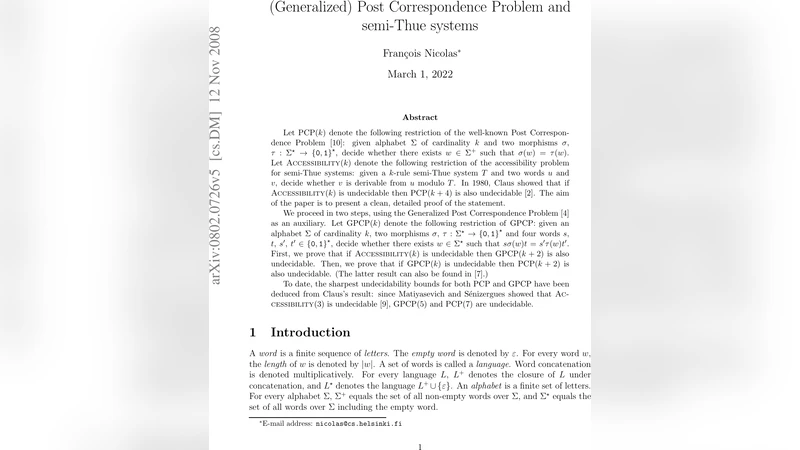
Let PCP(k) denote the Post Correspondence Problem for k input pairs of strings. Let ACCESSIBILITY(k) denote the the word problem for k-rule semi-Thue systems. In 1980, Claus showed that if ACCESSIBILITY(k) is undecidable then PCP(k + 4) is also undecidable. The aim of the paper is to present a clean, detailed proof of the statement. We proceed in two steps, using the Generalized Post Correspondence Problem as an auxiliary. First, we prove that if ACCESSIBILITY(k) is undecidable then GPCP(k + 2) is also undecidable. Then, we prove that if GPCP(k) is undecidable then PCP(k + 2) is also undecidable. (The latter result has also been shown by Harju and Karhumaki.) To date, the sharpest undecidability bounds for both PCP and GPCP have been deduced from Claus’s result: since Matiyasevich and Senizergues showed that ACCESSIBILITY(3) is undecidable, GPCP(5) and PCP(7) are undecidable.
💡 Research Summary
The paper revisits a classic result by Claus (1980) linking the undecidability of the word problem for semi‑Thue systems (ACCESSIBILITY(k)) to the undecidability of the Post Correspondence Problem (PCP) with a bounded number of tiles. The authors provide a clean, step‑by‑step reduction that clarifies the original proof and makes the construction transparent. First, they show that if ACCESSIBILITY(k) is undecidable then the Generalized Post Correspondence Problem (GPCP) with k + 2 pairs is also undecidable. The reduction encodes each rewriting rule a → b of a k‑rule semi‑Thue system into a pair of strings over a fresh alphabet, and adds fixed prefix and suffix symbols to the start and target words. This yields a GPCP instance that has a solution exactly when the original semi‑Thue system can transform the start word into the target word. The transformation is shown to be computable in polynomial time and to preserve the logical structure of the problem. In the second phase the authors convert any GPCP(k) instance into an ordinary PCP(k + 2) instance. They achieve this by surrounding every tile (p_i, q_i) with the same prefix and suffix strings (for example, “#” and “$”), thereby eliminating the explicit start and end conditions of GPCP while keeping the existence of a matching sequence of indices unchanged. Again the construction is polynomial‑time and correctness follows from a straightforward alignment argument. By chaining the two reductions, the paper establishes the implication ACCESSIBILITY(k) ⇒ PCP(k + 4). Since Matiyasevich and Senizergues proved that ACCESSIBILITY(3) is undecidable, the authors recover the best known bounds: GPCP(5) and PCP(7) are undecidable. The work not only supplies a detailed, self‑contained proof of Claus’s theorem but also highlights the elegance of using GPCP as an intermediate step. The authors discuss how the method could be adapted to tighten the bounds further or to analyze related decision problems in formal language theory, suggesting a fruitful direction for future research.
Comments & Academic Discussion
Loading comments...
Leave a Comment