The identity type weak factorisation system
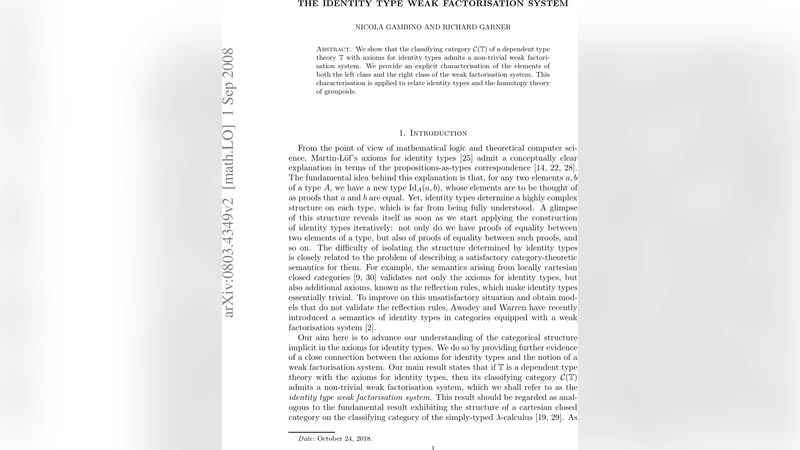
We show that the classifying category C(T) of a dependent type theory T with axioms for identity types admits a non-trivial weak factorisation system. We provide an explicit characterisation of the elements of both the left class and the right class of the weak factorisation system. This characterisation is applied to relate identity types and the homotopy theory of groupoids.
💡 Research Summary
The paper investigates the categorical structure hidden in dependent type theories that include identity types, and shows that the classifying category C(T) of any such theory T carries a non‑trivial weak factorisation system (WFS). The authors begin by recalling the syntax of a dependent type theory with the usual four forms of judgments (type formation, term formation, definitional equality of types, and definitional equality of terms) and then present the standard Martin‑Löf identity‑type rules (formation, introduction, elimination, and computation). They deliberately avoid the “reflection rules” that collapse propositional and definitional equality, because those rules would trivialise the type‑checking problem.
The classifying category C(T) is defined in the usual way: objects are contexts (lists of typed variables) modulo renaming and definitional equality, and morphisms are context morphisms given by tuples of terms satisfying the appropriate typing judgments. A distinguished class of morphisms, called display maps, consists of the projections (Γ, x∈A) → Γ that forget a single variable. Display maps are closed under composition and form the basic building blocks for the left class of the WFS.
The main construction is the “identity‑type weak factorisation system”. The left class L is generated by transfinite composites of display maps; intuitively these are exactly the maps obtained by repeatedly extending a context with new variables. The right class R consists of those morphisms that have the right lifting property with respect to all display maps. Using the identity‑type formation, introduction, elimination and computation rules, the authors prove that any map in R can be factored as a display‑map composite followed by a map that is essentially a family of identity‑type projections (e.g., Id A(a,b) → A). Consequently, (L,R) satisfies the axioms of a weak factorisation system: every morphism f factors as f = r ∘ l with l∈L and r∈R, and L consists precisely of those maps having the left lifting property with respect to all R‑maps, while R consists of those having the right lifting property with respect to all L‑maps.
Two applications are given. First, the authors prove a stability property: if a map belongs to L, then any pullback of that map along an arbitrary morphism also belongs to L. This mirrors the stability of context extensions under substitution in type theory. Second, they connect the construction to the homotopy theory of groupoids. For each context Φ they define a groupoid F(Φ) whose objects are the global elements of Φ and whose morphisms are generated by identity‑type proofs Id Φ(a,b). This yields a functor F : C(T) → Gpd. The authors show that F sends L‑maps to cofibrations (injective equivalences together with Grothendieck fibrations) in the standard Quillen model structure on Gpd, and sends R‑maps to fibrations. In this way the identity‑type weak factorisation system on C(T) is mapped precisely onto the weak factorisation system determined by injective equivalences and Grothendieck fibrations in Gpd.
Overall, the paper demonstrates that the higher‑dimensional equality structure encoded by identity types can be captured categorically by a weak factorisation system. This provides a bridge between dependent type theory and classical homotopy‑theoretic models, suggesting that many homotopical phenomena (such as path objects, fibrations, and cofibrations) already arise naturally from the syntax of identity types without invoking additional axioms like the reflection rules. The work thus deepens our understanding of the interplay between type‑theoretic equality, categorical semantics, and homotopy theory, and opens the way for extending these ideas to higher‑dimensional type theories and ∞‑categorical settings.
Comments & Academic Discussion
Loading comments...
Leave a Comment