Categorical aspects of toric topology
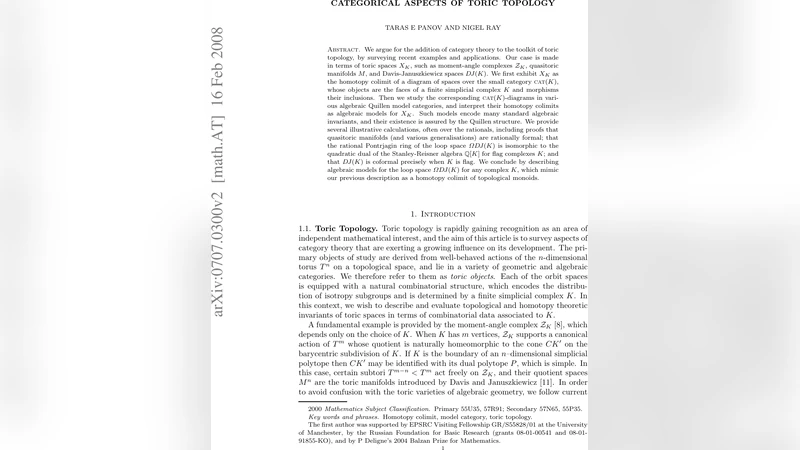
We argue for the addition of category theory to the toolkit of toric topology, by surveying recent examples and applications. Our case is made in terms of toric spaces X_K, such as moment-angle complexes Z_K, quasitoric manifolds M, and Davis-Januszkiewicz spaces DJ(K). We first exhibit X_K as the homotopy colimit of a diagram of spaces over the small category cat(K), whose objects are the faces of a finite simplicial complex K and morphisms their inclusions. Then we study the corresponding cat(K)-diagrams in various algebraic Quillen model categories, and interpret their homotopy colimits as algebraic models for X_K. Such models encode many standard algebraic invariants, and their existence is assured by the Quillen structure. We provide several illustrative calculations, often over the rationals, including proofs that quasitoric manifolds (and various generalisations) are rationally formal; that the rational Pontrjagin ring of the loop space \Omega DJ(K) is isomorphic to the quadratic dual of the Stanley-Reisner algebra Q[K] for flag complexes K; and that DJ(K) is coformal precisely when K is flag. We conclude by describing algebraic models for the loop space \Omega DJ(K) for any complex K, which mimic our previous description as a homotopy colimit of topological monoids.
💡 Research Summary
The paper makes a compelling case for incorporating categorical methods into toric topology by systematically treating toric spaces (X_K) (including moment‑angle complexes (Z_K), quasitoric manifolds (M), and Davis‑Januszkiewicz spaces (DJ(K))) as homotopy colimits of diagrams indexed by a small category (\mathrm{cat}(K)). The objects of (\mathrm{cat}(K)) are the faces of a finite simplicial complex (K) and the morphisms are inclusions. The authors first prove that each toric space (X_K) is weakly equivalent to (\operatorname{hocolim}{\mathrm{cat}(K)} D_K), where the diagram (D_K) assigns to a face (\sigma) the corresponding sub‑toric space (X\sigma) and to an inclusion (\tau\subset\sigma) the natural inclusion map. This reformulation translates the combinatorial data of (K) directly into a homotopical construction.
Having established the topological picture, the authors transport the diagram (D_K) into several algebraic Quillen model categories: rational chain complexes, commutative differential graded algebras (CDGAs), and simplicial sets. Because each of these categories carries a cofibrantly generated model structure, the homotopy colimit of the diagram exists and yields an algebraic model for (X_K). In the chain‑complex setting the homotopy colimit computes the Tor‑algebra of the Stanley‑Reisner ring, while in the CDGA setting it provides a minimal model that can be examined for rational formality.
The paper then applies this machinery to obtain several notable results. First, it shows that quasitoric manifolds and many of their generalisations are rationally formal: their CDGA models are quasi‑isomorphic to their cohomology algebras equipped with zero differential. Second, for flag complexes (K) the rational Pontrjagin ring of the loop space (\Omega DJ(K)) is identified with the quadratic dual (Koszul dual) of the Stanley‑Reisner algebra (\mathbb{Q}
Comments & Academic Discussion
Loading comments...
Leave a Comment