Persistent Queries
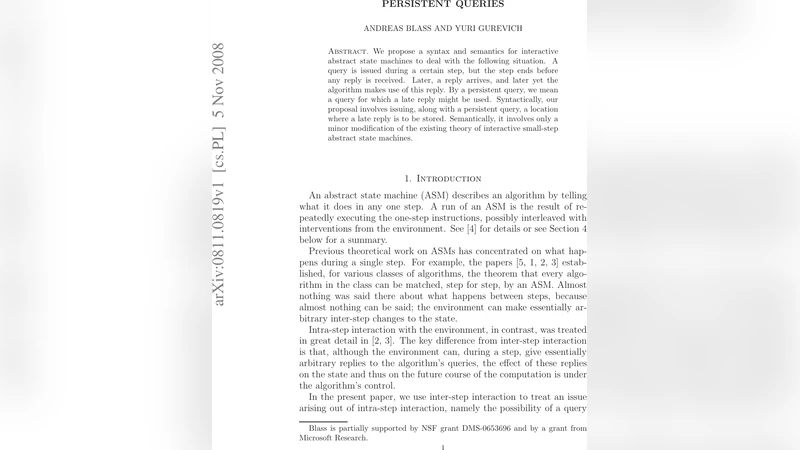
We propose a syntax and semantics for interactive abstract state machines to deal with the following situation. A query is issued during a certain step, but the step ends before any reply is received. Later, a reply arrives, and later yet the algorithm makes use of this reply. By a persistent query, we mean a query for which a late reply might be used. Syntactically, our proposal involves issuing, along with a persistent query, a location where a late reply is to be stored. Semantically, it involves only a minor modification of the existing theory of interactive small-step abstract state machines.
💡 Research Summary
The paper addresses a gap in the theory of interactive abstract state machines (ASMs) concerning queries whose answers arrive after the step in which they were issued has finished. Traditional ASM models treat each step as an atomic interaction: a query is issued, an answer is received within the same step, and the step’s history is cleared before the next step begins. However, many real‑world interactive computations involve “late replies” – responses that become available only after the originating step has terminated. The authors introduce the notion of a “persistent query”: a query whose eventual answer may influence the algorithm’s future behavior, even if that answer arrives late.
To handle persistent queries, the authors extend the ASM syntax by allowing each external function call (i.e., each query) to be accompanied by a storage specification, written as a “store‑in ℓ” clause or, equivalently, a unique tag t. The clause designates a location ℓ in the machine’s state where a late reply will be recorded, while the tag uniquely identifies the query across steps. This syntactic addition requires only a modest change to the existing small‑step ASM framework.
Semantically, the model retains the principle that the state must contain all information from the past that can affect future computation. At the start of a step the history of queries and answers is empty, but the state now also carries a set of pending persistent queries together with their tags. When a query is issued, it is added to the current step’s history; if the environment cannot answer immediately, the query remains pending. The environment may later deliver an answer, which the ASM records in the designated location ℓ (or associates with the tag t). At the end of the step the history is discarded, but the stored late replies persist in the state and can be read in subsequent steps.
The paper discusses two conventions for handling multiple occurrences of the same external function: the Lipari convention (identical calls collapse into a single query) and the must‑vary convention (each call receives a distinct identifier). The proposed tag mechanism works under both conventions, but it is essential under must‑vary because otherwise distinct pending queries could be confused.
Two illustrative examples are presented. The first involves a broker who offers a block of shares to two clients; the broker may complete the sale to the first client before hearing from the second, yet must still process the second client’s late reply to send an appropriate refusal. The second example concerns a pollster who sends questionnaires in a small‑step fashion; responses inevitably arrive after the steps in which the questionnaires were dispatched, making each questionnaire a persistent query.
The paper’s structure proceeds as follows: Section 2 motivates persistent queries with concrete scenarios; Section 3 sketches the syntactic extension; Section 4 reviews the underlying ASM theory; Section 5 examines the consequences of finishing a step while some queries remain unanswered; Section 6 provides a full formal definition of the extended model and shows how it can be embedded in the existing interactive ASM framework of
Comments & Academic Discussion
Loading comments...
Leave a Comment