Hierarchical structure and the prediction of missing links in networks
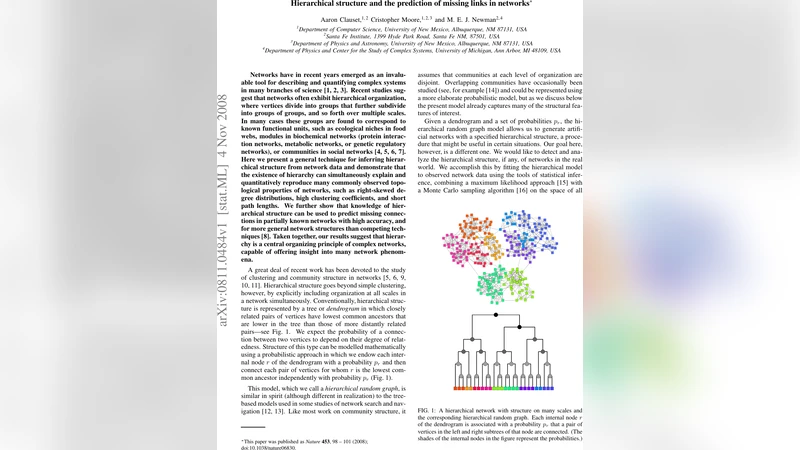
Networks have in recent years emerged as an invaluable tool for describing and quantifying complex systems in many branches of science. Recent studies suggest that networks often exhibit hierarchical organization, where vertices divide into groups that further subdivide into groups of groups, and so forth over multiple scales. In many cases these groups are found to correspond to known functional units, such as ecological niches in food webs, modules in biochemical networks (protein interaction networks, metabolic networks, or genetic regulatory networks), or communities in social networks. Here we present a general technique for inferring hierarchical structure from network data and demonstrate that the existence of hierarchy can simultaneously explain and quantitatively reproduce many commonly observed topological properties of networks, such as right-skewed degree distributions, high clustering coefficients, and short path lengths. We further show that knowledge of hierarchical structure can be used to predict missing connections in partially known networks with high accuracy, and for more general network structures than competing techniques. Taken together, our results suggest that hierarchy is a central organizing principle of complex networks, capable of offering insight into many network phenomena.
💡 Research Summary
In recent years network science has become a central tool for describing complex systems across biology, ecology, sociology and technology. While many studies have focused on community detection or degree‑based models, a growing body of evidence suggests that real‑world networks often possess a multi‑scale hierarchical organization: vertices group into modules, which themselves group into larger modules, and so on. The paper “Hierarchical structure and the prediction of missing links in networks” introduces a principled probabilistic framework—called the Hierarchical Random Graph (HRG)—to infer such nested structure directly from observed network data and to exploit it for link prediction.
Model definition
An HRG represents a network of n vertices by a binary dendrogram (a rooted tree) whose leaves correspond to the vertices. Each internal node r of the tree is assigned a connection probability p_r. For any pair of vertices i and j, the probability that an edge exists between them is exactly the p_r associated with their lowest common ancestor (LCA) in the dendrogram. By allowing the p_r values to vary arbitrarily across the tree, the model can capture assortative patterns (high p_r near the leaves, decreasing upward) as well as disassortative patterns (p_r increasing upward) and any mixture of the two at any scale.
Inference
Given an observed adjacency matrix A, the likelihood of a particular dendrogram D together with its set of probabilities {p_r} is the product over all vertex pairs of p_r (if an edge is present) or (1‑p_r) (if absent), where r is the LCA of the pair. The space of possible dendrograms is astronomically large, so the authors employ a Metropolis–Hastings Markov chain Monte Carlo (MCMC) algorithm to sample from the posterior distribution P(D,{p_r}|A). Each MCMC move either rearranges a subtree (a “tree‑swap” operation) or updates a p_r using a conjugate Beta prior, ensuring detailed balance. After a burn‑in period, the chain yields a collection of high‑likelihood dendrograms that together form an ensemble representing the uncertainty about the hierarchical organization.
Generating synthetic networks
To test whether the inferred hierarchy captures the essential structure of a network, the authors generate synthetic graphs by fixing a sampled dendrogram and its associated p_r values, then connecting each vertex pair independently with probability p_r. They apply this procedure to three disparate data sets: (1) the metabolic network of the spirochete Treponema pallidum, (2) a network of known associations among terrorist actors, and (3) a grassland food web comprising plants, herbivores, parasitoids and hyper‑parasitoids. For each data set they generate many synthetic replicas and compare global statistics—degree distribution, clustering coefficient, and average shortest‑path length—to the original. The synthetic graphs match the originals remarkably well, despite the fact that the HRG does not explicitly enforce any of these statistics. This demonstrates that hierarchical organization alone can explain a wide range of observed topological features.
Consensus dendrogram
Because the posterior over dendrograms is typically multimodal, the authors construct a consensus tree that captures relationships appearing consistently across the sampled ensemble. Using techniques from phylogenetics (majority‑rule consensus), they produce a single dendrogram that highlights robust groupings (e.g., distinct plant, herbivore, and parasitoid clusters in the grassland web). This consensus provides an intuitive visual summary of the network’s hierarchical architecture, complementing the raw ensemble of trees.
Link prediction methodology
A major contribution of the paper is a principled method for predicting missing edges. The authors simulate incomplete data by randomly deleting a fraction of edges from each real network, then run the HRG inference on the remaining subgraph. For every non‑adjacent vertex pair (i,j) they compute the average connection probability ⟨p_{LCA(i,j)}⟩ across the sampled dendrograms. Pairs with the highest average probabilities are ranked as the most likely missing links. Performance is measured using the Area Under the ROC Curve (AUC), which quantifies the probability that a randomly chosen true missing edge receives a higher score than a randomly chosen non‑edge.
Across all three test networks, the HRG‑based predictor achieves AUC values substantially above 0.5 (random guessing) and outperforms several widely used baseline methods: common‑neighbors, Jaccard similarity, degree product, and shortest‑path heuristics. Notably, for the grassland food web—characterized by a mixture of assortative (within‑trophic‑level) and disassortative (predator‑prey) patterns—the HRG predictor dramatically exceeds the baselines, which often mis‑identify predator–predator links as likely. In the metabolic network, the shortest‑path heuristic performs comparably, but the HRG still remains competitive without any domain‑specific tuning.
Comparison with prior work
Previous hierarchical models in network science typically sought a single “best” dendrogram, risking over‑fitting and ignoring the inherent ambiguity of hierarchical representations. By sampling an ensemble, the present approach quantifies uncertainty, avoids over‑fitting, and yields more robust predictions. Moreover, the HRG framework is flexible enough to incorporate external information (e.g., species traits, phylogenetic distances) by adjusting the prior on p_r or by adding covariates, although the authors demonstrate strong performance even without such side data.
Implications and future directions
The results support the hypothesis that hierarchy is a fundamental organizing principle of complex networks. Hierarchical structure can simultaneously account for degree heterogeneity, clustering, and short path lengths, and it provides a powerful basis for inferring missing information—a task of great practical importance in biology (e.g., undiscovered protein interactions), security (undetected terrorist links), and ecology (unobserved trophic interactions). Future extensions could explore dynamic HRGs for time‑varying networks, hierarchical models with overlapping communities (by allowing vertices to belong to multiple subtrees), or Bayesian non‑parametric priors that let the data determine the depth and branching factor of the hierarchy.
In summary, the paper delivers a comprehensive statistical machinery for (i) extracting multi‑scale hierarchical organization from arbitrary networks, (ii) validating that hierarchy reproduces key global network statistics, (iii) summarizing the structure via consensus dendrograms, and (iv) leveraging the inferred hierarchy to predict missing links with superior accuracy across diverse domains. This work stands as a significant methodological advance in network science, bridging the gap between descriptive hierarchical models and actionable inference.
Comments & Academic Discussion
Loading comments...
Leave a Comment