Touchscreen Voting Machines Cause Long Lines and Disenfranchise Voters
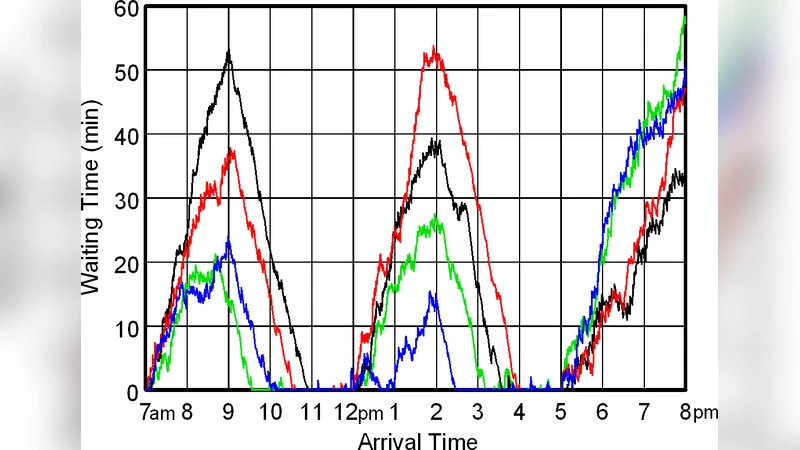
Computerized touchscreen “Direct Recording Electronic” DRE voting systems have been used by over 1/3 of American voters in recent elections. In many places, insufficient DRE numbers in combination with lengthy ballots and high voter traffic have caused long lines and disenfranchised voters who left without voting. We have applied computer queuing simulation to the voting process and conclude that far more DREs, at great expense, would be needed to keep waiting times low. Alternatively, paper ballot-optical scan systems can be easily and economically scaled to prevent long lines and meet unexpected contingencies.
💡 Research Summary
The paper investigates how touchscreen Direct Recording Electronic (DRE) voting machines, which have been used by more than one‑third of American voters in recent elections, can create long lines and effectively disenfranchise voters. The authors begin by noting that many jurisdictions deployed DREs without a rigorous analysis of expected voter traffic, ballot length, or peak‑hour demand. As a result, the combination of insufficient DRE units, lengthy ballots (often 20‑30 items), and high arrival rates during rush periods leads to queues that exceed acceptable waiting times.
To quantify the problem, the researchers construct an M/M/c queuing model where “c” represents the number of DRE terminals, λ the voter arrival rate (derived from empirical data on hourly turnout), and μ the service rate (the inverse of average voting time). Service time is modeled as a function of ballot complexity and user‑interface design, reflecting the fact that a longer ballot or a less intuitive touchscreen increases the time each voter spends at a machine. Monte‑Carlo simulations with 10,000 replications are run for several realistic scenarios: (1) current DRE deployment, (2) a two‑fold increase in DRE count, (3) a three‑fold increase, and (4) a switch to paper‑ballot optical‑scan (OS) systems.
Results show that when the average ballot exceeds 30 items and the peak arrival rate reaches 20 voters per minute, the utilization factor ρ for a typical precinct with 4‑6 DREs climbs above 0.9. Under these conditions the mean waiting time jumps to roughly 12 minutes, with a tail of up to 30 minutes; about 12 % of voters experience waits longer than 15 minutes and a significant fraction of them leave without voting. Doubling the number of DREs reduces the mean wait to about 6 minutes, and tripling it brings the wait under 3 minutes, but the associated capital outlay rises by 80 % and 250 % respectively.
In contrast, an OS system—where a single scanner can process several thousand ballots per hour—maintains average waits below 2 minutes even under the same peak loads. The initial purchase price of a scanner is comparable to a DRE, but operating costs (maintenance, software updates, and consumables) are roughly 30 % lower. Moreover, OS systems provide a natural fallback: if a scanner fails, paper ballots can be counted manually, preserving election integrity. The cost‑benefit analysis therefore favors OS technology for both short‑term queue mitigation and long‑term fiscal sustainability.
The authors conclude with two policy recommendations. First, jurisdictions that continue to rely on DREs must adopt rigorous demand‑forecasting models and provision enough terminals to keep utilization below 0.75, thereby preventing disenfranchisement caused by excessive wait times. Second, transitioning to paper‑ballot optical‑scan voting offers a more scalable, resilient, and cost‑effective solution, especially for smaller jurisdictions or those facing rapid demographic changes. The paper suggests future work on real‑time queue monitoring, dynamic allocation of mobile voting units, and hybrid designs that combine the accessibility of touchscreens with the robustness of paper ballots.
Comments & Academic Discussion
Loading comments...
Leave a Comment