On the length of attractors in boolean networks with an interaction graph by layers
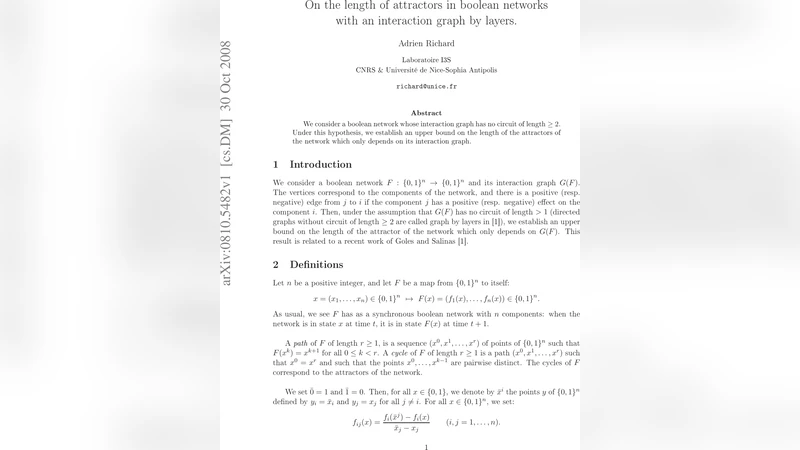
We consider a boolean network whose interaction graph has no circuit of length >1. Under this hypothesis, we establish an upper bound on the length of the attractors of the network which only depends on its interaction graph.
💡 Research Summary
The paper investigates the relationship between Boolean networks and the structure of their interaction graphs, focusing on a class of graphs called “layered graphs,” which are directed graphs that contain no directed cycles of length greater than one. In this setting, each vertex of the graph corresponds to a component (or variable) of the Boolean network, and a signed edge from vertex j to vertex i indicates that the Boolean function governing component i depends positively (sign +1) or negatively (sign –1) on component j. The authors aim to bound the length of attractors—periodic orbits (cycles) in the state space—solely in terms of combinatorial properties of the interaction graph.
Key definitions
- A Boolean network is a map F : {0,1}ⁿ → {0,1}ⁿ, with synchronous update.
- A path of length r is a sequence of states (x₀,…,x_r) such that F(x_k)=x_{k+1}.
- An attractor (or cycle) of length r is a path with x₀=x_r and all intermediate states distinct.
- For each pair (i,j) the quantity f_{ij}(x)=f_i(¬x_j)−f_i(x)·¬x_j−x_j captures the discrete partial derivative of f_i with respect to x_j; a non‑zero value for some x indicates an edge j→i in the interaction graph G(F).
- The graph G(F) may contain self‑loops (edges i→i) of either sign.
The authors introduce a graph‑theoretic invariant τ(G(F)). For any elementary (vertex‑simple) directed path P in G(F), τ_G(P) counts the vertices that either (1) are the first vertex on P that carries a negative self‑loop, or (2) have both a positive and a negative self‑loop. τ(G(F)) is the maximum of τ_G(P) over all elementary paths. Consequently, τ(G(F))≥1 iff a negative self‑loop exists, and τ(G(F))>1 precisely when there are vertices with both signs of self‑loops (so‑called “ambiguous loops”).
Previous work
Goles and Salinas (2008) proved that if G(F) contains no directed cycle of length ≥2, then any attractor length must be a power of two; moreover, if G(F) has no negative self‑loop, the only possible attractor length is 1 (a fixed point).
Main result (Theorem 2)
Assume G(F) has no directed cycle of length ≥2 (i.e., it is a layered graph). If F possesses an attractor, then its length is a power of two not exceeding 2·τ(G(F)). In other words, the presence of negative self‑loops and especially vertices that simultaneously have positive and negative self‑loops controls the maximal possible period.
Proof strategy
The authors define an “r‑minimal” Boolean map: a map that has an attractor of length r but no strict subgraph of its interaction graph can support an attractor of the same length. Lemma 1 shows that for any r‑minimal map with r≥2, one can construct a new map \tilde{F} by fixing the output of a specially chosen vertex i to the constant 0. This operation removes all incoming edges to i, thereby producing a strict subgraph of the original graph, reduces τ, and halves the attractor length (the new attractor has length r/2). The proof uses detailed analysis of the dynamics on the coordinates, showing that the state of component i alternates with period 2, which forces the overall period to halve.
With Lemma 1 in hand, the authors prove Theorem 2 by induction on the attractor length r. Starting from an r‑minimal map, they apply Lemma 1 to obtain a map with attractor length r/2 and strictly smaller τ. By the induction hypothesis, r/2 is a power of two bounded by 2·τ(\tilde{F}). Since τ(\tilde{F})<τ(G(F)), it follows that r≤2·τ(G(F)). The power‑of‑two property follows because each halving step preserves the form 2^k.
Corollaries and examples
- Corollary 1: If the interaction graph has no ambiguous loops (i.e., no vertex carries both a positive and a negative self‑loop), then τ≤1, and consequently every attractor has length at most 2. Thus, under this condition, only fixed points and 2‑cycles can occur.
- The paper also discusses a counter‑example to a claim by Robert (1995) that “if every vertex has a self‑loop and the graph has no cycles of length ≥2, then no attractor of length ≥3 exists.” The authors present a 2‑variable Boolean map with a length‑4 attractor, where each vertex indeed has a self‑loop, but one vertex possesses both a positive and a negative loop, violating the “no ambiguous loop” condition. This illustrates the necessity of the τ‑based bound.
Significance
The work provides a purely combinatorial bound on the dynamical complexity of Boolean networks with layered interaction graphs. By introducing τ(G(F)), the authors give a simple graph‑theoretic quantity that predicts the maximal possible period of any attractor. This result is valuable for the design and analysis of discrete dynamical systems in biology (e.g., gene regulatory networks), computer science (e.g., cellular automata, logical circuits), and social dynamics, where one often wishes to control or predict periodic behavior based on the wiring diagram alone. The methodology also suggests a constructive way to reduce periods by eliminating specific edges (fixing components), which may be useful for engineering networks with desired dynamical properties.
Comments & Academic Discussion
Loading comments...
Leave a Comment