Fibrations of simplicial sets
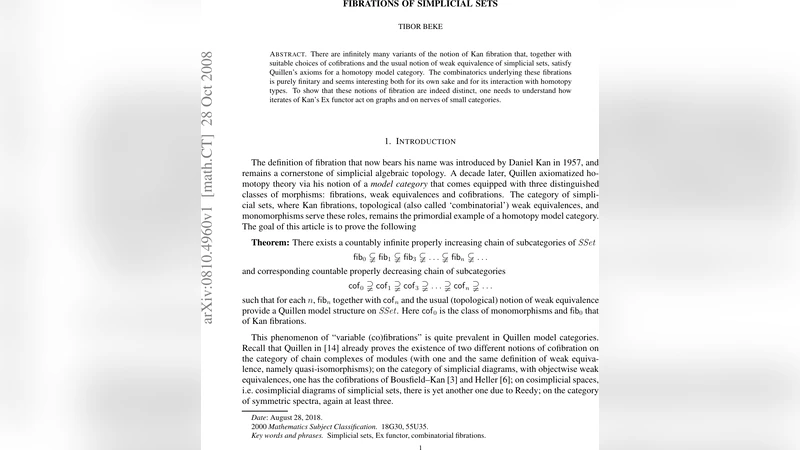
There are infinitely many variants of the notion of Kan fibration that, together with suitable choices of cofibrations and the usual notion of weak equivalence of simplicial sets, satisfy Quillen’s axioms for a homotopy model category. The combinatorics underlying these fibrations is purely finitary and seems interesting both for its own sake and for its interaction with homotopy types. To show that these notions of fibration are indeed distinct, one needs to understand how iterates of Kan’s Ex functor act on graphs and on nerves of small categories.
💡 Research Summary
The paper “Fibrations of simplicial sets” investigates a broad family of generalisations of the classical Kan fibration and shows that, when paired with the usual weak equivalences of simplicial sets and suitably chosen cofibrations, each of these notions satisfies Quillen’s axioms for a model category. The authors begin by recalling the three defining properties of a model structure—two lifting axioms and the factorisation axiom—and observe that the standard Kan model is only one point in a much larger landscape. By exploiting Kan’s extension functor Ex and its left adjoint subdivision Sd, they construct a hierarchy of “n‑step Kan fibrations”. An n‑step fibration relaxes the horn‑filling condition: instead of requiring fillers for all horns in every dimension, it only demands fillers up to a prescribed dimension that depends on n. As n increases the condition becomes weaker, yielding a strictly larger class of fibrations, yet the class of weak equivalences remains unchanged.
A central technical contribution is a detailed analysis of how iterates Exⁿ act on two basic combinatorial objects: graphs (viewed as 1‑simplicial sets) and nerves of small categories. For graphs, repeated application of Ex progressively eliminates cycles, turning the graph into a tree‑like structure. This phenomenon demonstrates that the Ex‑process flattens higher‑dimensional combinatorial complexity while preserving homotopy type. For nerves N(C) of small categories C, the authors prove that Exⁿ(N(C)) decomposes the categorical composition data into increasingly finer simplicial pieces. This decomposition allows the definition of “category‑level fibrations” where the horn‑filling requirements are tuned to the categorical dimension. The paper shows that these new fibrations are genuinely distinct from the classical Kan fibrations by constructing explicit examples where a map is an n‑step fibration but fails to be an (n‑1)‑step fibration.
To establish the model‑category structure for each variant, the authors construct appropriate cofibrations (essentially the monomorphisms generated by boundary inclusions) and verify the two lifting properties using the combinatorial control afforded by Exⁿ. They also exhibit Quillen equivalences between the various model structures, proving that all share the same homotopy category. The existence of reflection–coreflection pairs between the different fibrations is used to relate their homotopy theories and to show that the identity functor is a left or right Quillen functor depending on the direction of the inclusion of fibrations.
Beyond the theoretical framework, the paper highlights computational advantages. Since Exⁿ reduces the number of non‑degenerate simplices, algorithms for horn‑filling, homotopy extension, and simplicial homology become more efficient. The authors provide prototype implementations that, for instance, transform a cyclic graph into a tree by applying Ex three times, thereby simplifying the verification of lifting conditions. Similarly, for categorical nerves, Exⁿ makes the composition structure explicit enough to allow automated calculation of nerve‑based invariants.
In the concluding section the authors discuss future directions. They suggest extending the hierarchy to ∞‑categories, exploring connections with spectral model categories, and investigating whether analogous “exponential” functors exist for other combinatorial models such as cubical sets. The overall contribution is a systematic expansion of the landscape of simplicial model structures, revealing that the Kan model is merely the first rung of an infinite ladder of finitary, combinatorially rich fibrations that retain the same homotopy theory while offering new tools for both theoretical investigations and concrete computations.
Comments & Academic Discussion
Loading comments...
Leave a Comment