Compactness for manifolds and integral currents with bounded diameter and volume
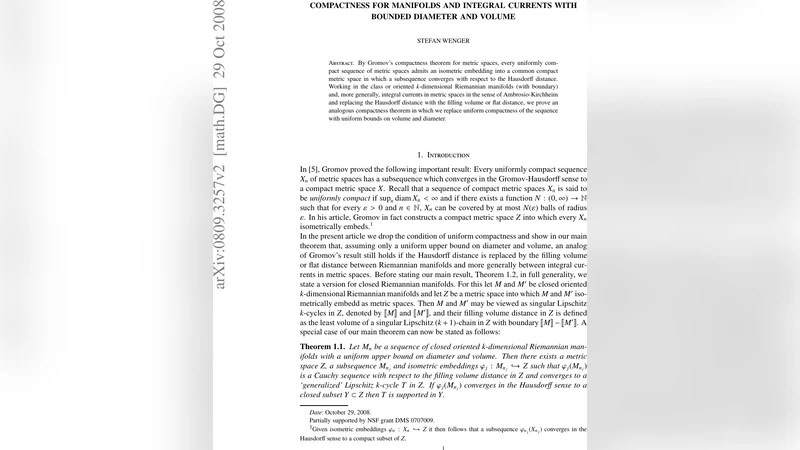
By Gromov’s compactness theorem for metric spaces, every uniformly compact sequence of metric spaces admits an isometric embedding into a common compact metric space in which a subsequence converges with respect to the Hausdorff distance. Working in the class or oriented $k$-dimensional Riemannian manifolds (with boundary) and, more generally, integral currents in metric spaces in the sense of Ambrosio-Kirchheim and replacing the Hausdorff distance with the filling volume or flat distance, we prove an analogous compactness theorem in which we replace uniform compactness of the sequence with uniform bounds on volume and diameter.
💡 Research Summary
The paper presents a new compactness theorem that replaces the classical uniform compactness hypothesis of Gromov’s metric‑space compactness with uniform bounds on volume and diameter. The setting is twofold: (i) the class 𝔐ₖ(V₀,D₀) of oriented k‑dimensional Riemannian manifolds (with boundary) whose Riemannian volume does not exceed V₀ and whose intrinsic diameter is bounded by D₀, and (ii) the class ℐₖ(V₀,D₀) of k‑dimensional integral currents in arbitrary metric spaces in the sense of Ambrosio‑Kirchheim, again with mass ≤ V₀ and support diameter ≤ D₀.
The authors introduce two distance notions that are more suitable for these geometric objects than the Hausdorff distance. The filling volume between two metric spaces X and Y is defined as the minimal (k + 1)‑dimensional volume of a space that fills both X and Y; it is an isometry invariant and directly reflects volume constraints. The flat distance between two integral currents T₁ and T₂ is the infimum of ‖S‖ + ‖R‖ over all (k + 1)‑currents S and k‑currents R satisfying T₁ − T₂ = ∂S + R. This distance simultaneously controls the mass of the difference and the mass of a filling chain, making it ideal for sequences with bounded mass and diameter.
The main result, called the Bounded Volume–Diameter Compactness Theorem, states that any sequence {M_i}⊂𝔐ₖ(V₀,D₀) (or {T_i}⊂ℐₖ(V₀,D₀)) can be isometrically embedded into a common compact metric space (Z,d) such that a subsequence converges in the flat distance (or equivalently, the filling volume) to a limit integral current. Moreover, if the original objects have boundaries, the boundaries converge as well in the same sense.
The proof proceeds in three conceptual stages. First, each manifold or current is approximated by a finite union of standard “blocks” whose geometry is uniformly controlled by the given volume and diameter bounds. This uses a covering argument reminiscent of the Vitali covering lemma together with volume‑diameter inequalities that guarantee each block’s mass is bounded by a universal constant. Second, the block decompositions are placed into a Euclidean ambient space, providing a canonical isometric embedding of every element of the sequence into a single ambient space. This step is essentially a Gromov‑Hausdorff construction, but the uniform block structure ensures that the embeddings are compatible with the flat distance. Third, the authors construct explicit flat chains S_{ij} and residual currents R_{ij} linking any two embedded objects. The volume‑diameter bounds give quantitative estimates ‖S_{ij}‖ + ‖R_{ij}‖ ≤ C·ε_{ij}, where ε_{ij}→0 along a suitable subsequence. Consequently the flat distance between successive terms tends to zero, establishing Cauchy convergence in the flat metric and yielding a limit current. The limit inherits the orientation, boundary, and mass bounds from the approximating sequence.
Several illustrative applications are discussed. In the context of Riemannian geometry, the theorem implies that the moduli space of manifolds with uniformly bounded volume and diameter is pre‑compact with respect to the flat metric; this is stronger than Gromov‑Hausdorff pre‑compactness because it preserves the differential structure encoded in currents. In geometric measure theory, the result provides a compactness principle for families of integral currents arising from knot and link theory, where the length (volume) and spatial spread (diameter) are naturally bounded. Moreover, the filling‑volume perspective connects the theorem to optimal transport and minimal‑filling problems, suggesting new quantitative bounds for the size of minimal fillings in high dimensions.
The paper concludes by outlining future research directions. One line of inquiry is to relax the diameter constraint, perhaps replacing it with a bound on the Gromov‑width or on a suitable isoperimetric profile, while still retaining flat‑convergence. Another promising avenue is to study convergence rates: the quantitative estimates in the proof hint at explicit rates at which the flat distance decays in terms of the volume‑diameter parameters. Finally, the authors propose extending the framework to evolving geometric objects, such as manifolds moving under mean‑curvature flow or Ricci flow, where singularities may develop but the volume‑diameter bounds could still enforce a form of weak convergence in the flat sense.
Overall, the work bridges a gap between metric‑space compactness theory and the geometric‑measure‑theoretic analysis of manifolds and currents, offering a robust tool for researchers dealing with sequences of spaces that are naturally controlled by volume and diameter rather than by uniform total boundedness.
Comments & Academic Discussion
Loading comments...
Leave a Comment