Message passing resource allocation for the uplink of multicarrier systems
We propose a novel distributed resource allocation scheme for the up-link of a cellular multi-carrier system based on the message passing (MP) algorithm. In the proposed approach each transmitter iteratively sends and receives information messages to…
Authors: ** - Andrea Abrardo ∗ (Dipartimento di Ingegneria dell’Informazione, University of Siena, Italy) - Paolo Detti ∗ (Dipartimento di Ingegneria dell’Informazione
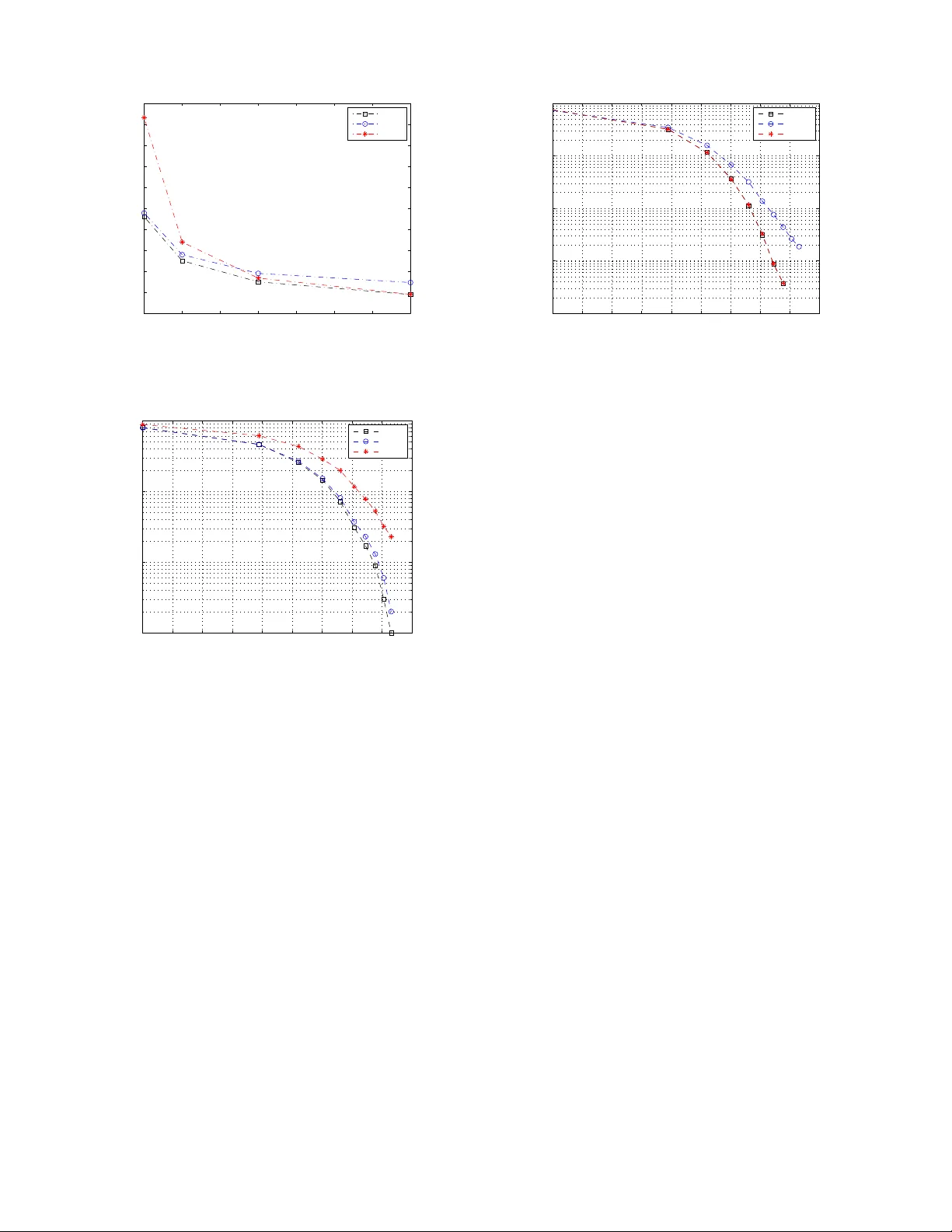
Message passing resource allocat ion for the uplink of multicarr ier systems Andrea Abrardo ∗ , Paolo Detti ∗ , Marco Moretti † ∗ Dipartimento di Ingegneria dell’In formazio ne, University of Sien a, Italy † Dipartimento di Ingegneria d ell’Info rmazione , Uni versity of Pis a, Italy Abstract —W e propose a novel d istributed resour ce allocation scheme for the up -link of a cell ular multi -carrier system based on the message passing (MP) algorithm. In th e proposed approach each transmitter iterativ ely sends and receiv es i nfor mation mes- sages to/from the base station with the goal of achieving an optimal re source allocation strate gy . The exchanged messag es are the solution of small distributed allocation problems. T o reduce the computational load, the MP problems at th e terminals fo llow a dynamic p rogra mming formulation. The advantage of the proposed scheme is that it d istributes the computational effo rt among all the transmitters in the cell and it does not require the presence of a central controller that takes all the decisions. Numerical results show that t he proposed approach is an excellent solution to th e resour ce allocation problem for cellular multi-carrier systems. I . I N T R O D U C T I O N Orthogo nal Fre quency Di vision (OFDM) mod ulation is one of th e cand idate techn ologies for future g eneration broadb and wireless networks. Provided that the system param eters are accurately dimensioned, OFDM transmissions are no t a ffected by intersym bol interferen ce (I SI) even in h ighly disper si ve channels. Moreover , OFDM can ef fectively exploit the channel frequen cy di versity [1], [2] by dy namically adap ting power and modulatio n form at o n all subcarriers. Orthogo nal frequen cy multiple access (OFDMA) is the mu ltiple access scheme based o n OFDM: each user is allocated a different subset of o rthogo nal subcarriers. When th e transm itter possesses f ull knowledge of chan nel state in formatio n, the subcarr iers can be allocated accord ing certain optimality criterion to increa se the overall spectral efficiency , explo iting the so-called multiuser diversity . Resource allo cation is one of the mo st efficient technique s to i ncrease the perf ormance of multicarrier systems. In fact, prop agation chann els are independen t for each user and thus the sub- carriers that are in a d eep fade for one user m ay be g ood ones f or ano ther . Many resour ce allocation algo rithms have been designed for taking advantage of both the f requen cy selecti ve nature o f the chan nel and th e multi-user diversity . In most cases dyn amic resource allo cation has been f ormulated with the goa l of either m inimizing the transmitted power with a rate constraint [3], [4] or max imizing the overall rate with a p ower con straint [5], [ 6]. In this paper, starting f rom the formu lation of resour ce allocation problem as a m inimization problem, we pr opose a novel distributed r esource allocation s cheme for the u p-link of a cellular multi-car rier system based on the message passing (MP) algorithm . MP algo rithms have gain ed their mom entum in the last years owing to their b road usage in LDPC and tu rbo channel decoding app lications [ 7]. In this setting, m essages represent probab ilities o r beliefs 1 , which are exchanged with the goal of achieving an optimal bit decision s. W e will show that resou rce allocatio n may re ly on a similar MP proced ure: with th e g oal of achieving a global optimal assignment, each transmitter iterati vely sends and receives information messages to/from the base station until an allocation decision is taken. The exchanged me ssages are the solution o f small d istributed allocation p roblems. T o r educe the computatio nal load, the MP problem s at the terminals follow a dynamic program ming formu lation. T he adv antage of the prop osed scheme is tha t it distributes the co mputation al ef fort among all the tran smitters in th e cell and it does no t r equire the presen ce of a ce ntral controller for a pro blem that in its original formulation is NP- hard, as pointed out at the en d of Section II. The rest of the p aper is organized as fo llows. In Section II we d escribe th e system model. In Sec tion III we show how message passing can be tailored to solve the prob lem of resource allocation in the u plink o f a cellular system. In Section IV we pr esent simulatio n results. Finally , in Section V we discuss fu ture work and draw ou r con clusions. I I . S Y S T E M M O D E L W e focus on the problem of channel allocation for the up link of an OFDMA system. The overall frequ ency bandwidth is divided into orthogon al sub-carrier s and, to red uce alloca tion complexity , we g roup sets of adjacent subcarr iers into F sub - channels . As lon g as the band width spanned by a subchan nel is smaller than the chan nel co herence bandwidth , the chan nel spectrum c an be appr oximated as flat in the subc hannel. Thus, we can assume that the choice of perf orming resource allocation on subch annels rather than on subc arriers causes almost no loss in di versity . Allocation is perfo rmed with the go al of minimizing the overall transmitted power sub ject to rate constraints per user . Due to p ractical co nsideration s, we con sider o nly a limited set Q = { 0 , . . . , Q } of possible transmission formats. A given transmission f ormat q corr esponds to the usage of a cer tain error corre ction cod e and symb ol m odulation that lead s to a spectral efficiency η q : a user employing format q on a certain subc hannel transmits with r ate R = B η q , B being the ba ndwidth of each su bchann el. Th e spectral efficiency 1 the alg orithm is also kno wn as the beli ef propagati on algorithm associated with fo rmat q = 0 is η 0 = 0 , i.e. no tran smission at all. The target SNR to ach iev e the spectral efficiency η q = log 2 (1 + S N R ( q )) is S N R ( q ) = 2 η q − 1 . Let F b e the set co ntaining the F available su bchann nels. Given the format q , th e power P n,f ( q ) n ecessary to user n to transmit on sub channel f is computed a s P n,f ( q ) = S N R ( q ) B N 0 | H n,f | 2 (1) where H n,f is the channel gain between user n and the BS on the f -th link and N 0 is the power spectral den sity o f the zero- mean thermal noise. Channel assignmen t is exclusi ve: each subchann el ca n be assigned to only one user and with a just a sing le form at. Our resou rce allocation problem is a co nstrained minimiza- tion pro blem in the vector x = [ x 1 , 1 , . . . , x N ,F ] , where the variable x n,f ∈ Q indicates the modulation format of user n on subc hannel f . The allocation pro blem has the following general fo rm minimize f 0 ( x ) (2) subject to d f ( x ) ≤ 1 f ∈ F (C1) h n ( x ) ≥ b n n = 1 , . . . , N (C2) g n ( x ) ≤ P max,n n = 1 , . . . , N (C3) Here the ob jectiv e function f 0 : D → R + is the cost in terms of overall power of th e allo cation x : f 0 ( x ) = N X n =1 X f ∈F P n,f ( x n,f ) (3) the domain D = Q N F is the set of all possible transmission formats on all sub channels for all users. The inequ ality con- straints fu nctions d f : D → R + represent th e co ndition of exclusi ve a llocation f or all su bchann els d f ( x ) = N X n =1 I ( x n,f ) (4) where I ( x n,f ) is 1 if 1 ≤ x n,f ≤ Q and 0 oth erwise. The constraints fu nctions h n : D → R + enforce that each user transmits at least with rate b n h n ( x ) = X f ∈F B η x n,f (5) The constraints fu nctions g n : D → R + enforce that ea ch user does no t exceed its maximum transmittin g power P max,n g n ( x ) = X f ∈F P n,f ( x n,f ) (6) The r adio resou rce allocatio n prob lem introdu ced above can be sho wn to be NP-h ard b y a straightforward re duction from the NP-har d problem Multipr o cessor Scheduling [ 8], even when o nly on e single transmission format is considered . I I I . R E S O U R C E A L L O C A T I O N V I A M E S S AG E P A S S I N G In the f ollowing, we formulate the allocation p roblem in such a way that can b e solved with a messag e passing technique (MP). The advantage o f MP is that the computatio n load is distrib uted among the various nodes by locally passing simple messages among simp le processors whose oper ations lead, after some time, to the so lution o f a global problem . First of all, to simplify the allocatio n task we assume that eac h user selects a subset o f all av ailab le subchan nels. Let P n ⊂ F be the subset of cardina lity P < F of subchann els that can be allocated to user n . In o ther terms, we assume that x n,f may be different from zer o only if f ∈ P n . As for the ch oice of the subch annels in P n , we make the natural assumption that they represent the P best sub channels f or user n , i.e. P n = { f ∈ F : | H n,f | is one of th e P largest values for u ser n } . Each u ser ma y p re-com pute its subset of chan nels befo re the resource alloca tion algo rithm is in itiated 2 . For our scop e, it is convenient to inter pret the resourc e allocation p roblem as a minimum cost prob lem, where the unfulfillmen t of c onstraints in (2) gives an infinite cost. Thus, we take c are of the co nstraints C1 by introd ucing the cost function C ( f ) ( f ∈ F ), which is 0 if the exclusive requirem ent o n subch annel f is fu lfilled and ∞ otherwise C ( f ) = ( 0 if P n ∈N ( f ) I ( x n,f ) ≤ 1 ∞ otherwise (7) where N ( f ) is the sub set of users that might use subc arrier f , i.e. N ( f ) = { n : f ∈ P n } . The constrain ts C2 and C3 are dealt by in troducin g the set o f functio ns W ( n ) ( n = 1 , . . . , N ), defined as: W ( n ) = P f ∈P n P n,f ( x n,f ) if P f ∈P n B η x n,f ≥ b n P f ∈P n P n,f ( x n,f ) ≤ P max,n ∞ otherwise (8) Despite notation co mplexity , the meaning o f ( 8 ) is straig htfor- ward: W ( n ) is the power transmitted by user n if power an d rate con straints for user n ar e fu lfilled, and ∞ otherwise. Giv en the above, it is straightfor ward to r ewrite the reso urce allocation pro blem in (2) as: ˆ x = ar g m in x X f ∈F C ( f ) + N X n =1 W ( n ) . (9) Since the g oal is to get a distributed solution for the above minimization problem , we focu s on a single variable, e .g., x n,f , and rewrite the same pro blem in a fo rm suited f or MP implementatio n as: ˆ x n,f = ar g min x n,f min ¯ x n,f X f ∈F C ( f ) + N X n =1 W ( n ) (10) 2 W e assume perfec t channel state estimation between each user and its serving BS. where notation mi n ¯ x n,f denote th e minimum over all variables x except x n,f . A. MP implementation The MP algorithm has been broadly used in th e last years in channel coding app lications. In particular, when dealing with bitwise MAP channel decoding, MP finds an optimum solution for the sum- produ ct problem, provided that the co rrespond ent factor grap h is a tre e [9]. T he MP algorithm fo r the sum- produ ct pro blem der iv es by th e distributi ve law , i.e., b y the proper ty P Q = Q P . Howe ver, since min P = P min , the same property still holds for min-sum problems, where minimization replaces add ition in the orig inal formulation 3 and addition replaces multiplication . By explo iting such a formal equiv alence, it is straightfor ward to ad apt the MP algor ithm to the min-sum problem (10). T o elabor ate, let associate with p roblem (10) a factor graph , where variables x i,p are circular nodes and fun ctions C ( f ) and W ( n ) are squar e nodes. V ariable node s are con nected with fun ction nodes by an e dge if and on ly if the variable appear s in th e function, i.e. x n,p is connected to the P functions C ( ℓ ) with ℓ ∈ P n and to W ( n ) . The factor graph for (10) is depicted in Fig. 1 where we den ote by ˜ x n,p ( p = 1 , . . . , P ) the tr ansmit fo rmat fo r user n on the p-th ordered elemen t o f P n . Follo win g a MP s trategy , variable and function node s exch ange messages along their connecting edges un til variable nod es can d ecide on the value of ˜ x i,p . Let now assume that th e factor graph is a single tree, i.e., a connec ted g raph where there is an u nique path to co nnect two nod es. In th is case, the implemen tation of the MP appro ach is straightfor ward. Le t firstly in tro- duce messages as ( Q + 1) -dimension al vector s, denoted by m = { m (0) , m (1) , . . . , m ( Q ) } . In p articular, deno te by m ( C V ) n,f / m ( V C ) n,f messages exchanged between the C function n odes and the connected variable no des, and by m ( W V ) n,f / m ( V W ) n,f messages e xchang ed between the W fun ction nodes an d the connected variable nodes. As in the c lassical sum-pro duct scen ario, message passing starts at th e leaf nod es, i.e., th ose no des which h av e only one con necting edg e. In p articular, each variable leaf no de passes an all-zero message to its adjacent function node, whilst each f unction leaf no de passes the value of the fu nction to its adjacent n ode. After initialization at leaf nodes, for every node we can compute the outgoing message a s soon as all inco ming messages a long all other conn ected nodes are receiv ed. As far as variable nodes are of con cern, the outgoin g message sent over an edg e is simply evaluated by summing all messages received fr om the o ther ed ges. With regard to function nodes, let first consider the C ( f ) no des and focus on generic subcha nnel ℓ . The squ are nod e correspond ing to C ( ℓ ) is conn ected to all the variable nod es x n,ℓ with n ∈ N ( ℓ ) . If we c onsider without lo ss of ge nerality th e message to be d eliv ered to x j,ℓ ( j ∈ N ( ℓ )) , the q -th element o f th e return message is the solu tion of the fo llowing minim ization 3 See [7], [9] for a detailed description of MP algori thm for the sum-product problem. Fig. 1. Factor graph for RRM. For ease of repr esentat ion, we denote by ˜ x n,p ( p = 1 , . . . , P ) the transmit format for user n on the p-th ordered element of P n . problem : m ( C V ) j,ℓ ( q ) = min P n ∈N ( ℓ ) ,n 6 = j m ( V C ) n,ℓ ( x n,ℓ ) subject to P n ∈N ( ℓ ) ,n 6 = j I ( x n,ℓ ) + I ( q ) ≤ 1 (11) In a similar way , we can rewrite m essage passing r ule for W ( n ) n odes. L et focus on generic user u , the squ are node correspo nding to W ( u ) is conne cted to the variable nodes x u,f with f ∈ P u . If we consid er without loss of generality the message to be deli vered to x u,ν ( ν ∈ P u ) , the q -th element of the return message is the solu tion o f the following minimization pr oblem: m ( W V ) u,ν ( q ) = min P f ∈P u P u,f ( x u,f ) + m ( V W ) u,f ( x u,f ) subject to P f ∈P u ,f 6 = ν B η x u,f + B η q ≥ b u P f ∈P u ,f 6 = ν P u,f ( x u,f ) + P u,ν ( q ) ≤ P max,u (12) When a me ssage has been sent in both direction s alo ng ev ery edge the alg orithm stop s. It is worth n oting that in the considere d OFDMA cellular scenario the W ( n ) function node and its connected variable n odes are locate d a t the n - th user , while all C ( f ) fun ction nod es are located at the BS. H ence, send ing messages from variable n odes to C ( f ) function nodes and vice-versa requires actual transmission on the radio channel. Instead, message exchange between v ariable nodes and W ( n ) fu nction nod es is p erform ed locally at the users’ term inals, withou t any transmission. The solutio n of Problem (1 2) req uires by far the largest computatio nal effort, since it calls for an exhausti ve search over all possible combin ations of tran smission formats. Thus, in the following we present a new fo rmulation of (1 2) to find the op timal solution with limited complexity . B. A Dynamic p r ogramming algorithm Giv en a user u , Problem (12) basically consists in find ing a set of subch annels f ∈ P u , and for each selected subchan nel the related transmission fo rmat to use by u , so th at a given function is min imized. Such problem can for mulated a s an Integer Linear Pro grammin g (ILP) proble m introducin g binary variables y f ,h equal to 1 if the user transmits on the subch annel f w ith the f ormat h , an d 0 otherwise. In a gen eral form , such a p roblem can be rewritten as min X f ,h c f ,h y f ,h X f ,h B η h y f ,h ≥ β X f ,h,f 6 = ν P u,f ( h ) y f ,h ≤ α (13) X h y f ,h ≤ 1 f ∈ P u y f ,h ∈ { 0 , 1 } where the cost c f ,h is th e cost f or user u of transmitting with format h o n subchannel f (i. e., c f ,h = P u,f ( h ) + m ( V W ) u,f ( h ) ), β = b u − B η q , α = P max,u − P u,ν ( q ) . As in (12), the first tw o constraints corr espond to th e requ irements on th e bit-rate b u and on th e max imal tran smission power P max,u , respectively . The su bsequent P co nstraints impo se that at most one f ormat is selected for ea ch subch annel f . Note that, b u is lim ited from above b y B η Q P , an d such a value is obtained when user u transmits with format Q on all the subchannels in P u . Assuming th at all admissible formats are multiple integer of a giv en spectr al ef ficiency ˜ η , ie η h = h ˜ η ( h = 0 , . . . , Q ), we can divide all term s o f the first constrain t of Prob lem ( 13) by B ˜ η to o btain th e equivalent constrain t X f ,h h y f ,h ≥ β B ˜ η (14) where β B ˜ η is lim ited f rom ab ove by QP . Observe that, the coefficients h in the left-h and side of constraint (14) are integer values. Hen ce, since the left-ha nd side of (14) is integer, for any choice of variables y f ,h ∈ { 0 , 1 } , β B ˜ η can be rou nded to ⌊ β B ˜ η ⌋ . Moreover , we may assume that v alues P u,f ( h ) and α are integer (e.g., by mu ltiplying all terms of th e secon d constraint of Problem (13) by a suitab le large nu mber). In the f ollowing, we show that Proble m (1 3) can be solved by a dynamic pr ogramming approach [10]. Let z p ( d, k ) be the optimal solution value of Problem (13) d efined on the first p subch annels, with a ”b it-rate” of ⌊ β B ˜ η ⌋ = d and a restricted maxim al transmission power o f k . W e assum e that z p ( d, k ) = + ∞ if no feasible solution e xists. Initially we set z 0 (0 , k ) = 0 and z 0 ( d, k ) = + ∞ for all d = 1 , . . . , QP and k = 0 , 1 , . . . , α . T o comp ute z p ( d, k ) , we can use the recursion (15), where we assume that the minimum operator returns + ∞ if we are m inimizing over an empty set. An optima l solutio n of Problem (1 3) can be fou nd c omputing z P ( QP, α ) , an d choosing the minimum of z P ( j, α ) f or j = ⌊ β B ˜ η ⌋ , . . . , QP . The formu la (15) r equires th e compar ison of Q term s, and, hence, the o ptimal solution value of Problem (13) can be found in O ( P 2 Q 2 α ) oper ations, only pseudopolyn omial, since α d epends on the input data (i.e, P max,u and P u,ν ( q ) ). Observe tha t, if no req uirement is given on the maxim um transmission p ower used by each user, i.e., if th e c onstraint on α can be relaxed, Problem (13) can be solved in O ( P 2 Q 2 ) operation s, p olynom ial in the n umber of subchan nels in P u and tra nsmission fo rmats. C. MP schedulin g and P ee ling pr o cedure As in tradition al MP app roach for the sum-pr oduct pro b- lem, if the factor gr aph is a tree there is a natura l sched- ule for MP given by star ting at the leaf nodes and send - ing a messag e o nce all inco ming messages require d for the com putation have ar riv ed [11]. Unfo rtunately , in gener al the g raph w hich represents min imization p roblem (1 0) is not a tree (e.g. , in Fig. 1 we h av e a cycle given by th e path ˜ x 1 , 1 , C ( f ) , ˜ x N , 1 , ˜ x N ,P , C ( F ) , ˜ x 1 ,P , ˜ x 1 , 1 ). In this ca se, to completely defin e the algorithm fo r a generic factor graph we need to sp ecify a sched ule. It is worth noting that, ev en if me s- sage passing in the presence o f cycles is strictly subop timal, the solution found b y means o f iterati ve ap proach es is in most cases very close to the optimu m (e.g., in the case of bitwise MAP d ecoding of lin ear blo ck cod es) [12],[13]. Iterative M P starts a t variable nodes, which send an all zer o message m ( V W ) n,f = 0 to their adjacen t W ( n ) functio n n odes and then the alg orithm proceeds in iteratio ns. The pseudocode of A lgorithm 1 illustrates the iterative MP alg orithm f or a generic user n . After I iterations, each user peels off all variable n odes x ( I ) n,f > 0 . All these variable no des, say it fulfilled nodes , send a message to the BS to commun icate th at the correspon ding subcha nnels ha ve b een reserved an d the BS signals it to all users via the downlink broadcast chan nel. Algorithm 1 Iterative MP pr ocedur e for user n while P f ∈ P n B η x n,f < b n do m ( V W ) n,f ← 0 ( f ∈ P n ) send m ( V W ) n,f to W ( n ) ( f ∈ P n ) fo r iter = 0 to I d o e va luates m ( W V ) n,f according to (12) ( f ∈ P n ) m ( V C ) n,f ← m ( W V ) n,f ( f ∈ P n ) send m ( V C ) n,f to C ( f ) ( f ∈ P n ) while not recei ved all m ( C V ) n,f from C ( f ) ( f ∈ P n ) do wait end while m ( V W ) n,f ← m ( C V ) n,f ( f ∈ P n ) end for m n,f ← m ( C V ) n,f + m ( W V ) n,f ( f ∈ P n ) x n,f ← arg min q =0 , 1 ,...,Q m n,f ( q ) ( f ∈ P n ) Sends a message containing assignments x n,f to the BS end wh ile V ariables correspon ding to fulfilled nodes are fixed and do not pass any message anymor e. At this st age, all u sers e valuate wether they f ulfill their rate constraints o r not. Those users that satisfy their constraints stop participating to MP . All other users take part to successiv e iterations o f MP , af ter having z p ( d, k ) = min z p − 1 ( d, k ) + c p, 0 ( subchann el p is n ot used by the user ) z p − 1 ( d − 1 , k − P u,p (1)) + c p, 1 if d − 1 ≥ 0 and k − P u,p (1) ≥ 0 ( p is used with form at 1) . . . z p − 1 ( d − Q, k − P u,p ( Q )) + c p,Q if d − Q ≥ 0 a nd k − P u,p ( Q ) ≥ 0 ( p is u sed with format Q ) (15) updated their rate constraints in (12) on the base of the am ount of resour ces they hav e been allocated. Befor e starting a new cycle of I iteration s, each user comp utes again the set P of the best P subchan nels among all subcha nnels which ha ve not been yet ass igned to other u sers. The pr ocess co ntinues until the rate c onstraint is fulfilled. I V . N U M E R I C A L R E S U LT S In this sectio n we p resent th e n umerical results o f the propo sed algorithm. W e have consid ered an hexagonal cell of radius R = 5 00 m . Th e u plink bandwidth is W = 5 MHz so the samplin g tim e is T c = 200 ns. Chan nel attenuation is due to path loss, prop ortional to the distance between the BS an d the MS, and fading . T he p ath loss expon ent is α = 4 . W e conside r a pop ulation of data users with very limited m obility so that the ch annel co herence time can be assumed very long. The pro pagation ch annel is fr equency- selecti ve Ray leigh fading. Th e po we r of the j -th path is: σ 2 j = σ 2 h exp − j σ n , ( j = 1 , . . . , N j ) wher e σ 2 h is a normalization factor chosen such that the av erage power of th e chann el is normalized to the value of the path loss, σ n = σ τ /T c is the normalized delay spread with σ τ = 0 . 5 µs and N j = ⌊ 3 σ n ⌋ is the number of paths taken into an accou nt. The available ban dwidth W is divided in F = 32 subchan- nels and there ar e N activ e users at one time. W e assume that all users request th e same rate i. e., b n = b 0 , ( n = 1 , . . . , N ), so that b 0 = W η avg / N , where η avg is the average spectral efficiency in the cell. The resu lts shown in the following have been obtain ed by setting η avg = 1 b/s/Hz and averaging o n 500 channel realizations. W e com pare the per forman ce of the propo sed MP alg orithm with two other resour ce allocation strategies: 1) The heur istic algorithm pr esented in [3] tha t we h av e indicated with the acronym BRCG (Bab s + RCG) that solves th e problem (2) by di viding it in three subprob- lems: 1) Decide the n umber o f sub carriers each user gets b ased on rate re quiremen ts and the users average channel ga in (ba ndwidth assignm ent based on SNR, B ABS); 2 ) Select w hich subcarriers to allocate to e ach user accor ding a greedy strategy (rate cra ving gree dy , RCG); 3) Set the mo dulation for each su bcarriers by employing a single-user bit load ing tech nique. 2) A linear progra mming (LP) implementatio n of the allo- cation pro blem (2) form ulated as in [4] where the rate constraints are translated into a number o f sub channe ls to a ssign to each user . In ou r implementation, we set a unique transm ission format for all users on all subchan- nels, so that each user is assigned the same number of subchann els F / N and transmits with spectral efficiency η = η avg . By doing so, we neglect on purpose the impact of freq uency diversity to focus only on the impact o f multi-user diversity o n the allo cation p erform ance. As f ar as MP an d BR CG are of concern, we set Q = 4 , i.e., we consider four d ifferent transmission form ats. Fig. 2 shows the average to tal transmitting p ower for different nu mber of users. As far as MP parame ters are of conce rn, we set P = 4 , 8 , 12 , 24 for N = 2 , 4 , 8 , 1 6 , respectively . M oreover , since both BRCG an d LP do no t take into accoun t any constraint on tr ansmitting po wer , we set m aximum transmitting power to + ∞ in (12). Note that the pr oposed MP algo rithm requires the minimum av erage power in all cases. In par ticular , for small values of N , MP and BRCG clearly o utperfo rm LP , whilst for h igh values of N , MP and L P ou tperfor m BRCG. W ith few users, i.e., for small values of N , each user is assigned a great nu mber of subchann els. In this case, th e use of multiple transmission formats in MP and BRCG algorithm s allows the transmitter to concentrate the po wer on the best channels while turning o ff the worst one s. Although d esigned to achieve an optimal globa l sub channel allocation, the L P schem e shows poor perfo rmance since it is f orced to use the same transmis- sion form at over all assigned su bchann els. On the oth er hand, increasing the number of users reduces the numb er of channels allocated and each u ser is assigned on ly ’goo d’ chann els, thus exploiting the so-called multi-user div ersity . Fig . 2 sh ows that for all th ree algor ithms increasing the n umber of user s determines a reduc tion of the average tra nsmission power . Howe ver, the B RCG alg orithm can n ot fully exp loit multi-user div ersity , since greed y chan nel a ssignments are su b-optim al and, even using several transmission formats, is ou tperform ed by the LP scheme already for N ≥ 8 . Similar co nsiderations can be drawn whe n consider ing th e outage pro bability curves, i.e., Figs. 3- 4. The outage p rob- ability P o is ev aluated b y specifyin g a max imum allowable transmitting power P max for each u ser . Such a maximum power is includ ed in (12), so that outage events in the M P case occur when the iterati ve MP algorithm is not able to provide a feasible solutio n for all users. Differently , since in the LP and BRCG appr oaches we have not included constrain ts on the maximum transmitting power, outage e vents occu r when, after the a llocation, the p ower transmitted by a user exceed s P max . Fig s. 3-4 show P o as a fu nction of P max for N = 2 and N = 16 . The prop osed MP scheme achieves the lower outage probability in all cases, thus confirming th at it allo ws to perfo rm an optimal sub channel assignment and to profitably exploit b oth frequency an d multi-user di versity . Furthermore, although the co mputation al complexity of MP depend s on the number of iterations, at each iteratio n, th e compu tation is naturally d istributed amo ng the transmitters, wh ich have to 2 4 6 8 10 12 14 16 0.8 1 1.2 1.4 1.6 1.8 2 2.2 2.4 2.6 N Avg. Power MP BRCG LP Fig. 2. A verage po wer consumptio n versus numbe r of users. −10 −8 −6 −4 −2 0 2 4 6 8 10 −3 10 −2 10 −1 10 0 N = 2 P max (dB) P o MP BRCG LP Fig. 3. Out age probability v ersus maximum tran smitting po wer for N = 2 . solve low-complexity an d in p ractice small problems. V . C O N C L U S I O N W e hav e prop osed a n ovel distributed resour ce allocation scheme for the up-link of a cellular m ulti-carrier s ystem based on the message pa ssing (MP) algorith m. Res ource allo cation may rely on a similar MP procedure: with the go al of achie ving a global optimal ass ignment, each transmitter iterati vely sends and rece i ves in formatio n m essages to/from the base station until an alloc ation decision is taken . The exchanged messages are the solution of small distributed allocation p roblems. T o reduce the computatio nal load, the MP prob lems at the ter mi- nals follow a dynamic programm ing for mulation. Hence, even if the com putationa l complexity of MP depends on the numb er of iteration s, at each iteration, the compu tation is natur ally distributed among the transmitters, which have to solve low- complexity an d in practice small pr oblems. Numerical results show that the propo sed approa ch is an excellent solution to the resource allocation p roblem for a single-cell multi-c arrier system. Mo reover , the distributed nature o f the propo sed strategy make it naturally suitable f or larger scale resource −20 −18 −16 −14 −12 −10 −8 −6 −4 −2 10 −4 10 −3 10 −2 10 −1 10 0 N = 16 P max (dB) P o MP Greedy LP Fig. 4. Outage probabilit y versus maximum transmitting po wer for N = 16 . allocation pro blems, su ch as g lobal resourc e optimiza tion in multi-cell OFMA systems. R E F E R E N C E S [1] T . K eller and L. Hanzo, ”Adapti ve Modulation T echniques for Duple x OFDM Tra nsmissions, ” IEEE T rans. V eh. T ec hn., V ol. 49, 1893-1906, 2000 [2] R. Cheng, and S. V erdu, ” Gaussian multiaccess channe ls with ISI: capac ity region and multi user water -filling, ” IE EE T rans. Inf . Theory , V ol. 39, 773-785, 1993. [3] D. Ki v anc, G. Li, and H. Liu, ”Computa tionall y Effici ent Bandwid th Allocat ion and Power Control for OFDMA, ” IEEE T rans. W irel ess Comm., V ol. 2, 1150-1158, 2003. [4] I. Kim, I. Park, an d Y . Lee, ”Use of Linear Programming for Dynamic Subcarrie r and Bit Allo cation in MultiUser OFDM, ” IEEE T rans. V ehic. T echnol., V ol. 55, 1195-1207, 2006. [5] W . Rhee, and J. Cioffi, ”Increase in capacity of multi user OFDM Syste m Using Dynamic Subchannel Allocati on, ” Proc. IEEE VTC 2000 Spring 1085-1089, 2000. [6] J. Jang, and K.B. Lee, ” Tran smit power adaptati on for multiuser OFDM systems, ” IEEE J ourn. Sel. Area s in Commun., V ol. 21, pp. 171-178, 2003. [7] T . Richardson, R. Urbancke , ”Mod ern Coding T heory , ” Cambridge Univer sity Press, United Kin gdom, 2008. [8] Garey M. R., D. S. Johnson, ”Compute rs and Intrac tabili ty: A Guid e to the T heory of NP-Completene ss, ” Fr eeman, Ne w Y ork, 1979. [9] David J. C. Mackay , ”Information Theory , Inference, and L earning Algorith ms” Cambridge Unive rsity Pr ess, U nited K ingdom, 200 3. [10] R.E. Bellman, ”Dynamic Programming, ” Princeton Universi ty Pr ess, 1957. [11] F .R. Kschischang, B. J. Frey , and H. -A. Loeliger , ”Factor graphs and the sum -product algorithm, ” IEEE T rans. Inform The ory , V ol 47, N o. 2, Feb . 2001. [12] S. L. L itsyn and V . S. She vele v , ”On ensemble s of lo w-density parity- check codes: asymptotic distance distrib utions, ” IE EE T rans. Inform Theory , V ol 48, No. 4, April 2002. [13] S. L. Litsyn and V . S. She vele v , ”Factor graphs and the sum-product algorit hm, ” IEE E T rans. Inform Theory , V ol 49, No. 12, Dec. 20 03.
Original Paper
Loading high-quality paper...
Comments & Academic Discussion
Loading comments...
Leave a Comment