Nonextensive Entropy, Prior PDFs and Spontaneous Symmetry Breaking
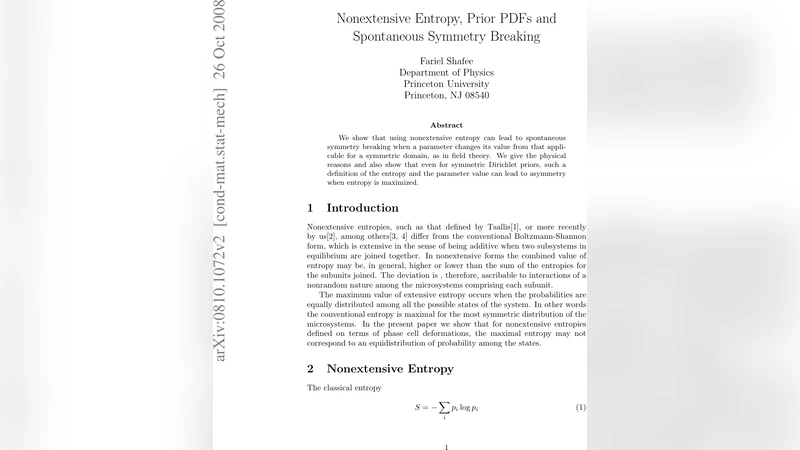
We show that using nonextensive entropy can lead to spontaneous symmetry breaking when a parameter changes its value from that applicable for a symmetric domain, as in field theory. We give the physical reasons and also show that even for symmetric Dirichlet priors, such a defnition of the entropy and the parameter value can lead to asymmetry when entropy is maximized.
💡 Research Summary
The paper investigates how the use of a non‑extensive entropy, specifically the Tsallis form S_q = (1‑∑_i p_i^q)/(q‑1), can induce spontaneous symmetry breaking (SSB) even when the prior distribution over probabilities is perfectly symmetric. The authors begin by recalling that with the conventional Shannon entropy, a symmetric Dirichlet prior (all concentration parameters α_i equal) leads to a symmetric posterior and a symmetric maximum‑entropy solution p_i = 1/K for K possible states. They then replace Shannon’s entropy with the Tsallis entropy, whose parameter q controls the degree of non‑linearity: for q > 1 large probabilities are weighted more heavily, while for q < 1 small probabilities receive greater emphasis.
To study the effect of this weighting, the authors formulate the constrained maximization problem by adding a Lagrange multiplier λ to enforce the normalization ∑_i p_i = 1. The stationarity condition ∂/∂p_i
Comments & Academic Discussion
Loading comments...
Leave a Comment