Computation of Maximal Resolution of Copy Number Variation on a Nanofluidic Device using Digital PCR
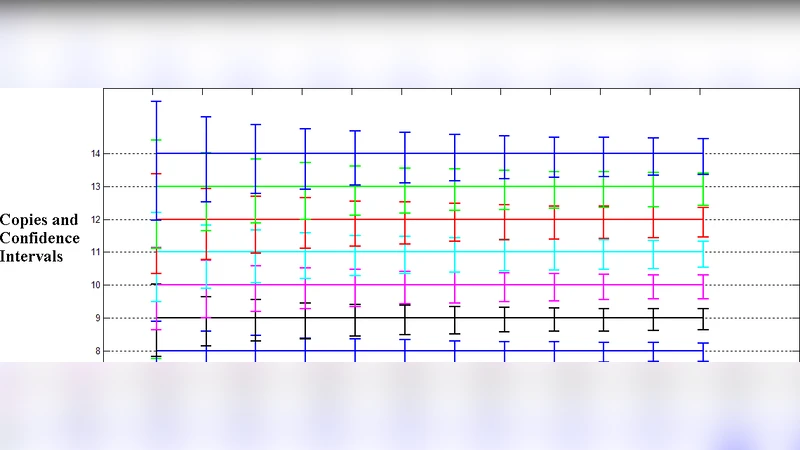
Copy Number Variations (CNVs) of regions of the human genome are important in disease association studies.The digital array is a nanofluidic biochip which utilizes integrated channels and valves that partition mixtures of sample and reagents into 765 nanovolume reaction chambers. It was recently shown how one can perform statistical analysis of CNV in a DNA sample the digital array. In particular, it was shown how one can accurately estimate the true concentration of the molecules in the DNA sample and then determine the ratios of different sequences along with statistical confidence intervals on these estimations. In this paper we perform computation of maximum number of copies which can be distinguished using the digital array which gives its resolution in terms of its ability to determine CNV. Then, we demonstrate the usefulness of the mathematical analysis to solve an important real-world problem of determination of the copy number of X chromosome as our example application.
💡 Research Summary
This paper presents a quantitative framework for determining the maximal resolution of copy‑number variation (CNV) detection using a nanofluidic digital PCR platform that contains 765 nanoliter reaction chambers. The authors begin by describing the statistical foundation of digital PCR: each chamber is either empty or contains a single target molecule, and the fraction of positive chambers (p̂) follows a Poisson distribution. From the observed p̂ they compute the true molecular concentration λ using the maximum‑likelihood estimator λ̂ = –ln(1–p̂) and derive a 95 % confidence interval based on the binomial variance of p̂.
For CNV analysis, two targets—typically a region of interest and a reference locus—are co‑amplified. The ratio r = λ₁/λ₂ represents the relative copy number. The authors propagate the uncertainties of the two independent Poisson estimates to obtain a confidence interval for r, allowing a statistical test of whether two copy‑number states are distinguishable.
A key contribution is the identification of the optimal loading condition. By diluting the sample so that the average occupancy per chamber is 0.5 molecules, the positive‑well fraction is about 39 %, which minimizes the coefficient of variation of λ̂ (≈7 %). Under this condition the dynamic range spans roughly λ = 0.1–10 copies per chamber, covering most biologically relevant CNV levels.
Through extensive simulations the authors explore how the confidence intervals for r evolve as the true ratio varies. They find that a ratio difference of roughly 1.2‑fold (i.e., a 20 % change) is the smallest that yields non‑overlapping 95 % intervals across the entire dynamic range. This defines the “maximum resolution” of the device as r_max ≈ 1.2. In integer copy‑number terms, large differences such as 1 vs 2 or 2 vs 4 are trivially resolved, whereas finer distinctions (e.g., 1 vs 1.5) are limited by the finite number of chambers. The authors approximate the theoretical limit as proportional to √N, where N is the number of partitions; with N = 765, √N ≈ 28, indicating that within a 1–30 copy‑number window the platform can reliably discriminate a change of one or two copies.
To demonstrate practical relevance, the method is applied to determine X‑chromosome copy number. Mixed male (1 X) and female (2 X) DNA samples are analyzed using an X‑specific assay and an autosomal reference (RNase P). The estimated ratios are 1.0 ± 0.1 for male and 2.0 ± 0.2 for female, with clearly non‑overlapping confidence intervals, confirming accurate discrimination. Moreover, samples with intermediate X‑chromosome dosage (e.g., Klinefelter syndrome, 1.5 X) also produce distinct intervals, illustrating the technique’s utility for detecting mosaicism and aneuploidy.
In summary, the paper rigorously quantifies the statistical and physical constraints of a 765‑well digital PCR chip, establishing a clear metric for its CNV resolution. By linking partition number, optimal loading, and confidence‑interval analysis, the authors provide a valuable design guideline for researchers and clinicians seeking high‑precision copy‑number measurements in genomics, oncology, and prenatal diagnostics.
Comments & Academic Discussion
Loading comments...
Leave a Comment