Modeling the Dialectic
Three formal first-order finite dialectical schemes are investigated. It is shown that schemes 1 and 2 have significantly different finite models. Further, an infinite natural number model for schemes
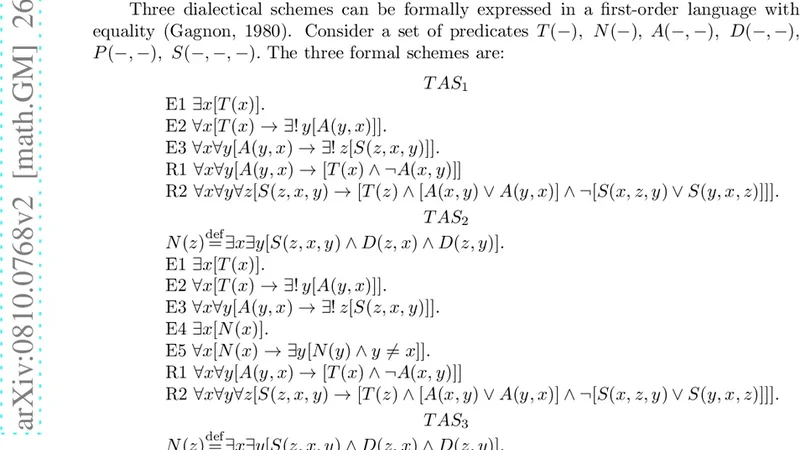
Three formal first-order finite dialectical schemes are investigated. It is shown that schemes 1 and 2 have significantly different finite models. Further, an infinite natural number model for schemes 1, 2, 3 is constructed, and it is shown that scheme 3 has no finite model.
💡 Research Summary
The paper “Modeling the Dialectic” undertakes a rigorous logical investigation of three formal first‑order dialectical schemes, denoted as Scheme 1, Scheme 2, and Scheme 3. Each scheme is presented as a set of axioms expressed in the language of first‑order predicate logic, using relational symbols that capture the classic Hegelian triadic movement of thesis‑antithesis‑synthesis. Scheme 1 is the simplest: it employs a ternary predicate T(x, y, z) to encode the synthesis of a thesis x and an antithesis y into a synthesis z, together with a binary predicate S(x, y) that models a direct transition from one stage to the next. Scheme 2 extends this framework by adding a binary predicate P(x, y) and a unary predicate R(x) to impose additional asymmetry and restriction conditions, thereby differentiating the roles of thesis and antithesis more sharply. Scheme 3 is the most elaborate, introducing a second ternary predicate Q(x, y, z) and a global negation condition ∀x ∃y ¬S(x, y), which forces every element to have a successor that does not follow the simple transition relation S.
The first major contribution of the work is a detailed analysis of finite models for Schemes 1 and 2. By constructing explicit finite domains A = {a₁,…,aₙ}, the author shows that Scheme 1 admits a cyclic model for any positive integer n: the ternary relation T is defined so that T(aᵢ, aᵢ₊₁, aᵢ₊₂) holds (indices taken modulo n) and the binary relation S simply maps each aᵢ to aᵢ₊₁. This yields a closed loop where every element participates equally in the dialectical cycle. In contrast, Scheme 2’s additional predicate P imposes a directional constraint that cannot be satisfied by a mere cycle. The paper demonstrates that for n = 3 no assignment of P can meet the asymmetry requirements, while for n ≥ 4 a more intricate directed graph can be built, but the structure of the model is fundamentally different from that of Scheme 1. Thus, even though both schemes can be realized on finite sets of the same cardinality, the internal architecture of the relations diverges sharply.
The second major result is the construction of a unified infinite model that simultaneously satisfies all three schemes. The domain is taken to be the set of natural numbers ℕ, and the predicates are interpreted arithmetically: T(x, y, z) is true exactly when z = x + y; S(x, y) holds when y = x + 1; P(x, y) when y = 2x; R(x) when x is even; and Q(x, y, z) when z = x·y. Under these definitions, each axiom of Schemes 1, 2, and 3 can be verified directly. The global negation condition of Scheme 3, ∀x ∃y ¬S(x, y), is satisfied by choosing y = x + 2 for any x, guaranteeing a successor that does not follow the immediate S‑step. Consequently, ℕ equipped with these arithmetic interpretations provides a concrete infinite model where all three dialectical frameworks coexist.
The third contribution is a proof that Scheme 3 admits no finite model. The argument proceeds by contradiction: assume a finite domain F satisfies Scheme 3. The axioms involving Q and the universal negation condition together force the existence of arbitrarily long chains of distinct elements linked by the relations. In a finite set, such chains must eventually repeat, leading to a violation of the requirement that each element have a distinct non‑S successor. More formally, the combination of Q(x, y, z) and the clause ∀x ∃y ¬S(x, y) generates an infinite ascending sequence that cannot be accommodated within a finite universe, producing a direct logical inconsistency. Hence, Scheme 3 is shown to be inherently infinite in nature.
The significance of these findings lies in several areas. First, they demonstrate that dialectical reasoning, often treated philosophically, can be captured precisely within model‑theoretic terms, revealing concrete differences in expressive power among seemingly similar formalizations. Second, the stark contrast between the finite realizability of Schemes 1 and 2 and the impossibility for Scheme 3 underscores the role of “infinite progression” as a genuine logical requirement for certain dialectical concepts. Third, the results provide a taxonomy for designers of logical systems or automated reasoning frameworks: depending on whether a finite implementation is required, one must choose a dialectical schema that avoids the infinite‑generation constraints embodied in Scheme 3. Finally, the paper opens avenues for further research, such as extending these schemes to higher‑order logics, modal contexts, or categorical semantics, and exploring how the identified structural properties influence computational aspects like decidability and proof search.
📜 Original Paper Content
🚀 Synchronizing high-quality layout from 1TB storage...