Kuranishi homology and Kuranishi cohomology: a Users Guide
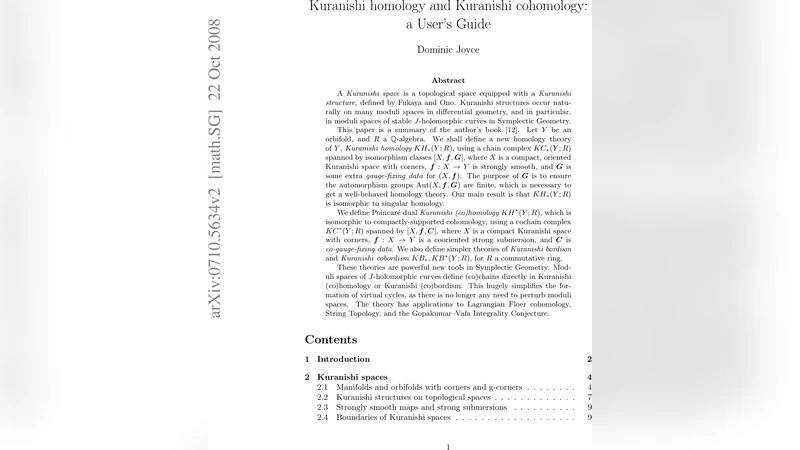
A Kuranishi space is a topological space with a Kuranishi structure, defined by Fukaya and Ono. Kuranishi structures occur naturally on moduli spaces of J-holomorphic curves in symplectic geometry. This paper is a brief introduction to the author’s book arXiv:0707.3572. Let Y be an orbifold and R a Q-algebra. We define the Kuranishi homology KH_(Y;R) of Y with coefficients in R. The chain complex KC_(Y;R) defining KH_(Y;R) is spanned over R by [X,f,G], for X a compact oriented Kuranishi space with corners, f : X –> Y smooth, and G “gauge-fixing data” which makes Aut(X,f,G) finite. Our main result is that KH_(Y;R) is isomorphic to singular homology. We define a Poincare dual theory of Kuranishi cohomology KH^(Y;R), isomorphic to compactly-supported cohomology, using a cochain complex KC^(Y;R) spanned over R by [X,f,C], for X a compact Kuranishi space with corners, f : X –> Y a submersion, and C “co-gauge-fixing data”. We also define simpler theories of Kuranishi bordism KB_(Y;R) and Kuranishi cobordism KB^(Y;R), for R a commutative ring. These are new topological invariants, and we show they are very large. These theories are powerful new tools in symplectic geometry. Defining virtual cycles and chains for moduli spaces of J-holomorphic curves is trivial in Kuranishi (co)homology. There is no need to perturb moduli spaces, and no problems with transversality. This gives major simplifications in Lagrangian Floer cohomology.
💡 Research Summary
**
The paper presents a comprehensive framework for Kuranishi homology and cohomology, together with associated bordism and cobordism theories, and demonstrates how these new tools simplify the construction of virtual cycles in symplectic geometry.
The starting point is the notion of a Kuranishi space, originally introduced by Fukaya and Ono. Such a space is a topological space equipped with a Kuranishi structure: locally it looks like the zero set of a smooth section of a finite‑dimensional vector bundle modulo the action of a finite group. This structure appears naturally on moduli spaces of J‑holomorphic curves, Gromov–Witten invariants, and Lagrangian Floer theory. Traditional approaches to virtual fundamental classes require delicate perturbations, multisections, or polyfold machinery to achieve transversality, which often leads to technical complications.
To avoid these difficulties the author introduces two auxiliary pieces of data. “Gauge‑fixing data” G is attached to a pair (X,f) where X is a compact oriented Kuranishi space with corners and f : X → Y is a smooth map to an orbifold Y. G is chosen so that the automorphism group Aut(X,f,G) becomes finite. Dually, “co‑gauge‑fixing data” C is attached to a submersion f : X → Y and also forces the corresponding automorphism group to be finite. With these data one defines a chain complex KC₍*₎(Y;R) generated over a Q‑algebra R by symbols
Comments & Academic Discussion
Loading comments...
Leave a Comment