Experimental Study of Application Specific Source Coding for Wireless Sensor Networks
The energy bottleneck in Wireless Sensor Network(WSN) can be reduced by limiting communication overhead. Application specific source coding schemes for the sensor networks provide fewer bits to represent the same amount of information exploiting the redundancy present in the source model, network architecture and the physical process. This paper reports the performance of representative codes from various families of source coding schemes (lossless, lossy, constant bit-rate, variable bit-rate, distributed and joint encoding/decoding) in terms of energy consumed, bit-rate achieved, quantization-error/reconstruction-error, latency and complexity of encoder-decoder(codec). A reusable frame work for testing source codes is provided. Finally we propose a set of possible applications and suitable source codes in terms of these parameters.
💡 Research Summary
The paper presents an extensive experimental evaluation of application‑specific source coding techniques aimed at reducing the energy consumption of wireless sensor networks (WSNs). Recognizing that radio transmission dominates the power budget, the authors investigate how compressing sensor data before transmission can lower the number of transmitted bits and thus save energy. They select representative codecs from several families—lossless, lossy, fixed‑rate, variable‑rate, distributed, and joint encoding/decoding—and implement them on a TinyOS platform using MICA2 motes (433 MHz, CC1000 radio, ATmega128L MCU).
The chosen codecs are:
- A‑law and µ‑law – standard non‑uniform quantizers providing lossy compression with simple lookup‑table (LUT) encoders (O(1) time) and binary‑search decoders (O(log n)).
- Fibonacci code – a universal variable‑length code whose self‑synchronizing property aids error recovery; implemented with LUTs for encoding and binary search for decoding.
- T‑code – a Huffman‑derived code that minimizes average code length while offering self‑synchronization; encoded via LUT (O(1)), decoded with linear search (O(n)).
- Differential Pulse Code Modulation (DPCM) – transmits the first sample raw and subsequent samples as differences, reducing average bit rate for slowly varying signals.
- Modulo‑code – exploits the fact that two correlated nodes can send a modulo‑N residue; decoding reconstructs the nearest multiple. It is O(1) for both encode and decode but only works when the two values fall in the same bin.
- Integer Haar wavelet – a 1‑level transform that computes sum and difference of two node readings, effectively decorrelating them; provides lossless compression with low complexity (O(1) for encode, O(n) for decode).
- DISCUS (Distributed Source Coding Using Syndromes) – a practical realization of Slepian‑Wolf coding. The authors split a (7,4) Hamming code into two sub‑codes, allowing each node to send 5 bits while the joint decoder reconstructs the original 7‑bit values, tolerating up to one bit error.
Implementation details include:
- All codecs are written in high‑level Octave for verification, then translated to C and finally to NesC for deployment.
- Encoder memory footprints range from a few bytes (DPCM) to a few hundred bytes (T‑code, A‑law). RAM usage is similarly modest, with the most demanding codec (DISCUS) requiring ~1.3 KB.
- Decoding complexities vary: O(1) for modulo and Haar, O(log n) for A‑law/µ‑law, O(n) for Fibonacci, T‑code, and DISCUS, and O(k n²) for the matrix‑based DISCUS variant.
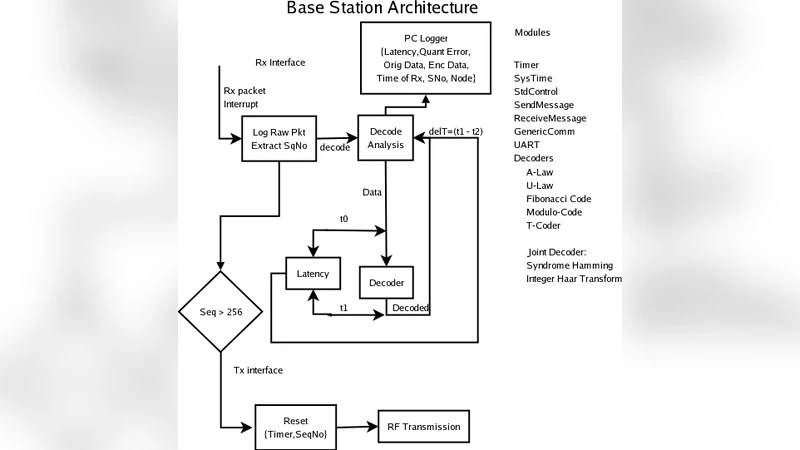
The experimental setup consists of two sensor nodes placed in a lab, each sampling a photo‑sensor at 2 Hz (tested up to 125 Hz). The base station receives packets via UART, logs them, and measures latency, packet loss, and energy consumption. Energy per transmitted bit is modeled as 430 nJ/bit, following prior literature.
Performance metrics evaluated:
- Energy consumption (proportional to message length).
- Average bit rate (bits per sample).
- Quantization/reconstruction error (for lossy codecs).
- Latency (encoding + decoding time in microseconds).
- Error rate (decoding failures due to synchronization or channel noise).
- Code size (ROM/RAM footprint).
Key findings:
- Lossy codecs (A‑law/µ‑law) achieve stable compression ratios (≈30 % reduction) with minimal latency (<50 µs) and the smallest memory footprint, making them ideal for applications tolerant to moderate distortion (e.g., environmental monitoring).
- Fibonacci and T‑code exhibit highly data‑dependent compression; with uniform or poorly matched distributions they can even expand the data. Their self‑synchronization is valuable in noisy channels, but they consume more memory and have higher decoding latency.
- DPCM reduces bit rate for slowly varying signals but suffers when the signal changes abruptly, leading to occasional spikes in error.
- Modulo‑code offers the simplest implementation and near‑zero latency, yet its applicability is limited to scenarios where correlated measurements fall within the same modulo bin.
- Haar wavelet provides consistent bit‑rate reduction (≈35 %) for correlated sensor pairs and retains lossless reconstruction, with modest computational cost.
- DISCUS achieves the most significant savings (≈40 % reduction) while also providing error‑correction capability (t = 1). However, it requires more RAM and higher decoding complexity due to syndrome processing.
Based on these results, the authors propose an application‑centric mapping:
- Low‑accuracy, latency‑tolerant tasks (e.g., long‑term environmental logging) → use A‑law or µ‑law.
- High‑accuracy, low‑latency tasks (e.g., intrusion detection) → employ DISCUS or Haar wavelet.
- Bandwidth‑constrained, error‑prone channels → consider T‑code or Fibonacci for their self‑synchronizing properties.
- Very simple hardware constraints → Modulo‑code or DPCM.
Finally, the paper contributes a reusable testing framework (source code, packet formats, measurement scripts) that can be extended to new codecs or hardware platforms, facilitating future research on energy‑aware source coding in WSNs.
Comments & Academic Discussion
Loading comments...
Leave a Comment