Growing Networks: Limit in-degree distribution for arbitrary out-degree one
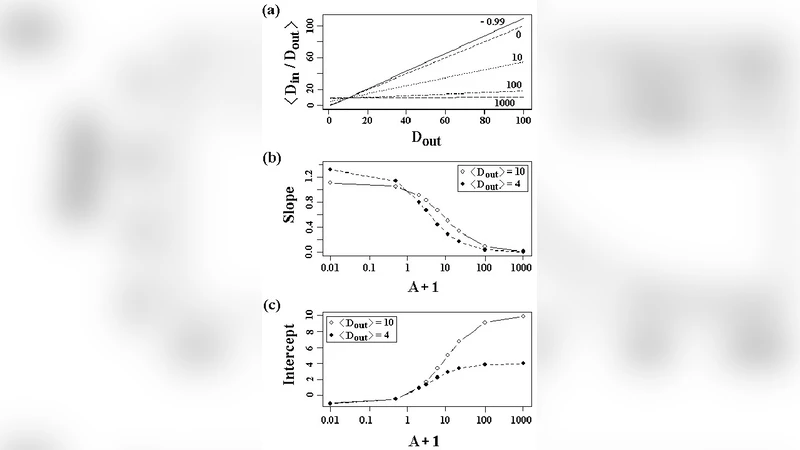
We compute the stationary in-degree probability, $P_{in}(k)$, for a growing network model with directed edges and arbitrary out-degree probability. In particular, under preferential linking, we find that if the nodes have a light tail (finite variance) out-degree distribution, then the corresponding in-degree one behaves as $k^{-3}$. Moreover, for an out-degree distribution with a scale invariant tail, $P_{out}(k)\sim k^{-\alpha}$, the corresponding in-degree distribution has exactly the same asymptotic behavior only if $2<\alpha<3$ (infinite variance). Similar results are obtained when attractiveness is included. We also present some results on descriptive statistics measures %descriptive statistics such as the correlation between the number of in-going links, $D_{in}$, and outgoing links, $D_{out}$, and the conditional expectation of $D_{in}$ given $D_{out}$, and we calculate these measures for the WWW network. Finally, we present an application to the scientific publications network. The results presented here can explain the tail behavior of in/out-degree distribution observed in many real networks.
💡 Research Summary
The paper investigates the stationary in‑degree distribution of a directed growing network in which each newly added node creates a random number of outgoing links drawn from an arbitrary out‑degree distribution (P_{\text{out}}(k)). The model extends the classic Barabási‑Albert preferential‑attachment scheme by allowing a node to attach multiple edges at birth and by incorporating an “attractiveness” term (a\ge 0) that adds a constant bias to the attachment probability. Specifically, when a new edge is created, it connects to an existing vertex (i) with probability proportional to (D_{\text{in}}(i)+a), where (D_{\text{in}}(i)) is the current in‑degree of that vertex.
Using a master‑equation approach, the authors derive a recursion for the stationary in‑degree probabilities (P_{\text{in}}(k)). By introducing a generating function and solving the resulting functional equation, they obtain an explicit expression that links (P_{\text{in}}(k)) to the moments of (P_{\text{out}}(k)) and to the attractiveness parameter. The analysis yields two principal regimes:
- Finite‑variance out‑degree – If the out‑degree distribution has a finite second moment (i.e., light‑tailed), the asymptotic tail of the in‑degree distribution is universal:
\
Comments & Academic Discussion
Loading comments...
Leave a Comment