Combining Semantic Wikis and Controlled Natural Language
We demonstrate AceWiki that is a semantic wiki using the controlled natural language Attempto Controlled English (ACE). The goal is to enable easy creation and modification of ontologies through the web. Texts in ACE can automatically be translated i…
Authors: ** - Tobias Kuhn (Department of Informatics, University of Zurich, Switzerl
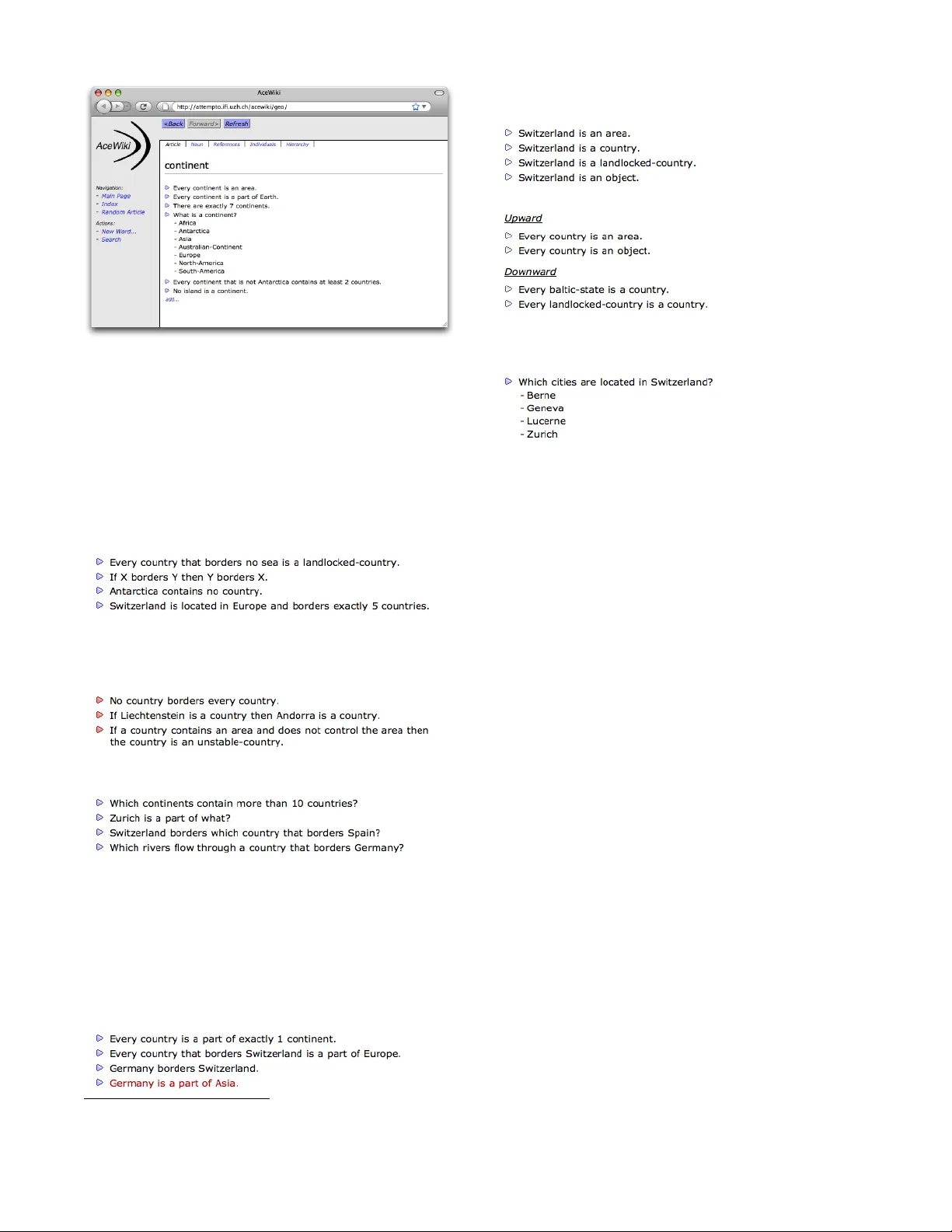
Combining Semantic Wikis and Contr olled Natural Language T obias K uhn Depar tment of Inf or matics University of Zurich, Switzerland tkuhn@ifi.uzh.ch ABSTRA CT W e demonstrate AceWiki that is a semantic wiki using the con trolled natural language Attempto Con trolled English (A CE). The goal is to enable easy creation and mo dification of ont ologies through the web. T exts in ACE can automati- cally be translated in to first-order logic and other languages , for example O WL. Previous ev aluation sh ow ed that ordinary people are able to use AceWiki without b eing instructed. K eywords Con trolled Natural Language, Attempto Controlled English (A CE), Semant ic W eb, Semantic Wiki, AceWiki, Ontology 1. INTR ODUCTION Most of the tasks the Semantic W eb is even tually supp osed to fulfill rely on the av ailabilit y of ontologies. Ho wev er, the creation and maintenance of ontologies is difficult b ecause a n umber of domain experts — most of which are not familiar with formal languages — hav e to agree on a conceptualiza- tion of the respective domain. F or that reason, it is crucial for the future of the Semantic W eb to provide tools that mak e the creation of ontologies easy for everybo dy . AceWiki 1 tac kles this problem by combining seman tic wikis with controlled natural language. The goal of AceWiki is to enable ordinary people with no background in formal lan- guages to create expressive on tologies in a collab orative and in tuitive wa y without the need of installing an application. 2. B A CKGR OUND There are severa l existing semantic wiki systems, see e.g. [3] for a brief survey . Unfortunately , most of those wikis do not support expressiv e ontology languages in a general wa y . F urthermore, they are often hard to understand for p eople who are not familiar with the technical terms. A ttempto Controlled English (ACE) 2 is the controlled nat- ural language that is used for AceWiki. Being a subset of English, ACE lo oks completely natural. Restrictions of the syn tax and the definition of a small set of interpretation rules mak e it a formal language that is automatically translatable in to first-order logic. A CE cov ers a large part of natural En- glish: singular and plural noun phrases, activ e and passive v oice, relative phrases, anaphoric references, existential and univ ersal quan tifiers, negation, and muc h more. 1 See [3], [4], and http://attempto.ifi.uzh.ch/acewik i 2 See [1] and http://attempto.ifi.uzh.ch Figure 1: A screenshot of the predictive editor of AceWiki. The fragment “Every area is” has already b een ente red and no w the editor shows all p ossibil- ities to contin ue the sen tence. A CE has been used as a natural language fron t-end to OWL with a bidirectional mapping of ACE to OWL [2]. AceWiki uses this for translating ACE sentences into OWL. The same w ork also introduces a Prot´ eg ´ e plugin called “ACE View” whic h enables to manage onto logies in ACE within the Pro- t ´ eg´ e environmen t. 3. SYSTEM In AceWiki, the ontolo gical ent ities are represented by nat- ural language words and phrases. Proper names (e.g. “Zu- ric h” , “Switze rland” , “Europe” ) are interpreted as individu- als, nouns (e.g. “cit y” , “coun try” ) are in terpreted as classes, and transitive v erbs (e.g. “borders” ), of -constructs (e.g. “part of ” ), and transitive adjectives (e.g. “located-in” ) are in terpreted as binary relations. Using those words together with the predefined function w ords of ACE (e.g . “a” , “ev ery” , “if ” , “then” , “and” , “n ot” , “is” , “that” ), on tological statemen ts are expressed as ACE sentences: As those examples sho w, the formal statemen ts are easily readable and understandable b y any English sp eaking p er- son. In order to enable easy creation and modification of A CE sentences, AceWiki in tegrates a predictiv e editor that sho ws step-b y-step the words that are syntactically p ossi- Figure 2: A screenshot of the w eb interface of AceWiki showing the wiki article for the class “con- tinen t” . ble at a giv en p osition in the sen tence. Figure 1 sho ws a screenshot of this editor. Eac h of the ontological entities gets its o wn wiki article. Figure 2 sho ws an example. Every article consist of A CE sen tences most of which can b e translated into OWL, e.g: A CE is more expressive than OWL, and thus we can write statemen ts that go beyond the semantic expressivit y of OWL (e.g. rule-lik e statemen ts). Such statements are mark ed with a red triangle (and are curren tly ignored by the reasoner): F urthermore, questions can b e used to query the knowledge base, e.g: Th us, ACE is an ontology language, a rule language, and a query language at the same time. AceWiki uses the O WL reasoner Pellet 3 to p erform rea- soning tasks ov er the sentences of the wiki that are OWL- complian t. In order to ensure the consistency of the ontol- ogy , ev ery new sentence is chec ked — immediately after its creation — whether it wo uld in troduce a con tradiction. If this is the case then the sente nce is not included in the on- tology and display ed in red font: 3 http://pellet.owldl.com/ The reasoner is also used to infer the class memberships of individuals. The results are presen ted in A CE again: The same is done for class hierarchies: This shows that not only asserted but also inferred knowl- edge is represented in AC E. Finally , the reasoner is also used to answer questions: In general, we can sa y that AceWiki communicates with the users on a very natural lev el. No knowledge ab out formal languages is required to deal with AceWiki. 4. EV ALU A TION In our previous w ork [3], w e conducted a user experiment that show ed that ordinary people with no background in logic and on tologies are able to deal with AceWiki. The par- ticipan ts — without b eing instructed ho w to interact with the interface — w ere ask ed to add knowledge to AceWiki. About 80% of the created sen tences w ere correct and sen- sible. Remark ably , more than 60% of those sen tences were complex in the sense that they con tained an implication or a negation. 5. CONCLUSIONS AceWiki shows how ontologies can be created and modified in a natural wa y within a wiki. It demonstrates how seman- tic wikis using controlle d natural language can b e expressiv e and easy to use at the same time. Our previous ev aluation sho wed that AceWiki is indeed easy to learn. 6. REFERENCES [1] Norbert E. F uchs, Kaarel Kaljurand, T obias Kuhn. A ttempto Con trolled English for Knowledge Represen tation. R e asoning Web, F ourth International Summer Scho ol , Springer, 2008 [2] Kaarel Kaljurand. Attempto Contr ol le d English as a Semantic Web L anguage . PhD thesis, F aculty of Mathematics and Computer Science, Universit y of T artu, 2007 [3] T obias Kuhn. AceWiki: A Natural and Expressive Seman tic Wiki. Pro c. of Semantic Web User Inter action at CHI 2008: Exploring HCI Chal lenges , CEUR W orkshop Pro ceedings, 2008 [4] T obias Kuhn. AceWiki: Collaborative Ontology Managemen t in Controlled Natural Language. Pr o c. of the 3r d Semantic Wiki Workshop , CEUR W orkshop Proceedings, 2008
Original Paper
Loading high-quality paper...
Comments & Academic Discussion
Loading comments...
Leave a Comment