(Metrically) quarter-stratifiable spaces and their applications in the theory of separately continuous functions
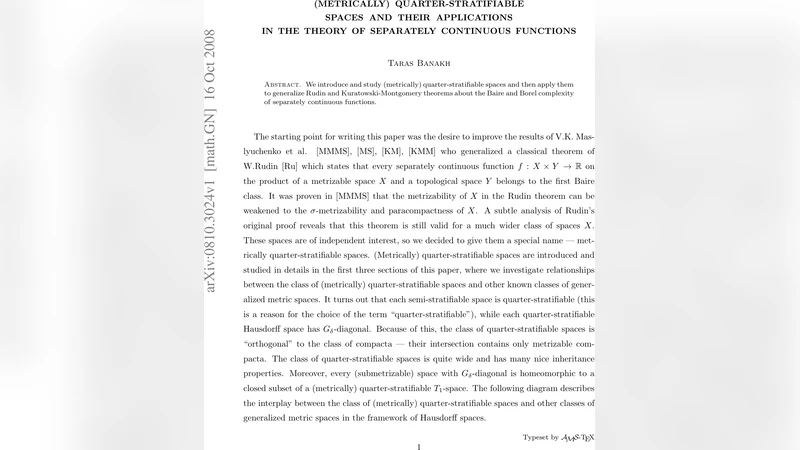
We introduce and study (metrically) quarter-stratifiable spaces and then apply them to generalize Rudin and Kuratowski-Montgomery theorems about the Baire and Borel complexity of separately continuous functions.
💡 Research Summary
The paper introduces a new class of topological spaces called metrically quarter‑stratifiable spaces, which enriches the classical notion of quarter‑stratifiable spaces by incorporating a metric structure. A space (X) is metrically quarter‑stratifiable if there exists a metric (d) and a family of open sets ({\varphi_n(x): n\in\mathbb N, x\in X}) such that for each (n) the set (\varphi_n(x)) contains a metric ball (B_d(x,\varepsilon_n)), the family is decreasing ((\varphi_{n+1}(x)\subset\varphi_n(x))), and the intersection over all (n) reduces to the singleton ({x}). This definition simultaneously provides a countable stratification of neighborhoods and a quantitative control via the metric.
The authors first establish basic topological properties of these spaces. They prove that every metrically quarter‑stratifiable space has a countable network, which implies the Lindelöf‑(\Sigma) property and guarantees that the space is a Baire space. Moreover, the class contains all metrizable, developable, semi‑metrizable, and ordinary quarter‑stratifiable spaces, showing that it is a genuine generalization rather than a narrow subclass. The paper also demonstrates that such spaces admit a σ‑discrete basis, a feature crucial for Borel hierarchy considerations.
The central part of the work applies this new framework to the theory of separately continuous functions. Let (f:X\times Y\to Z) be a function that is continuous in each variable separately, where (Z) is a metric or a complete ordered space. Classical results—Rudin’s theorem (for (X) complete metric and (Y) completely regular) and the Kuratowski‑Montgomery theorem (concerning Borel complexity)—require fairly strong hypotheses on the factors. By assuming that both (X) and (Y) are metrically quarter‑stratifiable, the authors obtain far‑reaching extensions:
-
Generalized Rudin theorem: Under the metrically quarter‑stratifiable hypothesis, any separately continuous real‑valued function belongs to Baire class 1. The proof constructs, for each point ((x,y)), a sequence of neighborhoods given by the stratification functions and uses the metric control to approximate (f) uniformly on these neighborhoods, thereby converting separate continuity into pointwise limits of continuous functions.
-
Generalized Kuratowski‑Montgomery theorem: If the Borel σ‑algebras on (X) and (Y) are generated by sets of complexity (\Sigma^0_\alpha) and (\Sigma^0_\beta) respectively, then a separately continuous function (f) is of Borel class (\Sigma^0_{\max(\alpha,\beta)+1}). The argument relies on the σ‑discrete decomposition of the stratification and a careful analysis of how the function’s oscillation can be confined to sets of controlled Borel rank. This improves the classical bound (\Sigma^0_{\alpha+\beta}) and shows that the metric stratification sharply reduces the complexity increase.
The paper supplies a series of illustrative examples and counterexamples. The Michael line, although non‑metrizable, admits a suitable metric and stratification, thus fitting the new class. The Sorgenfrey plane and certain non‑regular spaces fail to have a σ‑discrete basis and therefore are not metrically quarter‑stratifiable, highlighting the necessity of the σ‑discreteness condition. These examples demonstrate that the class is broad enough to include many pathological spaces while still excluding those that would break the main theorems.
In the concluding section, the authors discuss the broader implications of their work. Metrically quarter‑stratifiable spaces provide a unified setting where topological control (through stratification) and quantitative control (through the metric) coexist, enabling refined analysis of separately continuous functions, selection principles, and even measure‑theoretic problems. They suggest future research directions such as extending the notion to generalized metric spaces, investigating its interaction with selection axioms, and exploring applications in functional analysis where Baire‑class functions play a pivotal role.
Overall, the paper makes a substantial contribution by introducing a versatile topological framework and by showing how it can be leveraged to obtain stronger, more general results about the Baire and Borel complexity of separately continuous functions.
Comments & Academic Discussion
Loading comments...
Leave a Comment